University of Waterloo
Waterloo, Canada · Suburban
CANADA'S TECH & CO-OP POWERHOUSE
University of Waterloo Admissions Guide for International Students
Founded in 1957 with a cohort of 74 engineering students and a radical idea — that paid work experience should be woven into every degree — the University of Waterloo has grown into Canada's pre-eminent technology and innovation university. It hosts North America's largest co-operative education programme, the world's most concentrated cluster of mathematical and computing talent at a single institution, and a startup ecosystem that has produced some of Canada's most valuable technology companies.
For international students targeting careers in software engineering, computer science, quantitative finance, engineering, or entrepreneurship, Waterloo is not merely a good option — it is often the best option in Canada, and competitive with the top technology universities worldwide. The degree is a credential; the co-op record is a career. Together, they are Waterloo's singular offer to the world.
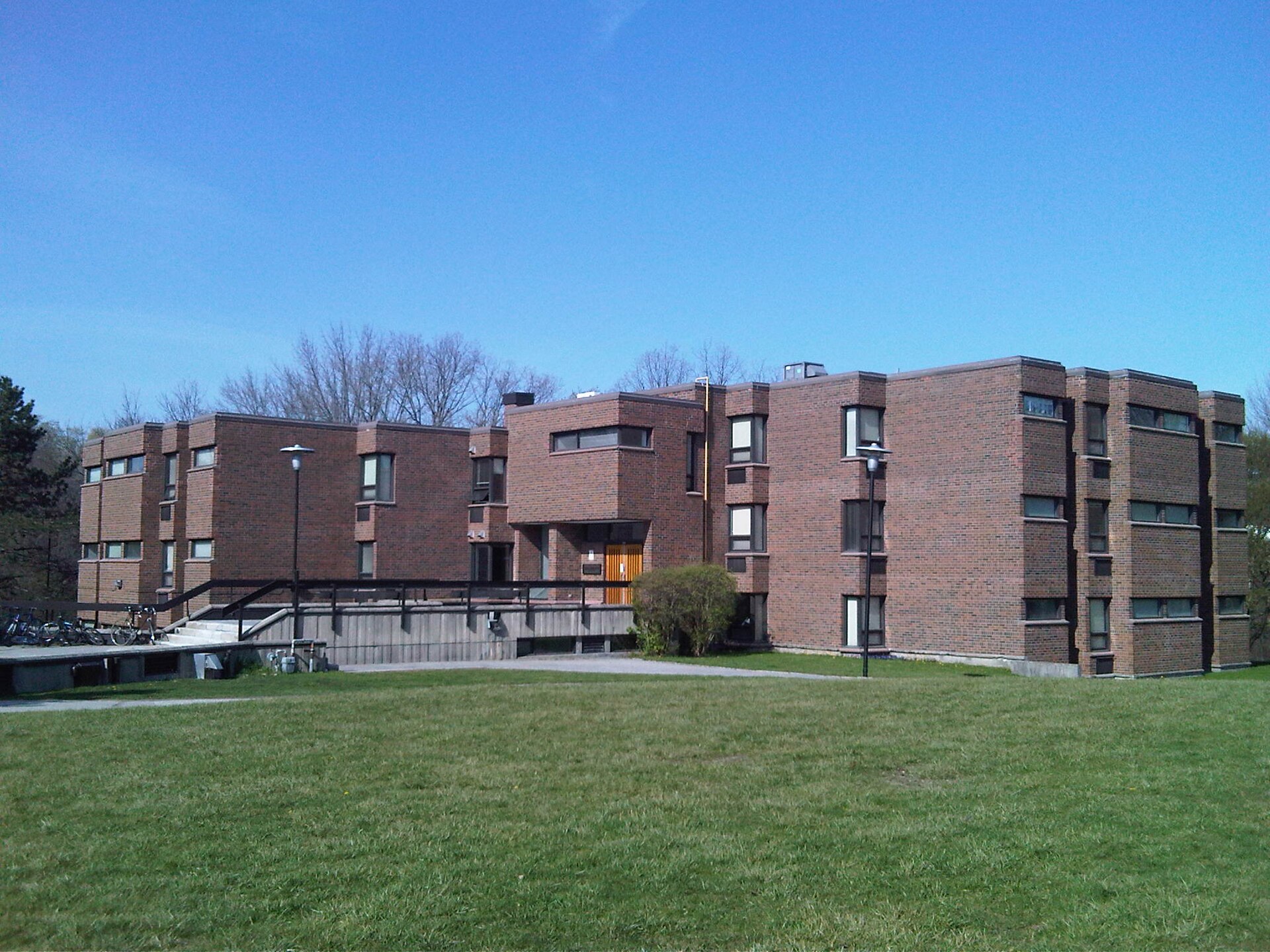
Campus
University of Waterloo — campus in pictures
Real, freely-licensed photographs of the campus (via Wikimedia Commons).





WHY WATERLOO
Why the University of Waterloo — Co-op, Computing & Career Launch
Waterloo's identity is inseparable from three things: the co-operative education model that puts students in paid professional roles before they graduate, a Faculty of Mathematics that is the world's largest dedicated mathematics and computing school, and a culture of entrepreneurship that treats starting a company as a natural extension of a degree. For international students who want to graduate employable, not merely educated, Waterloo is a compelling target.
SELECTIVITY
Acceptance Rate & Admissions Profile
Waterloo's institutional acceptance rate of 53% is significantly higher than the most selective US universities, but this number is deeply misleading for the programmes international students most frequently target. Computer Science, Software Engineering, and the Faculty of Mathematics flagship programmes select from the top fraction of applicants — Ontario applicants must present averages in the low-to-mid 90s (out of 100%) for CS and SE, and mid-80s for most Mathematics programmes. IB applicants targeting STEM should treat a score of 36 or higher as a floor, not a ceiling, for competitive consideration.
SAT and ACT are not required and are not part of Waterloo's standard review. The university evaluates international applicants primarily on academic transcripts, equivalent course completion, and the Admission Information Form (AIF) — a mandatory supplement for Engineering and Mathematics applicants.
QUICK FACTS
University of Waterloo — At a Glance
WHAT YOU'LL SUBMIT
The Waterloo Application — Components & Process
Waterloo uses the Ontario Universities' Application Centre (OUAC) — a centralised portal used by all Ontario universities. Within 24–48 hours of submitting via OUAC, you will receive further instructions directly from Waterloo by email. Waterloo admits students for September entry only; there is no January intake.
ADMISSION PHILOSOPHY
What Waterloo Actually Looks For
Waterloo evaluates applicants on a combination of strong academic preparation in relevant prerequisite subjects and evidence — primarily through the AIF — of the qualities that predict success in a demanding, co-op-integrated programme. The university is explicit that it does not expect a narrowly technical or extracurricular profile; it looks for intellectual curiosity, time management, interpersonal range, and clear motivation for the specific programme.
For the most competitive programmes (CS, SE, Computer Engineering), academic preparation in mathematics and sciences is a near-necessary but not sufficient condition. Students presenting strong grades in all required prerequisite courses must still differentiate themselves through the AIF — particularly in articulating why Waterloo's specific model (co-op, programme structure, faculty) aligns with their goals, and in demonstrating a record of engagement beyond the classroom.
APPLICATION DEADLINES
Waterloo Deadlines — All Programmes
Waterloo admits first-year students for September entry only. International students have the same deadlines as domestic applicants. Note that Engineering deadlines are several weeks earlier than other faculties — this is critical for international students who may need additional time to arrange transcripts and English test scores.
AIF deadlines match or follow the document deadlines for each faculty. Submit your OUAC application first; Waterloo will email you instructions to complete your AIF within 24–48 hours.
Deadlines above are for the 2026–27 application cycle. Always verify at uwaterloo.ca/future-students/admissions/deadlines before submitting. Deadlines may be extended for programmes that have not yet filled their cohort.
| Programme | Application Deadline | Documents Deadline | Aif Deadline |
|---|---|---|---|
| Engineering (excl. Architecture) | 15 January | 1 February | 1 February |
| Faculty of Mathematics (incl. CS) | 1 February | 15 February | 15 February |
| All Other Programmes | 1 February | 15 February | 15 February |
| Pharmacy (PharmD) | 6 January | 20 January | 20 January |
| Optometry | 12 November | TBC | TBC |
CAMPUS & CITY
Life at Waterloo — Campus, Community & the City
Waterloo's campus is a compact, self-contained suburban environment in the twin cities of Kitchener-Waterloo in southwestern Ontario. The region lacks the cultural gravity of Toronto or Vancouver but compensates with affordability, walkability, and an extraordinarily high density of engineering and computing talent per square kilometre — a genuine Silicon Valley North, not merely a marketing metaphor.
The university's six faculties are clustered within walking distance of one another, and most student services are campus-centred. Residence accommodation is available for first-year students and accommodates a mix of independent single rooms and suite-style living. Two universities (Waterloo and Wilfrid Laurier) and one college share the same small city, creating a student population that disproportionately shapes the city's identity, culture, and economy.
CAREER OUTCOMES
What Waterloo Graduates Do Next
Waterloo's co-op model means that most students have completed multiple paid professional roles and have at least one return offer before they graduate. The employment outcomes are consequently among the strongest of any university in Canada or North America for engineering and computing graduates.
Computer Science and Software Engineering graduates from Waterloo are among the most sought-after in the North American technology market. Major employers including Google, Microsoft, Apple, Amazon, Meta, Stripe, Shopify, and hundreds of growth-stage startups actively recruit through Waterloo's WaterlooWorks platform. The co-op record effectively acts as a portfolio of references and demonstrated performance — graduating students are not unknown quantities to employers who have already hired them for multiple terms.
For international graduates who remain in Canada, Waterloo's location in Ontario qualifies graduates for the Post-Graduation Work Permit (PGWP), which allows international students to work in Canada for up to three years after graduation. This pathway is a meaningful additional draw for international applicants planning careers in the Canadian technology sector.
FREQUENTLY ASKED
Waterloo Admissions — International Student FAQs
Does Waterloo accept the Common App?+
No. Waterloo does not use the Common App, the Coalition App, or UCAS. All applicants — including international students — must apply through the Ontario Universities' Application Centre (OUAC). After submitting via OUAC, you will receive an email from Waterloo within 24–48 hours with instructions to complete your supplementary materials, including the AIF.
Can international students apply to any programme, or are some restricted?+
International students can apply to almost all programmes. A small number of programmes — notably Social Work and some education degrees — are restricted to domestic students or permanent residents. Engineering, Computer Science, Mathematics, and all flagship programmes are fully open to international applicants.
How important is the AIF compared to grades?+
For Engineering and Mathematics programmes, both components are necessary but neither alone is sufficient. Students with exceptional grades but poor AIF responses are regularly denied. Students with borderline grades but compelling, honest, and specific AIF responses can receive offers. Think of grades as the threshold for being considered; the AIF as the instrument of actual selection.
Is Waterloo good for programmes outside of STEM?+
Waterloo is best known for STEM, and that reputation is deserved. The Faculty of Arts (including Economics, Psychology, and Planning), Environment, and Health also offer co-op programmes and strong career outcomes, but the international brand recognition is most powerful in engineering, computing, and quantitative fields. Applicants to Arts or Environment should have clear reasons for choosing Waterloo over larger, better-resourced universities in Toronto or Ottawa.
Does Waterloo offer need-based financial aid for international students?+
Waterloo's primary support for international students is entrance scholarship funding rather than need-based grants. The International Student Entrance Scholarship (automatic, $10,000 for eligible admitted students) and faculty-level scholarships represent the main financial instruments available to internationals. Need-based aid as understood in the US model (demonstrated financial need met by grants) is not available to international applicants.
What is the co-op structure for international students specifically?+
International students participate in co-op on the same basis as domestic students. Most co-op terms are completed in Canada, but international placements in the US and elsewhere are available. International students require a Canadian Co-op Work Permit to work during co-op terms — this is separate from your Study Permit. Waterloo's international office provides guidance on the process, and most students obtain this without difficulty.
Is Waterloo in Canada for immigration purposes? How easy is it to get a study permit?+
Yes, Waterloo is a designated learning institution in Canada. The university reports a study permit approval rate of approximately 81% for applicants it admits — one of the highest in Canada. Applying as soon as you receive your offer letter and working with Waterloo's international student services team maximises your approval chances.
Does Waterloo require an interview as part of admission?+
The online video interview is required for Engineering scholarship consideration and strongly recommended for competitive Engineering programmes (particularly Software Engineering). It is not a live interview — applicants record responses to prompts via a third-party platform. Faculty of Mathematics applicants (including Computer Science) do not have an interview requirement; their supplement is the AIF only.
ACADEMIC EXPECTATIONS
Academic Standards at Waterloo — What International Students Face
Waterloo's academic reputation rests on the genuine rigour of its programmes, particularly in Engineering and the Faculty of Mathematics. The co-op model compresses academic content: engineering degrees that would be four years at most Canadian universities are five years at Waterloo to accommodate six co-op terms. Courses are dense, paced quickly, and assume strong preparation in mathematics and the sciences.
For international applicants, academic preparation is evaluated through the lens of your home curriculum's equivalent of Ontario's Grade 12 U (university-preparation) courses. Waterloo is explicit: if you are not studying in Ontario, it will identify the equivalent courses in your curriculum and evaluate your standing in those. IB and A-Level students are assessed on this basis, with specific equivalencies published for each programme.
ACADEMIC BENCHMARKS
Academic Profile — Competitive Benchmarks by Programme
Waterloo evaluates applicants primarily on their grades in prerequisite courses, not on an overall GPA. The programme-level admission averages below reflect Ontario-scale grades (out of 100%). IB and A-Level equivalencies are described qualitatively. All values from the facts file or sourced official pages.
The university selects 'individually' from the stated average bands — meaning meeting the average does not guarantee admission, and falling slightly below does not guarantee rejection. The AIF plays a decisive role in the offer decision when academic profiles are close.
TEST POLICY
SAT, ACT & Standardised Tests — Waterloo's Policy
Waterloo's test policy is optional for SAT and ACT. These scores are not part of Waterloo's standard application review and play no role in admission decisions. Waterloo is a Canadian university operating under the Ontario system, and its primary academic metric is performance in specific high school prerequisite courses — not standardised test scores.
This is a meaningful structural difference from US university admissions. International students preparing for US applications alongside Waterloo should understand that strong SAT/ACT scores do not help at Waterloo, and that time invested in SAT preparation should be allocated proportionally to US schools where those scores matter. For Waterloo, invest that time in prerequisite course grades, AIF preparation, and mathematics contest preparation if pursuing Faculty of Mathematics scholarships.
SAT / ACT AT WATERLOO
Do SAT & ACT Scores Matter at Waterloo?
In short: no. Waterloo does not consider SAT or ACT scores in its admission decisions. There are no SAT or ACT bands published, no submission requirement, and no documented advantage to submitting scores voluntarily.
What does matter is your performance in mathematics-heavy prerequisite courses. For CS and Software Engineering, Ontario applicants must take Advanced Functions and Calculus and Vectors. International equivalents — IB HL Mathematics, A-Level Further Mathematics, AP Calculus BC — are the true proxies Waterloo cares about. Strong performance in these subjects is the analogue of a high Math SAT score, but with more granularity and course-specific signalling.
If you are applying to both Waterloo and US schools: pursue a strong SAT/ACT for your US applications, but do not rely on those scores to strengthen your Waterloo file. They are orthogonal to one another.
IB & A-LEVEL
IB Diploma & A-Level — How Waterloo Evaluates International Credentials
Waterloo evaluates IB and A-Level students by mapping their courses and grades to the Ontario 4U course equivalents required for each programme. It then assigns an admission average on the Ontario scale (out of 100%) for comparison with the programme's competitive range.
PREREQUISITE PREPARATION
Required Subjects — By Programme
Waterloo is specific about prerequisite courses in a way few universities are. Meeting the academic average is not sufficient if you have not completed the correct prerequisite courses. International students should identify Waterloo's Ontario-equivalent requirements for their target programme years before applying.
ENGLISH PROFICIENCY
English Language Requirements — All Accepted Tests & Minimums
An English language test is required if your four most recent years of full-time secondary education were NOT conducted entirely in English. The requirement is waived for students educated in English-language schools in Canada, the US, UK, Australia, New Zealand, and other approved English-medium systems. Results must arrive by your programme's document deadline.
TOEFL updated its scoring scale for tests administered from 21 January 2026 onward. Ensure you know which scoring system applies to your test date when interpreting score requirements.
| Test | Overall Minimum | Component Minima | Alternative |
|---|---|---|---|
| IELTS Academic | 6.5 | 6.5 Writing & Speaking; 6.0 Reading & Listening | 7.0 overall with min 6.0 in all bands |
| TOEFL iBT | 90 | 25 Writing & Speaking (old scoring); 4.5 overall / 5 W & S (new scoring from Jan 2026) | — |
| Duolingo English Test | 120 | 125 Literacy and Production (for tests after Jul 1, 2024) | — |
| PTE Academic | 63 | 65 Writing and Speaking | — |
| Cambridge C1 / C2 | 180 | 176 in all four components | — |
| EFAS (Waterloo pathway) | 75% in Level 400 | 70% in EFAS 420, 440, 460 | Waterloo's own English for Academic Purposes programme |
GRADE 9 TO 12
Building Your Academic Profile — A Four-Year Ladder
International students targeting Waterloo STEM programmes should begin building their academic profile deliberately from Grade 9. The university selects from the top fraction of competitive applicants; early preparation in mathematics and sciences is the most important investment.
COMMON PITFALLS
Academic Application Mistakes — What Costs Offers
International applicants to Waterloo make a recurring set of errors that range from structural misconceptions to AIF missteps. Knowing these in advance dramatically improves your application.
- Targeting Waterloo with no programming experience for CS or SE, and having no credible AIF response to 'what you have explored' in the field
- Submitting the AIF at the last moment with unrevised, generic responses — Waterloo can tell when an AIF was written in thirty minutes
- Misreading the 53% acceptance rate as applicable to CS or Software Engineering, where effective competition is far more intense
- Taking IB SL Mathematics and assuming it satisfies the HL Mathematics equivalent — verify the specific programme requirement before finalising your IB course selection
- Missing the Engineering application deadline (15 January) because you confused it with the general Waterloo deadline (1 February)
- Not requesting your English test score be sent to Waterloo — scores must arrive by the documents deadline, not just be achieved
- Skipping the Faculty of Mathematics mathematics contests because they are optional for admission, not realising they are required for significant scholarship consideration
- Writing an AIF goal response that focuses on post-Waterloo plans (graduate school, salary) rather than what you want to explore and experience specifically within the Waterloo programme
- Using AI-generated text in AIF responses — Waterloo explicitly states this risks admission denial or offer revocation
COST & AFFORDABILITY
Cost of Attending Waterloo — An Honest Breakdown for International Students
The University of Waterloo is not inexpensive for international students — annual tuition exceeds USD 53,000 — but its financial picture is fundamentally different from most universities of comparable standing, for one reason: co-op earnings.
Waterloo Engineering and CS students can realistically earn between $30,000 and $80,000+ CAD across six co-op terms, depending on programme, employer, and location. For international students who qualify for co-op work permits, these earnings directly offset the cost of the degree. Many Waterloo students graduate having earned back a substantial portion of their tuition investment before receiving their diploma. This co-op offset is unique to Waterloo's model and must be central to any honest cost analysis.
ANNUAL COSTS
Cost of Attendance — Annual Estimates for International Students
All figures are annual estimates in USD. Tuition rates vary by programme — Engineering and CS typically carry higher per-term fees than Arts. The figures below are from the university's facts data and represent current estimates. Actual costs should be verified at uwaterloo.ca before making financial decisions.
Waterloo Engineering and CS degrees are five years (four academic terms + six co-op terms). Total tuition over five years at current rates would exceed $200,000 USD without scholarship or co-op offset. Entrance scholarships and co-op earnings are both meaningful in addressing this figure.
| Category | Annual Estimate U S D | Notes |
|---|---|---|
| Tuition (International) | $53,290 | Varies by programme; Engineering/CS may be higher |
| Cost of Living | $14,000 | Housing, food, personal — Waterloo is more affordable than Toronto/Vancouver |
| Total Cost of Attendance | $68,000 | Tuition + living; books and health insurance additional |
| Application Fee | $110 | Paid via OUAC at application |
FINANCIAL AID
Need-Based Aid for International Students
Waterloo does not operate a US-style need-based financial aid programme for international students. There is no demonstrated-need grant process, no family income assessment for international applicants, and no published commitment to meet full financial need for internationals.
The primary financial support available to international students at Waterloo is through entrance scholarships (automatic and applied) and — critically — co-op earnings. International students are also eligible for on-campus work during study terms (up to 20 hours per week under the terms of a Canadian Study Permit) and full-time work during scheduled breaks.
Some privately funded awards with need-based components exist within individual faculties. These are administered separately and typically require a separate application during or after the first year. The university's Student Awards and Financial Aid office maintains a database of available awards.
ENTRANCE SCHOLARSHIPS
Scholarships for International Students
Waterloo offers a layered system of entrance scholarships — some automatic, some application-required. The most significant scholarships are faculty-level awards targeted at high-achieving international students in Mathematics and Science.
CO-OP EARNINGS
Co-op Earnings — The Hidden ROI of a Waterloo Degree
For programmes that include co-op, the financial analysis of a Waterloo degree must include co-op earnings. This is not a theoretical benefit — Waterloo students are paid employees during their co-op terms, and compensation scales with programme, employer, and level.
Engineering and Computing students at top-tier employers in the technology sector (US tech companies, Canadian fintech) routinely earn competitive hourly rates. Across five or six four-month co-op terms, the cumulative earnings for a high-performing student can reach six figures CAD — representing a substantial offset against international tuition costs. Students completing co-op terms in the United States often earn particularly competitive compensation.
Co-op earnings are not guaranteed and depend on employer selection, performance, and market conditions. International students completing Canadian co-op terms need a valid Co-op Work Permit (separate from their Study Permit). US co-op terms may require J-1 visa sponsorship, which some employers provide — verify with your co-op advisor before targeting US placements.
NET COST REALITY
Affordability — What Waterloo Actually Costs
For international students without co-op access (some programmes, or students who find co-op positions only in lower-paying sectors), the net cost of a Waterloo degree at $53,290 USD per year in tuition represents a significant financial commitment. Waterloo is in the same bracket as mid-range US private universities on tuition, but without the US need-based aid infrastructure.
For Engineering and CS students who access co-op in competitive sectors, the picture is markedly better. Students who earn well during co-op terms and graduate with strong job offers have effectively made Waterloo a more financially efficient path than comparable US private universities. The key variables are: (1) whether your programme is co-op eligible, (2) how effectively you use WaterlooWorks to secure competitive placements, and (3) whether you qualify for any of the major faculty-level scholarships.
Waterloo's location in the Kitchener-Waterloo region means cost of living is substantially lower than comparable cities. The $14,000 USD annual cost-of-living estimate is realistic for a student in shared off-campus housing. Students choosing on-campus residence will pay more, but still less than equivalent accommodation near Toronto.
HOW TO MAXIMISE FUNDING
Funding Steps — Making Waterloo as Affordable as Possible
COST FAQs
Cost & Financial Aid — Common Questions
Can international students work on campus during academic terms?+
Yes. International students holding a valid Canadian Study Permit are generally eligible to work up to 20 hours per week on campus (and off campus in many cases) during academic terms, and full-time during scheduled breaks and co-op terms. Verify current regulations with the Canadian federal government's immigration authority, as rules can change.
Is the $10,000 International Entrance Scholarship automatic? Are there conditions?+
Yes, it is automatic for eligible admitted students — no application is required. Conditions include: full-time enrolment in an eligible first-year degree programme. Excluded programmes include Medical Sciences, Social Work, Optometry, Pharmacy, and transfer or 2+2 arrangements. Confirm your programme's eligibility when you receive your offer.
What if I can't afford Waterloo without co-op earnings?+
Waterloo does not offer a need-based aid pathway that would significantly close the gap for students who cannot fund tuition from family resources or co-op earnings. Students in this position should weigh whether: (a) entrance scholarships sufficiently reduce the cost, (b) a fully-funded or highly-scholarship-endowed alternative university is a better fit, or (c) applying for a programme with strong early co-op placement potential is a viable path to financial sustainability.
Does the application fee go toward any scholarship consideration?+
No. The $110 application fee paid through OUAC is a standard administrative processing fee. It does not affect scholarship consideration, which is based entirely on academic performance and — for some awards — contest results or a separate scholarship application.
Are co-op earnings taxable in Canada?+
Yes. Co-op earnings are employment income and are subject to Canadian federal and provincial income tax. International students must file Canadian tax returns for years in which they earned Canadian-source employment income. A significant portion of taxes withheld may be refunded if your annual income is below Canadian basic personal exemption thresholds. The university's student services team can provide guidance, or students can use Canada Revenue Agency's online resources.
THE WRITTEN APPLICATION
Essays & Supplements at Waterloo — The AIF Is Everything
Waterloo does not use the Common App, the Coalition App, or UCAS. It does not have a personal statement in the traditional sense. Instead, its supplement — the Admission Information Form (AIF) — is the single most consequential non-academic component of your application, and for competitive programmes, it is where offers are won or lost.
The AIF is not a formal essay. It is five short-answer questions, each with a 150-word limit, covering your interests, community involvement, a personal experience of injustice, your goals at Waterloo, and your extracurricular activities over the past year. Within those constraints, your voice, self-awareness, and genuine understanding of the programme must come through clearly. Waterloo explicitly flags that AI-generated responses risk admission denial.
SUPPLEMENT OVERVIEW
The Waterloo Application — What You Write and When
Waterloo's written supplement is the AIF — five structured questions submitted through Waterloo's internal portal. It is required for all Engineering (except Architecture) and all Faculty of Mathematics (including Computer Science) applicants, as well as Computing and Financial Management. It is also used for scholarship consideration in applicable programmes.
THE AIF EXPLAINED
Understanding the AIF — Waterloo's Most Important Supplement
The Admission Information Form is Waterloo's proprietary supplement, built around five distinct questions. Each reveals a different dimension of who you are as an applicant — your intellectual passions, your community presence, your ethical awareness, your programme fit, and your capacity to manage a life outside the classroom.
The AIF is reviewed by trained admissions readers who evaluate hundreds of responses. They are experienced at distinguishing authentic responses from generic or AI-generated ones. The most effective AIF responses are specific to the applicant's actual experience — they reference real events, real timelines, and real reflections — and demonstrate a clear, considered understanding of the Waterloo programme the applicant is targeting.
The AIF cannot be edited after submission. Prepare all five responses in a separate document, review them carefully, have a trusted reader check for clarity and authenticity, then transfer them into the portal. 150 words is a tight constraint — every word must earn its place.
THE FIVE AIF QUESTIONS
AIF Prompts — Questions, Strategy & Approach
VIDEO INTERVIEW
The Online Video Interview — Engineering Scholarships
Engineering applicants receive an invitation to complete an asynchronous Online Video Interview (OVI) through a third-party platform after their OUAC application is submitted. The OVI is required for Engineering entrance scholarship consideration and is strongly recommended even for non-scholarship applicants as it provides additional positive evidence of communication skills and programme commitment.
The OVI is not a live interview — you record your responses to a set of prompts on your own schedule, within a given window. Prompts typically assess your communication skills, interest in engineering and co-op, and ability to articulate your reasoning clearly under light time pressure. It is similar in format to many corporate video interviews. Speak clearly, be specific and genuine, and demonstrate that you understand what engineering at Waterloo involves.
CHOOSING YOUR TOPICS
Topic Selection Strategy — What to Write and Why
The AIF's five questions each ask about a distinct dimension of your life and thinking. The temptation is to present the most impressive version of yourself on each question — instead, present the most authentic. Waterloo readers can tell the difference.
AIF PITFALLS
What Costs You the Offer — Common AIF Mistakes
These errors appear repeatedly in rejected AIF submissions. Avoid every one of them.
- Using AI tools (ChatGPT, etc.) to draft or refine AIF responses — Waterloo explicitly flags this as grounds for admission denial or offer revocation
- Writing generic responses that could apply to any university ('Waterloo's strong reputation in technology...')
- Exceeding 150 words per question — responses are cut off, leaving a truncated impression
- Answering what you think they want to hear rather than what is true — Waterloo has read thousands of AIF responses and recognises the shape of manufactured answers
- Writing Q4 (Goals) about career outcomes (salary, graduate school) rather than about what you want to explore and experience within the programme itself
- Treating Q5 (Activities) as a list of impressive titles rather than an honest accounting of how you actually spend your time
- Not reading the AIF instructions carefully — submitting after the document deadline, or submitting an AIF for the wrong programme
- Editing the AIF after submission — this is not possible; treat your submission as final and review accordingly before clicking submit
- Not practising for the Online Video Interview (Engineering), or leaving it until the last day of the invitation window
AIF & ESSAY FAQs
Written Application — Frequently Asked Questions
Do all Waterloo applicants need to submit an AIF?+
No. The AIF is required for all Engineering programmes (except Architecture), all Faculty of Mathematics programmes (including Computer Science, Data Science, Statistics, and Mathematics), and Computing and Financial Management. Programmes like Arts, Environment, Health, and Science typically do not require the AIF, though they may have their own supplementary forms.
Can I submit the same AIF for Engineering and Mathematics if I apply to both?+
Yes. The AIF questions are identical across all programmes that require it, and you submit it once — Waterloo shares it with all programmes you've applied to that require it. You cannot submit different AIFs for different programmes.
How long should I spend on the AIF?+
Many successful applicants spend two to four weeks drafting, revising, and refining their AIF responses before submitting. Each question's 150-word limit demands careful editing. The total writing is about 600 words — comparable to a medium-length personal essay — but the tight format means every word decision matters.
Can I ask a teacher, counsellor, or parent to help with my AIF?+
You can ask for feedback on clarity, grammar, and coherence. The content and voice must be your own — Waterloo requires the AIF to be your own work. AI-generated or extensively ghost-written responses risk admission denial. Use feedback to sharpen your own writing, not to replace it.
Does the AIF affect scholarship consideration as well as admission?+
Yes. The AIF is used for both admission decisions and scholarship consideration in Faculty of Mathematics and most Engineering programmes. Investing in a strong AIF is not only about getting the offer — it is also about maximising your scholarship outcome.
Is the Online Video Interview a live interview with an admissions staff member?+
No. The OVI is asynchronous — you record your responses to pre-set prompts through a third-party platform on your own schedule, within a given invitation window. There is no live interviewer. Your recording is then reviewed by Waterloo admissions staff.
What if I apply to Waterloo but not to any Engineering or Math programmes — do I still need the AIF?+
No. If you are applying only to programmes outside of Engineering and Mathematics (e.g., Arts, Environment, Health, Science — excluding Computing), you do not need the AIF. Check your specific programme's requirements via uwaterloo.ca/future-students/programs to confirm whether any supplementary form applies.
Can I apply to multiple programmes and submit one AIF?+
Yes. If you apply to multiple AIF-requiring programmes on your OUAC application, you submit the AIF once and it is shared across all relevant programmes. If your application includes both AIF-requiring and non-AIF programmes, the AIF is required for the AIF programmes but does not affect your non-AIF programme consideration.
Courses — schools, degrees & intake
98 degrees across 6 groupings.
Faculty of Engineering · 15 degrees
Architecture
Architectural Engineering
Biomedical Engineering
Chemical Engineering
Civil Engineering
Computer Engineering
Electrical Engineering
Environmental Engineering
Geological Engineering
Management Engineering
Mechanical Engineering
Mechatronics Engineering
Nanotechnology Engineering
Software Engineering
Systems Design Engineering
Faculty of Mathematics · 23 degrees
Actuarial Science
Applied Mathematics
Applied Mathematics with Scientific Computing and Scientific Machine Learning
Biostatistics
Combinatorics and Optimization
Computational Mathematics
Data Science
Information Technology Management
Mathematical Economics
Mathematical Finance
Mathematical Optimization
Mathematical Physics
Mathematical Studies
Mathematics/Teaching
Pure Mathematics
Statistics
Business Administration (Laurier) and Mathematics (Waterloo) Double Degree
Mathematics/Business Administration
Mathematics/Chartered Professional Accountancy
Mathematics/Financial Analysis and Risk Management
Computer Science
Business Administration (Laurier) and Computer Science (Waterloo) Double Degree
Computing and Financial Management
Faculty of Science · 17 degrees
Biochemistry
Biomedical Sciences
Biology
Psychology (BSc)
Biological and Medical Physics
Chemistry
Earth Sciences
Materials and Nanosciences
Medicinal Chemistry
Physics
Physics and Astronomy
Science and Financial Management
Science and Business
Environmental Sciences
Honours Science
Medical Sciences and Doctor of Medicine (St. George's University)
Science and Aviation
Faculty of Arts · 26 degrees
Honours Arts
Honours Arts and Business
Accounting and Financial Management
Anthropology
Classical Studies
Communication Studies
Economics
English
Fine Arts
French
Gender and Social Justice
Global Business and Digital Arts
History
Legal Studies
Medieval Studies
Music
Peace and Conflict Studies
Philosophy
Political Science
Psychology (BA)
Religion, Culture, and Spirituality
Sexualities, Relationships, and Families
Social Development Studies
Social Development Studies and Bachelor of Social Work Double Degree
Sociology
Theatre and Performance
Faculty of Environment · 8 degrees
Climate and Environmental Change
Environment and Business
Environment, Resources and Sustainability
Geography and Aviation
Geography and Environmental Management
Geospatial Data Analysis
Planning
Sustainability and Financial Management
Faculty of Health · 9 degrees
Health Sciences
Kinesiology
Optometry
Pharmacy
Public Health
Recreation and Leisure Studies
Recreation, Leadership and Health
Sport and Recreation Management
Therapeutic Recreation
Want your real chances at University of Waterloo?
Create a free TYCHR account for your personalised admit-chance, a shortlist you can track, exact entry requirements, and essay + counselling help.