University of Washington
Seattle, United States · Urban
PUBLIC IVY — SEATTLE'S RESEARCH FLAGSHIP
University of Washington Admissions Guide for International Students
The University of Washington is America's most research-intensive public university, a founding member of the Association of American Universities set in the heart of one of the world's most consequential technology ecosystems. Located in Seattle — home to Amazon, Microsoft, Boeing, and a growing constellation of biotech and AI companies — UW graduates step directly into a job market that routinely produces some of the highest starting salaries in the United States. For international students, UW represents something rare: a Public Ivy with a globally ranked degree, a world-famous CS programme, and an urban campus unlike any other in American public higher education.
UW is not a consolation prize. It is the deliberate first choice of students who want to be at the intersection of rigorous research, cutting-edge technology, and a genuinely global city. The Paul G. Allen School of Computer Science regularly outranks many private rivals. The medical school is one of the most research-funded in the country. And Seattle will accelerate your career in ways that few campuses anywhere can match.
Campus
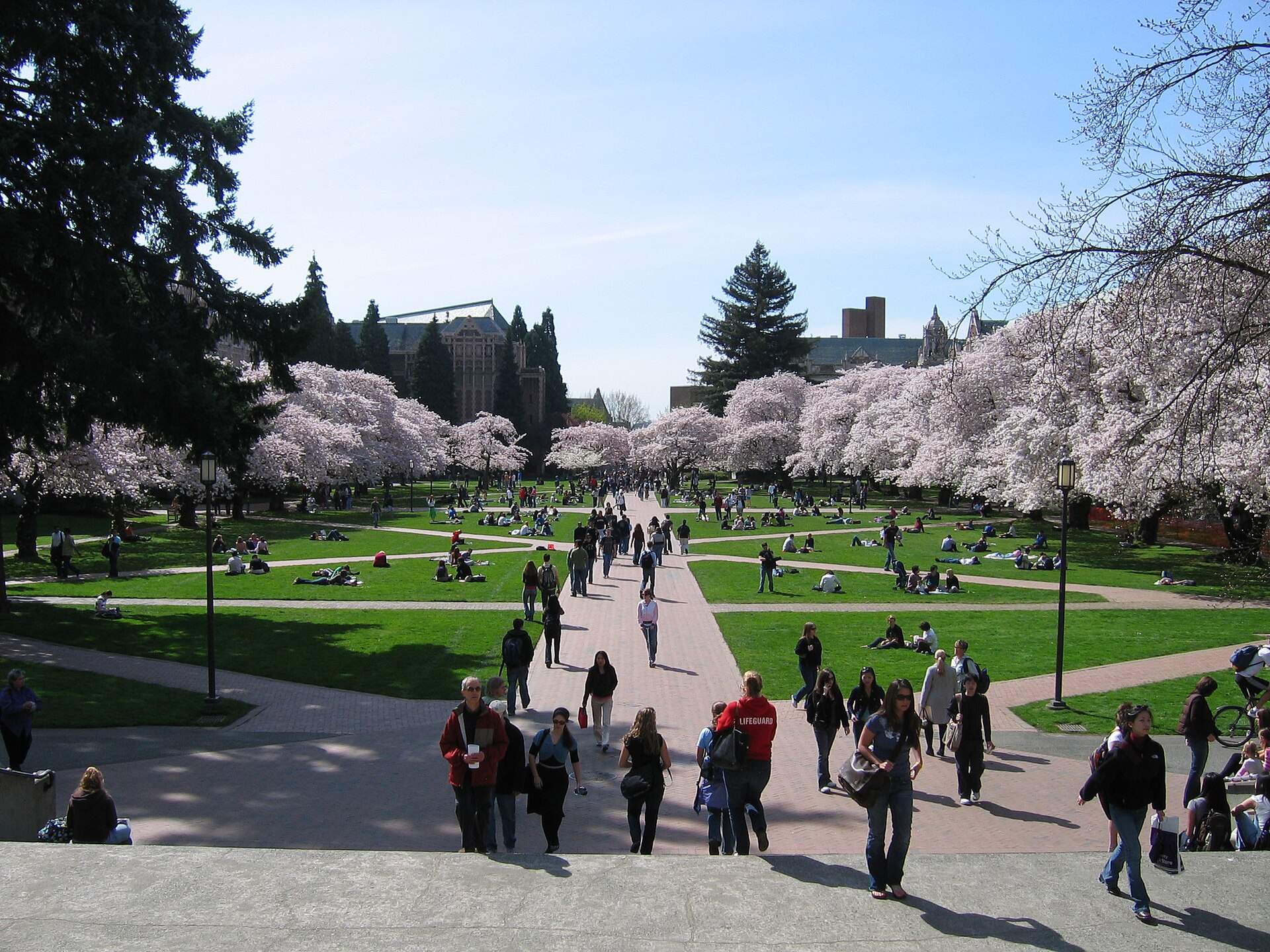
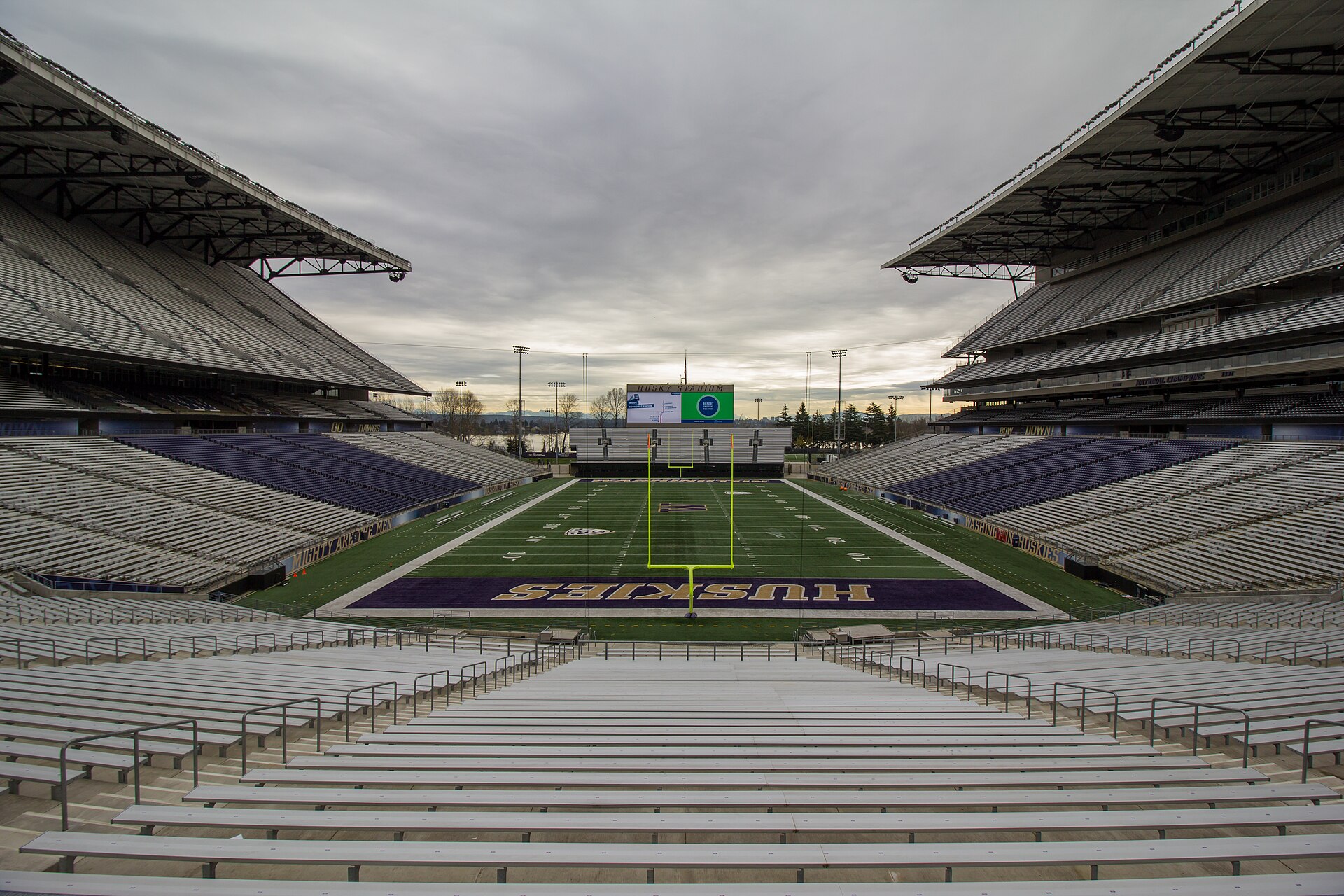
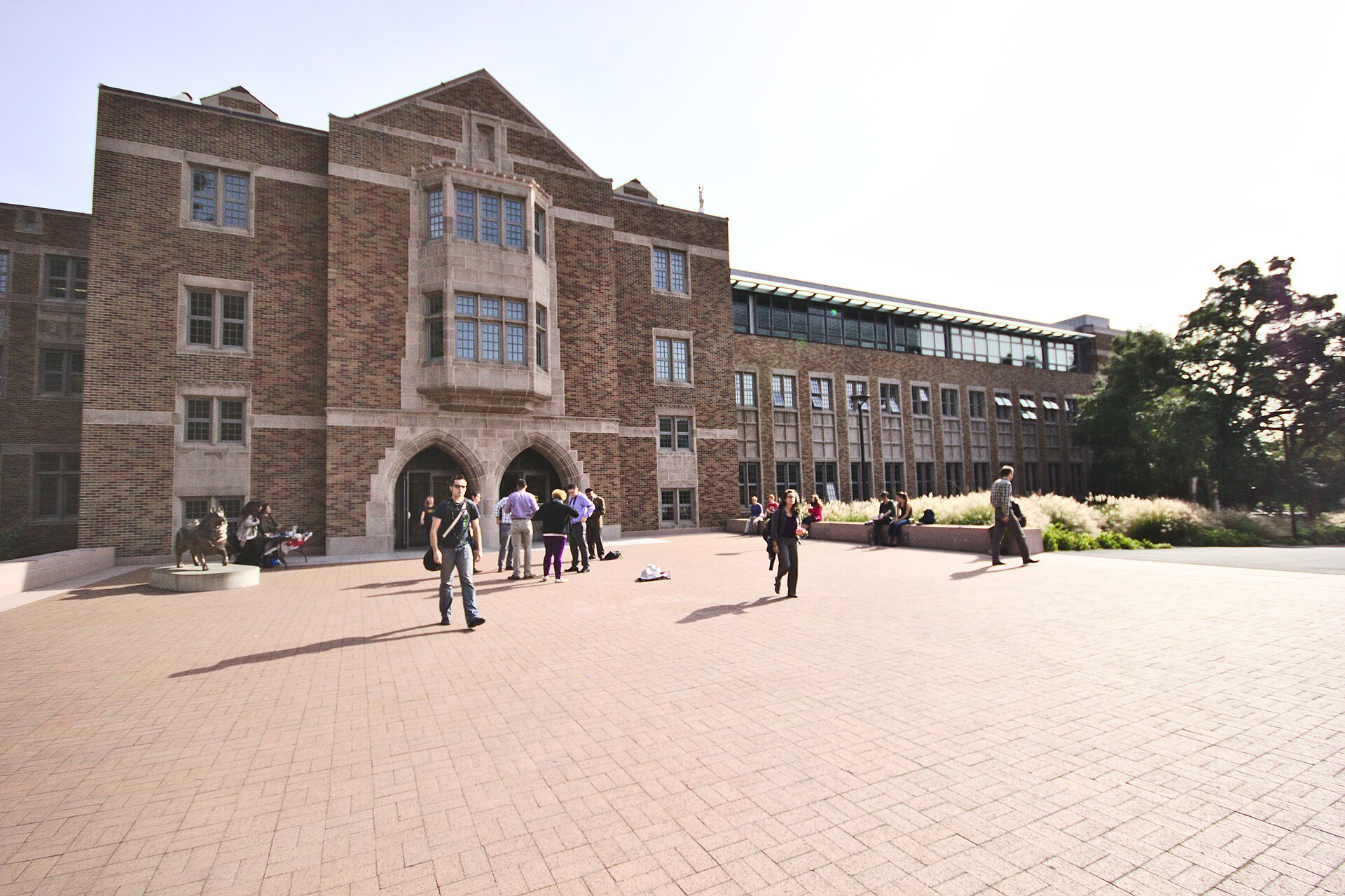
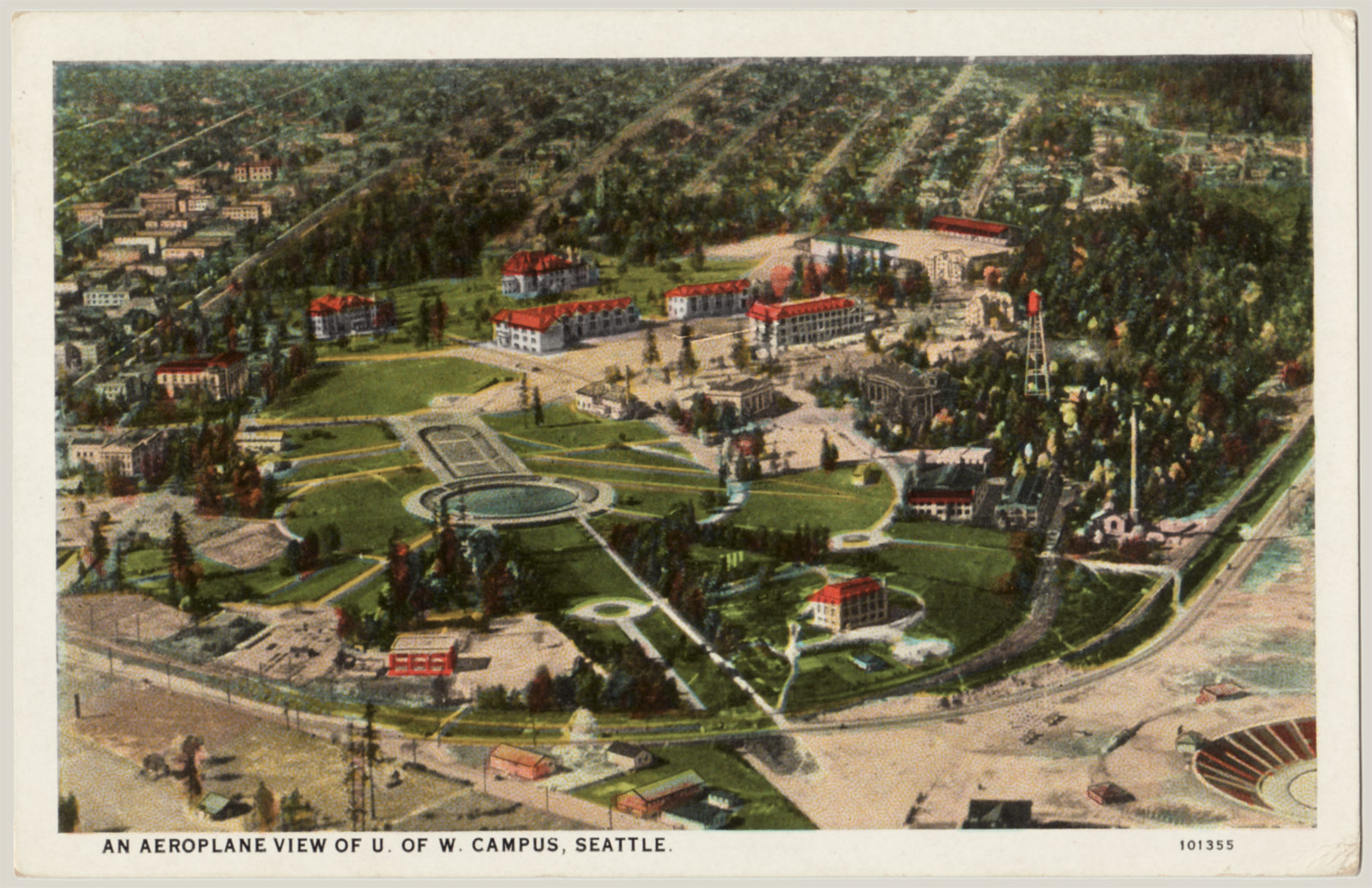
University of Washington — campus in pictures
Real, freely-licensed photographs of the campus (via Wikimedia Commons).
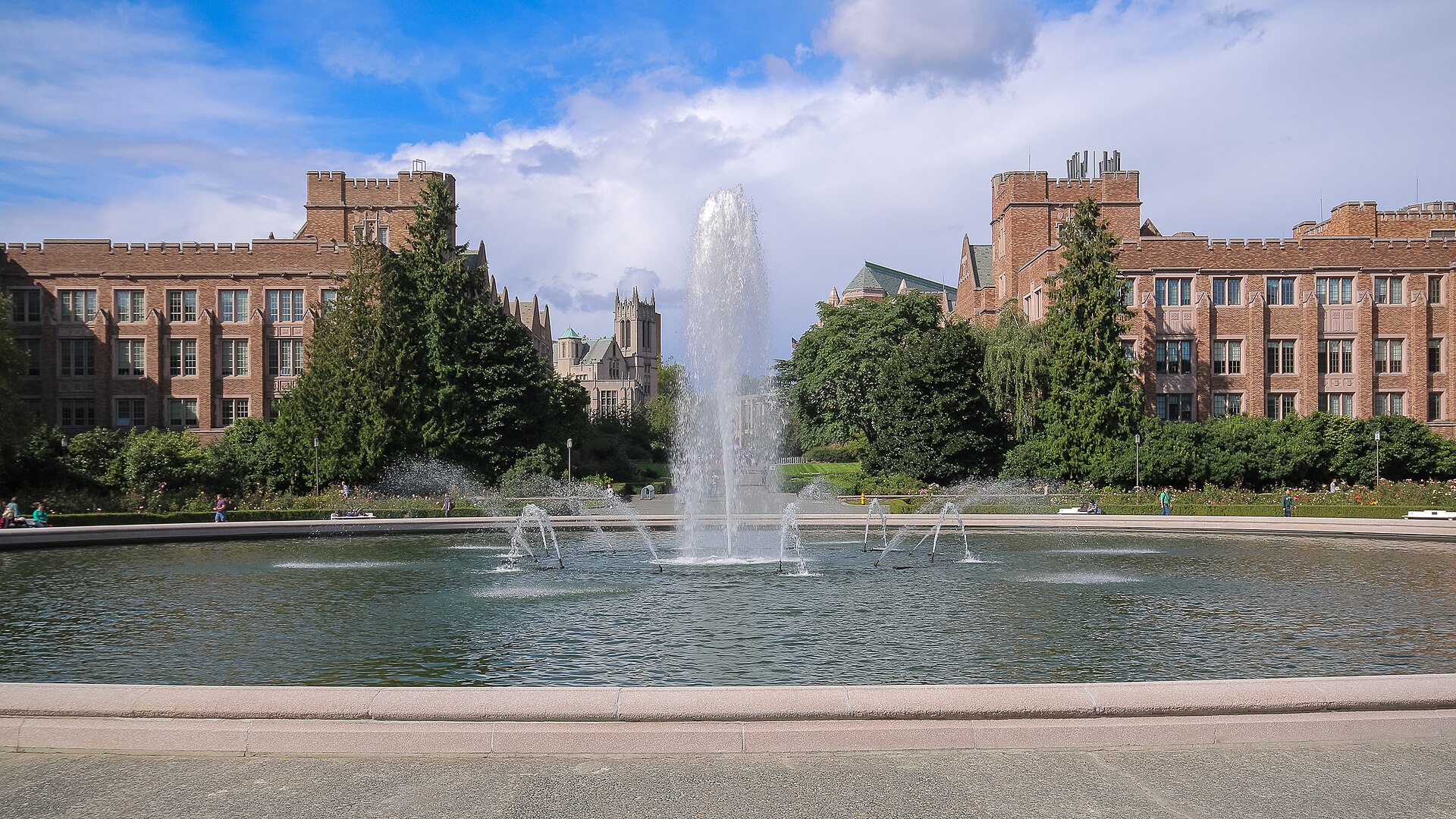
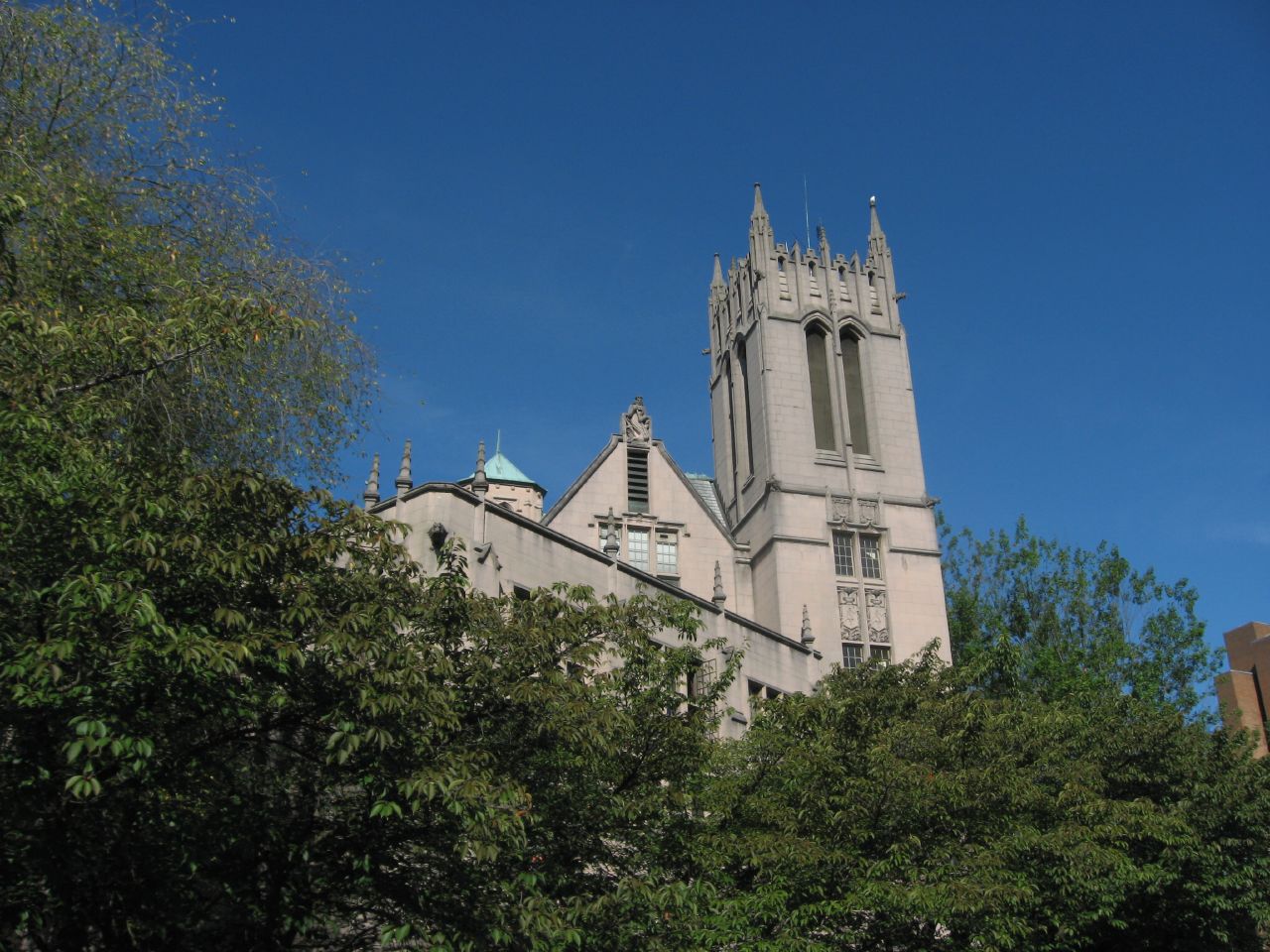
Why UW — Research, Tech, and the Seattle Advantage
The University of Washington has spent decades building one of the most powerful combinations in American public higher education: elite academic programmes, a billion-dollar research enterprise, and a campus embedded in a city that is simultaneously a tech powerhouse and a Pacific gateway. For international students, UW delivers a globally respected credential in an environment that actively connects you to industry from Day 1.
SELECTIVITY
UW Acceptance Rate & Admitted Student Profile
With an overall acceptance rate of 39%, the University of Washington is moderately selective as a whole — but this number conceals enormous variation by major. For the Paul G. Allen School of Computer Science, direct admission is highly competitive with far fewer spots than applicants. For popular majors in engineering, business (Foster), and nursing, competition is also significantly stiffer than the headline rate suggests. International students should treat UW as a target school requiring genuine preparation and a strong application.
The overall 39% acceptance rate is a university-wide average. Admission to capacity-constrained majors like CS (Allen School), nursing, pre-medicine pathways, and Foster Business is substantially more competitive. Applying to a less oversubscribed major and pursuing an internal major change is a viable strategy but carries no guarantee, especially for Allen School programmes.
AT A GLANCE
University of Washington Quick Facts
WHAT YOU'LL SUBMIT
The UW Application — What It Consists Of
UW accepts applications through the Common App. The application is deliberately streamlined — no supplemental essays, no letters of recommendation, no interviews. UW evaluates you holistically through grades, course rigour, your personal essay, and your extracurricular record.
HOLISTIC REVIEW
What UW Looks For — Academic Excellence & Individual Contribution
UW uses a holistic, individualised review process. Every application is read in full after the November 15 deadline; there is no rolling admission and no early decision or early action round. Admission decisions are released together between March 1 and March 15.
UW seeks students who will not only succeed academically but who will actively contribute to the intellectual and cultural energy of the campus. International students bring perspectives, languages, and experiences that enrich UW's learning environment, and the admissions office values this contribution explicitly.
DATES & DEADLINES
UW Application Deadlines & Timeline
UW operates on a quarter system and admits freshmen primarily for Autumn (September) entry. There is no early decision or early action programme. All applications receive the same deadline and are reviewed after it closes. International students should note that Winter quarter (January entry) is not available to first-year international applicants.
There is no Early Decision or Early Action at UW. No binding commitments, no advantage for early submission. Submit by November 15 for Autumn entry. All decisions are released as a single batch in early March.
| Round | Opens | Deadline | Decision |
|---|---|---|---|
| Autumn Entry (Primary) | August 15 | November 15 | March 1–15 |
| Summer Entry | September 1 | November 15 | March 1–15 |
| Winter Entry | N/A | N/A — NOT available to international first-years | N/A |
CAMPUS & CITY
Life at UW — Seattle, Community & the Husky Spirit
UW's 703-acre urban campus sits between Lake Washington and Lake Union, with views of Mount Rainier on clear days. It is one of the most architecturally striking campuses in the United States — a blend of collegiate Gothic buildings, modernist research facilities, and green lawns that border one of America's most dynamic cities.
Campus life at UW is anchored by the Husky Union Building (HUB), home to dining, gaming, events, and student services. Over 1,000 registered student organisations span academic, cultural, recreational, and professional interests. The Dawg Daze orientation programme welcomes incoming students with 250+ events across UW's many departments. UW has a vibrant Greek life presence alongside ethnic cultural centres, a Q Centre, and active multicultural organisations representing UW's 15% international population. Varsity athletics (Go Dawgs) and over 30 intramural sports leagues create a campus-wide community identity.
Seattle offers unmatched urban access: the Pike Place Market, Capitol Hill's dining and arts scene, the waterfront, and a world-class museum district are all reachable by public transit from campus. For international students who find smaller college towns isolating, Seattle's Pacific Rim culture and cosmopolitan energy make UW one of the most welcoming campuses in the United States.
AFTER UW
Career Outcomes — Tech, Medicine & Global Opportunity
UW's position inside Seattle's tech ecosystem creates a career pipeline that few universities can replicate. Amazon and Microsoft are among the largest employers of UW graduates globally. Boeing, Google, Meta, Salesforce, and hundreds of high-growth startups maintain deep campus recruiting relationships with the university.
UW graduates report an 88% employment or graduate school placement rate, with an average starting salary of $70,000 across all majors. Allen School alumni consistently command some of the highest starting salaries in computer science nationally. Foster School of Business graduates are recruited into investment banking, consulting, and tech operations roles. Pre-medical pathways connect to UW Medicine — one of the most competitive and respected medical schools in the country — as well as to the WWAMI regional medical education consortium across five states.
FREQUENTLY ASKED QUESTIONS
UW Admissions — International Student FAQs
Does UW have early decision or early action?+
No. UW does not offer early decision, early action, or any binding early programme. All freshman applications share the same November 15 deadline for Autumn entry, and all decisions are released together between March 1 and March 15. There is no strategic advantage to submitting early — focus on quality, not speed.
Is UW test-optional for international students?+
Yes. UW is test-optional: SAT and ACT scores are not required for admission. However, international applicants must submit English proficiency scores (TOEFL, IELTS, or Duolingo) unless they qualify for an exemption. Notably, strong SAT or ACT verbal scores may substitute for English proficiency test requirements — check with the admissions office if this applies to you.
Is there financial aid for international undergraduate students?+
This is critical to understand: UW does not provide need-based financial aid or institutional scholarships to undergraduate international students. International students must demonstrate sufficient financial resources for their entire stay before a visa can be issued. Plan for the full cost of attendance — approximately $91,128 per year — without relying on UW funding.
How competitive is admission to the Paul G. Allen School of Computer Science?+
Very competitive. While the university's overall acceptance rate is 39%, the Allen School is capacity-constrained and admits only a limited number of students annually across all pathways. Direct admission from high school is available and is the most straightforward path, but you should treat CS admission at UW as a highly selective process requiring a strong academic record, especially in mathematics and science.
Does UW require a supplemental essay or letters of recommendation?+
No. UW accepts the Common App and requires only the standard Common App personal essay (650 words). There are no UW-specific supplemental essays. Letters of recommendation are not required and are not reviewed even if submitted. This makes UW one of the least burdensome top universities to apply to.
Can I apply to UW directly to a major?+
Yes, for many programmes. UW allows you to list your intended major on the Common App. Some majors — particularly CS, nursing, and some engineering specialisations — are capacity-constrained and require direct admission; you cannot easily switch into them after arriving at UW. Choose your intended major carefully and be honest in your application.
What GPA and test scores do I need?+
UW's minimum stated GPA is 3.7 unweighted. Admitted students typically fall in the SAT 1333–1500 range and ACT 28–33. For competitive majors like CS and nursing, expect the upper end of these ranges. IB students typically present around a 34 score. There is no minimum test score since testing is optional.
What is the CADR requirement and does it apply to international students?+
Yes. UW's College Academic Distribution Requirements (CADRs) apply to all applicants, including international students. You need four years of English, three years of mathematics, three years of social sciences, two years of a world language, three years of science (including two with lab), one year of senior-year quantitative coursework, and at least 0.5 years of fine arts. IB Diploma, A-Level, and other national curricula typically satisfy these requirements — but map your coursework carefully.
ACADEMIC EXPECTATIONS
What UW Expects Academically — Rigour, Range & Intellectual Drive
UW is a highly research-intensive university that rewards intellectual curiosity, academic consistency, and a demonstrated willingness to push yourself. For international students, the academic bar is significant: a 3.7+ unweighted GPA, strong course rigour in a national or international curriculum, and — for competitive majors — a track record in mathematics and science that signals you are ready for UW's demanding coursework.
The university reviews grades in context: a student at a top-ranked international school facing a challenging IB Diploma curriculum will be evaluated differently from a student at a less rigorous institution with a perfect transcript. UW's holistic review accounts for school profile, curriculum type, and the rigour of individual course choices. Taking the hardest available classes in your school and performing well is more impressive than a perfect grade in an easy course load.
ADMITTED STUDENT PROFILE
Academic Benchmarks for Admitted Students
These ranges represent the middle 50% of admitted UW freshmen across all majors. For capacity-constrained programmes like the Allen School (CS), nursing, and engineering specialisations, competitive applicants will typically fall at or above the upper end of these ranges.
TEST POLICY
UW's Test-Optional Admissions Policy
UW removed the SAT/ACT requirement for incoming students and is now test-optional for all applicants. Standardised test scores are neither required nor expected for the vast majority of freshman applicants.
If you submit scores, they become part of your holistic file and can strengthen an application where grades alone leave questions. If your scores are below UW's middle 50% range, it is generally better not to submit them. There is no admissions penalty for not submitting scores.
EXCEPTION: Homeschooled applicants and students from schools with non-standard grading practices are required to submit SAT or ACT scores. International students from recognised national curriculum systems (IB, A-Level, CBSE, etc.) are not subject to this exception. IMPORTANT FOR INTERNATIONALS: The SAT/ACT test-optional policy applies to admissions testing only. All international applicants must still demonstrate English language proficiency through TOEFL, IELTS, or Duolingo — or qualify for an exemption via strong SAT/ACT verbal scores.
SAT & ACT STRATEGY
Standardised Tests — When and How to Submit
Since testing is optional, the decision to submit scores should be strategic. For international students applying to competitive majors, strong scores can differentiate a file in a holistic review. The key benchmark: if your score falls within or above UW's 25–75th percentile band, submitting is likely to help you.
IB, A-LEVEL & AP
How UW Reads International Curricula
UW explicitly encourages AP, IB, and A-Level coursework as evidence of academic rigour. A strong performance in a demanding international curriculum is one of the most compelling academic signals an international applicant can send.
IB Diploma students are evaluated with the full diploma in context. A competitive IB total is around 34 points, but UW considers the difficulty of your subject choices alongside your overall score. High Levels (HL) in mathematics, science, and languages signal readiness for UW's most demanding programmes. Students who complete the full IB Diploma are viewed particularly favourably for research-intensive programmes. A-Level students should present strong predicted grades — typically A*AA or above for competitive programmes — with particular weight on subjects relevant to the intended major. AP students are expected to be taking the most rigorous AP pathway available at their school. High AP scores (4–5) can earn credit at UW, potentially accelerating graduation.
IB Diploma holders with scores of 30 or above typically earn college credit at UW for higher-level subjects scored at 5 or above. A-Level students earn credit for AS and A-Level exams depending on subject and grade. Check UW's official exam credit table for specific equivalencies.
SUBJECT PREPARATION
Course Rigour — What UW Expects Subject by Subject
UW's College Academic Distribution Requirements (CADRs) set a minimum floor — but competitive applicants go well beyond them. Here is what to prioritise in each subject area.
ENGLISH PROFICIENCY
English Language Requirements for International Students
All international applicants whose primary language of instruction is not English must demonstrate English proficiency through one of the approved tests below. Scores must be current (typically within two years of the application deadline).
Students who completed at least three years of secondary education at a school where English was the sole language of instruction may be exempt. Contact the UW admissions office to confirm your eligibility for an exemption.
| Test | Minimum Score | Notes |
|---|---|---|
| TOEFL iBT | 92 | Internet-Based Test; section minimums may apply — verify with admissions |
| IELTS Academic | 7.0 | Academic band required; General Training IELTS not accepted |
| Duolingo English Test | 120 | Accepted by UW as an alternative to TOEFL/IELTS |
| SAT/ACT (verbal section) | Qualifying score | Strong SAT/ACT verbal scores may substitute; confirm current threshold with UW admissions |
GRADE-BY-GRADE STRATEGY
Building Your UW Profile — Year 9 to Year 13
UW's admissions committee reads your academic record as a story of growth and ambition. Here is how to build a compelling arc from entry to application.
ALLEN SCHOOL — SPECIAL PATHWAY
CS at UW — Direct Admission to the Allen School
The Paul G. Allen School of Computer Science & Engineering is one of the most selective CS programmes in the United States. For international students with serious CS aspirations, understanding how Allen School admission works is essential planning.
The Allen School admits approximately 630 new undergraduate students annually across three pathways: direct admission from high school, transfer from community college, and internal admission for current UW students. Each pathway is competitive; the school explicitly states that it is 'capacity-constrained' and that demand significantly exceeds available spots.
AVOID THESE
Academic Pitfalls — What Hurts UW Applications
- Dropping rigorous courses in Year 12/13 — UW checks your senior-year course load and notices any decline in academic ambition.
- Applying to the Allen School as a backup plan — CS direct admission is highly competitive; treat it as a selective target, not a fallback.
- Assuming the 39% acceptance rate reflects your major's difficulty — the headline rate masks much more selective thresholds for CS, nursing, and engineering programmes.
- Submitting low test scores when test-optional — if your SAT/ACT scores are below UW's 25th percentile band, not submitting them is almost always the right choice.
- Failing to satisfy the English proficiency requirement — many international applicants discover late that their TOEFL/IELTS scores don't meet UW's minimums. Test early, and retake if needed.
- Submitting unsolicited materials — UW does not review letters of recommendation, portfolio materials, or other documents not explicitly requested. Sending them does not help and may irritate reviewers.
- Misunderstanding CADR requirements — international students sometimes assume their national curriculum automatically satisfies UW's distribution requirements. Map your coursework to CADRs explicitly, and contact admissions if you have gaps.
- Underestimating the essay's importance — UW has no supplement, so the Common App personal essay carries all the weight of your 'voice' in the application. A generic or rushed essay is the single biggest self-inflicted wound in a UW application.
COST & FINANCIAL AID
What UW Costs — The Honest Picture for International Students
UW is one of the most important things to understand before you apply: for undergraduate international students, the University of Washington does not provide need-based financial aid, merit scholarships, or any form of institutional grant aid. You must plan to fund the full cost of attendance — approximately $91,128 per year — from personal, family, or external sources.
This is not unusual for American public universities, which are funded largely by state taxes and are structured to serve in-state residents first. The trade-off is a world-class education at a cost that — while significant — is meaningfully lower than comparable private universities. For families who can self-fund, UW delivers extraordinary value. For families who cannot, the financial reality requires careful external planning.
ANNUAL COST ESTIMATE
UW Cost of Attendance — International Undergraduate (Annual)
All figures below are from UW's official cost data and should be treated as estimates for planning purposes. Actual costs vary by programme, housing choice, and personal spending.
Four-year total cost of attendance at current rates: approximately $364,512. Families should budget for annual tuition increases (historically 2–5% per year at US public universities) and factor in currency exchange risk if funding from outside the United States.
| Component | Annual Cost | Notes |
|---|---|---|
| Tuition (non-resident/international) | $44,640 | Per academic year; does not include fees |
| Total Cost of Attendance | $91,128 | Tuition + fees + housing + dining + books + personal |
| Estimated cost of living (Seattle) | $18,000 | Housing, food, transport, personal — approximate |
| Application fee | $80 | One-time; paid at application submission |
FINANCIAL AID FOR INTERNATIONALS
The Honest Truth — No Institutional Aid for International Undergrads
UW's official financial aid policy is explicit: international undergraduate students on F-1, J-1, or other non-immigrant visas are not eligible for federal financial aid, and the University of Washington does not provide institutional need-based grants or merit scholarships to international undergraduates.
Federal regulations prohibit F-1 visa holders from receiving U.S. federal financial aid (Pell Grants, subsidised loans, etc.). UW's scholarships — the Husky Promise, Purple & Gold, Presidential Scholar, and others — are explicitly limited to U.S. citizens, permanent residents, and in some cases undocumented Washington state residents. None of these scholarships are available to international students on student visas.
Before applying to UW, you will be required to submit a financial documentation declaration showing you have sufficient funds to cover your entire programme. This is a visa requirement. If you cannot demonstrate these funds, your student visa application will not be approved. Do not apply to UW as an international student unless you are confident in your ability to self-fund.
SCHOLARSHIP OPTIONS
External Funding — Where International Students Can Look
While UW itself does not fund international undergraduate students, external funding sources do exist. The search requires planning and early action — most external scholarships have deadlines well before UW's November 15 application deadline.
NET COST REALITY
Affordability Assessment — Realistic Planning for International Families
At a full cost of approximately $91,128 per year, UW represents a major financial commitment for international families. However, compared to private US universities at similar or lower academic rankings — where total cost of attendance can exceed $90,000–$95,000 per year — UW's public tuition structure offers genuine relative value.
Families who can self-fund four years at UW are investing in a degree with exceptional return: 88% employment outcomes, $70,000 average starting salaries, and direct access to the Seattle tech ecosystem mean that UW alumni often recoup their investment rapidly, particularly in computer science, engineering, and business. The key is entering with eyes open: budget the full $91,128 per year, add 3–5% annual increases, and plan for currency fluctuation. Students who enter UW without adequate funding are placed in severe financial stress that affects academic performance.
ACTION PLAN
How to Fund a UW Education — A Step-by-Step Approach
COST & AID FAQs
Cost of Attendance — Frequently Asked Questions
Does UW offer any financial aid or scholarships to international undergraduate students?+
No. UW's official policy is that it does not provide need-based aid or institutional scholarships to undergraduate international students on F-1 or other student visas. The university's domestic scholarships (Husky Promise, Purple & Gold, Presidential Scholar) are restricted to US citizens, permanent residents, and qualifying Washington state residents. International students must self-fund.
What is the total cost of attendance for an international student?+
Approximately $91,128 per year, covering tuition, fees, housing, dining, books, and personal expenses. Over four years at current rates, budget approximately $364,000–$400,000, accounting for annual increases. Tuition alone is approximately $44,640 per year.
Can I work while studying at UW on an F-1 visa?+
Yes, F-1 visa holders can work on-campus up to 20 hours per week during the academic year and full-time during scheduled breaks. Off-campus work requires special authorisation (CPT or OPT) and is generally not available during your first academic year. On-campus work can offset some living expenses but does not cover tuition.
Is UW more affordable than US private universities?+
Marginally so. UW's total cost of attendance ($91,128/year) is typically $5,000–$15,000 less than elite private universities, which can exceed $95,000–$100,000 per year. However, many private universities offer substantial need-based aid to international students (particularly the wealthiest Ivies and similar institutions). For families who qualify for substantial private university aid, a fully-funded private offer may be more affordable than UW's sticker price.
Are there any emergency funds available to international students at UW?+
UW's International Student Services office maintains limited emergency assistance resources and can provide guidance on temporary support. These are emergency funds for unexpected hardship — not a funding strategy for tuition. Do not rely on emergency funds as part of your financial plan.
THE UW ESSAY
Why Essays Matter at UW — Your Only Personal Voice in the Application
Here is what makes UW's essay situation unusual: there is no supplemental essay. No 'Why UW?' prompt. No 150-word 'describe your background' question. UW reads only your Common App personal essay — 650 words — alongside your grades, test scores (optional), and extracurricular activities. This means your personal essay carries 100% of the weight of your personal voice in the application.
For many students, this is liberating: one great essay instead of five adequate ones. But it also means a mediocre personal essay has nowhere to hide. UW's holistic review explicitly states that 'the entire application, including the essay, is important in the individualised review.' In a competitive applicant pool, the student with the most memorable, specific, and honest essay often wins the close call.
APPLICATION SYSTEM
UW Uses Common App — One Essay, No Supplement
UW accepts applications through the Common App. The essay component consists of a single personal statement of up to 650 words, chosen from seven prompts. There are no UW-specific supplemental essays — making UW one of the most streamlined applications among top American public universities.
COMMON APP PROMPTS
The Seven Prompts — Themes and How to Approach Them
The Common App provides seven personal essay prompts covering a range of universal human themes. You choose one. For UW, any prompt can work — what matters is not which prompt you choose but how specifically, honestly, and compellingly you write. Below are the thematic families of the prompts and how to think about each for a UW application.
Visit commonapp.org/apply/essay-prompts for the current-cycle verbatim prompt text before writing your essay. Prompts are stable across cycles but verify the exact wording before you begin.
PERSONAL STATEMENT STRATEGY
Writing the Essay — Craft, Specificity & Honest Voice
The Common App personal essay is a 650-word argument that you are the kind of person who belongs at UW. Not the most impressive. Not the most credentialled. The most specific, honest, and self-aware.
UW's own guidance asks applicants: 'What should we know about you that isn't reflected in your grades and coursework?' This is the essay's job. If your essay reads like a rephrasing of your activities list — accomplishment, result, lesson learned — it is the wrong essay. The reader can see your activities list. Give them something your transcript cannot: a specific scene, a particular voice, a genuine human moment that makes them want to meet you.
650 words is a constraint, not a target. A focused 580-word essay with no wasted sentences is better than a padded 650-word essay that meanders. Cut every sentence that is not doing specific work. The best UW personal essays often use the first sentence to drop the reader directly into a specific moment — not into a generalisation, a dictionary definition, or an origin story.
WHAT TO KNOW ABOUT SUPPLEMENTS
No Supplement — What This Means Strategically
Because UW has no supplemental essay, you cannot speak directly to your interest in the university, a particular faculty member, or a specific programme. This creates both a challenge and an opportunity.
CHOOSING YOUR TOPIC
How to Select the Right Topic for Your UW Essay
At UW, where the essay is your only written voice, topic selection is the most consequential essay decision you will make. Follow this process.
WHAT KILLS ESSAYS
Common Essay Mistakes — Specific to UW Applicants
- Writing a generic 'I want to study CS because technology will change the world' essay — UW's Allen School application pool is full of them. Be specific about a particular problem, project, or question that drives you.
- Using the essay to repeat your resume — grades and activities are already on your application. The essay exists to add a new dimension, not to reinforce data the reader already has.
- Choosing a topic that is impressive but doesn't reveal anything personal — winning a Maths Olympiad is notable, but an essay about winning it that doesn't reveal anything unexpected about you is a wasted opportunity.
- Writing a 'Why UW?' essay without a 'Why UW?' prompt — don't fill your personal essay with generic praise of UW. The reader knows UW is good; they want to know who you are.
- International students 'translating' their experience into what they think American admissions officers want to hear — authenticity is immediately recognisable. Write your real story in your real voice.
- Starting with a dictionary definition, a famous quote, or a rhetorical question — these openings are clichéd and signal a lack of confidence in the actual story.
- Ending with a broad future-looking statement about changing the world — end on a specific note, not a generic aspiration. Close with what changed in you, not what you plan to do for humanity.
- Exceeding 650 words — the Common App will truncate your essay at 650 words. Edit ruthlessly; every word counts.
ESSAY FAQs
UW Essays — Frequently Asked Questions
Does UW require any supplemental essays beyond the Common App personal statement?+
No. UW requires only the standard Common App personal essay (650 words maximum, one of seven prompts). There are no UW-specific supplemental essays. This makes UW one of the most streamlined applications among top American public universities.
Which Common App prompt should I choose for a UW application?+
Choose the prompt that produces your most specific and honest essay. UW does not have a preferred prompt and does not distinguish between applicants by prompt choice. The quality, specificity, and authenticity of your essay matters far more than which prompt you select.
Should I mention UW specifically in my personal essay?+
Sparingly, if at all. There is no 'Why UW?' prompt, and the personal essay is not the place for a university-specific interest statement. Your interest in UW's specific strengths should be evident from your chosen major, your intellectual passions, and the coherence of your overall application — not from name-dropping UW in your essay.
How much weight does the personal essay carry in UW's holistic review?+
Significant weight, particularly in borderline cases. UW's admissions team explicitly states that the essay is an important part of the holistic review. In a pool of applicants with similar GPAs and test scores, the student with the more compelling personal essay often receives an offer. For competitive majors like CS, a memorable essay can be a decisive differentiator.
Can I write about my experience as an international student or immigrant?+
Yes, if your story is specific and honest and not a generic 'I moved to a new country and it was hard' arc. International students have powerful stories to tell — cultural transitions, linguistic experiences, specific moments of cross-cultural understanding. These become compelling essays when they are anchored in specific scenes and lead to specific insights, not when they follow a predictable narrative template.
Should I write about computer science or my intended major?+
Only if your essay adds something that your academic record and activities list don't already show. If you are applying to the Allen School with four CS competitions on your resume, an essay about how you love coding is redundant. Write about CS only if you have a genuinely unexpected or intellectually specific angle — a particular problem, a surprising realisation, or an experience that shows intellectual depth beyond what your transcript already demonstrates.
Is the personal essay required for international applicants?+
Yes. The Common App personal essay is a required component of the UW application for all freshman applicants, including international students. It cannot be waived, substituted, or skipped. Budget significant time for writing, revising, and polishing your essay.
Courses — schools, degrees & intake
18 degrees across 5 groupings.
College of Engineering · 4 degrees
Aeronautics & Astronautics (BS)
Bioengineering (BS)
Electrical & Computer Engineering (BS)
Mechanical Engineering (BS)
Paul G. Allen School of Computer Science & Engineering · 2 degrees
Bachelor of Science in Computer Science
Bachelor of Science in Computer Engineering
Michael G. Foster School of Business · 4 degrees
Business Administration — Accounting (BABA)
Business Administration — Finance (BABA)
Business Administration — Marketing (BABA)
Business Administration — Information Systems (BABA)
College of the Environment · 4 degrees
Marine Biology (BS)
Oceanography (BA/BS)
Environmental Studies (BA)
Atmospheric and Climate Science (BS)
College of Built Environments · 4 degrees
Architectural Design (BA)
Landscape Architecture (BLA)
Construction Management (BS)
Real Estate (BS)
Want your real chances at University of Washington?
Create a free TYCHR account for your personalised admit-chance, a shortlist you can track, exact entry requirements, and essay + counselling help.