University of Waikato
Hamilton, New Zealand · Suburban
NEW ZEALAND · HAMILTON & TAURANGA
University of Waikato Admissions Guide for International Students
A lakeside public university in the heart of the Waikato region, the University of Waikato punches well above its size. Home to one of the world's most storied machine-learning research groups — birthplace of the WEKA toolkit — and a Triple Crown–accredited management school found at fewer than 1% of business schools globally, Waikato offers internationally ambitious students a research-intensive environment, an inclusive bicultural campus, and straightforward direct-entry admissions with no application fee.
If you want a university that combines recognised global research output with genuine accessibility for international students, a welcoming campus culture shaped by Te Tiriti o Waitangi, and two campuses on New Zealand's spectacular North Island, Waikato deserves serious consideration.
Campus
University of Waikato — campus in pictures
Real, freely-licensed photographs of the campus (via Wikimedia Commons).

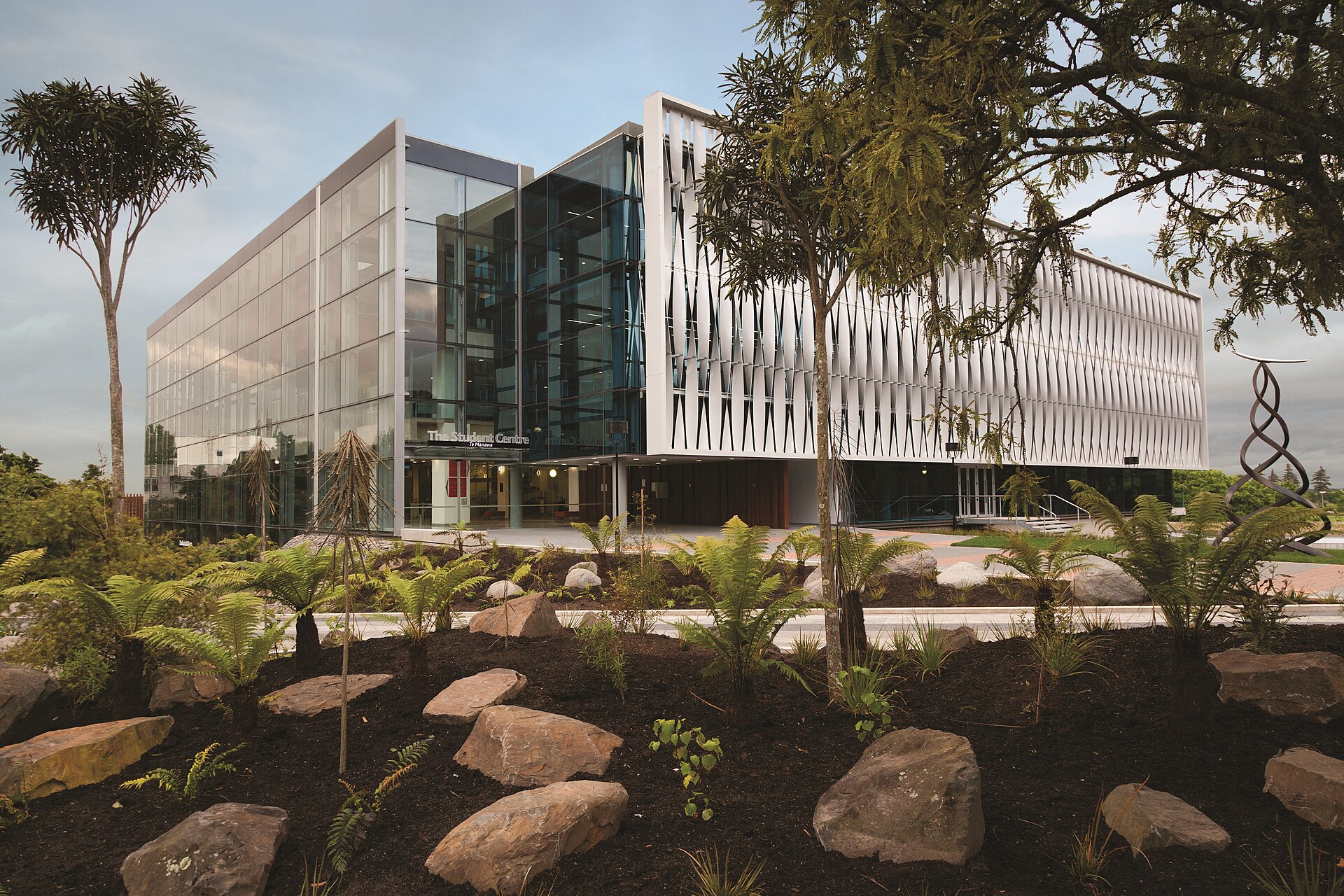




WHY WAIKATO
Six Reasons to Choose Waikato
SELECTIVITY
Acceptance Rate & Admission Profile
The University of Waikato is accessible but not open-entry. A 65% headline acceptance rate reflects that qualified international students have a strong chance of admission, provided they meet the academic and English-language thresholds. Entry to competitive programmes — Engineering, Computer Science, Law — is more selective than the university average.
Admission is primarily academic-qualification based. Your IB Diploma total, A-Level grades, or national board results are the principal criteria. SAT and ACT scores are not required and are rarely considered. Competitive programmes may set higher subject-specific thresholds — confirm requirements for your chosen programme on the official admissions page before applying.
AT A GLANCE
Quick Facts
WHAT YOU SUBMIT
The Waikato Application: What You Need
The University of Waikato uses a direct online application portal — there is no Common App, UCAS, or intermediary platform. The application is straightforward and can be submitted at any time during the year. There is no application fee.
No personal statement or application essay is required for standard undergraduate or postgraduate entry at Waikato. Some competitive scholarships may require a written statement — check individual scholarship conditions.
THE ADMITTED PROFILE
What Waikato Looks for in International Students
Waikato is academically driven but not defined by narrow metrics. The admissions office looks for students who have performed at or above threshold in their home qualification system, can demonstrate English proficiency, and have chosen a programme that aligns with their background.
WHEN TO APPLY
Application Deadlines & Intake Periods
Unlike most US and UK universities, Waikato does not operate fixed application rounds with single-day deadlines. Applications are accepted year-round through a rolling system. You choose your preferred intake when completing the application form.
International students needing a New Zealand Student Visa should apply several months in advance of their intake to allow visa processing time. Immigration New Zealand processing can take 4–8 weeks depending on nationality. Scholarship applications may have their own earlier deadlines — check the scholarships page separately.
| Intake | Start Month | Application Open | Notes |
|---|---|---|---|
| Semester A (Summer) | November | Year-round rolling | Smaller intake; limited programme availability |
| Semester B (Autumn) | February | Year-round rolling | Main intake; full programme selection |
| Semester C (Winter) | July | Year-round rolling | Second major intake; most programmes available |
CAMPUS & CITY LIFE
Student Life at Waikato
The Tauranga campus offers a different setting entirely: a coastal city with beaches, a marina, and a rapidly growing professional economy. Students can alternate between campuses for certain programmes. Both cities are within two hours of Auckland by road or regional flight.
The main campus in Hamilton sits beside a lake on the outskirts of a city of roughly 170,000 people — large enough to offer cafes, live music, restaurants, and sports venues, small enough to be genuinely student-friendly. Rent and food costs are considerably lower than in Auckland or Wellington, making Hamilton a practical choice for budget-conscious international students. The campus itself has a Marae (traditional Māori meeting ground), lakeside lawns, gardens, and the HIKO hub as the centre of student services.
CAREERS & OUTCOMES
Graduate Outcomes & Career Paths
Waikato Management School's Triple Crown accreditation means MBA and business graduates are recognised by employers in over 80 countries. Management and accounting graduates have found roles at New Zealand's major financial institutions, Big Four accounting firms, and multinational corporations across Southeast Asia and beyond. The careers and employability team offers internship placement support, career fairs, and networking events with local employers from Year 1.
Waikato graduates enter a wide range of industries, with particular depth in technology, management consulting, finance, environmental services, education, and law. The Computer Science department has a strong track record of graduates joining global technology firms and founding start-ups, aided by proximity to Hamilton's growing tech sector and the university's AI research reputation.
FAQs
Frequently Asked Questions
Do I need a Student Visa to study at Waikato?+
Yes. All international students studying in New Zealand for programmes longer than three months require a New Zealand Student Visa from Immigration New Zealand. The university's offer letter and proof of fee payment are required documents for the visa application.
Is there an application fee?+
No. There is no application fee to apply to the University of Waikato. This is one of the advantages of the direct New Zealand application system compared to US or UK pathways.
Can I work while studying?+
Yes. Most international student visa holders can work up to 20 hours per week during semester and full-time during scheduled breaks. This is subject to the conditions on your individual visa — always confirm with Immigration New Zealand.
Does Waikato accept the IB Diploma?+
Yes. The IB Diploma is explicitly recognised for admission to undergraduate programmes. A total score of 27 points is the published minimum, with individual programme requirements varying. Your HL subject results will be assessed for programme-specific prerequisites.
How do I find out the entry requirements for my specific programme?+
Each programme on the Waikato website lists its specific entry requirements, including subject prerequisites and minimum scores. The international office (info@international.waikato.ac.nz) can provide personalised guidance based on your qualifications.
Are there intakes for both February and July?+
Yes. Waikato has two main intakes (February/Semester B and July/Semester C) plus a smaller November/Semester A intake. Most programmes are available at the February and July intakes. Applications are accepted year-round on a rolling basis.
What is the Waikato Management School's Triple Crown?+
Triple Crown accreditation means Waikato Management School is simultaneously accredited by AACSB (USA), EQUIS (Europe), and AMBA (UK) — the three most prestigious business school accreditation bodies. Fewer than 1% of business schools globally hold all three. This signals that Waikato business degrees meet international quality standards recognised by employers worldwide.
Is Waikato's Computer Science department good for international students?+
Yes. The department is internationally recognised, particularly in machine learning and data science — the WEKA toolkit, developed at Waikato, remains one of the most widely used ML platforms in academic research. The AI Institute provides undergraduate exposure to live research. Graduates compete for roles at technology companies globally.
ACADEMIC EXPECTATIONS
Academic Standards for International Applicants
Waikato is an accessible research university — not a highly selective gatekeeping institution in the US/UK mode. Academic requirements are transparent and tied to qualification type. If you meet the published thresholds with relevant subjects, you have a strong chance of admission. The academic challenge begins after you arrive.
International students enter a degree structure built around flexibility: you may combine subjects across faculties, and many programmes allow a major plus a double major or minor. Class sizes are smaller than at New Zealand's largest universities, and the research-active faculty bring their work into undergraduate teaching — particularly in Computer Science, Environmental Science, and Management.
ACADEMIC BENCHMARKS
Admitted Student Academic Profile
These are the published minimum thresholds. Competitive programmes — especially Computer Science, Engineering, and Law — receive more applications from well-qualified candidates, and practical entry scores can be above the stated minimums. Plan your application assuming you need to clearly exceed minimums rather than just meet them.
SAT & ACT
Standardised Test Policy: Not Required
The University of Waikato does not require SAT or ACT scores for admission. These tests are part of the US higher education system and are not part of the New Zealand direct-entry framework. Submitting them will not strengthen or weaken your application.
If you are holding both a New Zealand application and US university applications, there is no need to send SAT/ACT scores to Waikato.
IB & A-LEVELS
How Waikato Reads IB Diploma & A-Level Results
A-Level applicants should hold at least two or three A-Level passes at grade C or above, with higher grades expected for competitive programmes. The university maps international qualifications onto its own academic credit framework, meaning some A-Level results may qualify you for advanced standing (credit transfer), reducing your time to degree.
The IB Diploma is fully recognised for undergraduate entry. A total score of 27 points is the published minimum for most undergraduate programmes. Some faculties — particularly Science and Engineering — will look closely at your Higher Level mathematics and science results alongside the total score. A strong total with weak HL performance in your intended major subject may result in a conditional offer or prerequisite bridging requirement.
SUBJECT PREPARATION
Subject-Level Readiness by Programme Area
ENGLISH LANGUAGE
English Proficiency Requirements
All international students whose first language is not English, and whose previous qualification was not taught and examined in English, must provide evidence of English proficiency. The table below shows Waikato's published minimums.
If your secondary qualification was taught and examined entirely in English (e.g., IB Diploma in English, A-Levels, Sri Lankan O/A-Levels in English medium), you may be exempt from the language test requirement. Confirm exemption eligibility with the international admissions team before applying.
| Test | Overall Min | Notes |
|---|---|---|
| IELTS Academic | 6.0 | No individual band below 5.5; some programmes require 6.5 |
| TOEFL iBT | 80 | Institution code: 0369 |
| Duolingo English Test | 110 | Accepted for most undergraduate programmes |
| PTE Academic | Verify | PTE typically accepted — confirm current minimum with admissions |
| Cambridge C1 Advanced / C2 | Verify | Cambridge qualifications generally accepted; confirm directly |
YEAR-BY-YEAR PLAN
Building Your Academic Profile From Year 9 to Application
COMMON PITFALLS
Academic Mistakes to Avoid
- Applying without confirming whether your specific programme has higher-than-minimum entry requirements — always check the programme page, not just the general minimums.
- Assuming that meeting the 27-point IB minimum guarantees entry into competitive programmes like Computer Science or Law. In practice, competitive programmes may expect scores considerably higher.
- Not confirming your English language exemption status before sitting an unnecessary IELTS. If your IB Diploma was taught and examined in English, you may already qualify.
- Underestimating New Zealand Student Visa processing time. Apply for your visa as soon as you have accepted your offer and paid fees — do not leave it to the month before classes start.
- Choosing the wrong intake semester. If you need Semester A (February), your visa, fees, and accommodation must all be confirmed by late November/early December at the latest.
- Missing scholarship application windows. Unlike the degree application (which is rolling), many Waikato scholarships have fixed annual deadlines — check the scholarships finder as early as possible.
- Ignoring prerequisite bridging courses. A conditional offer with a bridge requirement is still a path to your degree — engage with the international office to understand your pathway rather than withdrawing your application.
ACADEMIC FAQs
Academics — Frequently Asked Questions
Can I start my degree with an IB score lower than 27 through a Foundation Year?+
Yes. Waikato offers Foundation Studies programmes for students who do not yet meet direct undergraduate entry requirements. Successful completion of the appropriate Foundation programme guarantees a pathway into degree study. Fees for Foundation programmes are different from degree fees.
Will my IB Higher Level subjects count for credit towards my degree?+
Some IB HL subjects may qualify for credit transfer or advanced standing. This is assessed individually by the relevant faculty. Discuss your specific HL results with the faculty or international office before enrolment to maximise your academic standing.
Does Waikato accept the IB Career-related Programme (CP)?+
The CP is generally assessed on a case-by-case basis. Contact the international admissions team directly if you hold or expect to hold a CP result — the relevant academic and vocational components of the CP will be reviewed for the programme you are applying to.
How does the Waikato degree structure differ from my home system?+
Most Waikato undergraduate degrees are three years (360 credit points), with an additional Honours year available. The credit system allows flexibility to choose major and minor subjects across faculties. Assessment typically combines coursework assignments, mid-semester tests, and end-of-semester examinations.
Are classes taught in English throughout?+
Yes. All degree-level teaching at the University of Waikato is conducted in English. Some te reo Māori content and greetings are used across the campus and in specific papers, but all assessment is in English unless you are studying Māori language papers specifically.
COST & AFFORDABILITY
Understanding the Cost of Studying at University of Waikato
Waikato is one of New Zealand's more affordable research universities for international students. There is no application fee, the cost of living in Hamilton is lower than in Auckland or Wellington, and the university actively markets scholarships to reduce the net cost. That said, studying in New Zealand does require careful financial planning — including the visa requirement to demonstrate sufficient funds.
The figures below are drawn from the university's facts profile. Tuition varies by programme (engineering and IT programmes cost more than arts programmes). The cost of attendance estimate reflects tuition plus typical living costs across an academic year. All international students should budget for accommodation, health insurance (required by Immigration NZ), living expenses, and one-off setup costs in their first year.
ANNUAL COSTS
Estimated Annual Cost for International Students
NZD tuition ranges for undergraduate programmes in 2026: Arts/Social Sciences NZD 32,400–42,230; Business NZD 38,252; Engineering NZD 48,345; Science NZD 42,235. The USD equivalents shown above are approximate based on the facts file; actual NZD amounts are authoritative and set annually.
| Component | Estimate Usd | Notes |
|---|---|---|
| Tuition (undergraduate) | $20,400 | Varies by programme; Engineering/IT higher |
| Cost of Attendance (total) | $31,400 | Tuition + living (annual estimate) |
| Living Costs | $11,000 | Housing, food, transport, personal |
| Application Fee | $0 | No application fee |
| Student Visa Fee | ~$200 (NZD ~330) | Immigration NZ fee — verify current rate |
| Health & Travel Insurance | ~$500–$700 | Compulsory for Student Visa; varies by provider |
FINANCIAL AID
Financial Aid for International Students
Most Waikato financial support is merit-based, rewarding strong academic performance. Some awards also recognise leadership, community engagement, or specific field of study. International students should build their financial plan around self-funding or family funding as the primary source, with scholarships as a supplement.
The University of Waikato provides financial support primarily through scholarships and awards rather than a US-style need-based aid programme. New Zealand Government student loans are not available to international students. The average aid package for international students who receive support covers approximately 10% of costs — meaning scholarships are meaningful but rarely cover full costs.
New Zealand's international tuition fees, while lower than US or Australian peers in many programmes, still represent a significant investment. Students from countries where the NZD/home-currency exchange rate is unfavourable should factor in currency risk when planning.
SCHOLARSHIPS
Scholarships for International Students
Waikato offers a range of scholarships specifically for international students. Specific award amounts and eligibility criteria are managed through the university's online scholarship finder tool and may change annually. Named awards include the following (verify current availability and amounts on the official scholarships page):
The scholarship finder is the authoritative source. Scholarship deadlines are separate from and earlier than admissions deadlines. Apply for scholarships as early as possible — some close in October or November for a February intake.
NET COST REALITY
Is Waikato Affordable for International Students?
Hamilton's cost of living is one of the lowest among New Zealand university cities. Shared flat accommodation is available for well under NZD 200/week in many cases. International students on a valid visa can work up to 20 hours per week during semester, which can meaningfully offset living expenses. The combination of moderate tuition, manageable living costs, and work rights makes Waikato one of the more financially realistic choices among internationally ranked universities.
Compared to equivalent universities in the UK, Australia, and the United States, Waikato sits in a genuinely competitive cost bracket. Annual tuition of approximately NZD 32,000–48,000 (USD 20,000–30,000 depending on programme and exchange rate) is lower than most Group of Eight Australian universities and significantly below US private university costs for international students.
YOUR FUNDING PLAN
Step-by-Step Guide to Funding Your Waikato Degree
COST FAQs
Cost & Aid — Frequently Asked Questions
Are New Zealand university fees lower than Australian or UK fees?+
For many programmes, yes. Waikato's undergraduate tuition for international students (approximately NZD 32,000–48,000 per year depending on programme) compares favourably to many UK and Australian university fees. However, exchange rate fluctuations mean the real cost varies depending on your home currency.
Can I apply for a New Zealand Government student loan as an international student?+
No. New Zealand Government student loans are available only to New Zealand citizens, permanent residents, and certain other categories. International students must fund their studies through savings, family support, scholarships, and/or part-time work income.
Do PhD students pay international tuition fees?+
Not necessarily. Doctoral students at Waikato may qualify for domestic-rate tuition fees, which are significantly lower than international fees. This makes Waikato particularly attractive for postgraduate research. Confirm eligibility with the School of Graduate Research.
When do I need to pay my tuition fees?+
You pay your first-year (or full programme) fees after accepting your offer through the MyWaikato portal. The payment receipt is required before you can apply for your New Zealand Student Visa, so fee payment is a prerequisite for the visa process.
Are there extra costs in the first year I should budget for?+
Yes. Set-up costs in your first year include bedding and kitchen supplies if living in a flat, a laptop or other technology if needed, Student Visa fee (payable to Immigration NZ), health insurance premium, and potential international flight and travel costs. Budget approximately NZD 1,500–2,500 for one-off first-year setup costs on top of regular fees and living expenses.
APPLICATION & STATEMENT
Applying to Waikato: No Essays, But Strategy Still Matters
New Zealand's direct university application system does not require application essays or personal statements for standard undergraduate or postgraduate entry. Admission is based on your academic qualifications and English language test results. However, strategy — in choosing your programme, timing your application, and applying for scholarships — still determines whether you get the outcome you want.
This guide covers how to approach your Waikato application strategically, what written materials may be needed for scholarships, and how to present your academic case most effectively even in a grades-first system.
THE APPLICATION SYSTEM
How the Waikato Application Actually Works
The application can be submitted at any time of year. You select your programme(s), upload your supporting documents, and receive an offer (or conditional offer) by email. For most international students, the entire process from application to offer takes a few weeks if documents are complete.
Unlike US universities (Common App / Coalition) or UK universities (UCAS personal statement), the University of Waikato uses a direct online application portal: MyWaikato. You submit academic transcripts, English language test results, and personal identification. There is no personal statement, no supplemental essays, and no interview required for standard undergraduate admission.
SCHOLARSHIP APPLICATIONS
Writing for Waikato Scholarship Applications
The principles that apply to scholarship statements are similar to those used in US or UK personal statements: be specific rather than generic, connect your academic interests to your future goals, and provide concrete evidence of what you have achieved. Generic 'I have always been interested in...' openings are as ineffective at Waikato as anywhere else.
While the degree application has no essay, high-value Waikato scholarships — such as the Sir Edmund Hillary Scholarship Programme — require applicants to submit personal statements, describe their achievements, and often demonstrate leadership or community engagement. If you are targeting a named Waikato scholarship, your written application matters considerably.
IF YOU WRITE A STATEMENT
Choosing What to Write About (Scholarship Applications)
For any Waikato scholarship that requires a statement or essay, the most effective approach is to write about a genuine experience — academic, personal, or community-based — that demonstrates your capacity to succeed and contribute. New Zealand universities value authenticity, intellectual curiosity, and engagement with the world around you.
WHAT TO AVOID
Common Mistakes in the Waikato Application Process
- Assuming the absence of an essay means the application is purely administrative — scholarship competition still rewards students who present their profile compellingly.
- Submitting incomplete supporting documents and then waiting weeks for an outcome that cannot progress. Have transcripts, language scores, and passport scan ready before you start the online form.
- Applying for the wrong programme to meet minimum requirements, then hoping to transfer — programme transfers are possible but not guaranteed, and starting in the right programme saves time and money.
- Ignoring scholarship application deadlines because admissions is rolling. Scholarships have fixed deadlines that do not flex to match your individual application timeline.
- Not declaring your English language exemption evidence — if your qualification was taught in English, clearly indicate this in your application to avoid being asked for a language test you do not need.
- Writing generic scholarship statements that could apply to any university — Waikato assessors can tell when an applicant has not researched the institution specifically.
- Underestimating the visa timeline — accepting your offer and then waiting too long to start the visa process can mean missing your intake even after being admitted.
HOW TO APPLY
Your Complete Application Checklist
APPLICATION FAQs
Application & Statement — Frequently Asked Questions
Do I need to write a personal statement or essay to apply to Waikato?+
No. Standard undergraduate and postgraduate applications to the University of Waikato do not require a personal statement or application essay. Admission is based on academic qualifications and English language results.
Are there any programmes that require a portfolio or interview?+
Some creative and professional programmes may require a portfolio or audition. Check the specific requirements on the programme page — most standard academic programmes do not. Law, Medicine, and Teaching may have additional requirements or competitive ranking processes.
Do scholarship applications require a written statement?+
Yes, many of Waikato's named scholarships require a written statement or evidence of leadership and achievement as part of the scholarship application. These are separate from — and have different deadlines than — the degree application.
Can I apply for multiple programmes in one application?+
Yes. You can indicate programme preferences in your application. However, confirm the entry requirements for each programme separately, as they may differ in prerequisite subjects or minimum scores.
What happens if I receive a Conditional Offer?+
A Conditional Offer means you meet some but not all entry requirements. Common conditions include providing final IB results, completing a bridging course, or meeting an English language requirement. Follow up with the international office to understand exactly what you need to fulfil to convert the conditional offer to a full offer.
Can I apply before I have my final IB results?+
Yes. You can apply with predicted IB results during your final year. The university will issue a conditional offer pending final results, and your offer will be confirmed once official results are provided. Many international students apply in September–November for the following February intake.
Courses — schools, degrees & intake
62 degrees across 10 groupings.
Te Kura Toi | School of Arts · 5 degrees
Bachelor of Arts
Bachelor of Communication
Bachelor of Design
Bachelor of Music
Bachelor of Global Studies
Au Reikura | School of Computing and Mathematical Sciences · 3 degrees
Bachelor of Computer Science
Bachelor of Applied Computing
Bachelor of Science (Mathematics)
Te Kura Toi Tangata | School of Education · 2 degrees
Bachelor of Teaching (Early Childhood Education)
Bachelor of Teaching (Primary)
Te Kura Mata-Ao | School of Engineering · 8 degrees
Bachelor of Engineering with Honours - Chemical and Process Engineering
Bachelor of Engineering with Honours - Civil Engineering
Bachelor of Engineering with Honours - Electrical and Electronic Engineering
Bachelor of Engineering with Honours - Environmental Engineering
Bachelor of Engineering with Honours - Materials and Manufacturing Engineering
Bachelor of Engineering with Honours - Mechanical Engineering
Bachelor of Engineering with Honours - Mechatronics Engineering
Bachelor of Engineering with Honours - Software Engineering
Te Wānanga Waiora | Division of Health · 2 degrees
Bachelor of Nursing
Bachelor of Health
Te Piringa | Faculty of Law · 1 degrees
Bachelor of Laws (LLB)
Te Pua Wānanga ki te Ao | Faculty of Māori and Indigenous Studies · 3 degrees
Bachelor of Arts - Māori and Indigenous Studies
Bachelor of Arts - Te Reo Māori
Bachelor of Arts - Pacific and Indigenous Studies
Te Kura Whatu Oho Mauri | School of Psychological and Social Sciences · 14 degrees
Bachelor of Social Sciences - Anthropology
Bachelor of Social Sciences - Criminology
Bachelor of Social Sciences - Geography
Bachelor of Social Sciences - History
Bachelor of Social Sciences - Human Rights
Bachelor of Social Sciences - International Relations
Bachelor of Social Sciences - Philosophy
Bachelor of Social Sciences - Political Science
Bachelor of Social Sciences - Sociology
Bachelor of Social Sciences - Population Studies
Bachelor of Social Sciences - Psychology
Bachelor of Sport and Human Performance - Human Performance Science
Bachelor of Sport and Human Performance - Sport Development and Coaching
Bachelor of Sport and Human Performance - Healthy Active Living
Te Aka Mātuatua | School of Science · 9 degrees
Bachelor of Science - Chemistry
Bachelor of Science - Ecology and Biodiversity
Bachelor of Science - Earth Sciences
Bachelor of Science - Biomedical Sciences
Bachelor of Science - Marine Science
Bachelor of Science - Molecular and Cellular Biology
Bachelor of Science (Technology)
Bachelor of Climate Change
Bachelor of Environmental Planning
Te Raupapa | Waikato Management School · 15 degrees
Bachelor of Business - Accounting
Bachelor of Business - Agribusiness
Bachelor of Business - Business Analytics
Bachelor of Business - Digital Business
Bachelor of Business - Economics
Bachelor of Business - Finance
Bachelor of Business - Human Resource Management
Bachelor of Business - Leadership
Bachelor of Business - Management Communication
Bachelor of Business - Marketing
Bachelor of Business - Project Management
Bachelor of Business - Public Relations
Bachelor of Business - Strategic Management
Bachelor of Business - Supply Chain Management
Bachelor of Banking, Finance and Technology
Want your real chances at University of Waikato?
Create a free TYCHR account for your personalised admit-chance, a shortlist you can track, exact entry requirements, and essay + counselling help.