University of Strathclyde
Glasgow, United Kingdom · Urban
GLASGOW, SCOTLAND · FOUNDED 1796
University of Strathclyde Admissions Guide for International Students
Scotland's leading technological university, Strathclyde was founded as a 'place of useful learning' in 1796 and has never stopped living up to that name. With the largest engineering faculty in Scotland, a triple-accredited business school, and research partnerships spanning energy, space, and advanced manufacturing, Strathclyde turns academic rigour into real-world impact. If you are an ambitious international student who wants a respected degree in a vibrant, affordable European city — Glasgow's own — Strathclyde deserves a serious look.
Campus
University of Strathclyde — campus in pictures
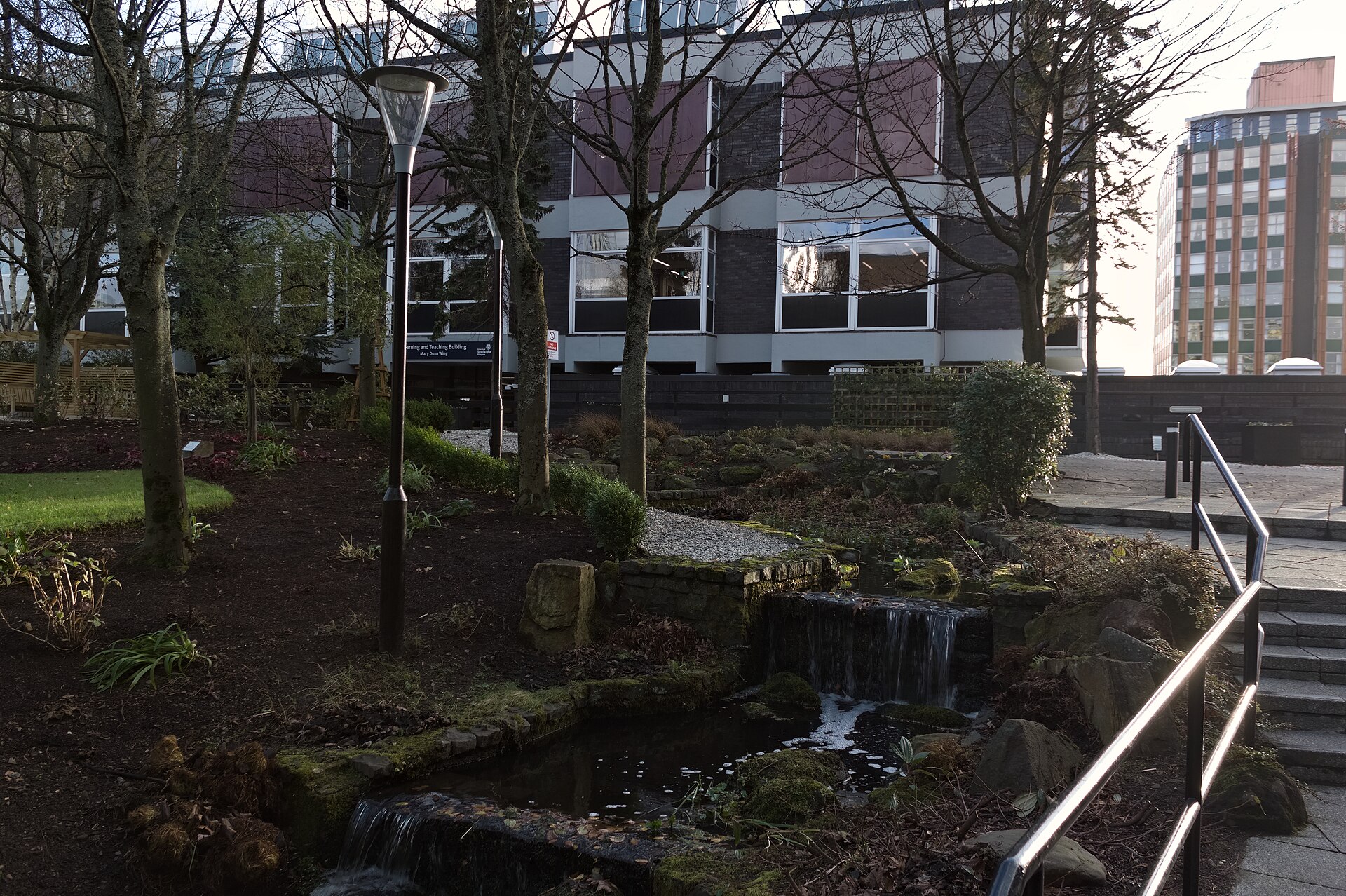
Real, freely-licensed photographs of the campus (via Wikimedia Commons).
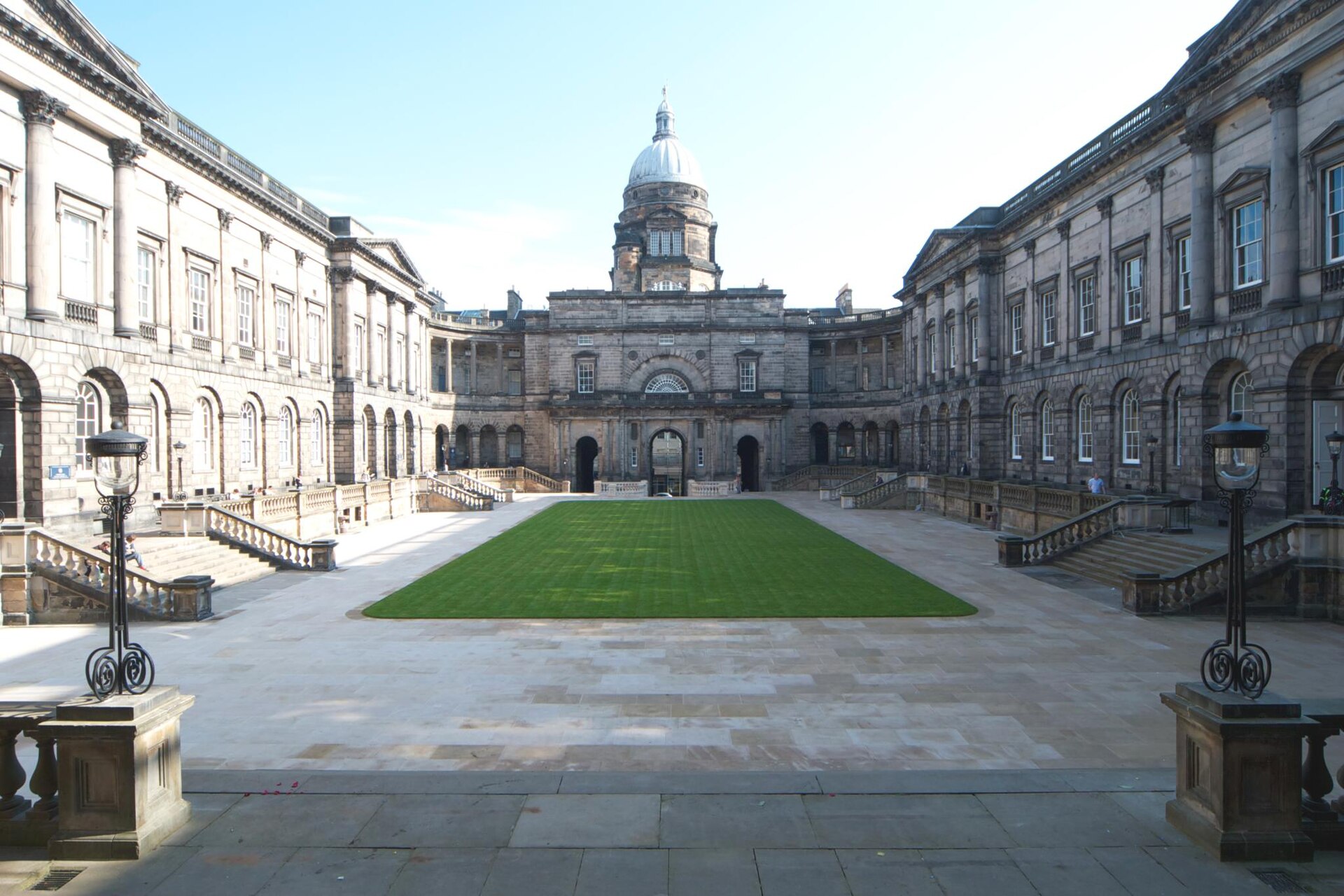
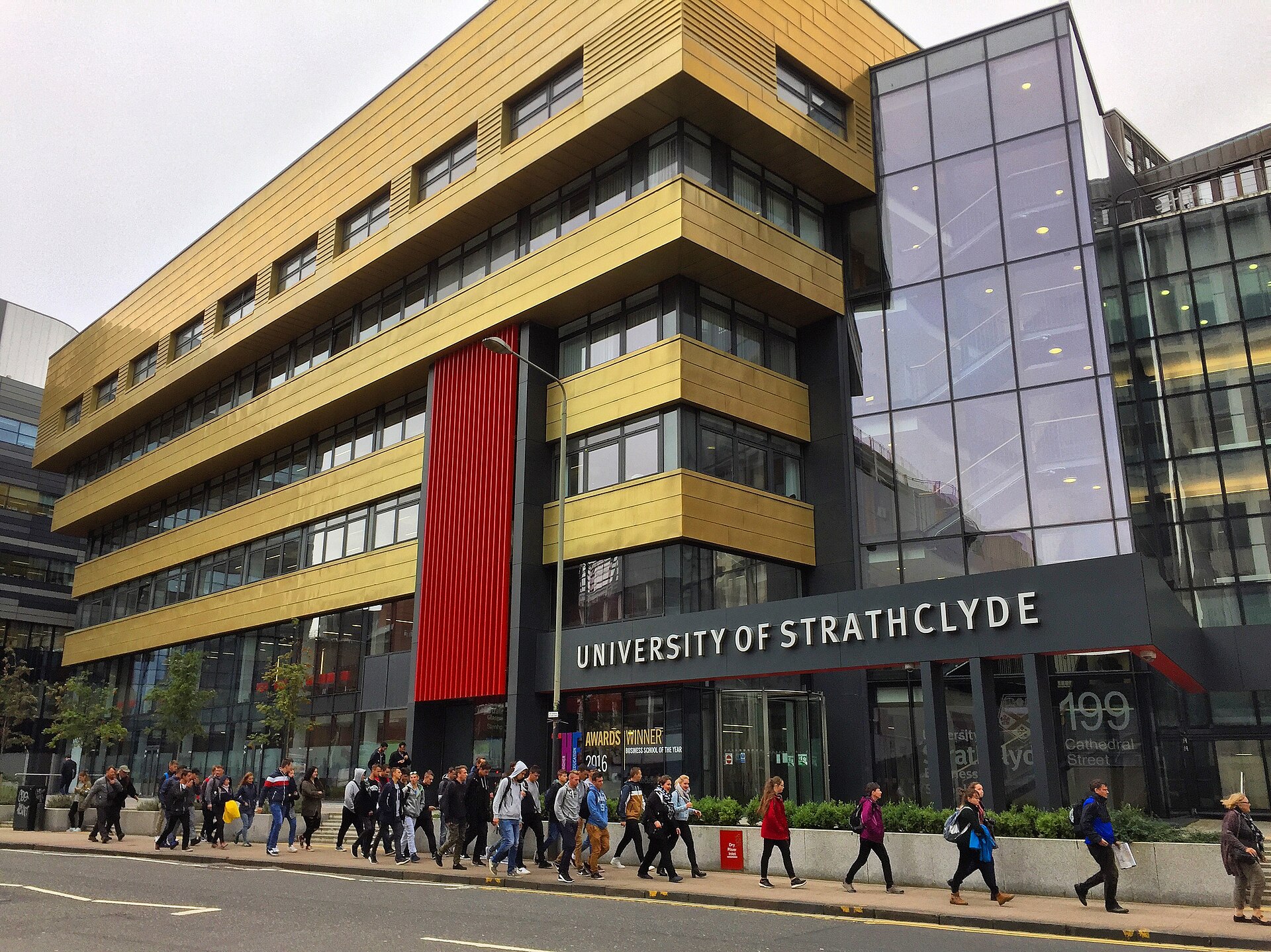
Why Strathclyde — Scotland's Place of Useful Learning
Strathclyde occupies a rare position: a research-intensive university with an explicit vocation for practical impact. It ranks among the UK's top 40 nationally and sits in the QS World Top 300, yet its Glasgow campus puts you closer to industry, innovation, and an extraordinarily welcoming city than almost any other research university in Britain.
SELECTIVITY
How Selective Is Strathclyde?
Strathclyde is accessible relative to the most selective UK universities, with an acceptance rate around 72% overall. However, selectivity varies sharply by programme: Engineering, Law, Pharmacy, and competitive Business pathways carry significantly higher entry requirements than the overall average suggests. International students should target the grade band for their specific course, not the university-wide figure.
Entry requirements differ significantly by programme. STEM and professionally accredited courses (Law LLB, MPharm, MEng) attract stronger applicant pools and carry higher typical offers. Always check the specific course page for the offer range.
AT A GLANCE
Strathclyde at a Glance
Stats
Cards
WHAT YOU SUBMIT
Components of a Strathclyde Application
Undergraduate international applicants typically apply through UCAS (the UK's centralised admissions service), submitting one application for up to five universities at once. For some courses, a direct international application route is also available. The application is straightforward compared to US systems — no school-specific supplements — but the UCAS personal statement is a critical differentiator.
ADMISSIONS PHILOSOPHY
What Strathclyde Looks For
Strathclyde's admissions are academically driven. The university prioritises students with clear, programme-specific academic preparation and genuine subject motivation — not a well-rounded CV of extracurriculars for its own sake. What moves an application forward at Strathclyde is: strong predicted grades in relevant subjects, a compelling case for why you have chosen this specific course, and evidence that you understand what the degree involves and where it leads.
KEY DATES
Application Deadlines
Undergraduate applicants at Strathclyde use the UCAS system, which runs a single annual cycle. The January UCAS equal consideration deadline covers the vast majority of Strathclyde's undergraduate courses. Applications received after this date may still be considered if places remain.
Application fee via UCAS is £28.95 for up to five choices (2026 entry). Strathclyde's UCAS institution code is S78. International students should check individual course pages for any earlier programme-specific deadlines.
| Round | Deadline | Decision | Notes |
|---|---|---|---|
| UCAS Equal Consideration (UG) | 29 January 2026 | By end of March 2026 | Courses with January deadline; most Strathclyde UG programmes |
| UCAS October Deadline (Oxford/Cambridge/Medicine) | 15 October 2025 | Variable | Not applicable to Strathclyde; for reference only |
| Late / Clearing Applications | After results day (August) | Rolling | UCAS Extra from February; Clearing from July — subject to availability |
| Postgraduate Taught (Sep 2026 start) | See course pages | Rolling | International applicants should apply early; some programmes fill before official close |
STUDENT EXPERIENCE
Campus & City Life
Strathclyde's campus sits in central Glasgow, minutes from the Merchant City and the West End. The city is famous for its warmth, its arts scene (the world's third-largest cultural festival in Celtic Connections), its food, and its nightlife — all at a fraction of London prices. Over 100 nationalities study here, and the international student community is large and well-supported.
LIFE AFTER STRATHCLYDE
Career Outcomes & Graduate Prospects
Strathclyde is joint 1st in Scotland for graduate outcomes and consistently places strongly in UK employability rankings. The university's 'place of useful learning' ethos is not marketing copy — it is reflected in dedicated industry partnerships, placement programmes, and a careers service with deep sector connections in engineering, energy, finance, and law.
Stats
Cards
COMMON QUESTIONS
Frequently Asked Questions
Do international students apply through UCAS or directly to Strathclyde?+
Undergraduate international applicants can use either route: UCAS (institution code S78) is the standard path and allows you to apply to up to five UK universities simultaneously. Some courses also offer a direct international application — check individual course pages. Postgraduate students apply directly through Strathclyde's online portal.
Is English-language evidence required for all international applicants?+
Yes, if English is not your first language. Minimum requirements are IELTS Academic 6.5 overall (with typically no band below 5.5), TOEFL iBT 88, or Duolingo English Test 115. Some courses — particularly Law and Pharmacy — require higher scores. Always verify on the specific course page.
Can I apply after I receive my IB results, rather than on predicted grades?+
Yes. Post-qualifications applicants (those with confirmed IB or A-Level results) can apply through UCAS Clearing in July–August, or in some cases directly. If you have confirmed strong results, this route can be advantageous. Contact Strathclyde's admissions team at international@strath.ac.uk to discuss your options.
Does Strathclyde offer scholarships to international undergraduates?+
Yes, Strathclyde offers scholarships for international undergraduate and postgraduate students. The scholarship search tool on the university website allows you to filter by level and status. Aid coverage is limited — on average around 10% of costs — so most international students should plan to cover the majority of fees independently or through home-country funding.
What IB score do I need to get into Strathclyde?+
The typical IB offer is around 32 points overall, but this varies significantly by programme. Engineering and technology courses may require 34–36 with Higher Level Mathematics at grade 5 or 6. Law and Pharmacy carry higher demands. Always check the specific course's entry requirements on the Strathclyde course finder.
Is Strathclyde a Russell Group university?+
No, Strathclyde is not a member of the Russell Group. However, it is a leading research university recognised for its distinctive technological and professional vocation. Its REF 2021 performance, employer partnerships, and specialist graduate outcomes often compare favourably to Russell Group peers in its key disciplines.
What is student life like for international students in Glasgow?+
Glasgow is consistently rated one of the UK's best student cities. It is significantly cheaper than London and Edinburgh, rich in culture and nightlife, and genuinely welcoming to international students. Strathclyde's central campus location means you are never isolated — you are part of the city from day one.
Can I get a part-time job as an international student?+
Most international students on a valid UK Student visa are permitted to work up to 20 hours per week during term time and full-time during vacation periods. Glasgow's service, hospitality, and technology sectors provide good opportunities, and the university's careers service can help you find part-time roles consistent with your visa conditions.
ACADEMIC STANDARDS
Academic Expectations for International Applicants
Strathclyde is a research-intensive institution with a practical edge. Academic entry standards are demanding in technical and professionally-accredited courses and more accessible in others. What unites all successful applicants is genuine subject preparation — a deep engagement with the discipline you are proposing to study, evidenced through strong predicted grades in relevant pre-university qualifications.
As an international student, your qualifications will be assessed against established equivalency tables. The IB Diploma is well recognised and widely accepted; A-Levels (UK, Singapore, or Cambridge International) are a natural fit for the UK system. North American applicants typically apply on the strength of AP scores and GPA rather than SAT/ACT, though test scores may be noted.
ENTRY BENCHMARKS
Academic Profile — Typical Offers
These benchmarks are drawn from the facts on record and Strathclyde's publicly stated entry standards. Individual course requirements vary — always verify on the Strathclyde course finder.
Programmes such as LLB Law, MPharm Pharmacy, and MEng Engineering degrees typically carry offers at the higher end of the range. Entry to Year 2 or Year 3 direct entry may be possible for applicants with strong prior degree-level study.
STANDARDISED TESTS
Test Policy
Strathclyde's undergraduate admissions are test-optional for international students in the sense that SAT and ACT scores are not required and are not part of the standard assessment process. The UK admissions system centres on A-Level/IB/equivalent qualification grades rather than standardised test scores. However, some professionally-accredited courses may have additional assessments.
INTERNATIONAL QUALIFICATIONS
IB, A-Levels & International Qualifications
Strathclyde is experienced with the full range of international qualifications. The IB Diploma is widely accepted and recognised; Cambridge A-Levels and the Scottish Higher system are standard domestic reference points. North American applicants with AP credits are considered, as are students from South Asia (CBSE/ISC/state boards), the Middle East (Emirates qualification frameworks), and East Asia.
SUBJECT PREPARATION
What to Study in School
Subject choices at A-Level or IB Higher Level can make or break an application. Strathclyde is explicit that specific subjects are required or preferred for most of its technical and professional programmes.
LANGUAGE REQUIREMENTS
English Language Requirements
All applicants whose first language is not English must demonstrate language proficiency. Requirements apply across all programmes and are a condition of the offer, not optional.
If your English test results do not meet requirements, the Strathclyde International Study Centre offers pre-sessional English programmes. Completing an approved pre-sessional course can fulfil your language condition. Contact ELT@strath.ac.uk for details.
| Test | Minimum | Notes |
|---|---|---|
| IELTS Academic | 6.5 overall | Typically no sub-band below 5.5; some courses higher |
| TOEFL iBT | 88 | Check course-specific requirements for higher bands |
| Duolingo English Test | 115 | Accepted for most programmes; verify on course page |
| Cambridge C1 Advanced / C2 Proficiency | Grade C or above (C1) | Widely accepted equivalent |
| PTE Academic | Verify on course page | May be accepted — confirm with admissions |
YEAR-BY-YEAR GUIDE
Building Your Academic Profile (Year 9–13)
PITFALLS
Common Academic Mistakes to Avoid
Items
- Choosing A-Level or IB Higher Level subjects without checking Strathclyde's specific prerequisites — discovering you lack Higher Level Mathematics in Year 13 when applying for Engineering is too late.
- Applying with predicted grades that are aspirational rather than realistic — admissions teams are experienced at reading school predictions and will flag implausible jumps from current performance.
- Sitting English language tests too late — attempting IELTS in October or November of application year leaves no time to resit if results fall below the 6.5 threshold.
- Assuming the same personal statement works for all five UCAS choices — while the statement is shared, the best answers to the three UCAS questions are course-specific, not university-general.
- Not reading Strathclyde's country-specific entry pages — qualification equivalencies differ significantly by educational system, and a strong result in your home system may not automatically translate to a strong UK equivalent without specific context.
- Delaying the application to wait for a resit or improved mock result — if your school can provide a credible upward trajectory and context, apply on predicted grades; Strathclyde admissions consider context.
Faqs
My school does not offer the IB — can I still apply?+
Yes. Strathclyde accepts a wide range of national qualifications. A-Levels, AP courses, Indian board exams, and many other systems are assessed on equivalency. Contact international@strath.ac.uk with details of your qualification for a specific assessment.
Do I need Mathematics A-Level for all Engineering programmes?+
For virtually all engineering programmes at Strathclyde, yes — Mathematics at A-Level (or IB Higher Level equivalent) is required. Some programmes additionally require Physics or Chemistry. Always check the specific course entry requirements.
FEES & FUNDING
Cost of Study at Strathclyde for International Students
Strathclyde is meaningfully more affordable than most London universities and many Russell Group institutions, particularly when you factor in Glasgow's lower cost of living. For international students, total annual costs of attendance are estimated around $42,200 — less than many comparable UK universities. That said, financial aid for international undergraduates is limited, so effective financial planning from the outset is essential.
ANNUAL COST ESTIMATE
Cost Breakdown (Annual Estimates)
All figures are drawn from the university's facts data and converted to approximate USD for reference. Actual costs in GBP may vary by programme and year — confirm current tuition on the Strathclyde course pages before budgeting.
Glasgow's cost of living is significantly lower than London — roughly 30–40% less for accommodation. This makes Strathclyde's overall value proposition strong relative to southern UK equivalents.
| Component | Usd | Notes |
|---|---|---|
| International Tuition (annual) | ~$29,200 | Varies by programme; STEM courses may be higher |
| Cost of Living (Glasgow) | ~$13,000 | Accommodation, food, transport, personal — Glasgow is affordable vs London |
| Total Cost of Attendance (estimate) | ~$42,200 | Tuition + living; books and supplies additional |
| Application Fee | ~$36 | Via UCAS (£28.95 for up to five choices); paid once for all UCAS applications |
FINANCIAL AID
Financial Aid for International Students
Financial aid coverage for international undergraduates at Strathclyde is limited. On average, aid covers approximately 10% of study costs for those who receive it. The primary funding mechanisms available to international students are named scholarships (competitive, partial) and home-country government or sponsor funding. Strathclyde does not offer need-blind admissions or meet full demonstrated financial need for international undergraduates in the way some US institutions do.
Students from certain countries may be eligible for British Council scholarships, Commonwealth Scholarships, or home-government sponsorship (particularly applicable to students from Gulf states, African nations, and some Asian countries). Investigating these external funding streams early — often 12–18 months before your intended start date — is strongly recommended.
Average aid coverage is approximately 10% of costs (where aid is awarded). Most international students fund the majority of their studies through family resources, loans from their home country, or external scholarships.
SCHOLARSHIPS
Scholarships for International Students
Strathclyde offers scholarships for international undergraduate and postgraduate students. Specific awards, values, and eligibility criteria should be verified through the Strathclyde scholarship search tool on the university website, as offerings change each cycle. The categories below reflect the general types of funding available — verify current named awards and amounts directly.
Always verify current scholarship names, amounts, and deadlines via https://www.strath.ac.uk/studywithus/scholarships/ — do not rely on third-party listings which may be out of date.
VALUE & AFFORDABILITY
Strathclyde's Value Proposition
A degree from Strathclyde in engineering, business, or law carries genuine professional currency in the UK and internationally — without requiring the financial outlay of institutions that cost 30–50% more annually. For students targeting careers in energy, manufacturing, financial services, or law in a UK/European context, the return-on-investment case is compelling.
When comparing UK universities, Strathclyde stands out for cost-effectiveness. While its tuition is comparable to other Scottish research universities for international students, Glasgow's cost of living is dramatically lower than London, Oxford, or Cambridge. Students typically spend less on rent, food, and daily expenses in Glasgow than in virtually any other major UK student city. The combination of a respected research degree, strong employment outcomes, and lower overall outlay makes Strathclyde a strategically smart choice for cost-conscious international families.
FUNDING STRATEGY
Steps to Fund Your Strathclyde Degree
COST FAQs
Cost & Funding FAQs
What is the tuition fee for international undergraduate students?+
The approximate annual tuition for international undergraduate students is around $29,200 USD equivalent. Actual GBP fees vary by programme — confirm the current rate on the specific course page on strath.ac.uk before budgeting.
Is Glasgow expensive to live in as a student?+
Compared to London, Glasgow is significantly cheaper — typically 30–40% less for accommodation and everyday costs. Annual living expenses (accommodation, food, transport, personal) are estimated at around $13,000 USD equivalent, though personal spending patterns vary.
Does Strathclyde offer full scholarships for international students?+
Full scholarships covering all tuition and living costs are not routinely available through Strathclyde directly. Partial merit scholarships exist through the university. Full funding for international students more commonly comes from external sources: Chevening, Commonwealth, and home-government schemes.
When should I apply for scholarships?+
Start your scholarship research 12–18 months before your intended start date. Home-government schemes often have very early deadlines. Strathclyde's own scholarships typically have deadlines linked to the admission cycle — check the scholarship search tool in the autumn preceding your entry year.
Can I get a student loan as an international student?+
UK government student loans (Student Finance England/Scotland) are generally not available to international students. Some home countries offer education loans for overseas study — check with your national student finance authority. Strathclyde's student services team can advise on what documentation you might need.
UCAS APPLICATION
The UCAS Personal Statement for Strathclyde What It Is and How to Use It
Strathclyde is a UK university. It does not use the US Common App system, and there are no university-specific supplemental essays or short answers. Undergraduate applications go through UCAS (the UK's centralised system), and the centrepiece of that application is the UCAS personal statement — now structured around three questions from 2026 entry onward. This is your one written opportunity to differentiate yourself. Use it well.
WHAT IS REQUIRED
The UCAS Personal Statement — Overview
From 2026 entry, UCAS replaced the single open-essay personal statement with a structured format comprising three distinct questions. The same answers are sent to all universities you list in your UCAS application (up to five), so your responses must work for every institution on your list. There are no Strathclyde-specific essay prompts.
THE THREE QUESTIONS
UCAS Personal Statement Questions (2026 Entry)
The following questions are the structure of the new UCAS personal statement from 2026 entry. These are the official prompts you will answer. Word/character limits apply per question — check the current UCAS guidance as limits may be updated.
STRATEGY
Writing a Strong UCAS Personal Statement for a Strathclyde-Type Application
Strathclyde's admissions culture is practically minded. Admissions officers are looking for students who know what they want to study, understand what the degree involves, and can show they have prepared for it. A personal statement full of abstract ambition and clichés about 'making a difference' will not impress. Specificity, intellectual curiosity, and honest self-awareness will.
The best personal statements for technological and professional universities like Strathclyde follow a clear logical arc: you encountered a concept or problem that intrigued you → you pursued it seriously (through coursework, reading, or project) → you want to extend that pursuit at degree level. This narrative is simple but effective when executed with specific, verifiable detail.
ADDITIONAL REQUIREMENTS
Other Components — Portfolios & Interviews
A small number of Strathclyde programmes require additional materials beyond the UCAS personal statement. These are not essays but other forms of evidence.
CHOOSING YOUR CONTENT
What to Write About — Topic Guidance by Subject Area
The UCAS questions are about your subject, your academic preparation, and your wider experiences. Here is how to approach each for the most common Strathclyde application areas.
WHAT TO AVOID
Common UCAS Personal Statement Mistakes
- Naming a specific university in your personal statement — this is sent to all your UCAS choices and will immediately alienate the others.
- Writing a generic 'I've always loved science/business/law' opening without immediately grounding it in a specific moment, book, project, or encounter.
- Spending more than a small part of Question 3 on hobbies or activities that have no connection to your academic or career direction — admissions teams are primarily interested in course-relevant experiences.
- Copying or paraphrasing text from elsewhere — UCAS runs plagiarism detection on personal statements. Any copied content, including from AI tools used uncritically, will be flagged.
- Answering the three questions as if they are one long essay — each question should be answered distinctly, with the content tailored to what that question asks.
- Leaving the personal statement until December or January — a rushed statement produced in the week before the UCAS deadline is almost always weaker than one developed over several months. Start in September of Year 13.
- Forgetting that your UCAS reference comes from your school, not you — give your referee early notice (ideally by October) and discuss your course intentions so they can write something specific and compelling.
APPLICATION FAQs
UCAS & Personal Statement FAQs
Does Strathclyde ask for any essays beyond the UCAS personal statement?+
No. For standard undergraduate applications, Strathclyde does not request additional essays, writing samples, or 'why Strathclyde' short answers. The UCAS personal statement (three questions) and your academic record are the primary written components of your application.
Can I mention Strathclyde specifically in my personal statement?+
You should not name any individual university in your UCAS personal statement, because the same statement is sent to all five universities you choose. Write about your subject motivation and preparation in a way that is compelling to any good university in your field.
What is the new UCAS personal statement format for 2026 entry?+
From 2026 entry, UCAS replaced the single open-format personal statement with three structured questions: (1) why you want to study this subject, (2) how your academic studies have prepared you, and (3) what wider non-academic experiences you bring. Each question has its own word/character limit. See ucas.com for current character limits.
How long should each answer be?+
UCAS sets character or word limits per question for the new format. Check the current UCAS guidance at ucas.com for the precise limits, as these may be refined. Aim to use the available space well — complete but not padded.
Is an interview required for all courses at Strathclyde?+
No, interviews are not standard across all programmes. A small number of professionally-accredited or competitive courses (some Pharmacy and Law pathways) may include telephone interviews for international applicants. Most Engineering, Business, and Science applicants will not be interviewed.
Can I get feedback on my personal statement from Strathclyde?+
Strathclyde's admissions team does not review draft personal statements. Your school's university counsellor or teacher should be your primary reviewer. TYCHR counsellors can provide expert guidance on all three UCAS question responses with a focus on your specific programme target.
What is the UCAS deadline for Strathclyde?+
The standard UCAS equal consideration deadline is in January (29 January 2026 for 2026 entry). Strathclyde's institution code is S78. Applications after this date may still be considered if places remain, but early applications receive earlier decisions.
Courses — schools, degrees & intake
86 degrees across 4 groupings.
Strathclyde Business School · 12 degrees
Accounting (BA Hons)
Accounting & Finance (BA Joint Hons)
Business Administration (BBA Hons)
Business Analysis and Technology (BA Hons)
Business Enterprise (BA Hons)
Economics (BA Hons)
Finance (BA Hons)
Hospitality & Tourism Management (BA Hons)
Human Resource Management (BA Hons)
International Business (BA Hons)
International Business with a Modern Language (MIBML)
Marketing (BA Hons)
Faculty of Engineering · 26 degrees
Aero-Mechanical Engineering (BEng Hons)
Aero-Mechanical Engineering (MEng)
Biomedical Engineering (BEng Hons)
Biomedical Engineering (MEng)
Chemical Engineering (BEng)
Chemical Engineering (MEng)
Civil & Environmental Engineering (BEng Hons)
Civil Engineering (BEng Hons)
Civil Engineering (MEng)
Computer & Electronic Systems (BEng)
Computer & Electronic Systems (MEng)
Electrical & Mechanical Engineering (BEng Hons)
Electrical & Mechanical Engineering (MEng)
Electrical Energy Systems (MEng)
Electronic & Digital Systems (MEng)
Electronic & Electrical Engineering (BEng Hons)
Electronic & Electrical Engineering (MEng)
Manufacturing Engineering with Management (BEng Hons)
Mechanical Engineering (BEng Hons)
Mechanical Engineering (MEng)
Naval Architecture & Marine Engineering (BEng Hons)
Naval Architecture & Marine Engineering (MEng)
Naval Architecture with High Performance Marine Vehicles (BEng Hons)
Naval Architecture with Ocean Engineering (BEng Hons)
Product Design Engineering (BEng Hons)
Product Design Engineering (MEng)
Faculty of Science · 30 degrees
Applied Chemistry & Chemical Engineering (MSci)
Biochemistry (MSci)
Biochemistry & Immunology (BSc Hons)
Biochemistry & Microbiology (BSc Hons)
Biochemistry & Pharmacology (BSc Hons)
Biomedical Science (BSc Hons)
Biomolecular Sciences (BSc Hons)
Chemistry (BSc Hons / MChem)
Chemistry with Data Science (BSc Hons / MChem)
Chemistry with Drug Discovery (BSc Hons / MChem)
Computer Science (BSc Hons)
Computer Science (MEng)
Data Analytics (BSc Hons)
Forensic & Analytical Chemistry (BSc Hons / MChem)
Immunology (MSci)
Immunology & Microbiology (BSc Hons)
Immunology & Pharmacology (BSc Hons)
Mathematics (BSc / MMath)
Mathematics & Computer Science (BSc Hons)
Mathematics & Physics (BSc Hons)
Mathematics & Statistics (BSc Hons)
Microbiology (MSci)
Microbiology & Pharmacology (BSc Hons)
Pharmacology (MSci)
Pharmacy (MPharm)
Physics (BSc Hons)
Physics (MPhys)
Physics with Advanced Research (MPhys)
Product Design & Innovation (BSc Hons)
Software Engineering (BSc Hons)
Faculty of Humanities & Social Sciences · 18 degrees
Childhood Practice (BA)
English (BA Hons)
English & Creative Writing (BA Hons)
History (BA Hons)
Journalism, Media and Communication (BA Hons)
Law (LLB Hons)
Law (Clinical) (LLB Hons)
Law with French (LLB Hons)
Law with Spanish (LLB Hons)
Politics & International Relations (BA Hons)
Primary Education (BA Hons)
Prosthetics & Orthotics (BSc Hons)
Psychology (BA Hons)
Psychology & Counselling (BSc Hons)
Social Policy (BA Hons)
Social Work (BA Hons)
Speech & Language Pathology (BSc Hons)
Education (Secondary) with Teaching Qualification (BSc Hons)
Want your real chances at University of Strathclyde?
Create a free TYCHR account for your personalised admit-chance, a shortlist you can track, exact entry requirements, and essay + counselling help.