University of Liverpool
Liverpool, United Kingdom · Urban
RUSSELL GROUP · FOUNDED 1881
University of Liverpool Admissions Guide for International Students
A founding member of the Russell Group, the University of Liverpool sits at the heart of one of Europe's most culturally vibrant cities. Renowned for world-leading research in medicine, veterinary science, engineering, and architecture, Liverpool offers international students a rigorous academic environment within a warm, multicultural community of over 33,000 students from 135 countries.
Campus
University of Liverpool — campus in pictures
Real, freely-licensed photographs of the campus (via Wikimedia Commons).
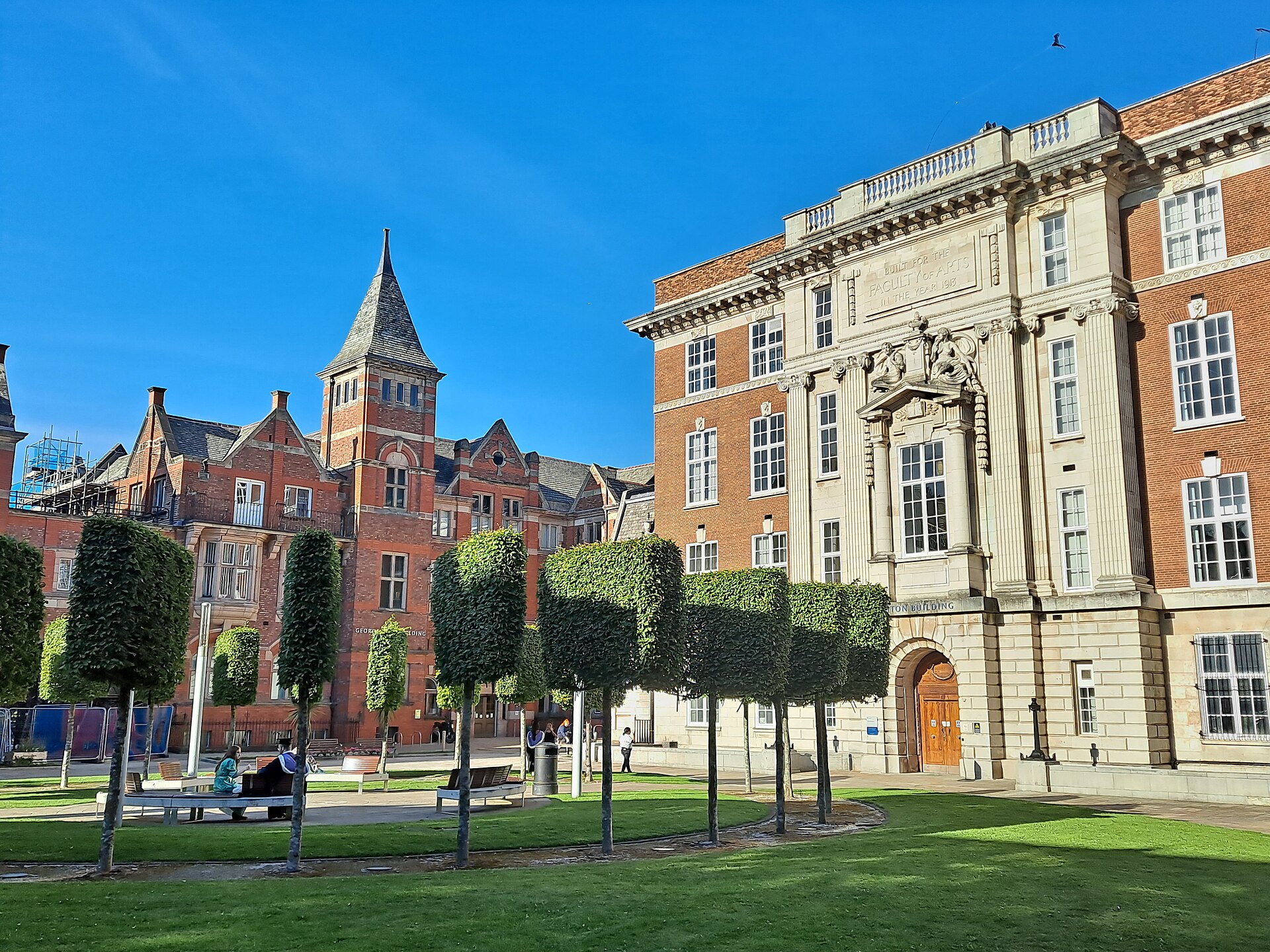

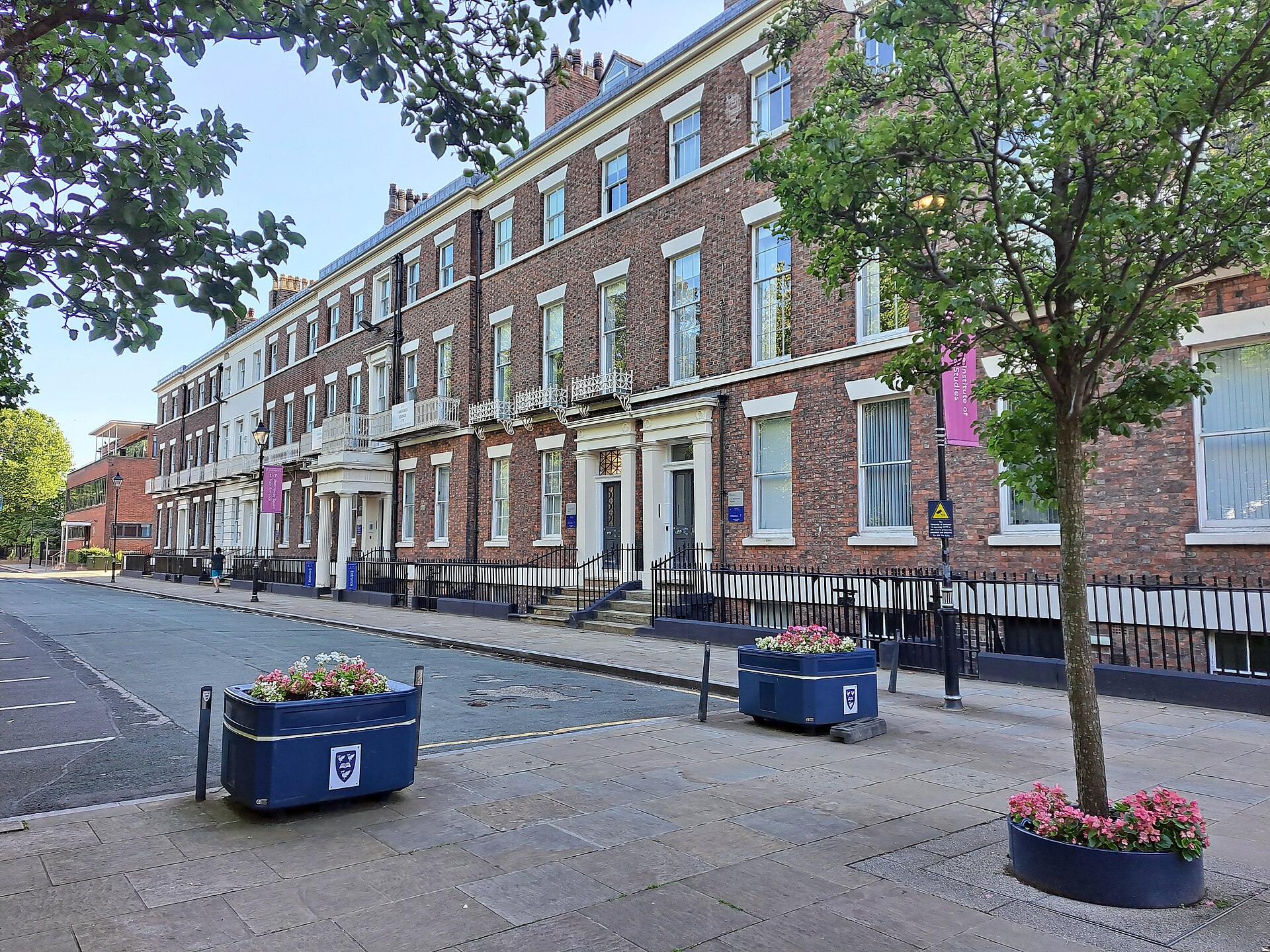

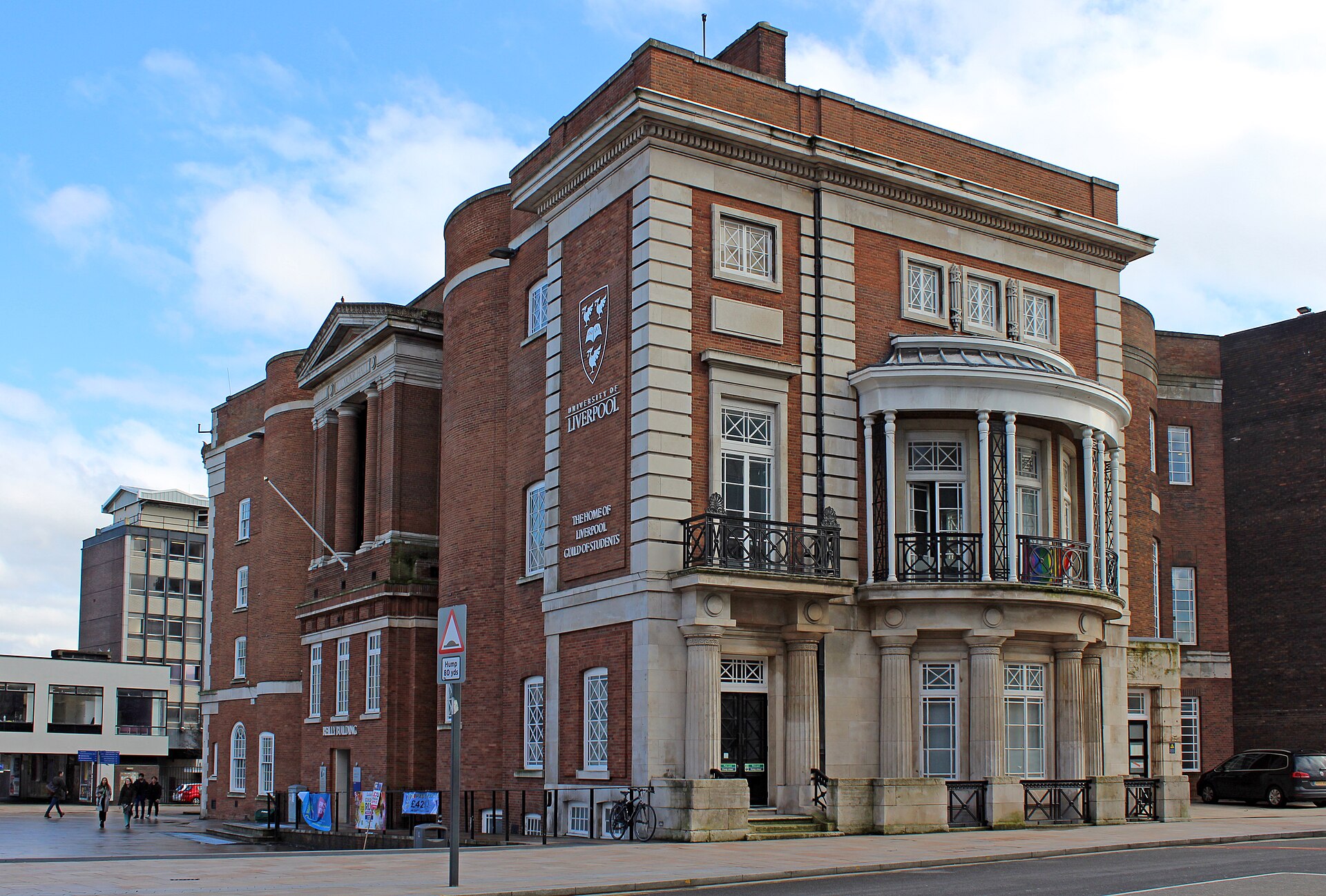
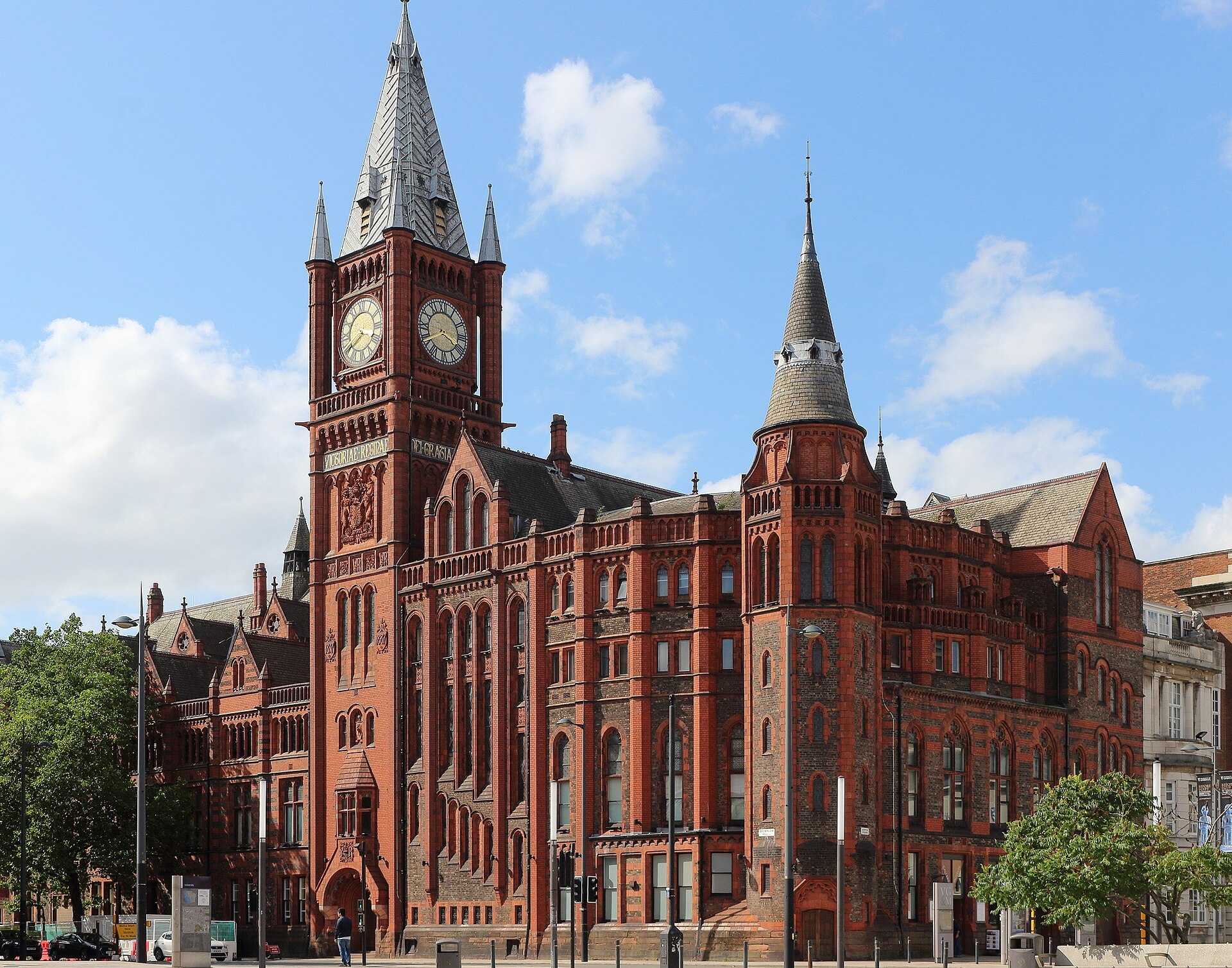
WHY LIVERPOOL
Why Choose the University of Liverpool
Liverpool is not just a great university — it is a great university in a great city. As a Russell Group institution with a proud civic mission, it combines research intensity with genuine student focus, giving international students the academic credentials and personal development opportunities they need to compete globally.
SELECTIVITY
Acceptance Rate & Admissions Profile
The University of Liverpool is accessible to strong international students while maintaining meaningful academic standards through its Russell Group membership. Admission is primarily based on predicted or achieved grades in A-Levels, IB, or equivalent international qualifications, with each programme setting its own entry requirements.
Acceptance rates vary dramatically by programme. Medicine, Veterinary Science, Dentistry, and Architecture are far more competitive than the overall institutional rate suggests. Always check the individual course page for entry requirements.
AT A GLANCE
University of Liverpool Quick Facts
APPLICATION COMPONENTS
What Your Application Must Include
All international undergraduate applicants apply through UCAS (Universities and Colleges Admissions Service). The application is a holistic package — academic qualifications are central, but your personal statement, reference, and English language proof all contribute.
WHAT LIVERPOOL SEEKS
The Profile Liverpool Wants to Admit
Liverpool's admissions philosophy is rooted in academic merit and potential. As a Russell Group university with a strong civic mission, it values students who have the intellectual rigour to thrive in demanding programmes while contributing to the wider university community.
For most programmes, strong predicted or achieved grades in your chosen subjects are the primary criterion. For highly competitive programmes like Medicine, Veterinary Science, and Law, Liverpool looks at a fuller picture: work experience (especially in healthcare for Medicine/Vet), motivation for the subject demonstrated through your personal statement, performance in admissions tests, and sometimes a formal interview.
KEY DATES
Application Deadlines & UCAS Timeline
All undergraduate applications go through UCAS. Deadlines are set by UCAS, not by individual universities. Missing a deadline does not mean you cannot apply — UCAS Extra and Clearing provide additional routes — but applying by the main deadline maximises your options.
Deadlines listed are for a typical UCAS cycle — confirm the exact dates for your entry year at ucas.com. International students should begin their application well before the January deadline to allow time for transcript requests, English language testing, and reference coordination.
| Route | Deadline | Notes |
|---|---|---|
| Medicine, Dentistry, Veterinary Science | 15 October | UCAS early deadline — applies to all UK universities for these courses |
| Most undergraduate programmes | 29 January | Main UCAS deadline for equal consideration |
| UCAS Extra | February – July | If you applied to 5 choices and hold no offers; add one choice at a time |
| UCAS Clearing | July – October | If you don't hold an offer by results day; available places are listed in Clearing |
LIFE AT LIVERPOOL
Student Life in Liverpool City
Studying at Liverpool means living in one of the UK's most distinctive and affordable major cities — a place with genuine character, world-class cultural institutions, and a famously welcoming local community.
The university's campus sits in the heart of the city, close to the iconic waterfront, major museums, and the vibrant city centre. The Liverpool Guild of Students — one of the UK's largest students' unions — runs hundreds of clubs and societies, from academic and professional societies to sports clubs, performing arts groups, and cultural associations representing the university's many international communities.
CAREERS & OUTCOMES
Graduate Outcomes & Career Prospects
Liverpool graduates are in strong demand — the university ranks 20th in the UK among institutions most targeted by top employers (High Fliers Graduate Market Report 2026). The Careers and Employability service works with students from Year 1 to build the skills and connections that lead to successful careers.
Strong graduate outcomes are particularly notable in medicine and clinical sciences (NHS trust placements, international health roles), engineering and technology (major infrastructure and energy employers), business and management (graduate schemes with FTSE 100 companies), and law (bar and solicitor pathways). Liverpool's global alumni network — spread across over 180 countries — provides meaningful professional connections for international graduates returning home.
COMMON QUESTIONS
Frequently Asked Questions
Do I apply directly to the University of Liverpool or through a central system?+
All undergraduate applicants — UK and international — apply through UCAS (ucas.com). You can apply to up to five universities in one application. Liverpool's UCAS code is L41. Postgraduate applicants apply directly through the university's online portal.
Is the University of Liverpool part of the Russell Group?+
Yes. Liverpool is a founding member of the Russell Group, the association of 24 leading UK research universities. This membership is a significant quality signal to employers and graduate schools worldwide.
What A-Level / IB grades do I need?+
Entry requirements vary significantly by programme. A typical IB requirement is around 33 points, but Medicine, Veterinary Science, and other highly competitive programmes require considerably higher. Always check the specific requirements on the individual course page at liverpool.ac.uk.
Is there financial support available for international students?+
Yes. Liverpool offers the Liverpool Scholarships programme, which can provide up to £7,500 for eligible undergraduate international students. Additional funding may be available through country-specific awards. Contact the Fees and Funding team to understand what you might be eligible for.
What English language score do I need?+
Most courses require IELTS 6.5 overall (with no band below 6.0), TOEFL iBT 88, or Duolingo English Test 120. Some courses — particularly Medicine, Law, and Education — require higher scores. Check your specific course requirements, and note that Liverpool also offers pre-sessional English programmes.
Is Liverpool a good city for international students?+
Consistently yes. Time Out named Liverpool the 7th best city in the world in 2024. It offers excellent cultural life, affordable student costs compared to London, a warm local culture, and a large and active international student community of approximately 8,000 students from 135 countries.
Can I work during my studies?+
International students on a UK Student visa are typically permitted to work up to 20 hours per week during term time and full time during official vacations. Always check current UK Home Office rules, as visa conditions can change.
Does Liverpool offer foundation programmes for international students?+
Yes. Foundation programmes and pathway courses are available for international students who do not yet meet direct entry requirements. These are offered in partnership with specialist pathway providers and lead to guaranteed or conditional progression to the relevant undergraduate degree.
ACADEMIC STANDARDS
Academic Expectations for International Applicants
Liverpool sets clear, programme-specific academic entry requirements for international students. As a Russell Group university, it expects genuine academic preparation — strong grades in relevant subjects, appropriate qualifications, and evidence that you are ready to operate at university level. Understanding how your international qualifications are assessed is the first step to a competitive application.
ACADEMIC BENCHMARKS
Typical Academic Entry Benchmarks
The following benchmarks reflect typical offers. Many competitive programmes — especially Medicine, Veterinary Science, Law, and Architecture — require grades above these typical thresholds. Always verify on the specific course page.
TEST POLICY
Standardised Tests — Liverpool's Approach
The University of Liverpool operates a test-optional policy for standardised tests such as SAT and ACT. These tests are not required and are not a primary admissions criterion for international undergraduate applicants. Liverpool is a qualification-based admissions system: A-Levels, IB, and equivalent national qualifications are the primary evidence of academic readiness.
If you have strong SAT or ACT scores, you may include them in your application as supplementary evidence, but they will not substitute for meeting the grade requirements in your primary qualifications. For UK university admissions, your predicted or achieved grades in your national qualification carry the most weight.
UCAT (University Clinical Aptitude Test) is required for Medicine applicants and is a separate, mandatory admissions test — not optional. Research your specific programme for any required tests.
SAT / ACT
Standardised Tests — Context for UK Admissions
UK university admissions, including Liverpool, are primarily qualification-based rather than test-based. The following context helps US-curriculum and international students understand how standardised tests factor in.
IB, A-LEVELS & AP
How Liverpool Reads International Qualifications
Liverpool has clear processes for assessing the most common international qualifications. Understanding how your specific qualifications map to UK entry requirements is essential.
SUBJECT PREPARATION
Academic Preparation by Discipline
Liverpool's degree programmes have specific subject requirements. Here is what to expect across the major discipline groups — confirm exact requirements on the individual course page.
ENGLISH LANGUAGE
English Language Requirements
If English is not your first language, you must demonstrate English language proficiency. Requirements vary slightly by programme — always check your specific course.
Clinical and professional programmes (Medicine, Dentistry, Law) often require IELTS 7.0 or above with specific sub-score requirements. Confirm on your specific course page.
| Test | Minimum | Notes |
|---|---|---|
| IELTS Academic | 6.5 overall | No individual band below 6.0 (some courses require higher) |
| TOEFL iBT | 88 | Some courses require higher sub-scores |
| Duolingo English Test | 120 | Accepted for most programmes — verify for professional courses |
| Pre-Sessional English | Varies | Available if you narrowly miss the requirement; completes before term starts |
YEAR-BY-YEAR PLAN
Building a Competitive Profile for Liverpool
A strong Liverpool application for international students is built steadily over Years 9–13. Here is a practical roadmap.
COMMON PITFALLS
Academic Mistakes to Avoid
- Not checking the specific subject requirements for your course — the institutional IB typical offer is 33 points, but Medicine may require 36–38+ with specific HL subjects.
- Underestimating the UCAT: many strong academic students apply to Medicine without sufficient UCAT preparation, resulting in rejection despite good grades.
- Applying with an English test score that meets the general university threshold but not the higher threshold required by your specific programme.
- Missing the 15 October UCAS deadline for Medicine, Dentistry, and Veterinary Science — this deadline is non-negotiable.
- Not researching whether your specific national qualification is directly accepted or needs a foundation year — contact Admissions before applying.
- Neglecting to arrange work or volunteering experience for clinical programmes — Liverpool specifically looks for this in Medicine and Veterinary Science personal statements.
- Applying to Architecture without a portfolio — failing to prepare and submit creative work alongside academic qualifications will result in rejection regardless of grades.
- Leaving English language testing too late — some tests have limited booking slots, and results may take 2–3 weeks to arrive after testing.
FEES & FUNDING
Understanding the Cost of Studying at Liverpool
As an international student, you will pay international tuition fees, which are set separately from UK domestic fees. While Liverpool is not among the cheapest UK universities to attend, it is considerably more affordable than studying in the USA or Australia at a comparable level of institution. The city of Liverpool significantly lowers your overall cost of living compared to London-based universities.
ANNUAL COSTS
Cost Breakdown (Annual Estimates)
The figures below are annual estimates in USD for planning purposes. Actual tuition is set in GBP — convert at the current exchange rate for precise figures. Tuition varies by programme; science and clinical programmes typically cost more than arts or humanities.
Liverpool is one of the UK's most affordable major student cities. Accommodation, food, and entertainment are substantially cheaper than London, Edinburgh, or Bristol, making your real cost of attendance considerably lower than the total cost of living at a comparable London institution.
| Item | Annual Usd | Notes |
|---|---|---|
| International tuition (approximate) | $28,400 | Varies by programme; verify for your specific course |
| Cost of living (Liverpool) | $14,000 | Accommodation, food, transport, personal expenses |
| Estimated total cost of attendance | $45,000 | Including tuition, living, books, and personal costs |
| Application fee | $0 | No application fee (UCAS charges a separate small fee) |
FINANCIAL AID
Financial Aid for International Students
Financial aid for international undergraduate students at UK universities operates very differently from the US model. There is no institutional 'need-blind' financial aid for international students in the UK. Support takes the form of merit scholarships and, in some cases, partial fee waivers.
The Liverpool Scholarships programme is the primary source of institutional funding for international undergraduate students, providing merit-based awards of up to £7,500. This is a partial scholarship — it reduces the total cost but does not cover full tuition. Most international students at Liverpool fund their studies through a combination of family savings, home-country government scholarships, and part-time work during term time.
SCHOLARSHIPS
Named Scholarships & Funding Opportunities
The following are known funding opportunities for international students at Liverpool. Scholarship programmes can change — verify current availability and award amounts on the Liverpool website before applying.
REAL COST
Affordability in Context
Liverpool is often cited as one of the best-value destinations for UK university study. Here is the honest picture for international students.
Compared to London universities of equivalent or lower ranking, Liverpool offers substantially lower accommodation and living costs. Student-specific accommodation in Liverpool typically costs less per week than comparable London housing, and everyday expenses — food, transport, entertainment — are proportionally lower. The financial trade-off is that UK universities, unlike top US private universities, generally do not offer generous need-based aid to international students. If you are comparing Liverpool against a well-endowed US liberal arts college that offers substantial international aid, the net cost picture may differ significantly.
Liverpool does offer a pre-sessional English programme for students whose English score is close but not yet at the required level. Factor this into your cost planning if it applies to you — it typically adds one term of additional fees before your degree starts.
HOW TO APPLY FOR FUNDING
Steps to Secure Your Funding
COST FAQS
Frequently Asked Funding Questions
Is there need-based financial aid for international students at Liverpool?+
UK universities, including Liverpool, do not operate a US-style need-blind or need-based financial aid system for international undergraduates. Support is primarily through merit scholarships. If financial need is a significant factor, also research your home government's scholarship programmes and external awards like Chevening.
How much can I expect in merit scholarship support?+
Liverpool's international scholarship programme offers up to £7,500 for eligible undergraduate students. This is a partial award — it does not cover full tuition. The exact amount depends on your academic profile and which scholarship tier you qualify for.
Is Liverpool more affordable than London universities?+
Yes, significantly. Liverpool's cost of living — accommodation, food, transport, entertainment — is substantially lower than London. For two students at universities of similar ranking, the one in Liverpool will spend notably less on living costs over a three-year degree.
Can I work during my studies to cover costs?+
Yes. International students on a UK Student visa can typically work up to 20 hours per week during term time and full time during official university vacations. Part-time work can supplement your income but should not be relied upon as a primary funding source.
Is there a UCAS application fee?+
Liverpool itself charges no application fee. UCAS charges a small service fee for its application system — check the current UCAS fee on ucas.com, as it is updated periodically.
When should I apply for Liverpool scholarships?+
Scholarship applications for incoming students typically open after you receive your offer. Monitor the Liverpool international pages closely once you have applied and check your email regularly, as offer letters often contain scholarship application information.
UCAS PERSONAL STATEMENT
The UCAS Personal Statement — Your Voice in the Application
The University of Liverpool, like all UK universities, evaluates international applicants through the UCAS application system. From 2026 entry, UCAS has introduced a new three-question personal statement format, replacing the traditional open-text essay. Your personal statement is the only part of your application where you speak directly to the admissions team — it must demonstrate genuine motivation for your subject and readiness to study it at university level.
THE UCAS SYSTEM
How the UCAS Application Works for Liverpool
Unlike US university applications, there are no separate supplemental essays written for each university. You write ONE personal statement (in three structured sections from 2026) and submit it to up to five universities simultaneously through UCAS. Liverpool, along with all your other choices, sees exactly the same personal statement.
This means your personal statement cannot be tailored to Liverpool specifically — it must make a compelling case for why you want to study your chosen subject, regardless of which university ultimately offers you a place. The subject matters far more than the institution. Liverpool's admissions team is reading to understand: Have you genuinely engaged with this discipline? Do you have the academic preparation to succeed? Do you understand what the degree demands?
Liverpool does not conduct interviews for most programmes. Medicine and Veterinary Science are exceptions — shortlisted applicants are typically called for interview as part of the selection process.
THE PROMPTS
The 2026 UCAS Three-Question Personal Statement Format
From 2026 entry, UCAS replaced the single open personal statement with a structured three-question format. All applicants answer the same three questions. This is a significant change — the content you write is the same in substance, but the structure is now guided.
STRATEGY
How to Approach Your UCAS Personal Statement
The shift to three questions in 2026 is actually an opportunity. The structure forces you to be organised and specific, rather than writing a sprawling essay that tries to say everything. Here is how to think about it.
The entire personal statement (across all three questions) has a character limit. This means every sentence must earn its place. Avoid spending lines on your background, your school, or generic statements about the importance of your subject. The admissions reader at Liverpool has read hundreds of statements — they want to see the specific intellectual depth of this particular applicant, not a polished-sounding but generic narrative.
Because your statement goes to all five of your UCAS choices simultaneously, do not name any university in the text. Write as if you are explaining your passion for the subject and your preparation to any serious academic reader.
PROGRAMME-SPECIFIC ADVICE
Programme-Specific Personal Statement Strategy
The content of your personal statement must be calibrated to your specific programme. Here is what Liverpool's admissions team will prioritise for major subject areas.
TOPIC & CONTENT GUIDANCE
What to Write About — and What to Avoid
The most common failure in UCAS personal statements is writing what the student thinks sounds impressive, rather than writing what is true and specific about them. Here is how to choose the right content.
COMMON MISTAKES
Personal Statement Mistakes to Avoid
- Opening with a cliché — 'Ever since I was young, I have been fascinated by...' is one of the most common and immediately forgettable openings in UCAS statements.
- Writing about extracurricular activities that are not relevant to the subject — this is a UK statement, not a US application. Academic motivation is primary.
- Being generic about work experience — describing what you did is far less useful than reflecting on what you observed, what it challenged or confirmed for you, and how it developed your thinking.
- Failing to demonstrate independent reading or engagement beyond the school curriculum — university admissions tutors want to see students who pursue their intellectual interest outside the classroom.
- Naming a university in the statement — your statement is sent to all five choices simultaneously; mentioning Liverpool (or any other university) would be immediately visible to the others.
- Writing a statement that would work for any subject — the best statements could only have been written about the specific subject being applied for.
- Submitting without multiple rounds of feedback from a teacher, counsellor, or advisor who is familiar with UK university admissions.
- Leaving drafting to the last minute — a strong UCAS personal statement typically takes 6–10 weeks of drafting, feedback, and revision to reach submission quality.
PERSONAL STATEMENT FAQS
Frequently Asked Questions
Does Liverpool give me specific writing prompts or essay questions beyond UCAS?+
No. For most programmes, your application consists of the UCAS form including the three-question personal statement. There are no Liverpool-specific supplemental essays. Medicine and Vet Science applicants may face an interview, but there is no separate written component.
Is the UCAS personal statement different in 2026 from previous years?+
Yes, significantly. From 2026 entry, UCAS moved from a traditional open-text personal statement to a three-question structured format. If you are applying for 2026 entry or later, you will answer three specific questions rather than writing a single open essay. Check ucas.com for the current format details.
Does Liverpool read personal statements carefully, or are grades all that matter?+
For most programmes, grades are the primary filter, but the personal statement matters significantly for borderline applicants and for competitive programmes like Medicine and Veterinary Science where academic credentials alone do not differentiate candidates sufficiently.
Will I have an interview at Liverpool?+
Most programmes do not include an interview. Medicine and Veterinary Science are the primary exceptions — shortlisted applicants are typically invited to attend an in-person or online interview. Some other programmes, including Architecture, may involve a portfolio review or informal conversation.
Can I ask a TYCHR counsellor to help with my personal statement?+
Yes. TYCHR counsellors are experienced with UK university applications and UCAS personal statements. Given how much is riding on a single document that goes to all five of your university choices simultaneously, professional guidance during the drafting process is strongly advisable.
How long should my personal statement be?+
UCAS imposes character limits on the three-question format — check ucas.com for the exact limits for your entry year. In general, be as specific and concise as possible. Quality and specificity matter far more than length.
What if English is not my first language — will my writing style be judged?+
Admissions tutors understand that international applicants may not be native English speakers. Your writing needs to be clear and coherent, not literary. Focus on the substance — your ideas, your evidence, your reflection — rather than attempting overly complex prose. Clear, direct writing is more effective.
Courses — schools, degrees & intake
84 degrees across 19 groupings.
School of Medicine · 1 degrees
Medicine and Surgery (MBChB)
School of Dentistry · 2 degrees
Dental Surgery (BDS)
Dental Therapy (BSc Hons)
School of Health Sciences · 6 degrees
Nursing (BN Hons)
Physiotherapy (BSc Hons)
Occupational Therapy (BSc Hons)
Diagnostic Radiography (BSc Hons)
Therapeutic Radiography and Oncology (BSc Hons)
Orthoptics (BSc Hons)
School of Pharmacy and Biomolecular Sciences · 2 degrees
Pharmacy (MPharm)
Pharmacology (BSc Hons)
Institute of Infection, Veterinary and Ecological Sciences · 2 degrees
Veterinary Science (BVSc)
Bioveterinary Science (BSc Hons)
Institute of Systems, Molecular and Integrative Biology · 7 degrees
Biological Sciences (BSc Hons)
Biomedical Sciences (BSc Hons)
Biochemistry (BSc Hons)
Anatomy and Human Biology (BSc Hons)
Marine Biology (BSc Hons)
Microbiology and Infection (BSc Hons)
Zoology (BSc Hons)
School of Engineering · 7 degrees
Aerospace Engineering (BEng Hons)
Civil Engineering (BEng Hons)
Mechanical Engineering (BEng Hons)
Electrical and Electronic Engineering (BEng Hons)
Architectural Engineering (BEng Hons)
Mechatronics and Robotic Systems (BEng Hons)
Product Design Engineering (BEng Hons)
Department of Computer Science · 7 degrees
Computer Science (BSc Hons)
Artificial Intelligence (BSc Hons)
Computer Science with Software Development (BSc Hons)
Computer Science and Electronic Engineering (BEng Hons)
Financial Computing (BSc Hons)
Mathematics and Computer Science (BSc Hons)
Game Design (BSc Hons)
Department of Mathematical Sciences · 8 degrees
Mathematics (BSc Hons)
Actuarial Mathematics (BSc Hons)
Applied Mathematics (BSc Hons)
Mathematics and Statistics (BSc Hons)
Mathematics and Economics (BSc Hons)
Mathematics with Finance (BSc Hons)
Climate Science (BSc Hons)
Mathematics and Philosophy (BA Hons)
Department of Physics · 4 degrees
Physics (BSc Hons)
Astrophysics (MPhys Hons)
Theoretical Physics (MPhys Hons)
Mathematical Physics (MMath Hons)
Department of Chemistry · 1 degrees
Chemistry (BSc Hons)
Department of Earth, Ocean and Ecological Sciences · 2 degrees
Geology (BSc Hons)
Environmental Geoscience (BSc Hons)
School of Law and Social Justice · 5 degrees
Law (LLB Hons)
Law with Business (LLB Hons)
Law with Criminology (LLB Hons)
Law with Philosophy (LLB Hons)
Law with Politics (LLB Hons)
School of Management · 7 degrees
Business Management (BA Hons)
Accounting and Finance (BSc Hons)
Economics (BA Hons)
Business Economics (BA Hons)
Marketing (BA Hons)
International Management (BA Hons)
Finance and Data Analytics (BSc Hons)
School of the Arts · 6 degrees
Architecture (BA Hons)
Architecture Design Studies (BA Hons)
Urban Planning (BA Hons)
Music (BA Hons)
Popular Music (BA Hons)
Music and Technology (BA Hons)
School of Histories, Languages and Cultures · 8 degrees
History (BA Hons)
Ancient History (BA Hons)
English (BA Hons)
French (BA Hons)
German (BA Hons)
Hispanic Studies (BA Hons)
Italian (BA Hons)
Modern Languages (BA Hons)
Department of Sociology, Social Policy and Criminology · 2 degrees
Sociology (BA Hons)
Criminology (BA Hons)
Department of Politics and Communication · 6 degrees
Politics (BA Hons)
International Relations (BA Hons)
Philosophy, Politics and Economics (BA Hons)
Philosophy (BA Hons)
Communication and Media (BA Hons)
Film Studies (BA Hons)
Department of Psychology · 1 degrees
Psychology (BSc Hons)
Want your real chances at University of Liverpool?
Create a free TYCHR account for your personalised admit-chance, a shortlist you can track, exact entry requirements, and essay + counselling help.