University of Florida
Gainesville, United States · Suburban
UNIVERSITY OF FLORIDA ADMISSIONS GUIDE
University of Florida Admissions Guide for International Students
The University of Florida — Florida's flagship AAU research university — offers an exceptional combination of academic depth, research scale, and affordability that is rare among top-30 public universities. Founded in 1853 and home to 55,000 students across 16 colleges in Gainesville, UF spans everything from a major academic health centre and one of the nation's leading agricultural research networks to a nationally recognised engineering school and a top-10 journalism programme.
For international students, UF presents a compelling case: a university ranked #30 nationally (US News), #4 among public universities by Forbes, and #155 globally (THE), offering out-of-state tuition that is meaningfully lower than most peer institutions. With an acceptance rate of 24%, UF is selective but not ultra-competitive — the achievable target for a strong international student who presents a well-rounded, genuine application.
Campus
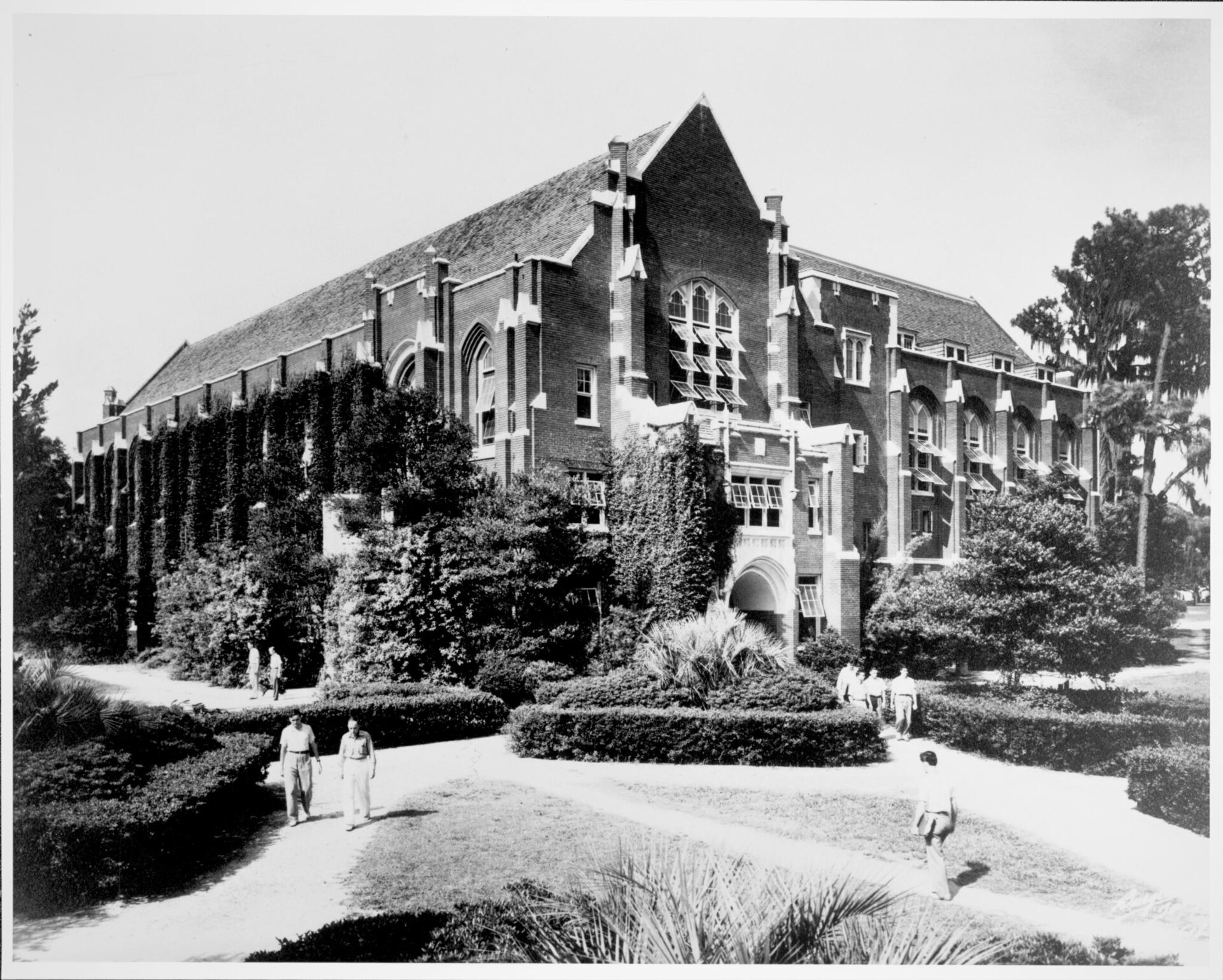
University of Florida — campus in pictures
Real, freely-licensed photographs of the campus (via Wikimedia Commons).





WHY UNIVERSITY OF FLORIDA
Why Choose UF — Value, Research, and the Gator Network
UF is one of only two Florida universities in the Association of American Universities — an invitation-only consortium of the top 64 research universities in North America. Its combination of academic prestige, research infrastructure, and relatively accessible tuition makes it the most cost-effective elite public university in the American South.
SELECTIVITY
UF Acceptance Rate — Selective but Achievable
With an acceptance rate of 24%, the University of Florida sits at the competitive-but-accessible end of the top-30 public university spectrum. Unlike flagship publics that admit under 15% of applicants, UF remains reachable for international students who present strong academics, genuine engagement, and a well-crafted application.
UF conducts a holistic admissions review. All freshman applicants — domestic and international — receive equal, uniform comprehensive review irrespective of their secondary curriculum origin or citizenship. Academic preparation (GPA and course rigour), standardised test scores, extracurricular engagement, and essays all factor into decisions. For international students, the credential evaluation process is an additional step: non-US transcripts must be submitted with a certified translation and a course-by-course credential evaluation from a NACES member agency.
QUICK FACTS
University of Florida — At a Glance
WHAT YOUR APPLICATION INCLUDES
The UF Application — Components for International Students
UF uses the Common App platform. International applicants submit the same application as all other freshmen, with additional requirements for non-US credentials. Plan ahead: international transcript processing takes longer than domestic, and UF recommends applying well in advance of stated deadlines.
ADMISSIONS PROFILE
What UF Looks For — The Profile They Admit
UF conducts holistic admissions review — academic record and test scores are primary, but the full picture of who you are and what you will contribute to the campus matters. UF is one of the few selective public universities that explicitly states all applicants receive equal review regardless of citizenship or curriculum origin.
The minimum GPA benchmark for competitive consideration is 3.6 (on a 4.0 scale), and UF expects to see the most rigorous curriculum available to you — IB Diploma, A-Levels, AP courses, or the highest-level tracks at your school. Below the academic floor, no other part of the application compensates. Above it, the essay, activities, and character of your application differentiate you.
APPLICATION DEADLINES
UF Application Rounds — Dates and Decision Timeline
UF offers three application pathways. Early Decision is binding — you commit to enroll if admitted. Early Action and Regular Decision are both non-binding. International students should apply well before the stated deadline to allow time for international credential processing.
All official test scores must be submitted by May 1. All official transcripts must be submitted by July 1. International applicants are strongly advised to apply as early as possible to accommodate international credential processing time.
| Round | Deadline | Materials | Decision | Confirm |
|---|---|---|---|---|
| Early Decision (Binding) | 15 Oct | 22 Oct | 11 Dec | 8 Jan |
| Early Action (Non-Binding) | 1 Nov | 8 Nov | 22 Jan | 1 May |
| Regular Decision (Non-Binding) | 15 Jan | 22 Jan | 19 Mar | 1 May |
LIFE AT UF
Student Life at UF — Gainesville and the Gator Experience
The University of Florida delivers the quintessential large American public university experience: a self-contained campus city in Gainesville with enormous school spirit, Division I SEC athletics, hundreds of student organisations, and a campus culture that is welcoming, energetic, and socially rich.
Gainesville is a university town — meaning student life, local restaurants, arts, and culture revolve around UF. The city is affordable by American standards, warm year-round given Florida's climate, and an hour's drive from both the Gulf Coast and Atlantic beaches. On campus, the Ben Hill Griffin Stadium (nicknamed 'The Swamp') and the culture of Gators football create a communal energy unlike anything in urban university settings. For international students, this combination of a tight-knit campus community and easy access to Florida's broader geography is distinctive. UF has over 1,000 registered student organisations. The International Center supports international student transition, immigration advising, and cultural programming. Housing in first-year residence halls puts new students at the centre of social life immediately.
CAREER OUTCOMES
What Happens After UF — Outcomes and the Gator Network
UF graduates enter the workforce with strong placement rates and one of the most active alumni networks of any US public university. With 92% employment or graduate school placement within six months of graduation and an average starting salary of $62,000, UF outcomes are competitive with more expensive peer institutions.
UF's strongest sector placements are in healthcare and life sciences (via UF Health and the Shands system), technology (particularly in Florida's growing tech corridor), business and finance, and government and public policy. The Heavener School of Business, Warrington College of Business, and the Herbert Wertheim College of Engineering are consistently among UF's highest-outcome programmes. For international students who gain US work authorisation, the Gator alumni network in Florida, New York, and nationally provides meaningful connections that translate to internships and full-time roles.
FREQUENTLY ASKED QUESTIONS
UF Admissions — FAQs for International Students
Does UF treat international applicants differently from domestic applicants?+
No. UF explicitly states that all freshman applicants receive equal, uniform comprehensive admission review irrespective of their secondary curriculum origin or citizenship. There is no separate international quota or different admissions bar. You are evaluated on the same holistic criteria as every other applicant.
Is UF test-optional for international students?+
No. UF requires test scores (SAT, ACT, or CLT) from all first-year applicants under Florida state regulations. This is not waivable. Plan your test preparation timeline accordingly — scores should ideally be in hand before your target application round deadline.
What credential evaluation does UF require for non-US transcripts?+
International transcripts not issued in English must be accompanied by a certified, word-for-word English translation. All international coursework requires a course-by-course credential evaluation with GPA calculation from a National Association of Credential Evaluation Services (NACES) member agency. This process takes time — begin it well before your application deadline.
Is an IB score of 36 competitive for UF?+
Yes — UF's published IB benchmark for competitive consideration is 36 points. Students significantly above this (38–42) are in a very strong position. Students below 36 with strong overall profiles are not automatically disqualified, but the lower your IB score the more every other element of your application needs to compensate.
Can international students receive financial aid at UF?+
International students are not eligible for US federal financial aid (FAFSA-based grants and loans). However, UF offers merit scholarships including the out-of-state tuition reduction scholarships that may be open to international students. Contact UF's Office of Student Financial Affairs directly to confirm current international eligibility for specific merit awards.
What is the UF Supplement and how long does it take?+
The UF Supplement is a set of short-answer questions completed within the Common App platform. It is required of all UF applicants. The questions are designed to help admissions staff learn more about you beyond grades and test scores. Allow several hours to draft, revise, and finalise your answers thoughtfully.
Should I apply Early Decision or Early Action to UF?+
Early Decision is binding — only apply ED if UF is your clear first choice and you have evaluated your financial options. Early Action is non-binding and gives you a decision by late January, which is useful for planning without commitment. For international students uncertain about financial packages, Regular Decision preserves the most flexibility. Neither EA nor ED provides a significant statistical admissions advantage at UF compared to some peers, but earlier application allows more time to resolve credential processing issues.
What English proficiency scores does UF require?+
UF's minimum English proficiency thresholds are: IELTS 6.5, TOEFL iBT 80, or Duolingo English Test 120. These are minimums — competitive applicants typically exceed them. Native English speakers and students who attended English-medium schools for several years may be exempt from these requirements; check with UF International Admissions for your specific situation.
ACADEMICS AT UF
Academic Expectations at UF — What International Students Should Know
The University of Florida spans 16 academic colleges offering over 300 degree programmes across virtually every discipline. For international students, understanding UF's academic profile means understanding both the admissions bar and the environment you will enter: a large, research-active flagship university where your outcomes are shaped significantly by how proactively you engage with faculty, research, and the broader campus ecosystem.
UF is a member of the Association of American Universities — a distinction reserved for North America's top 64 research universities. With $1.26 billion in annual research expenditure, undergraduates at UF have genuine access to research that at other universities is reserved for graduate students. The academic environment rewards students who seek out these opportunities rather than waiting for them to come.
ACADEMIC PROFILE
Admitted Student Academic Profile — Benchmarks from the Facts
UF's admitted class is academically strong across all metrics. Test scores are required at UF — unlike many peer institutions — which means the SAT/ACT range reflects a true picture of academic preparation rather than a self-selected subset.
TEST POLICY
UF's Test-Required Policy — What It Means for You
University of Florida requires standardised test scores (SAT, ACT, or CLT) from all first-year applicants under Florida state regulations. This is a non-negotiable requirement — unlike many peer universities that have adopted test-optional or test-blind policies, UF has not.
For international students, this means you must sit and score well on the SAT or ACT as part of your application preparation. There is no test-optional pathway, no waiver based on your curriculum type, and no exemption for IB or A-Level candidates. Treat test preparation as a required component of your UF application strategy, not an optional add-on. Scores may be self-reported on the application but must be submitted officially to UF by May 1 if you are admitted.
SAT AND ACT
Standardised Tests at UF — Strategy for International Applicants
UF's SAT middle 50% is 1310–1470 and ACT middle 50% is 29–33. Competitive applicants should aim for the upper half of these ranges — SAT 1420+ or ACT 32+ — to be well-positioned. Neither test is preferred over the other.
IB, A-LEVELS & AP
How UF Reads International Qualifications — IB, A-Levels, and AP
UF's admissions office reviews international qualifications through the lens of credential evaluation — your non-US transcript is assessed by a NACES-member agency for GPA equivalency. The IB Diploma is widely recognised and respected; A-Levels and national board curricula are equally valid.
UF's published IB competitive benchmark is 36 points. IB Diploma students with scores in the 36–42 range are considered competitive. Higher-level subjects in mathematics, sciences, or other analytically rigorous disciplines are viewed favourably, particularly for STEM, business, and health science programme applicants. A-Level students should present strong predicted and achieved grades — three A/A* grades at A-Level in relevant subjects signals strong preparation. UF does not publish specific A-Level thresholds, but strong A-Level candidates mirror the academic preparation of students scoring in the upper SAT/ACT range. AP credit: UF awards credit for AP scores of 3 or higher on most exams, allowing international students who have taken AP courses to place out of introductory requirements and access higher-level coursework sooner.
SUBJECT PREPARATION
Academic Preparation — What UF Expects by Major
UF expects to see you in the most rigorous version of the curriculum available to you. The specific subjects that matter most depend on your intended major — but certain foundations are expected across virtually all programmes.
ENGLISH PROFICIENCY
English Language Requirements — Minimums and Competitive Benchmarks
International students whose primary language is not English must demonstrate English proficiency through one of three standardised tests. These are minimum thresholds — competitive applicants typically exceed them.
Students who have completed four or more years of schooling in English as the primary language of instruction may be exempt from proficiency testing requirements. Contact UF International Admissions to confirm your specific eligibility.
| Test | Minimum | Notes |
|---|---|---|
| IELTS Academic | 6.5 Overall | No sub-score below 6.0 typically expected |
| TOEFL iBT | 80 | Total score across all four sections |
| Duolingo English Test | 120 | Increasingly accepted; confirm current status with UF |
GRADE 9 TO 12 ROADMAP
Building Your UF Profile — A Year-by-Year Ladder
UF is achievable for international students who plan deliberately. The admissions bar is high but not extreme — a student who builds consistently across all four years of secondary school is well positioned.
ACADEMIC PITFALLS
Common Academic Mistakes — What Weakens an International Application to UF
- Submitting without standardised test scores — UF requires them; there is no opt-out.
- Delaying your NACES credential evaluation — this is a required step that takes time; start early.
- Underestimating the GPA threshold — 3.6 is the floor, not the target; aim higher.
- Choosing a less rigorous curriculum to protect GPA — UF looks at both the grade and the course level.
- Waiting until Grade 12 to sit the SAT or ACT, leaving no time for retakes.
- Submitting a grade-11 transcript without the certified translation — all non-English documents must be translated.
- Assuming test-optional exemptions apply — UF does not offer test-optional pathways.
- Treating the UF Supplement as an afterthought — it is a required component that many applicants underinvest in.
COST AND FINANCIAL AID
The Cost of UF — Honest Framing for International Students
University of Florida is one of the most cost-effective top-30 public universities in the United States for international students. Out-of-state tuition of $28,700 per year is meaningfully lower than flagship peers like the University of Michigan ($55,000+), UCLA ($43,000+), or the University of Virginia ($54,000+). For international families, UF represents a genuine value proposition at a prestige level most peer universities cannot match at this cost.
That said, international students at US public universities are almost always classified as out-of-state for tuition purposes and are ineligible for US federal financial aid (FAFSA-based grants and loans). UF's financial aid for international students is primarily merit-based and not guaranteed. Plan your UF application with a clear-eyed financial analysis: the full cost of attendance is approximately $47,000 per year, and you will need to demonstrate sufficient funds to support your studies as part of your I-20 visa process.
ANNUAL COSTS
Estimated Annual Cost — What You Should Budget For
These are annual estimates for the 2025–26 academic year. Figures are from the university's published data — always verify current rates directly with UF for the academic year you will enrol.
Gainesville is one of the most affordable university towns in Florida — your personal cost of living can be meaningfully lower than the estimate above, particularly in off-campus housing after the first year.
| Component | Amount | Notes |
|---|---|---|
| Out-of-State Tuition & Fees | $28,700 | International students pay out-of-state rates |
| Room & Board (on-campus estimate) | ~$10,000–12,000 | Varies by housing option |
| Cost of Living (Gainesville) | $15,000 | Books, personal expenses, local transport |
| Total Cost of Attendance | $47,000 | UF's published annual estimate |
| Application Fee | $30 | Non-refundable; fee waivers available for qualifying students |
FINANCIAL AID
Financial Aid for International Students — What Is and Is Not Available
International students at UF are not eligible for US federal financial aid programmes (Pell Grants, Stafford Loans, FAFSA-based grants). Most state-funded Florida scholarships are also restricted to Florida residents or US citizens. UF's average aid award covers approximately 30% of costs — but this average is heavily weighted toward domestic students receiving state and federal aid.
For international students, UF's primary financial support routes are merit scholarships from the university and external scholarships from your home country or international foundations. UF does not meet full demonstrated financial need for international students. Before applying, evaluate whether you and your family can cover the full cost of attendance — you will need to demonstrate financial capacity for your I-20 student visa regardless. Contact UF's Office of Student Financial Affairs directly to ask about current aid availability for international students, as policies and funded award pools change year to year.
SCHOLARSHIPS
Scholarships Worth Knowing — Out-of-State and Merit Awards
UF offers several named merit scholarships that reduce out-of-state tuition costs. While most named UF scholarships are designed for domestic students, out-of-state merit scholarships may be accessible to international students. Confirm current international eligibility with UF Student Financial Affairs before factoring these into your planning.
NET PRICE REALITY
The UF Value Proposition — Why Affordability Matters Here
For international families, the true value of a US university is not its sticker price but the ratio of prestige, outcomes, and cost. UF sits in a particularly favourable position on this ratio: a Top-30 national university, an AAU research institution, a member of the SEC with enormous alumni network reach — at an out-of-state tuition rate of $28,700, roughly half to two-thirds of most comparable flagship publics.
Gainesville's cost of living reinforces this advantage. Florida's university town is significantly cheaper than university cities like Ann Arbor, Chapel Hill, Los Angeles, or Boston. Off-campus housing, food, and transport costs are all below the national average for college towns. A student who manages their personal budget carefully at UF can meaningfully reduce total annual costs below the $47,000 headline figure, particularly after the first year when on-campus housing is no longer required. The $62,000 average starting salary for UF graduates compares favourably when set against a total four-year investment closer to peers than the sticker price implies.
HOW TO FUND YOUR UF EDUCATION
Steps to Secure Funding — A Practical Guide for International Families
COST FAQS
Financial Questions — Answered for International Students
Can international students apply for FAFSA at UF?+
No. FAFSA (Free Application for Federal Student Aid) is available only to US citizens and eligible non-citizens. International students on F-1 visas are not eligible for FAFSA-based federal grants or loans. This is not specific to UF — it is a US federal policy that applies at every American university.
What is the total cost of four years at UF for an international student?+
Based on the published cost of attendance of approximately $47,000 per year, four years at UF totals approximately $188,000 before any scholarships or aid. This is a conservative estimate — personal costs vary and off-campus housing in later years can reduce the total.
Are any UF merit scholarships available to international students?+
Potentially yes — UF's out-of-state tuition reduction scholarships (including the Gator Nation Tuition Scholarship, Sunshine Scholarship, and Alumni Tuition Scholarship) may be accessible to international students. However, eligibility for international students should be confirmed directly with UF Student Financial Affairs, as policies can change.
How does UF compare to other US public universities on cost for international students?+
UF's out-of-state tuition of $28,700 is significantly lower than comparable flagship publics: University of Michigan charges $55,000+, UCLA $43,000+, and University of Virginia $54,000+. For a Top-30 national university, UF offers rare cost efficiency.
Does UF offer any need-blind admissions for international students?+
No. UF does not offer need-blind admissions for international students, nor does it meet 100% of demonstrated financial need for international applicants. Financial need may be a factor in admission decisions for international students — UF is need-aware for this population. Confirm the current policy with UF admissions.
What funds do I need to show for the student visa (I-20)?+
The I-20 form required for your F-1 student visa will specify the estimated cost of attendance. You will typically need to demonstrate access to at least one year's cost of attendance (approximately $47,000) in liquid funds through bank statements or financial guarantee letters. Visa documentation requirements may vary — confirm with UF's International Center.
ESSAYS AND WRITING
Essays at UF — Why They Matter in a Holistic Review
With an acceptance rate of 24%, UF admits a significant proportion of applicants — but the essay is still a meaningful differentiator, particularly among the large pool of applicants whose academic credentials (GPA, test scores) are similar. The Common App personal statement and UF Supplement together are your primary opportunity to show the admissions committee who you are, what you care about, and why UF.
For international students, the essays carry additional weight: they demonstrate English writing ability, cultural awareness, and the authentic voice that credential evaluations and test scores cannot capture. A student whose academic profile places them comfortably in the UF range can be separated from another similar student entirely by the quality and specificity of their written applications.
ESSAY OVERVIEW
How Many Essays and What System — Common App Plus the UF Supplement
UF uses the Common Application. The writing required consists of two main components: the Common App personal statement (your choice of prompt, up to 650 words) and the UF Supplement (a set of short-answer questions submitted through the Common App platform). Both are required of all applicants.
Students applying to the UF Honors Programme or Innovation Academy will need to complete additional programme-specific essays beyond these two standard components. If either programme is relevant to your interests, treat those additional essays as an integral part of your UF application, not an afterthought. Verify the exact current Supplement prompts on the UF admissions website before drafting — the specific short-answer questions may vary by cycle.
Source: admissions.ufl.edu/apply/freshman
ESSAY PROMPTS
Common App Personal Statement — The Seven Prompts
The Common App offers seven personal statement prompts. All carry equal weight — choose the one that allows you to write most authentically and specifically about yourself. UF explicitly asks that your essay tell them something they would not learn elsewhere in your application.
The Common App presents 7 prompts. Students choose ONE for their personal statement. Always verify current prompt text at commonapp.org before drafting — prompts occasionally change between cycles.
PERSONAL STATEMENT STRATEGY
Writing Your Common App Essay — Strategy for the Personal Statement
The Common App personal statement is 650 words. At UF, it is read as part of a holistic review that includes your grades, test scores, activity list, and supplement. It should not duplicate what is already visible in your application — it should add a new, distinctly human dimension.
For international students, the personal statement is an opportunity to write about the specific texture of your experience — not as a representative of your country, but as yourself. The biggest mistake international applicants make is writing an essay that explains their culture to an American reader, as if they are an ambassador rather than a student. Write for yourself. Write about something so specific to your individual experience that no one else could have written it. UF's admissions essay prompt is direct: 'tell us something about yourself that we wouldn't learn elsewhere in your application.' Take this literally. Do not restate your activities, your GPA story, or your family's admiration for education. Find the specific thing — a curiosity, a contradiction, a realisation — that is distinctly, undeniably yours.
Strong personal statements at UF are specific (named people, places, moments), show genuine reflection, and end somewhere meaningfully different from where they began. They are written in a natural, clear voice — not in the formal register of an academic essay.
UF SUPPLEMENT
The UF Supplement — Short Answers That Complete Your Profile
The UF Supplement is a required set of short-answer questions submitted through the Common App. The questions vary by cycle — verify the current prompts directly on UF's admissions website before drafting. These questions typically ask about your intended major, your specific interest in UF, and aspects of your background or interests not captured elsewhere.
TOPIC SELECTION
Choosing What to Write About — A Framework for International Applicants
Topic selection is the most consequential essay decision you will make. A brilliant essay on a weak topic underperforms. A specific, honest essay on an unexpected topic regularly outperforms polished essays on predictable subjects.
ESSAY MISTAKES
Essay Pitfalls to Avoid — What Weakens a UF Writing Application
- Writing a generic 'I am an international student therefore I value diversity' essay — UF reads thousands of these.
- Restating your activities and grades in essay form — the essay should add new information, not summarise what is already visible.
- Choosing a topic you think admissions committees want to read, rather than a topic that is genuinely yours.
- Writing in an overly formal or academic register — the personal statement is not a research paper; write in a natural, clear voice.
- Fabricating specificity — vague name-drops of research centres or faculty you have not actually researched read as hollow.
- Ignoring the UF Supplement in favour of the personal statement — both are required and both are read.
- Using every word of the 650-word limit when fewer words would be tighter and more powerful.
- Failing to have someone who writes well — a teacher, counsellor, or mentor — read and give honest feedback on your drafts.
- Writing the supplement before researching what UF actually offers in your area of interest — generic 'why UF' responses are immediately apparent.
- Submitting without proofreading for grammar and spelling — errors undermine otherwise strong essays.
ESSAY FAQS
Essay Questions — Answered for International Applicants
Does UF require supplemental essays in addition to the Common App personal statement?+
Yes. UF requires the UF Supplement — a set of short-answer questions — in addition to the Common App personal statement. Both are required of all applicants. Students applying to the Honors Programme or Innovation Academy complete additional programme-specific essays.
How important are essays compared to GPA and test scores at UF?+
At UF, academic credentials (GPA, test scores, course rigour) are the primary admissions factors — no essay compensates for academic performance below UF's threshold. However, among the large pool of academically qualified applicants, essays are a meaningful differentiator. They can be the deciding factor between candidates who are otherwise comparable.
Can I write in formal English even though it is not my first language?+
Yes, but aim for natural clarity rather than formal complexity. Admissions readers at US universities read for voice, authenticity, and ideas — not for academic formality. A clear, honest essay in simple, direct English almost always outperforms a stylistically complex essay that sacrifices clarity. If English is not your first language, have a trusted English-fluent reader review your drafts for naturalness.
Should I mention that I am an international student in my essays?+
Only if your international background or experience is genuinely material to what you want to say — not as a way to gain sympathy or explain context. Your application already makes clear you are an international student. The essay should reveal something specific about you as an individual, not as a category of applicant.
Where do I find the current UF Supplement prompts?+
Log in to the Common App (commonapp.org), add University of Florida as a college, and navigate to the Questions tab for that school. The current cycle's UF Supplement questions will be there. Do not rely on third-party sources for supplement prompts — they may be from a previous cycle.
Is there a word limit for the UF Supplement questions?+
Yes — each short-answer question in the UF Supplement has a specified word or character limit visible within the Common App. These limits vary by question. Respect the limits — exceeding them is disqualifying, and hitting them exactly is often not necessary. Write the strongest possible answer within the limit.
Can I reuse my UF essays for other US universities?+
The Common App personal statement is the same document submitted to all Common App schools, so no separate UF-specific version is required. The UF Supplement, however, is specific to UF — particularly any 'Why UF?' question. Do not reuse Why UF responses for other universities; the specificity required makes cross-application reuse obvious and counterproductive.
Courses — schools, degrees & intake
94 degrees across 12 groupings.
College of Agricultural and Life Sciences · 15 degrees
Agricultural Education and Communication (BS)
Agricultural Operations Management (BS)
Animal Sciences (BS)
Botany (BS)
Dietetics (BS)
Entomology and Nematology (BS)
Family, Youth and Community Sciences (BS)
Food and Resource Economics (BS)
Food Science (BS)
Forest Resources and Conservation (BSF)
Geomatics (BSGE)
Marine Sciences (BS)
Microbiology and Cell Science (BS)
Natural Resource Conservation (BSF)
Nutritional Sciences (BS)
College of Liberal Arts and Sciences · 29 degrees
African American Studies (BA)
Anthropology (BA/BS)
Astronomy and Astrophysics (BA/BS)
Biology (BA/BS)
Chemistry / Biochemistry (BS)
Classical Studies (BA)
Computer Science (BS)
Criminology (BA)
Data Science (BS)
Economics (BA)
English (BA)
French and Francophone Studies (BA)
Geography (BA/BS)
Geology (BA/BS)
History (BA)
Hispanic and Latin American Languages, Literatures and Linguistics (BA)
Interdisciplinary Studies (BA/BS)
International Studies (BA)
Linguistics (BA)
Mathematics (BA/BS)
Meteorology (BS)
Philosophy (BA)
Physics (BA/BS)
Political Science (BA)
Psychology (BA/BS)
Religion (BA)
Sociology (BA)
Statistics (BA/BS)
Environmental Science (BA/BS)
Herbert Wertheim College of Engineering · 15 degrees
Aerospace Engineering (BSAE)
Biological Engineering (BSBE)
Biomedical Engineering (BSBM)
Chemical Engineering (BSCH)
Civil Engineering (BSCE)
Computer Engineering (BSCO)
Computer Science (BSCS)
Digital Arts and Sciences (BSDA)
Electrical Engineering (BSEE)
Environmental Engineering (BSEN)
Industrial and Systems Engineering (BSIS)
Materials Science and Engineering (BSMS)
Mechanical Engineering (BSME)
Nuclear Engineering (BSNE)
Industrialized Construction Engineering (BSICE)
Warrington College of Business · 6 degrees
Accounting (BSAc)
Business Administration - General Studies (BABA)
Finance (BSBA-FIN)
Information Systems (BSBA-IST)
Management (BSBA-MGT)
Marketing (BSBA-MKG)
College of Journalism and Communications · 3 degrees
Advertising (BSAD)
Journalism (BSJ)
Media Production, Management, and Technology (BSTE)
College of Design, Construction and Planning · 4 degrees
Architecture (BDES)
Interior Design (BDES)
Landscape Architecture (BLAE)
Construction Management (BSCM)
College of the Arts · 11 degrees
Art History (BAHA)
Art (BA)
Art (BFA)
Graphic Design (BFAG)
Music (BA)
Music (Bachelor of Music)
Music Business and Entrepreneurship (BS)
Music Education (BMusEd)
Dance (BA)
Dance (BFA)
Digital Arts and Sciences (BA)
College of Education · 3 degrees
Early Childhood Education (BAE)
Education Sciences (BA)
Elementary Education (BAE)
College of Health and Human Performance · 2 degrees
Applied Physiology and Kinesiology (BSAP)
Health Education and Behavior (BSHE)
College of Public Health and Health Professions · 2 degrees
Communication Sciences and Disorders (BHS)
Health Science (BHS)
College of Nursing · 1 degrees
Nursing (BSN)
Hamilton Honors College · 3 degrees
American Government, History, Literature, and Law (BA)
Great Books and Ideas (BA)
Philosophy, Politics, Economics, and Law (BA)
Want your real chances at University of Florida?
Create a free TYCHR account for your personalised admit-chance, a shortlist you can track, exact entry requirements, and essay + counselling help.