The University of Auckland
Auckland, New Zealand · Urban
NEW ZEALAND'S #1 UNIVERSITY
The University of Auckland — Admissions Guide for International Students
New Zealand's largest and most internationally connected university sits in the heart of one of the Pacific's most liveable cities. Ranked #65 globally by QS and #1 in New Zealand, the University of Auckland combines rigorous research with broad programme choice — making it the leading destination for ambitious international students who want a world-class degree, an English-speaking environment, and a gateway to the Asia-Pacific.
This guide is written for international students planning to apply to Auckland for undergraduate study. Admission is qualification-based — there are no mandatory application essays, no SAT/ACT requirements — so strategy means academic excellence, early applications, smart scholarship targeting, and meticulous attention to programme prerequisites. Read the full guide before you apply.
Campus
The University of Auckland — campus in pictures
Real, freely-licensed photographs of the campus (via Wikimedia Commons).

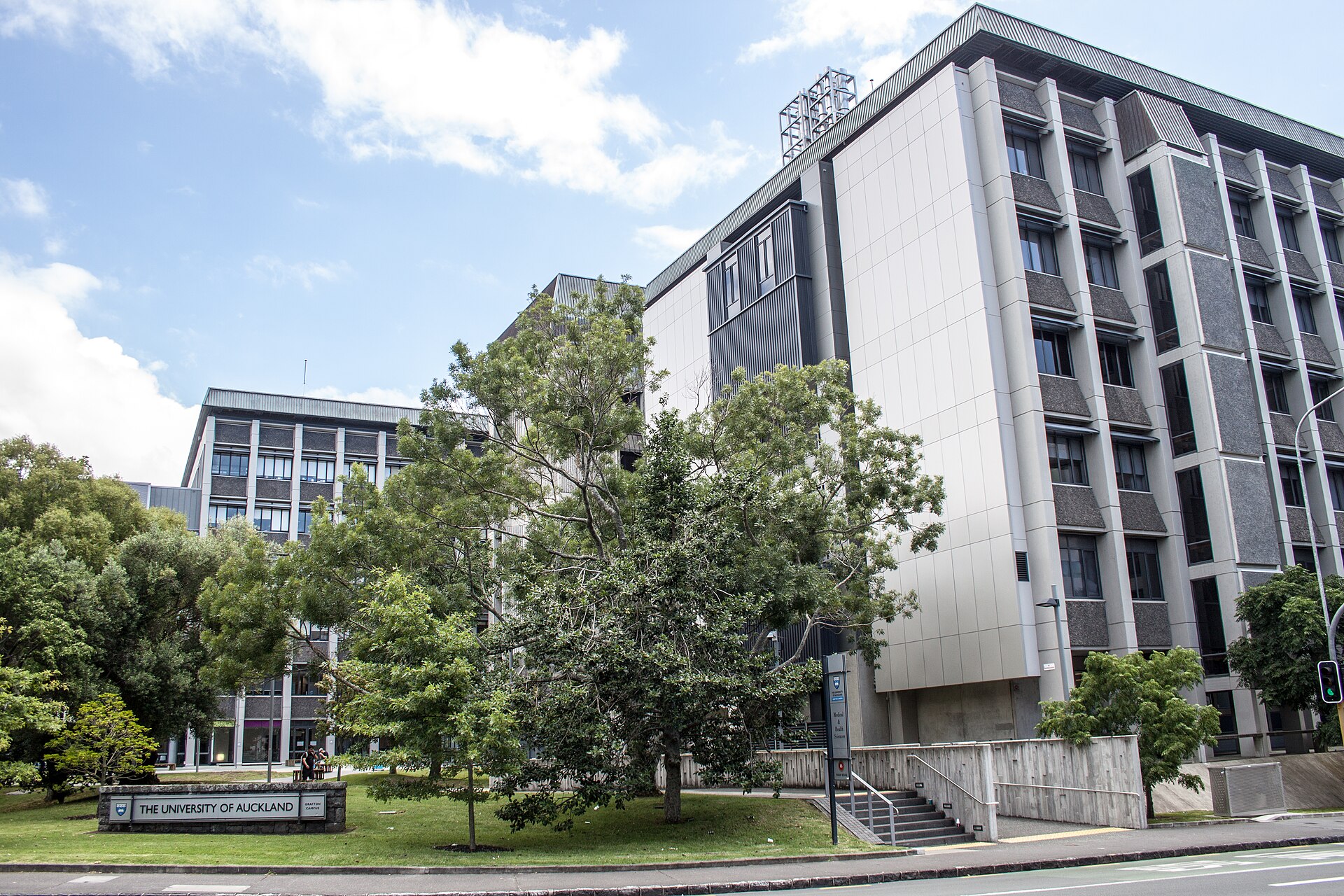




Why Auckland — Rank, Research, City & Career
The University of Auckland is New Zealand's only university consistently in the global top 100, a member of Universitas 21 and APRU, and the country's most research-intensive institution. Here is why international students from 120+ countries choose it every year.
Auckland Acceptance Rate & Entry Profile
Auckland's overall acceptance rate (~45%) reflects its size and broad intake. Selectivity varies sharply by programme: Medicine (MBChB) and Law are highly competitive; some Arts pathways are more open. International students compete on academic merit — your qualifications are the decisive factor.
Profile Stats
Stats
Rea Vs Rd
Auckland Admissions Requirements — Qualifications, Prerequisites & Profile
- General entry: 33+ overall
- Medicine, Law: typically 38–42+ with HL Biology/Chemistry or strong humanities
- Engineering: 36–40+ with HL Mathematics (Analysis & Approaches) required
- SL Mathematics 'Applications & Interpretation' not accepted for Engineering/Physical Sciences
- English A or B (HL, grade 5+) satisfies literacy requirement
- General entry: ABB minimum in three subjects
- STEM programmes: Mathematics and a science required
- Law: English strongly preferred; analytical essay subjects valued
- Predicted grades accepted for conditional offers
- AS results reviewed alongside predicted A2 grades
- US High School Diploma: minimum GPA 3.0 on a 4.0 scale
- CBSE/ISC: strong aggregate in relevant subjects
- Gaokao: competitive provincial performance required
- Singapore A-Levels: AAB or higher
- No SAT/ACT requirement — qualifications are primary
Auckland Application Components — Direct Portal, Documents & Programme Steps
Auckland uses a direct online application system — not UCAS, Common App, or any centralised clearing house. Applications are submitted through the university's portal and assessed primarily on academic results. No standardised tests (SAT/ACT) are required.
Auckland Written Statements — Scholarships, Portfolios & Postgraduate Applications
The University of Auckland does not require an application essay for standard undergraduate admission. Entry is assessed on academic qualifications. However, written statements are decisive for scholarships and certain competitive programmes — and they deserve careful attention.
Prompts
Tips
What Auckland Admissions Are Looking For
Auckland's undergraduate admissions are merit-based and transparent. Understanding what each evaluation dimension means — and how to demonstrate it in your application — is the foundation of a competitive profile.
Financial Aid & Scholarships for International Students at Auckland
Auckland does not offer need-blind or need-based institutional aid for international undergraduates. Financial support comes primarily through merit-based scholarships, New Zealand's part-time work rights, and home-country government funding programmes.
Aid amounts are approximate USD equivalents at current exchange rates. Verify exact NZD amounts on the official scholarships page. Auckland scholarships are merit-based and competitive — not guaranteed.
Stats
Contribution Tiers
| Range | Percent | Percent Value | Note |
|---|---|---|---|
| Merit Scholarships (Excellence Award) | Up to USD 10,000 | 25 | ~50 awarded per intake; separate application required |
| Country-Specific Awards | Up to USD 20,000 | 50 | Varies by country; check the scholarships database |
| Part-Time Work (during term) | 20 hrs/wk | 30 | Automatic right on student visa; NZ minimum wage applies |
| Home-Country Government Scholarships | Varies widely | 40 | ICCR (India), GCC state scholarships, etc. |
| Post-Study Work Visa | Up to 3 years | 60 | Open-market employment in NZ after graduation |
Key Dates
Advantages
- Largest intake — most programme places available
- Most scholarships are calibrated to Semester 1 entry
- Full academic year experience from the start
- More accommodation options available
- IB final results (July) can confirm conditional offer before Semester 2 enrolment if needed
Disadvantages
- Missed Semester 1 deadline — Semester 2 is a viable alternative
- IB final results released in July confirm your offer in time for Semester 2 enrolment
- Some programmes do not offer Semester 2 entry (Medicine, Law — verify)
- Scholarship availability is lower for Semester 2
- Accommodation for Semester 2 is tighter — apply early
Auckland Interviews — When They Apply & What to Expect
Unlike many US and UK universities, the University of Auckland does not conduct interviews for standard undergraduate admission. The process is qualification-based and assessed on submitted documents. However, interviews are a genuine part of admission for selected competitive programmes — particularly Medicine and some professional degrees.
Meta
Questions
Accommodation & Residential Life at Auckland
Unlike Oxford, Cambridge, or Yale, the University of Auckland does not have a residential college system. Instead, it operates a range of on-campus and affiliated Halls of Residence — particularly important for international students arriving in a new country. For first-year internationals, Hall accommodation is strongly recommended.
Houses
Lottery Steps
- Apply for accommodation as soon as you receive your offer of place — demand is high and international applicants should apply early
- First-year international students are given priority allocation in catered Halls (O'Rorke, Grafton)
- Catered Halls include meal plans, resident advisors, and pastoral care — strongly recommended for first-year arrivals
- Self-catered options (Carlaw Park, Waipārūrū) are more economical for students who prefer to cook
- Off-campus private rentals in Grafton, Parnell, and Mt Eden are the main alternative for returning students — budget NZD 250–350/week for a shared flat near campus
Auckland Faculties & Undergraduate Programmes
- {"label":"Programme length (BE(Hons))","value":"4 years"}
- {"label":"IB minimum (competitive entry)","value":"36–40+"}
- {"label":"Required subject","value":"HL Mathematics (A&A)"}
- {"label":"Accreditation","value":"Engineering NZ + Engineers Australia"}
- {"label":"MBChB programme length","value":"6 years"}
- {"label":"IB (competitive for Medicine)","value":"40–42+"}
- {"label":"Selection process","value":"CASPer + interview"}
- {"label":"Required HL subjects","value":"Biology + Chemistry"}
- {"label":"Dual accreditation","value":"AACSB + EQUIS"}
- {"label":"Programme","value":"BCom (3 years)"}
- {"label":"Conjoint options","value":"BCom/BA, BCom/BSc, BCom/LLB"}
- {"label":"NZ Business School rank","value":"#1"}
- {"label":"Programme options","value":"LLB, LLB/BCom, LLB/BA, LLB/BSc"}
- {"label":"Programme length","value":"4–5 years (conjoint)"}
- {"label":"Bar qualification","value":"NZ + Australia"}
- {"label":"NZ Law School rank","value":"#1"}
- {"label":"Majors available","value":"50+"}
- {"label":"Programme","value":"BA (3 years)"}
- {"label":"Conjoint options","value":"BA/LLB, BA/BCom, BA/BSc"}
- {"label":"Entry","value":"Broad — open to most qualified applicants"}
- {"label":"BSc majors","value":"18+"}
- {"label":"Programme length","value":"3 years (BSc), 4 years (BSc(Hons))"}
- {"label":"Conjoint options","value":"BSc/BA, BSc/BCom, BSc/LLB"}
- {"label":"Notable research centre","value":"Maurice Wilkins Centre"}
Research & Extracurricular Opportunities at Auckland
Career Outcomes & Auckland Alumni Network
Auckland graduates are highly sought after across New Zealand, Australia, and Asia-Pacific. The university's location in Auckland — New Zealand's commercial, legal, and medical capital — gives students direct access to the region's most significant employers from their first year of study.
Stats
Categories
Tychr's Auckland Admissions Track Record
Frequently Asked Questions
Do I need to sit the SAT or ACT to apply to Auckland?+
No. The University of Auckland does not require or consider SAT or ACT scores for undergraduate admission. Admission is based on your secondary school qualifications (IB, A-Levels, CBSE, US High School Diploma, etc.) and their equivalency to New Zealand University Entrance.
Is there an application fee?+
No — submitting an undergraduate application to Auckland is free of charge. This is a significant advantage over US and UK universities that typically charge USD 50–90 per application.
Can I apply for Semester 2 if I miss the Semester 1 deadline?+
Yes. Auckland accepts applications for both Semester 1 (February/March start) and Semester 2 (July start). If you miss the Semester 1 closing date, Semester 2 is a straightforward alternative. Note that some programmes (Medicine, Law) may not offer mid-year entry.
What IB score do I realistically need?+
The general minimum is 33, but competitive programmes require significantly more: Engineering 36–40+, Law 37+, Medicine 40–42+. Aim above the threshold — the competitive cohort does.
Can I work while studying in Auckland?+
Yes. A New Zealand student visa permits full-fee-paying international students to work up to 20 hours per week during term and full-time during semester breaks. This meaningfully offsets living costs given New Zealand's relatively high minimum wage.
Is Auckland safe for international students?+
New Zealand consistently ranks among the safest countries in the world. Auckland has a strong international-student support infrastructure including 24-hour campus security, a dedicated International Student Services team, and pastoral care through the Halls of Residence.
Can I stay in New Zealand after graduation?+
Yes — Auckland graduates can apply for a Post-Study Work Visa allowing open-market employment in New Zealand for up to 3 years after graduation (duration depends on programme length). This extends significantly under Trans-Tasman arrangements for those who wish to work in Australia.
How does Auckland compare to Australian Group of Eight universities for an international student?+
At a comparable QS ranking level (#65 vs Group of Eight range #20–#100), Auckland's tuition is broadly similar to or slightly lower than Australian peers. Living costs in Auckland are generally lower than Sydney or Melbourne. The academic offering is strong across all professional fields, and the Post-Study Work Visa provides solid career mobility.
Book a Free Auckland Admissions Strategy Session
In 60 minutes our Auckland admissions specialists will evaluate your academic profile, identify your application strengths and gaps, develop your qualification and scholarship strategy, and confirm the right programme and intake for your goals.
- No commitment required
- Auckland specialists with programme-specific knowledge
- Personalised strategy — qualification review, scholarship targeting, visa timeline
- IB, A-Level, CBSE, and international qualification expertise
Auckland Academic Requirements
Auckland Academic Requirements — The Honest Breakdown for International Students
What IB score, A-Level grades, and academic profile do Auckland's admitted students actually present? And what do Auckland's grade thresholds mean for students from different international curricula?
GPA & Grade Equivalency
Auckland and GPA — What the Grade Thresholds Show
Auckland publishes University Entrance equivalency tables for all major international qualifications. The minimum GPA equivalent is 3.0 on a 4.0 scale — but this is the floor, not the target. Competitive programmes expect significantly above this.
Meeting the minimum is a baseline. What distinguishes competitive Auckland applicants is the combination of strong grades in the right subjects — not grades alone. Always verify the specific grade requirement for your intended programme on the official course page.
Academic Context
School Context — How Auckland Reads International Qualifications
Auckland's admissions team is experienced in evaluating academic performance across widely different school systems. Your qualification is assessed against its known conventions — not against a universal standard that may not fit your context.
SAT — US Applicants
SAT Scores at Auckland — What US Applicants Should Know
Auckland does not require SAT scores and they are not a primary admissions criterion. For US applicants, the relevant metric is GPA on a 4.0 scale (minimum 3.0). SAT results, if submitted, are noted as supplementary evidence but do not substitute for GPA.
| Label | Score | Percent |
|---|---|---|
| Required for admission | No | 0 |
| US minimum GPA (not SAT) | 3.0 | 60 |
ACT — US Applicants
ACT Scores at Auckland — The Honest Position
ACT scores are not required and not a primary admissions criterion for Auckland. US applicants are assessed on GPA and high school transcript. The ACT, if submitted, is supplementary context only.
Metrics
Comparison Cards
Testing Strategy
Auckland's Test-Optional Reality — What It Means for Applicants
Auckland's 'test-optional' policy means standardised tests (SAT/ACT) are neither required nor a primary evaluation criterion. This applies to all international applicants. Understanding what this means in practice — and what matters instead — is essential for strategic planning.
Submit Items
Withhold Items
Curricula
IB Diploma & A-Levels at Auckland — Specific Benchmarks
- {"label":"General minimum","value":"33 total points"}
- {"label":"Literacy requirement","value":"English A (HL or SL) or English B HL (grade 5+)"}
- {"label":"UE equivalency","value":"24+ (IB diploma) — but programme entry requires more"}
- {"label":"Mathematics","value":"SL Mathematics (A&A) sufficient for most; HL required for Engineering"}
- {"label":"Engineering (competitive)","value":"36–40+ with HL Mathematics (A&A) and HL Physics"}
- {"label":"Medicine (MBChB)","value":"40–42+ with HL Biology and HL Chemistry required"}
- {"label":"Law","value":"37+ with strong Humanities or Social Sciences"}
- {"label":"Commerce / Business School","value":"35+ with Mathematics"}
- {"label":"General entry","value":"ABB minimum in 3 subjects"}
- {"label":"Engineering","value":"Mathematics + Physics required; AAB–AAA competitive"}
- {"label":"Medicine","value":"AAA with Biology + Chemistry; highly competitive"}
- {"label":"Predicted grades","value":"Accepted for conditional offers; confirmed by final results"}
AP Examinations
AP Courses at Auckland — Relevance and Credit Recognition
Advanced Placement examinations are not required for Auckland admission and are not weighted in the admissions process. However, strong AP results submitted alongside a US High School Diploma can support credit recognition after admission — allowing students to enter advanced courses or receive exemptions from introductory coursework.
Academic Rigour
Rigour of Secondary School Record — Auckland's Most Important Academic Factor
For Auckland's competitive programmes, rigour of secondary school record is the decisive academic dimension. Meeting the general threshold is not enough — the question is whether you challenged yourself appropriately in the right subjects.
Taking the most challenging courses available to you — in the subjects most relevant to your intended programme — and performing strongly in them.
Subject-Level Preparation
Subject Preparation — What Auckland Expects by Programme Area
Auckland has no formal prerequisites for general admission, but in practice, competitive programme applicants must demonstrate subject-specific preparation. The wrong subject choices can disqualify you regardless of overall score.
Language Proficiency
English Language Requirements for Auckland International Applicants
All applicants whose prior education was not conducted primarily in English must demonstrate English proficiency. The minimum thresholds below apply to most undergraduate programmes — some programmes (Medicine, Law) require higher.
Students who completed at least 2 years of secondary schooling taught in English in an approved country (India, Singapore, South Africa, Zimbabwe, and others) may be exempt from language testing. Always verify your specific country's exemption status on the official page before assuming exemption.
Requirements by Programme
Academic Requirements by Faculty — What to Aim For
Auckland admits students to specific programmes. The profile you present should be coherent with the programme you are applying for. Subject choices in IB or A-Level have direct consequences for eligibility.
| Concentration | Expectation | Signals |
|---|---|---|
| Engineering (BE Hons) | IB 36–40+, HL Maths (A&A) + HL Physics | STEM competition results; coding projects |
| Medicine (MBChB) | IB 40–42+, HL Biology + HL Chemistry | CASPer + interview; demonstrated empathy/service |
| Computer Science (BSc) | IB 35+, HL Maths preferred | Programming experience; projects; competitions |
| Law (LLB) | IB 37+, strong English and Humanities | Analytical writing; debating; critical thinking |
| Commerce (BCom) | IB 33–38, Mathematics required | Finance/economics interest; quantitative ability |
| Architecture | IB 33+, HL Visual Arts advantageous | Portfolio (creative work required); spatial thinking |
| Arts (BA) | IB 33+, broad humanities | Wide subject interest; languages; writing |
| Science (BSc) | IB 33+, relevant HL sciences | Subject-specific research interest; lab experience |
Curriculum Assessment
How Auckland Evaluates International Curricula
Auckland receives applications from students presenting dozens of different national secondary qualifications. Understanding how your specific qualification is assessed — and how to present it most effectively — is a strategic advantage.
Year-by-Year Roadmap
Building Your Academic Profile — Grade 9 to 12
Common Pitfalls
Academic Mistakes to Avoid
- Choosing SL Mathematics 'Applications and Interpretation' when targeting STEM degrees — this is not accepted for Engineering or Physical Sciences at Auckland.
- Applying with only the minimum IB score of 33 for competitive programmes — this is not sufficient for Medicine, Law, or Engineering Honours.
- Submitting an application without an English proficiency test result, assuming exemption — always verify your specific country's exemption status officially.
- Applying for Semester 1 too late — missing the December closing date leaves you waiting six months for Semester 2 entry.
- Failing to check programme-specific prerequisites before finalising subject choices — subject mismatches can disqualify you regardless of overall score.
- Underestimating visa timelines — New Zealand student visas can take 4–8 weeks or longer during peak periods. Apply immediately after receiving your offer.
- Neglecting scholarship deadlines — the International Excellence Scholarship has its own closing dates separate from admission closing dates.
- Ignoring additional selection processes for Medicine and Architecture — grades alone are not sufficient; portfolio and CASPer/interview preparation needs to begin well in advance.
Student Profiles
What Admitted Auckland International Students Look Like
Admitted international students at Auckland cover a wide academic range — from strong IB Diploma holders applying to professional programmes, to high-achieving students from national board systems entering Science or Arts. These representative profiles illustrate what successful applications typically present.
Academic FAQs
Academic Frequently Asked Questions
Do I need HL Mathematics for Commerce or Arts?+
Not typically. SL Mathematics (Analysis & Approaches) is generally sufficient for Commerce and Arts. However, if you plan to major in Finance, Economics, or Statistics, HL Mathematics is a significant advantage and may be required for some advanced paper sequences.
What IB score do I realistically need for Engineering?+
While the general minimum is 33, competitive Engineering applicants typically present 36–40+ with HL Mathematics (Analysis & Approaches) and HL Physics. The higher your score, the more likely you are to secure a place in your preferred Engineering specialisation.
Can I submit predicted IB scores with my application?+
Yes — and in most cases you must, since final IB results are not available until July. Auckland issues conditional offers based on predicted grades, which become unconditional once your final results are confirmed by the IBO.
Is IB Mathematics Applications and Interpretation accepted for Engineering?+
No. Auckland explicitly does not accept SL or HL Mathematics 'Applications and Interpretation' for Engineering or Physical Sciences programmes. You must take Mathematics 'Analysis and Approaches' (SL or HL, with HL strongly preferred for Engineering).
How does Auckland compare to Australian universities for academic standards?+
Auckland's academic standards are broadly comparable to Australian Group of Eight universities. The entry requirements, faculty quality, and research output are at a similar level. Auckland's Medicine and Law programmes are particularly well-regarded in the Australasian context.
What English score do I need if I'm from India?+
Students who have completed at least 2 years of secondary schooling with English as the primary language of instruction at an approved school in India may be exempt from English testing. Verify your specific school's status on the official exemption list. If not exempt, IELTS 6.5+ or TOEFL 90+ is required for most undergraduate programmes.
Cost for International Students
Understanding the Cost of Study at Auckland
Auckland is not a cheap destination — but it is significantly more affordable than comparable institutions in the US or UK, and there is no application fee. This section covers the honest cost picture for international undergraduate students.
International students pay full non-subsidised tuition fees. New Zealand government subsidies do not apply. However, merit scholarships, part-time work rights (20 hours/week during term), and a lower cost of living than Sydney, London, or New York make Auckland financially accessible for well-prepared families.
Annual Cost Estimate
Annual Cost of Attendance — International Students
All figures are approximate annual estimates in USD. Actual fees are set in NZD — exchange rate fluctuations affect the USD equivalent. Verify current NZD tuition fees on the official fees page.
Tuition fees are set annually by Auckland in NZD and vary by programme. Medicine and some Engineering programmes carry higher per-year tuition. Always verify on the official fees page before planning.
| Component | Estimate Usd | Notes |
|---|---|---|
| Tuition (average, across programmes) | ~USD 27,000 | Varies by programme; Medicine and Engineering are higher |
| Living costs (food, transport, personal) | ~USD 14,000 | Annual estimate; Auckland is NZ's most expensive city |
| Total cost of attendance (tuition + living) | ~USD 40,000 | Excludes airfare and one-time setup costs |
| On-campus accommodation (catered Hall) | Included in living cost | Catered Hall cost varies; check current Halls fees |
| Application fee | USD 0 | No application fee for international undergraduate applicants |
| Health insurance (required) | ~USD 500–700 | International student insurance is compulsory |
Financial Aid Policy
Financial Aid for International Students
New Zealand government student loans (StudyLink) are not available to international students. The University of Auckland does not offer need-blind or need-based institutional aid for international undergraduates in the way major US universities do. Financial support for internationals comes primarily through merit-based scholarships.
This is a significant difference from US or UK universities with large endowments. Auckland's financial model for international students is: full tuition fees + merit scholarships + part-time work rights. Plan your finances assuming full tuition costs, and then target scholarship funding as a supplement — not a primary funding mechanism.
The university does administer a scholarship portfolio specifically for international students, and the right to work 20 hours/week during term is a meaningful contribution to living costs. Research your home government's outbound scholarship programmes as an additional funding layer.
Affordability in Context
Auckland's Commitment to Affordability
Compared to US top-50 and UK Russell Group universities, Auckland represents strong value for money at a comparable research quality level. A QS top-70 university education at roughly USD 27,000/year in tuition — versus USD 55,000–75,000 at comparable US private universities — makes Auckland genuinely competitive on cost.
The right to work 20 hours per week during semester is a significant financial offset. A part-time role in Auckland's service economy typically contributes meaningfully to living costs. Students who combine an Excellence Scholarship with part-time work can offset a substantial portion of Auckland's living expenses each year.
Step-by-Step
How to Apply for Scholarships & Funding
Financial Aid — International Students
Financial Aid Specifically for International Students at Auckland
Auckland's financial aid for international undergraduates is merit-based. There is no need-blind or need-based institutional grant programme equivalent to major US universities. Below is an honest summary of what international students can access.
Typical Aid Picture
What Financial Support International Students Typically Receive
There is no published average aid percentage for international students at Auckland, as aid is merit-based and competitive — not systematically distributed. The picture below represents the realistic funding landscape for international undergraduates.
The honest picture: most Auckland international undergraduates pay full tuition without institutional grant aid. The Excellence Scholarship is competitive and covers only a portion of one year's tuition. Budget for full tuition costs and treat scholarship income as a potential supplement, not a guaranteed reduction.
For doctoral (PhD) students, the University of Auckland Doctoral Scholarship covers full tuition plus a living stipend. Doctoral funding is substantially more generous than undergraduate — if you are targeting a research degree, the funding picture is significantly different.
Key Scholarships
Merit-Based Scholarships — Named Awards at Auckland
Scholarship amounts are stated in approximate USD equivalents at current exchange rates. Verify exact NZD amounts on the official pages. Scholarship deadlines are separate from admissions deadlines.
External Funding Sources
External Scholarships & Home-Country Funding
Beyond Auckland's institutional scholarships, international students can access home-country government programmes, bilateral agreements, and private foundations. These represent a second layer of funding independent of the university.
Loans & Debt
Student Loans — What International Students Can and Cannot Access
New Zealand government student loans (StudyLink) are available to domestic students and certain residents only — not to international students on student visas. This is the same policy as most English-speaking countries.
International students must therefore fund their studies from: personal and family savings, home-country government scholarships, Auckland institutional scholarships, and part-time employment during study. Private bank loans from your home country are an option some families use — terms and interest rates vary significantly by country.
Do not plan your Auckland study assuming access to New Zealand student loan funding. Build your financial plan from provable sources of funding before committing to enrolment.
Work During Study
Work Rights During Study in New Zealand
One of New Zealand's most significant financial advantages for international students is the automatic right to work included on student visas. This is not a separate application — it is built into the standard student visa.
A full-fee-paying international student visa grants 20 hours of work per week during term and full-time work during official semester breaks. New Zealand's minimum wage is among the highest in the Asia-Pacific region — at current rates, a 20-hour/week role at or above minimum wage contributes meaningfully to living expenses over an academic year.
Comparative Context
How Auckland's Financial Aid Compares to Comparable Universities
Understanding how Auckland's financial support compares to alternatives in Australia, the UK, and the US helps frame realistic expectations and inform your choice between study destinations.
Comparison figures are approximate. Auckland's competitive advantage is: no application fee, cost of living lower than Sydney/Melbourne, and one of the most generous post-study work visa arrangements in the English-speaking world.
| University | Tuition | Aid For Internationals | Work Rights |
|---|---|---|---|
| University of Auckland (NZ) | ~USD 27,000 | Merit scholarships (~USD 10,000/yr max); no need-based aid | 20 hrs/wk term; full-time breaks |
| Australian Group of Eight (e.g. UNSW, UMelb) | ~USD 28,000–35,000 | Similar merit scholarship range; no need-based aid | 24 hrs/wk on student visa (recent policy) |
| UK Russell Group | ~USD 22,000–30,000 | Limited merit awards; rare need-based aid | 20 hrs/wk on student visa |
| US Public University (Top 50) | ~USD 35,000–50,000 | Limited; most US publics offer little aid for internationals | On-campus only (F-1 visa) |
Net Cost Reality
The True Cost of Auckland — What You Will Actually Spend
The sticker cost (tuition + living) of approximately USD 40,000/year is the starting point. Your actual net cost depends on scholarships received, work income earned during study, and one-time setup costs in your first year.
A realistic first-year cost for an international undergraduate at Auckland (tuition + catered Hall accommodation + living costs + insurance + setup) ranges from USD 42,000–48,000. From Year 2 onwards, students typically move to self-catered or private accommodation, reducing living costs. Part-time work during term and full-time work in breaks can meaningfully reduce net cost over the degree — particularly for 3-year programmes.
Scholarship Appeals
Missed a Scholarship? What to Do Next
Auckland's scholarships are competitive and intake-specific. If you miss a scholarship deadline or are unsuccessful in a competitive round, there are structured next steps.
Financial Planning
Financial Planning Timeline — Before and During Study
Effective financial planning for Auckland study starts 12–18 months before your intended intake. Use this timeline to avoid common financial mistakes.
Steps
Faqs
Does Auckland offer need-based aid to international students?+
No — Auckland does not offer need-blind admission or substantial need-based financial aid for international undergraduate students. Support for internationals comes primarily through merit-based scholarships. Plan your finances assuming full tuition and living costs.
Is Auckland more affordable than Australian universities?+
At a comparable QS ranking level, Auckland's tuition is broadly similar to or slightly lower than Australian Group of Eight universities. Auckland's cost of living is generally lower than Sydney or Melbourne — making the total cost of attendance more competitive for many students.
Are there payment plans for tuition?+
Yes — Auckland offers tuition fee instalment plans. Contact the Student Finance team or check the fees page for current payment schedule options.
What health insurance do I need?+
New Zealand requires all international students on student visas to hold appropriate health and travel insurance for the duration of their studies. Auckland offers a group insurance scheme for enrolled international students — details are provided at enrolment.
Application & Written Statements
Applying to Auckland — No Essays, But Statements Matter
The University of Auckland does not require application essays for standard undergraduate admission. Entry is assessed on academic qualifications and English proficiency. However, written statements are required for scholarships, some competitive programme selections, and postgraduate applications — and these can be financially decisive.
This guide covers the New Zealand application system honestly: what written materials exist, when they matter, and how to make yours count. Auckland's admission process is qualification-based — but the scholarship application is where a well-written statement can secure up to USD 10,000 in tuition funding.
Application System Overview
How the Auckland Application System Works
The University of Auckland uses a direct online application system — not UCAS, Common App, or any centralised clearing house. Admission is assessed primarily on academic qualifications. Written statements are not part of the standard undergraduate admission process.
Written Statement Guide
Key Written Statements at Auckland
There are no standardised essay prompts for general undergraduate admission. The written components below apply to specific contexts — scholarships, competitive programme selection, and postgraduate applications.
Scholarship Statement Strategy
How to Write Your Auckland Scholarship Statement
For most Auckland undergraduate applicants, the scholarship statement is the only piece of personal writing in the application. Done well, it can secure up to USD 10,000 in tuition funding. Done generically, it will be passed over in a competitive field.
The most effective scholarship statements for Auckland share three qualities: they are specific about the applicant's academic achievements and how those achievements connect to the programme at Auckland; they are honest about why Auckland specifically (not just 'New Zealand' or 'a good university'); and they articulate a plausible and motivated vision of what the applicant will do after graduation. The panel is looking for students who will become advocates for Auckland internationally.
Programme-Specific Applications
Competitive Programme Applications — Strategy for Selected Programmes
Beyond the standard qualification-based admission, selected Auckland programmes have additional selection steps. Prepare for these well in advance — they are competitive and cannot be rushed.
What to Write About
Choosing What to Write — Topic Strategy for Scholarship Statements
For scholarship statements and postgraduate personal statements at Auckland, the most effective topics share one quality: they are honest and specific. Reviewers read hundreds of applications from highly qualified international students — the ones that stand out are authentic and particular.
Common Mistakes
Application & Statement Pitfalls — What to Avoid
- Submitting a generic scholarship statement that could apply to any university — always tailor the statement to Auckland and the specific programme you are entering.
- Missing the scholarship deadline because you assumed it aligned with the admission deadline — they are separate, and missing the scholarship closing date costs you funding without affecting your admission.
- Failing to verify English test exemption eligibility and submitting without a language test score when one is required — this can delay or invalidate your application.
- Applying to Architecture without a prepared portfolio — the portfolio is non-negotiable and cannot be submitted after the deadline.
- Not reading postgraduate application requirements carefully — many research programmes expect a research proposal and evidence of supervisor contact before formal application.
- Writing a scholarship statement in the third person or overly formal academic language — Auckland reviewers prefer clear, direct, first-person writing.
- Assuming postgraduate coursework programmes do not require a personal statement — most taught postgraduate programmes require a statement of purpose, even if it is not heavily weighted in a selective process.
- Neglecting to proofread written statements — grammatical errors in an English-language scholarship statement are particularly visible and damaging for non-native English speakers applying to an English-instruction institution.
Application FAQs
Application & Statement FAQs
Do I need to write a personal statement to apply for undergraduate admission?+
No — the standard undergraduate admission application at Auckland does not require a personal statement or essay. Your academic qualifications and English test scores are the primary criteria. Written statements are required for scholarships and some competitive programme selection processes.
Is there a word limit for the scholarship personal statement?+
Word limits vary by scholarship. The International Student Excellence Scholarship typically requires a concise statement — check the official application form for the current word or character limit. Aim for quality and specificity over length. A tight, well-argued statement of 400–600 words is more effective than a sprawling 1,000-word essay.
Can I use the same statement for multiple scholarships?+
Only if the questions are identical — which they rarely are. Each scholarship has a slightly different focus, and a statement written for one will read as generic for another. It is worth tailoring each one, even if only by adjusting the specific scholarship reference and closing paragraph.
Do I need to contact a supervisor before applying for a research degree?+
For doctoral (PhD) programmes, yes — making contact with a potential supervisor before submitting a formal application is strongly recommended and often expected. This demonstrates genuine research interest and helps the supervisor support your application internally. Without a supervisor, PhD applications at Auckland are unlikely to succeed.
Is the Auckland admissions process entirely online?+
Yes — the application for admission is submitted online through Auckland's Application for Admission portal. Document uploads, communications, and offer letters are all handled digitally. There is no in-person or paper application requirement. You can apply from anywhere in the world.
Can I apply to multiple programmes simultaneously at Auckland?+
Yes — you can list multiple programme preferences in your application. Auckland will assess your eligibility for each. This is advisable if you are deciding between, for example, Commerce and Arts, or if your competitive programme application (e.g. Law) might not succeed — listing a backup programme is sensible risk management.
How long does it take to receive an admission decision?+
Processing times vary by programme and time of year. Standard applications with all required documents typically receive a decision within 2–6 weeks. Competitive programmes with additional selection steps (Medicine, Architecture) take longer. Apply early to ensure ample time before visa applications.
What should my scholarship statement NOT do?+
It should not read as a generic essay about wanting to study abroad. It should not list achievements without connecting them to Auckland specifically. It should not be written in the third person or use vague aspirational language ('I hope to make a difference'). It should not be longer than the word limit. Be specific, direct, and honest.
Courses — schools, degrees & intake
26 degrees across 6 groupings.
Faculty of Arts / Faculty of Education and Social Work · 9 degrees
Bachelor of Arts
Bachelor of Communication
Bachelor of Dance Studies
Bachelor of Early Childhood Studies
Bachelor of Education (Teaching)
Bachelor of Education (Teaching English to Speakers of Other Languages)
Bachelor of Fine Arts
Bachelor of Music
Bachelor of Sport, Health and Physical Education
Business School · 2 degrees
Bachelor of Commerce
Bachelor of Property
Faculty of Engineering / Faculty of Creative Arts and Industries · 4 degrees
Bachelor of Engineering (Honours)
Bachelor of Architectural Studies
Bachelor of Design
Bachelor of Urban Planning (Honours)
Faculty of Medical and Health Sciences · 7 degrees
Bachelor of Medicine and Bachelor of Surgery (MBChB)
Bachelor of Pharmacy
Bachelor of Optometry
Bachelor of Medical Imaging (Honours)
Bachelor of Biomedical Science
Bachelor of Health Sciences
Bachelor of Nursing
Faculty of Science · 2 degrees
Bachelor of Science
Bachelor of Psychology
Faculty of Law / University-Wide · 2 degrees
Bachelor of Laws
Bachelor of Global Studies
Want your real chances at University of Auckland?
Create a free TYCHR account for your personalised admit-chance, a shortlist you can track, exact entry requirements, and essay + counselling help.