← All universities

Rice University

Houston, United States · Urban

AAUPrivateResearch
Acceptance
8.0%
QS World
#145
Tuition/yr
$71,140
Students
8,900
Founded
1912

Rice University is one of the most selective universities in the United States — and one of the least understood by international applicants. With just 8,900 students on a wooded 300-acre campus in Houston, Texas, Rice delivers research-university resources inside a genuinely intimate academic community. Its 6:1 student-to-faculty ratio, student-administered honour code, and the 12-college residential system create an academic culture that is unusually collaborative for a university of its calibre.

Campus

Rice University — campus in pictures

Real, freely-licensed photographs of the campus (via Wikimedia Commons).
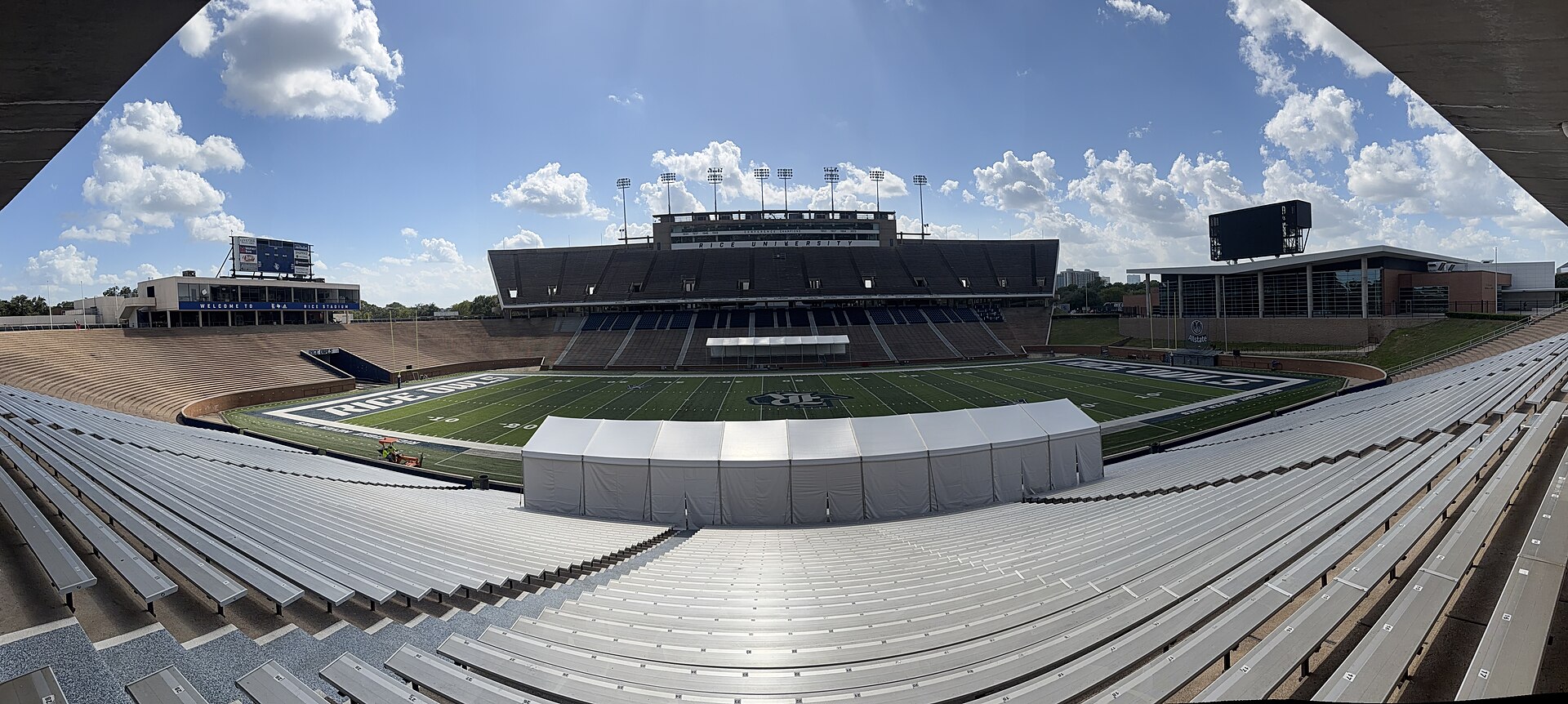
Panorama of Rice Stadium in July 2026
Panorama of Rice Stadium in July 2026Gatorfan252525 · CC BY-SA 4.0 · via Wikimedia Commons
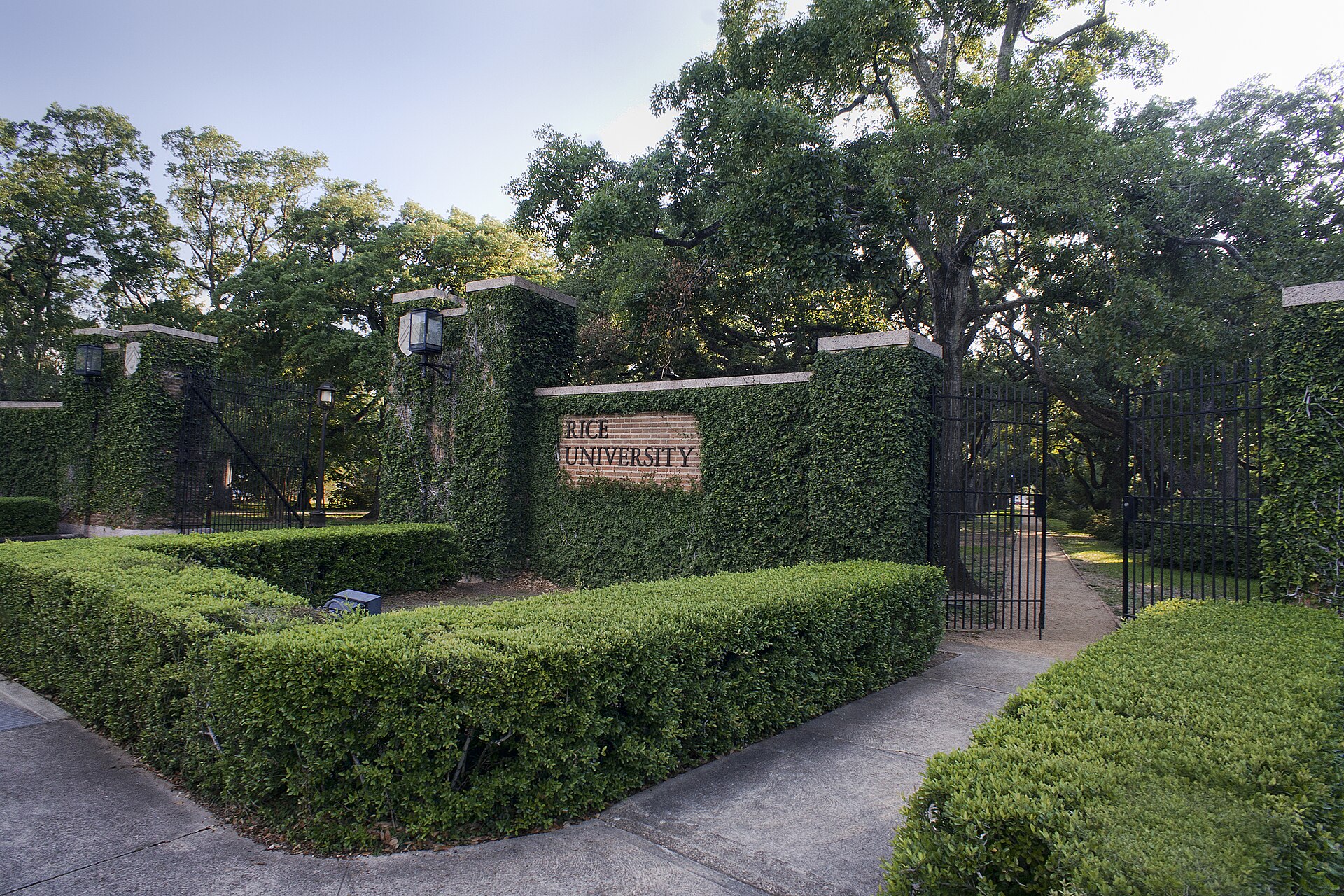
The main entrance of Rice University
The main entrance of Rice UniversityKatie Haugland Bowen · CC BY 2.0 · via Wikimedia Commons
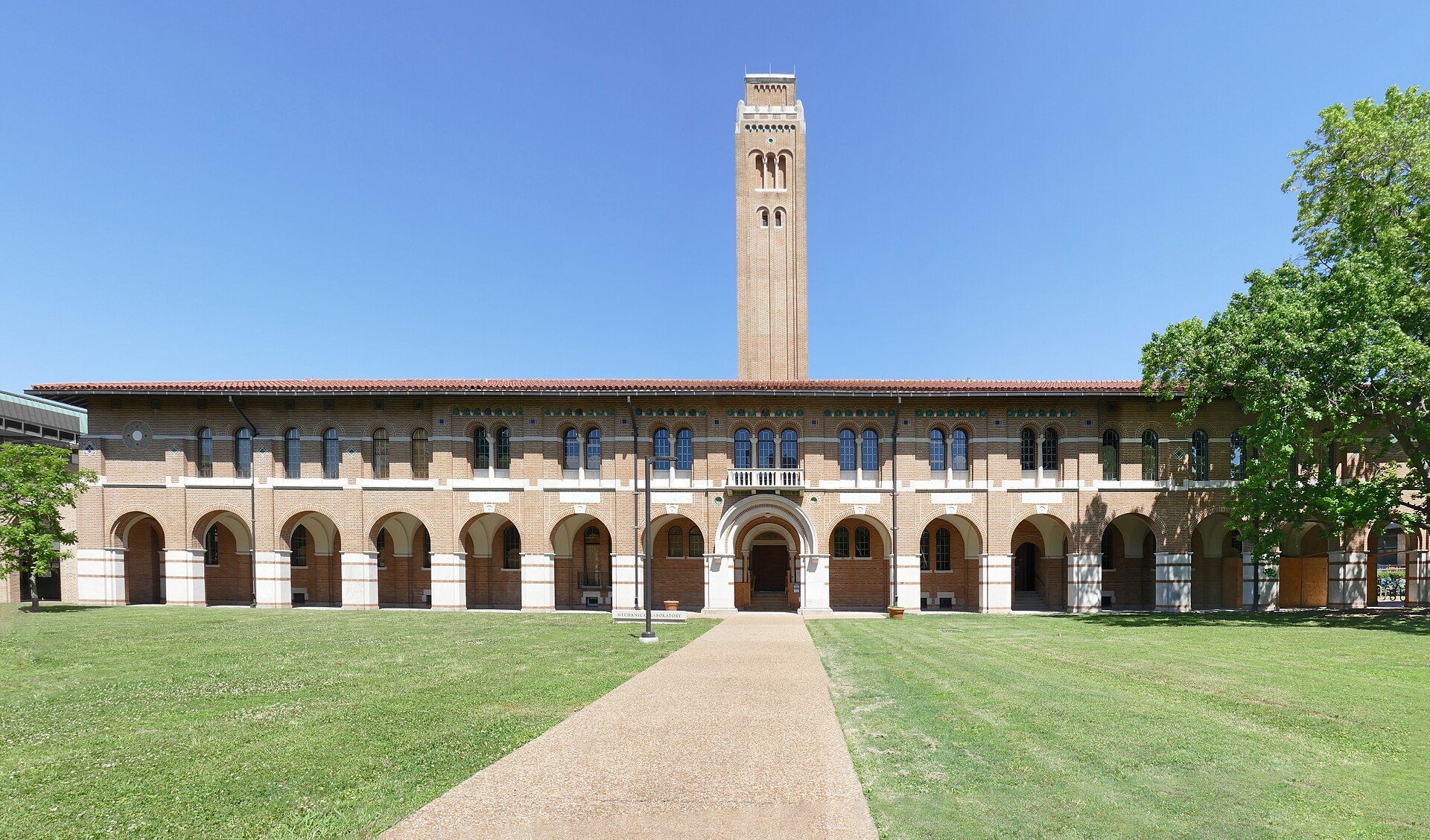
Rice University Mechanical Laboratory and Power House
Rice University Mechanical Laboratory and Power HouseJim Evans · CC BY-SA 4.0 · via Wikimedia Commons
College football game - The University of Texas Longhorns vs the Rice University Owls, 16 September 2006.
College football game - The University of Texas Longhorns vs the Rice University Owls, 16 September 2006.Johntex · CC BY-SA 2.5 · via Wikimedia Commons
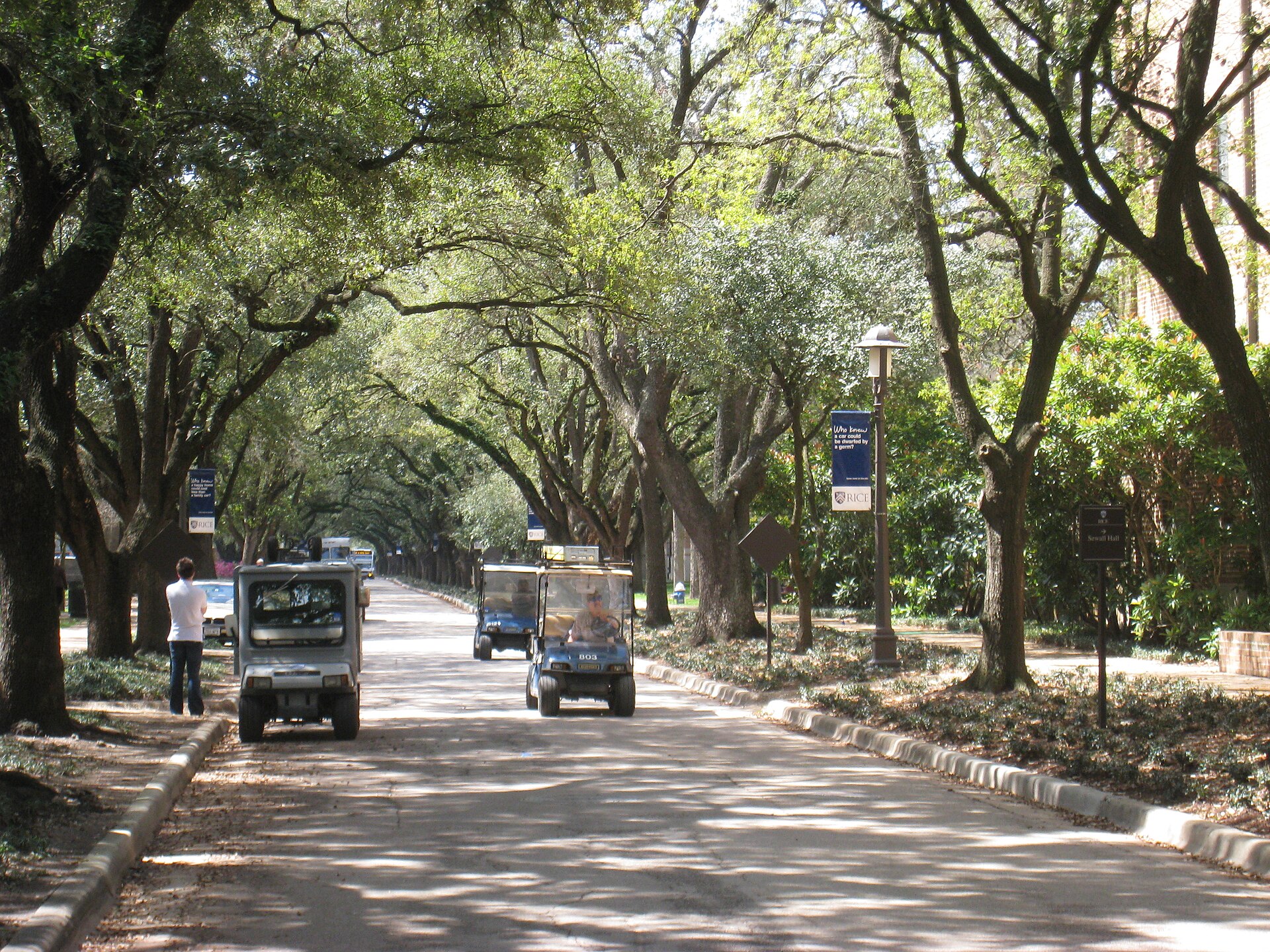
Rice University, Houston, Texas, USA - arboretum (extends across all of campus).
Rice University, Houston, Texas, USA - arboretum (extends across all of campus).Daderot · Public domain · via Wikimedia Commons
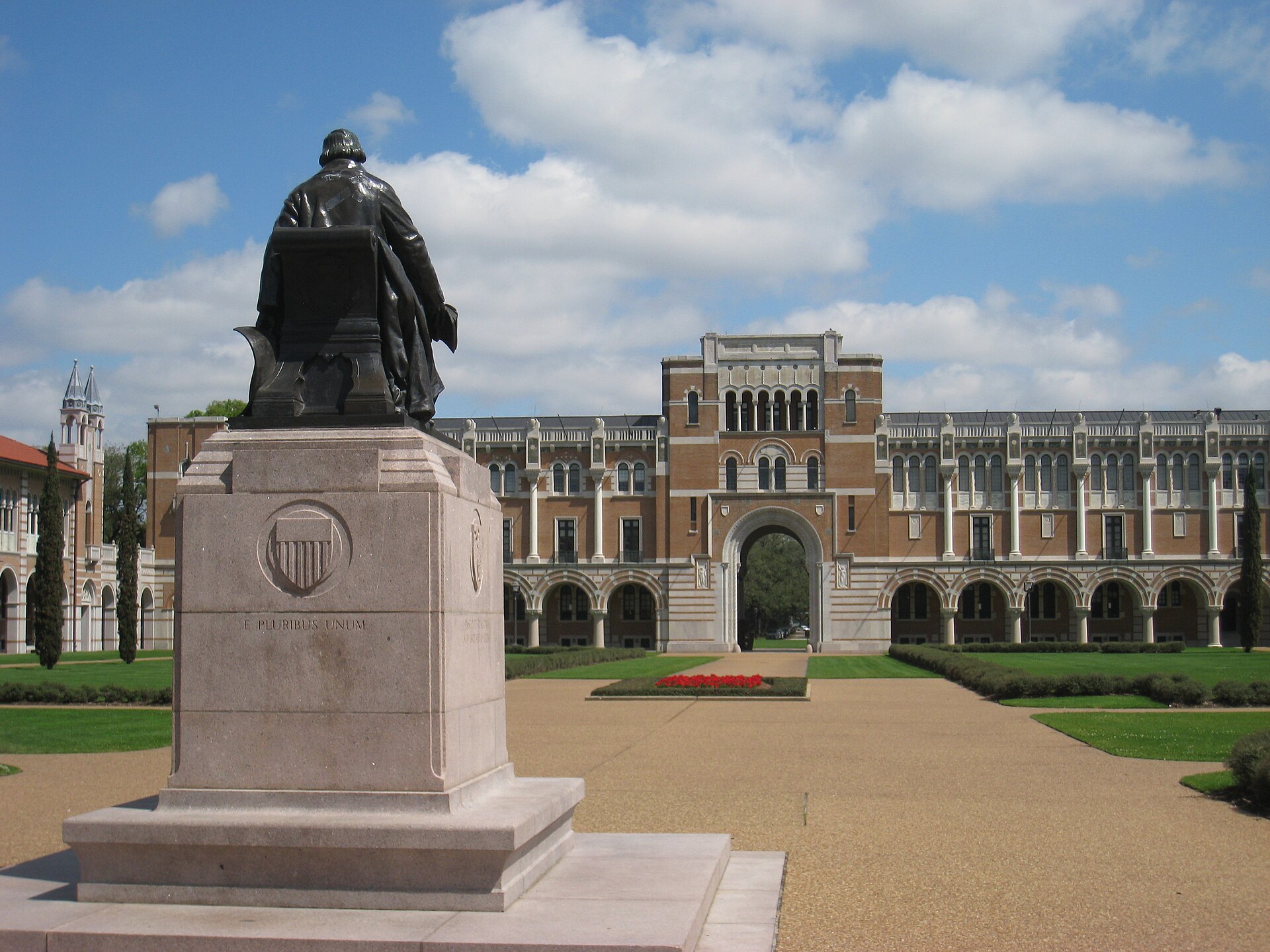
Rice University, Houston, Texas, USA - Statue of founder William Marsh Rice with Lovett Hall in background.
Rice University, Houston, Texas, USA - Statue of founder William Marsh Rice with Lovett Hall in background.Daderot · Public domain · via Wikimedia Commons

Why Rice University — Collaboration, Scale & Houston

Rice sits inside the US national top-20, but what distinguishes it is the combination of small scale, direct faculty access, and a culture built deliberately around collaboration over competition. For international students, Rice's residential college model and Houston's global industry density create an unusually supportive and professionally powerful environment.

016:1 Student-to-Faculty Ratio
Among the lowest of any US research university. Undergraduates work directly alongside faculty from their first semester — not as lab assistants, but as genuine intellectual contributors. Small seminar classes and direct faculty access are not marketing claims; they are the structural reality of a Rice education.
02The 12-College Residential System
Every incoming undergraduate is randomly assigned to one of 12 residential colleges — Baker, Will Rice, Hanszen, Wiess, Jones, Brown, Lovett, Sid Richardson, Martel, McMurtry, Duncan, or Chao — and remains a member for all four years. Rice has no fraternities or sororities. The college is your community, your lifelong alumni network, and the defining social structure of the Rice experience.
03Houston's Global Industry Ecosystem
Houston is the energy capital of the world, home to the Texas Medical Center — the largest medical complex on Earth — Johnson Space Center, and a rapidly growing technology and startup ecosystem. Rice's location creates internship and research pipelines unavailable at any other elite university: MD Anderson, NASA, Shell, and Baylor College of Medicine are Rice's immediate neighbours.
04Shepherd School of Music
One of the top five music conservatories in the United States, embedded inside a major research university. Shepherd School undergraduates perform in professional venues and collaborate with Houston's world-class Symphony Orchestra, graduating with both a conservatory-level musical education and a Rice degree.
05Research Depth at Undergraduate Scale
Rice is an R1 research university — the highest Carnegie classification — with the intimacy of a liberal arts college. The Oshman Engineering Design Kitchen, the Rice Space Institute, the Ken Kennedy Institute, and more than 100 research centres give undergraduates immediate access to cutting-edge research environments.
06Honour Code Culture
Rice operates under a student-administered honour code. Take-home exams, unsupervised testing, and collaborative problem-solving are the norm. This is a measurably different academic culture from competitive peer institutions: students support each other because the system rewards intellectual integrity, not individual advantage.

Rice University Acceptance Rate & Admitted Student Profile

Stats

~37,000
Applications (Class of 2029)
25%
International Students
8,900
Total Student Population

Profile Stats

1510–1560
SAT Middle 50%
34–36
ACT Middle 50%
3.9
GPA Minimum (Unweighted)
38+
IB Competitive Band
25%
International Students

Rea Vs Rd

Rd Label: Regular Decision
Rd Value: ~6-7%
Rea Label: Early Decision I
Rea Value: Higher than RD

Rice Admissions Requirements — Academics, Test Scores & International Profile

GPA & Coursework
Value: 3.9+ Unweighted
  • Near-top-of-class performance expected across four years
  • Course rigour evaluated as a distinct factor — most challenging courses available
  • Upward grade trajectory is valued; a dip in Grade 9 followed by sustained excellence reads contextually
  • International transcripts evaluated against school-specific grading norms and curriculum offerings
Rice's published minimum GPA is 3.9 unweighted. In practice, the majority of admitted students are at or near the top of their graduating class. The key criterion is whether students challenged themselves as fully as their context allowed — not simply whether they achieved perfect marks in easier options.
SAT / ACT
Value: 1510–1560 / 34–36
  • SAT middle 50%: 1510–1560 (submit at or above 1510)
  • ACT middle 50%: 34–36 (submit at or above 34)
  • Rice evaluates SAT and ACT equally — choose the test that plays to your strengths
  • TOEFL minimum 100 / IELTS minimum 7.0 for non-native English speakers
Rice's official policy is test-optional, but the university explicitly describes scores as 'recommended.' Strong scores above the 25th-percentile thresholds add direct academic signal. The decision to submit or withhold is strategic: submit if you are at or above 1510 SAT or 34 ACT.
International Grades
Value: 38+ IB Points
  • IB: 38+ total diploma points; 6s and 7s at HL in relevant subjects
  • A-Levels: AAA to A*A*A* depending on intended school
  • CBSE: 95%+ in relevant subjects for competitive consideration
  • Competition mathematics (AMC/AIME), science olympiad, or equivalent research achievement are strong differentiators
For international students: IB 38+ (with stronger candidates presenting 40–44); A-Level AAA to A*A*A*; CBSE 95%+ in relevant subjects. Rice has extensive experience with IB, A-Level, CBSE, HKDSE, Gaokao, and many other national curricula and evaluates each within its own context.

Rice Application Components — Common App, Essays, The Box & More

Rice accepts the Common Application exclusively and requires the Rice Writing Supplement plus The Box — its distinctive 2D image requirement. Architecture and Music applicants have additional portfolio or recording requirements.

01RequiredCommon Application
Rice accepts the Common Application exclusively. The platform opens August 1 each year. QuestBridge National College Match participants may apply through that platform.
02RequiredRice Writing Supplement
Rice's supplement includes a short-answer response about a current interest or activity (~150 words) and a longer essay about why you want to attend Rice and how you will contribute to your intended school and the residential college community (~500 words).
03Required — All ApplicantsThe Box — 2D Image Submission
Every applicant submits one 2D image — a photograph, drawing, painting, digital graphic, or any visual — that represents who they are. No written explanation is required or permitted. Every admissions reader sees every submitted Box. Give it as much strategic thought as your written essays.
04RequiredSchool Report & Transcripts
Official high school transcripts covering Grades 9–12, plus a counsellor recommendation. Give counsellors at least six weeks. For students at lesser-known international schools, the counsellor letter provides the institutional context Rice needs to evaluate your academic record fairly.
05RequiredTwo Teacher Evaluations
Choose teachers from two different core academic subjects who know your intellectual work well. Rice values recommendations that speak to your curiosity, collaborative character, and engagement — not just to your grades.
06RecommendedSAT / ACT Scores
Rice's official policy is test-optional, but scores are explicitly 'recommended.' Middle 50%: SAT 1510–1560, ACT 34–36. Submit strong scores; withhold if significantly below these thresholds.
07Architecture and Music OnlyPortfolio or Preliminary Recording
Architecture applicants submit a PDF portfolio (max 15MB, up to 10 pages). Shepherd School of Music applicants must submit a preliminary recording by 1 December — two full months before main deadlines. Missing the Music deadline is disqualifying.

Rice Essays — Writing the Perfect Common App, The Box & Supplement

Tips

The Why Rice essay must be unambiguously about Rice
The most common failure is writing an essay that could be submitted to any top-20 university. Name specific faculty, specific programmes (the Oshman Engineering Design Kitchen, Rice Space Institute, Shepherd School faculty), specific residential college traditions. If you can swap 'Rice' with 'Northwestern' without changing anything else, rewrite it.
The Box is not a graphic design test
A polished professional image created for the application is typically less effective than a photograph of your grandmother's kitchen, a hand-drawn map of your neighbourhood, or a screenshot of your most important code. Choose something genuinely personal, not something visually impressive.
Show community contribution, not just academic aspiration
Rice's residential college model means admissions readers are explicitly asking: what will this person add to their college for four years? Name a college tradition. Describe what you would build or organise. Address community contribution directly — it is not optional.
Each essay should reveal a different dimension of you
The Common App personal essay and Rice supplement should complement each other, painting a richer combined portrait. If both address the same theme, you have used 1,200 words to show one dimension when you had the opportunity to show two or three.

Prompts

Common App Personal Essay
Choose from 7 prompts — or write your own topic. 650 words maximum. The personal essay should reveal genuine character and voice that no other part of your file captures.
The Box — Image Submission (Required)
Every Rice applicant submits one 2D image — a photograph, drawing, painting, digital graphic, or any visual — that represents who you are. No written explanation is required. Every admissions reader sees it.
Short Answer — Current Interest
Describe a current interest or activity — academic, creative, professional, or personal — that has been particularly meaningful to you. (~150 words — verify exact wording and word limit at admission.rice.edu)
Why Rice and Your Intended School
Please describe why you are interested in attending Rice University and how you see yourself contributing to your intended school or college and to the Rice community. (~500 words — verify exact wording at admission.rice.edu)
The most common Rice essay mistake. Writing a Why Rice essay that mentions 'collaborative culture, small classes, and top research' without naming a single specific programme, faculty member, or residential college tradition.

What Rice Admissions Officers Are Looking For

Rice's holistic review is genuine — no single metric determines admission. What Rice evaluates beyond grades and scores is intellectual depth, collaborative character, and a student who will actively contribute to a residential college community for four years.

01Academic Strength in Context
Rice evaluates grades and course rigour relative to what your specific school offers. A student at an international school with limited IB or AP access is evaluated in that context. The central question is always: did you challenge yourself as fully as your environment allowed?
02Intellectual Depth Beyond Grades
Rice values students who pursue ideas outside formal coursework — through research, independent projects, competitions, creative work, or self-directed study. Breadth of activities matters far less than demonstrable depth of genuine intellectual passion in a primary area.
03Collaborative Character
Rice's honour code culture and residential college system depend on students who genuinely support each other. Admissions readers look for evidence of collaborative instinct — students who make the people around them better, not those who compete against them.
04Contribution to Residential College Community
Every Rice student joins a residential college for all four years. Readers ask: what will this person add to their college? Rice looks for builders, organisers, performers, mentors, and connectors — students who will shape the community, not just benefit from it.
05Genuine Fit With Rice's Culture
Rice's culture is collaborative, intellectually earnest, and unpretentious. Admissions officers can identify applicants who are applying to Rice as a prestige option versus those who genuinely understand and want the specific Rice experience. Your essays must demonstrate the latter.
06Personal Identity and Voice
The Box and the personal essay are evaluated as windows into authentic identity. Rice does not want a polished brand — it wants a real person whose presence in a residential college of 250 students will make those 250 students' experience richer.

Rice Financial Aid for International Students

Rice's financial aid programme is one of the most generous in the US for admitted students. The critical caveat for international applicants is that Rice is need-aware — financial aid requests factor into admissions decisions for international students, unlike domestic applicants who are reviewed need-blind.

Aid amounts are determined by the Financial Aid Office on a case-by-case basis through the CSS Profile. Rice is need-aware for international applicants — requesting aid is a factor in the admissions review.

Stats

~70%
Students receiving institutional grant aid
100%
Of demonstrated financial need met for all admitted students
$75
Rice application fee
$97,309
Annual cost of attendance

Contribution Tiers

NoteRangePercentPercent Value
Rice meets full demonstrated need — exact contribution depends on CSS Profile assessmentLower Income100% need met100
Institutional grants cover the gap between demonstrated need and cost of attendanceMiddle Income100% need met80
Contribution scales with demonstrated family resources; Rice Investment covers domestic students under $200KUpper-Middle IncomePartial grants available50
Full-pay expected; some merit aid available through specific programmesHigh IncomeLimited institutional aid20
100% Need-Met, Grant-Only — With an Important Caveat. Rice commits to meeting 100% of demonstrated financial need for every admitted student through institutional grant aid. Unlike many universities that include loans in aid packages, Rice's institutional aid is grant-only. However, unlike Harvard, Rice is need-aware for international applicants — the financial aid request is a factor in the admissions decision. Understanding this distinction before you apply is essential.
Expected Contribution Framework (Qualitative)

Key Dates

Early Decision I Deadline
Date: 1 Nov
ED I Decision Released
Date: Mid-Dec
Shepherd School Preliminary Recording
Date: 1 Dec
Early Decision II & RD Deadline
Date: 4 Jan
ED II Decision Released
Date: Late Jan
Regular Decision Released
Date: 1 Apr

Advantages

  • ED I historically offers a modest admissions advantage over RD
  • Earlier decision — mid-December notification for ED I
  • Demonstrates clear first-choice commitment to Rice
  • ED II provides a second binding round with a January 4 deadline
  • Both ED rounds allow strong seniors to show commitment before regular review

Disadvantages

  • Both ED rounds are binding — you must enrol if admitted and withdraw other applications
  • Cannot compare Rice's financial aid package with other universities' offers
  • International students who need to compare aid packages lose that flexibility
  • Less time to strengthen senior-year grades or test scores for ED I
  • If deferred from ED I, you wait until April alongside all RD applicants
ED I vs ED II vs Regular Decision. Rice offers three decision plans: Early Decision I (binding, November 1), Early Decision II (binding, January 4), and Regular Decision (non-binding, January 4). Both ED rounds offer a modest admissions advantage. The binding commitment is the central trade-off for international students who need to compare aid packages.
Tychr's ED/RD Recommendation for Rice. Apply ED I if Rice is your clear first choice and your application is complete by October — and if you are confident your family can manage the financial commitment regardless of the specific aid package, since you cannot compare offers. If financial aid comparison is critical to your decision — as it is for most international students — Regular Decision preserves that flexibility. ED II provides a middle path: a later binding round with more time to complete your application.
Rice Early Decision vs Regular Decision — Pros, Cons & Strategy

Rice Admissions Interviews — What You Need to Know

Rice does not conduct formal evaluative admissions interviews as part of its standard first-year application review. Some regional outreach or informal alumni events may occur, but these are not scored components of the application. The personal evaluation that interviews provide at other universities is accomplished at Rice through The Box, the Why Rice essay, and teacher recommendations.

Meta

Rice does not conduct formal evaluative admissions interviews
Format
Informal outreach may occur but is not an evaluated component
Alumni Events
The Box, essays, and recommendations carry the weight of personal evaluation
What Replaces It
Encouraged but not required or tracked for admissions credit
Campus Visits

Questions

How does Rice evaluate personal character without interviews?
Tip: Rice does not formally interview undergrad applicants. Use your essays and The Box to do this work instead.
What is The Box designed to evaluate?
Tip: The Box is the closest Rice equivalent to a personal introduction — choose your image to reveal who you are, not what you have achieved.
How do I demonstrate genuine fit with Rice without an interview?
Tip: Your Why Rice essay must name specific programmes, faculty, and residential college traditions — this is where specificity of fit is evaluated.
What should recommendations say about me for Rice?
Tip: Teacher recommendations should speak to your collaborative instincts and intellectual engagement — the qualities Rice most specifically evaluates.
How can I research Rice deeply without visiting in person?
Tip: Virtual events, student-produced residential college videos, the Rice Thresher newspaper, and faculty research pages are all legitimate research sources for writing specific essays.

Rice's 12 Residential Colleges — The Defining Feature of Rice Life

Every incoming Rice undergraduate is randomly assigned to one of 12 residential colleges and remains a member for all four years. There are no fraternities, no sororities, no athlete dorms, and no honours housing — the residential colleges are the entire social infrastructure of Rice.

Houses

Baker College
Tag: Original 8
Known for bakerShake, its beloved annual Shakespeare production
Will Rice College
Tag: Original 8
Strong academic culture, close-knit community
Hanszen College
Tag: Original 8
Oldest college, strong traditions and house pride
Wiess College
Tag: Original 8
Known for Wiess Day and distinctly irreverent spirit
Jones College
Tag: Original 8
Floor Olympics tradition; artistic and social culture
Brown College
Tag: Original 8
Large college, known for Night of Decadence tradition
Lovett College
Tag: Original 8
International culture and architecture-adjacent vibe
Sid Richardson College
Tag: Original 8
Sid Rich; known for community service emphasis
Martel College
Tag: Newer
Diverse traditions; Greek Week; newer community
McMurtry College
Tag: Newer
Modern facilities; growing traditions
Duncan College
Tag: Newer
STEM-adjacent culture; newer and high-tech spaces
Chao College
Tag: Newest
Newest college; rapidly developing its own identity and traditions

Lottery Steps

  • All incoming students are randomly assigned to one of 12 colleges before arriving on campus
  • Assignment is permanent — you cannot request reassignment or transfer between colleges
  • Random assignment is intentional: it prevents any college from becoming a self-selected social bubble
  • Each college has its own faculty magister, traditions, governance, dining, and physical space
  • You are a member of your college for all four years — as a student and for life as an alumnus

Rice Schools & Undergraduate Programmes

School of Engineering and Computing
Label: Largest Rice School
  • {"label":"Undergraduate majors","value":"10+"}
  • {"label":"Key programmes","value":"CS, Bioengineering, Electrical, Mechanical, Chemical"}
  • {"label":"Research centre","value":"Oshman Engineering Design Kitchen"}
  • {"label":"Portfolio required","value":"No"}
Rice Engineering feeds directly into Houston's energy, aerospace, and biotech sectors and into leading technology companies globally. Computer Science, Bioengineering, and Electrical Engineering are the most competitive majors.
School of Natural Sciences
Label: Pre-Medical & Sciences
  • {"label":"Key programmes","value":"Biology, Chemistry, Biochemistry, Physics, Psychology"}
  • {"label":"Pre-medical pathway","value":"Texas Medical Center partnership"}
  • {"label":"Research access","value":"MD Anderson, Baylor College of Medicine"}
  • {"label":"Portfolio required","value":"No"}
Rice's Natural Sciences school is a gateway to the Texas Medical Center — the world's largest medical complex. Pre-medical students benefit from proximity to MD Anderson Cancer Center, Baylor College of Medicine, and Houston's dense biotech ecosystem.
Shepherd School of Music
Label: Top-5 US Conservatory
  • {"label":"Preliminary recording deadline","value":"1 December"}
  • {"label":"National ranking","value":"Top 5 conservatories in the US"}
  • {"label":"Partnership","value":"Houston Symphony Orchestra"}
  • {"label":"Portfolio required","value":"Yes — preliminary recording"}
One of the top five music conservatories in the United States, embedded inside a research university. Applicants must submit a preliminary recording by 1 December. Missing this deadline is disqualifying. Graduates enter professional orchestras, opera companies, and chamber ensembles worldwide.
School of Architecture
Label: NAAB-Accredited, Internationally Recognised
  • {"label":"Programmes","value":"Architecture (B.Arch)"}
  • {"label":"Signature experience","value":"Rice Building Workshop; Paris Programme"}
  • {"label":"Portfolio deadline","value":"With application"}
  • {"label":"Portfolio required","value":"Yes — PDF, max 15MB"}
Rice School of Architecture is NAAB-accredited and internationally recognised. The Rice Building Workshop sends students into real construction projects before graduation. Applicants must submit a PDF portfolio demonstrating visual thinking and creative process.
School of Humanities
Label: Liberal Arts Core
  • {"label":"Key programmes","value":"English, History, Philosophy, Linguistics, Religious Studies"}
  • {"label":"Research strength","value":"Humanities Research Center"}
  • {"label":"Portfolio required","value":"No"}
  • {"label":"Cross-school flexibility","value":"Yes"}
Rice Humanities offers rigorous training in analysis, writing, and critical thinking. Students benefit from small seminars and direct faculty engagement. Strong performance in IB or A-Level English, History, and Languages is the relevant academic preparation.
School of Social Sciences
Label: Economics, Policy & Cognitive Sciences
  • {"label":"Key programmes","value":"Economics, Political Science, Sociology, Cognitive Sciences"}
  • {"label":"Analytical emphasis","value":"Quantitative methods increasingly expected"}
  • {"label":"Research centre","value":"Baker Institute for Public Policy"}
  • {"label":"Portfolio required","value":"No"}
Rice Social Sciences is home to Economics, Political Science, Sociology, and the distinctive Cognitive Sciences programme. The Baker Institute for Public Policy gives students direct access to policy research and international affairs at the highest level.

Research & Extracurricular Opportunities at Rice

Oshman Engineering Design Kitchen (OEDK)
Category: Engineering Research & Making
A 9,000-square-foot maker space open to all Rice students — not just engineers. The OEDK provides access to 3D printers, laser cutters, electronics labs, woodworking tools, and prototyping equipment. From their first semester, students build real devices, products, and systems with professional-grade tools.
Rice Space Institute
Category: Space & Aerospace Research
Located minutes from Johnson Space Center, the Rice Space Institute connects students with NASA researchers, astronauts, and aerospace engineers. Undergraduate research through RSI gives Rice students access to ongoing space missions and aerospace engineering projects unavailable elsewhere at the undergraduate level.
Baker Institute for Public Policy
Category: Policy Research
One of the most respected policy research centres in the US, housed at Rice. Undergraduate students participate in Baker Student Forum events, attend policy briefings with national and international figures, and pursue research fellowships across energy, health, science and technology, and international affairs.
Student Life & Extracurriculars
Category: 200+ Student Organisations
The Rice Thresher (independent student newspaper), Rice Debate, Model UN, engineering competitions, intramural sports through the residential colleges, cultural organisations, and performance groups. Because Rice has no Greek system, residential colleges organise all major social events — making participation the default, not the exception.
Scroll right to explore Rice's research centres and student life opportunities.

Career Outcomes & the Rice Alumni Network

Rice graduates benefit from Houston's extraordinary industry density — the energy capital of the world, the largest medical complex on Earth, and a major aerospace hub, all within minutes of campus. The Rice alumni network is small by Ivy League standards but unusually dense in these specific sectors.

Stats

92%
Employed or in graduate school within 6 months
$75,000
Average starting salary
#17
US News national ranking
#145
QS World Ranking
8,900
Total student population
25%
International student percentage

Categories

Energy
Shell, ExxonMobil, Schlumberger, Halliburton, bp — Houston's energy sector provides Rice graduates with an internship-to-employment pipeline that no other elite university can match. Rice engineers and geoscientists enter the global energy industry at the highest levels.
Healthcare & Biotech
MD Anderson Cancer Center, Baylor College of Medicine, Texas Medical Center biotech ecosystem — Rice Natural Sciences graduates enter biomedical research, clinical pathways, and healthcare leadership in the world's largest medical complex.
Space & Aerospace
NASA Johnson Space Center, SpaceX, Boeing, Lockheed Martin — Rice's proximity to JSC and the aerospace industry creates a space-to-career pipeline for engineering students that is unique in American higher education.

Our Rice Admissions Track Record & Student Success Stories

Priya S.
I had applied to several top universities with strong grades and scores, but my Why Rice essay was the generic version — 'collaborative culture, great research.' Tychr coaches pushed me to research specific residential college traditions and name actual faculty in my intended school. The rewritten essay was completely different. Rice was my first choice and I was admitted ED I.
Country: India
Program: Rice — Bioengineering
Class Year: Class of 2027
Residential: Martel College
Academic Profile: SAT 1540 · IB 42
Lucas M.
The Box is what Rice students talk about, and I almost chose a completely generic image. My Tychr counsellor helped me understand what Rice is actually evaluating — not visual skill, but authentic identity. The image I chose was a photograph that only I could have submitted. It became the most memorable part of my application.
Country: Brazil
Program: Rice — Computer Science
Class Year: Class of 2026
Residential: Duncan College
Academic Profile: SAT 1560 · GPA 4.0
Soo-Jin P.
The financial aid process at Rice was the most important planning challenge I had, not just the essays. Tychr walked me through the CSS Profile in detail, explained exactly what Rice's need-aware policy meant for international students, and helped me apply Regular Decision so I could compare packages. Rice met 100% of our demonstrated need.
Country: South Korea
Program: Rice — Cognitive Sciences
Class Year: Class of 2025
Residential: Lovett College
Academic Profile: ACT 35 · IB 41

Faqs

Is Rice need-blind or need-aware for international students?+

Need-aware. Rice is need-blind for domestic US applicants only. For international applicants, your financial aid request is a factor in the admissions decision. However, if Rice admits you, it commits to meeting 100% of your demonstrated financial need through institutional grant aid — not loans. This dual structure means the aid is generous for those who receive it, but requesting aid affects your competitive standing at the margins.

What is The Box and is it truly required?+

The Box is required for every applicant without exception. You submit a single 2D image — a photograph, drawing, painting, digital graphic, or any visual — that represents who you are. No written explanation is required or permitted. Every admissions reader sees every submitted image. It is evaluated alongside your written essays as a separate, meaningful window into your identity. Missing or submitting a placeholder is not an option.

Should I apply Early Decision I if Rice is my first choice?+

ED I offers a modest historical admissions advantage, but the binding commitment means you cannot compare Rice's financial aid package with offers from other universities. If financial aid comparison is central to your family's decision — which it is for most international students — Regular Decision preserves your ability to compare offers. Apply ED I only if Rice is your clear first choice and your family can commit to Rice's package regardless of the specific amount.

Do I need to declare a school (Engineering, Architecture, Music, etc.) when applying?+

Yes. Rice applicants select their intended undergraduate school at the time of application. Architecture and Shepherd School of Music are hard divisions with specific portfolio or recording requirements and earlier sub-deadlines. Other schools (Engineering and Computing, Natural Sciences, Humanities, Social Sciences, Business) allow more flexibility after matriculation.

Can I transfer between residential colleges?+

No. College assignment is permanent for all four years by design. Rice believes that long-term community belonging produces the depth of connection that defines the Rice experience. The random assignment prevents any college from becoming a self-selected demographic bubble.

How important is the Why Rice essay?+

Extremely important — and the most frequently done poorly. Generic Why Rice essays mentioning 'small classes, collaborative culture, top research' are immediately identifiable as non-specific. The strongest Why Rice essays name specific faculty, programmes, residential college traditions, or Houston-specific opportunities and connect them to a clear personal vision. Research specifically — not generally.

Does Rice conduct admissions interviews?+

Rice does not conduct formal evaluative admissions interviews as part of its standard first-year application review. Some regional outreach or informal alumni events may occur, but these are not scored components. The personal evaluation interviews provide at other universities is accomplished at Rice through The Box, the Why Rice essay, and teacher recommendations.

What English proficiency scores does Rice require?+

TOEFL minimum 100 (internet-based), IELTS minimum 7.0, or Duolingo English Test minimum 120. Students whose primary language of instruction for all four secondary school years was English may request an exemption — contact Rice admissions to confirm eligibility before assuming you qualify.

Book a Free Rice Admissions Strategy Session

In 60 minutes our Rice admissions specialists will evaluate your academic profile, identify your strengths and gaps, develop your Box image strategy, craft your Why Rice essay approach, and determine whether ED I, ED II, or Regular Decision gives you the best odds given your financial aid needs.

  • No commitment required
  • Rice specialists with insider knowledge of The Box and supplement strategy
  • Personalised strategy — not generic advice for any top-20 university
Getting into Rice is not about being the most accomplished — it's about being the most genuinely yourself.

Rice University Academic Requirements

Rice Academic Requirements — The Honest Breakdown for International Students

What GPA, test scores, and academic profile do Rice's admitted students actually have? And what does Rice's holistic review mean for students from IB, A-Level, AP, and other international curricula?

3.9
GPA Minimum (Unweighted)
Published minimum; most admits at or near class top
1510–1560
SAT Middle 50%
Enrolled students
34–36
ACT Middle 50%
Enrolled students
38+
IB Competitive Band
Total Diploma points
6:1
Student:Faculty Ratio
Among lowest of any US research university
8%
Acceptance Rate
Class of 2029

GPA & Class Rank

Rice and GPA — What the Data Shows

Rice does not admit students to a programme — it admits them to a residential college and a school. The academic standard is high and consistent: a minimum unweighted GPA of 3.9 is Rice's published floor. In practice, the vast majority of admitted international students are at or very near the top of their graduating class.

A 3.9 GPA is the floor, not the average. What distinguishes admitted students is the combination of strong grades in the most rigorous courses available — not grades alone.

3.9
Published minimum unweighted GPA
Top 5–10% of class, strongest available courses
Most competitive admitted profile
What this means for international students. International students from systems without formal class rank (IB, UK A-Levels, many Asian curricula) are evaluated on their grades relative to their school's known performance range and in comparison to other applicants from the same educational system. Rice has extensive experience with every major international curriculum.
Grade trajectory matters. A student with an upward grade trajectory — improving from moderate to exceptional performance — reads differently from one whose grades have plateaued or declined. An early weak period followed by sustained excellence is context, not disqualification. Rice's holistic review accommodates genuine improvement with honest explanation.

Academic Context

Class Rank and School Context — How Rice Reads Academic Performance

Rice does not evaluate transcripts in isolation. Every application is read with reference to your specific school's curriculum, grading norms, and available course offerings — a process sometimes called 'reading in context.' Understanding how this works helps you understand both what to submit and how to frame it.

How Rice contextualises your academic record
Rice's admissions officers review the school profile submitted by your counsellor alongside your transcript. This profile describes your school's curriculum, grading scale, course offerings, and the academic context of your cohort. A student at a school that offers only three AP courses is evaluated differently from one at a school with twenty AP options. What matters is whether you challenged yourself relative to what was possible.
What this means practically
Taking the most rigorous courses available at your specific school is more important than achieving a perfect grade in easier options. Rice explicitly evaluates 'strength of curriculum' as a distinct academic factor — it is listed separately from GPA in the holistic review framework. Grade optimisation at the cost of course rigour is a recognisable and common mistake.
For students at less well-known international schools. Your school counsellor's letter is particularly important for students at lesser-known international schools — it provides Rice with the institutional context needed to evaluate your academic performance fairly. Tychr coaches students and counsellors on how to provide this context effectively in the school report.

Standardised Testing

SAT Scores at Rice — What You Actually Need

Rice SAT Data — Enrolled Students

LabelScorePercent
25th percentile151065
75th percentile156090
Mid-range (estimated)~153578
The SAT Math subscore. For STEM-focused applicants to Engineering and Computing or Natural Sciences, a strong SAT Math subscore (780–800) is particularly meaningful. Rice's engineering and science programmes are quantitatively demanding from the first semester — a high Math subscore signals direct readiness.
Preparation. Tychr's structured SAT preparation programme averages meaningful score improvement over 8–12 weeks. Students targeting Rice should aim for a composite score of 1510 or above before considering submission. If you cannot achieve 1510, investing additional preparation time before submitting is better than submitting a score that draws attention to a below-median dimension.
Submitting vs. withholding scores. Rice is test-optional, but explicitly describes scores as 'recommended.' For international students, Tychr generally recommends submitting scores at or above 1510. Scores between 1480 and 1510 are judgment calls depending on the strength of the rest of the academic file. Scores below 1480 are typically better withheld.

Standardised Testing

ACT Scores at Rice — The Data and the Strategy

Rice ACT Data — Enrolled Students

Metrics

25th percentile
Score: 34
75th percentile
Score: 36

Comparison Cards

Both accepted equally
Rice does not prefer one over the other. The choice should be based entirely on which test plays to your specific strengths — take a diagnostic of both before committing.
SAT rewards
Careful reading comprehension, precise mathematical reasoning, and evidence-based writing.
ACT rewards
Speed across four sections (English, Math, Reading, Science) and familiarity with the Science data interpretation format.
Superscore policy. Rice's current policy on superscoring should be verified directly at admission.rice.edu for the current application cycle. When planning which scores to submit, focus on your strongest composite performance.
Tychr's recommendation. Take a diagnostic of both tests before committing to either. If your ACT diagnostic reaches 33 or above, it is worth pursuing. If ACT Science is a significant weakness, the SAT may be the better vehicle. For Shepherd School of Music applicants, test scores play a proportionally smaller role — the recorded audition carries more weight.

Testing Strategy

Rice Test-Optional — The Strategic Decision Explained

Rice has maintained a test-optional policy. Understanding what this actually means — and when submitting or withholding scores is or is not advantageous — is important for Rice applicants, particularly internationals.

Submit Items

Your SAT is at or above 1510 — submit. At or above the 25th percentile, scores add positive value.
Your ACT is at or above 34 — submit.
You are an international student — a strong score provides standardised academic context that Rice describes as recommended, not optional.

Withhold Items

Your score is below 1480 (SAT) or below 33 (ACT) — withholding is typically the better strategy.
Submitting would draw attention to a dimension of your academic profile that is significantly weaker than the rest.
Current policy. Rice accepts applications without test scores and does not formally penalise students who don't submit. However, the university explicitly describes scores as 'recommended' — a meaningful signal that strong scores are valued rather than neutral. Applications are reviewed holistically whether or not scores are included.
The misconception. 'Test-optional' does not mean 'test-irrelevant.' Students who submit strong scores receive a positive academic signal. Students who don't submit remove that signal — the rest of the academic profile must carry more weight. For international students especially, strong test scores provide standardised evidence that complements transcripts from unfamiliar educational systems.

International Curricula

A-Levels and IB at Rice — Specific Benchmarks

IB Diploma
Note: What Rice values in IB applicants: HL course selection that demonstrates intellectual ambition, not grade optimisation. The Extended Essay grade and subject add useful contextual information about intellectual interests and research capability. Higher-level performance in subjects relevant to your intended Rice school is the primary evaluative lens.
  • {"label":"Competitive range","value":"38–45 points (most admitted internationals: 39–44)"}
  • {"label":"HL expectations","value":"6,7,7 or 7,7,7 at Higher Level in subjects relevant to intended school"}
  • {"label":"Engineering/Science","value":"HL Mathematics: Analysis and Approaches strongly preferred; HL sciences at 6 or 7"}
  • {"label":"Extended Essay","value":"A or B grade; used as supplementary evidence of research capability"}
A-Levels
Note: Rice's admissions office is experienced in reading UK A-Level profiles. Predicted grades are evaluated alongside GCSE or IGCSE results — strong AS performance reinforces predicted grade credibility. Rice understands the grading conventions of UK-curriculum schools and evaluates contextually.
  • {"label":"Competitive range","value":"AAA to A*A*A* depending on intended school"}
  • {"label":"Engineering / Natural Sciences","value":"A*A*A* or AAA* in Mathematics, Further Mathematics, and a science"}
  • {"label":"Humanities / Social Sciences","value":"AAA in relevant subjects; strong English Literature performance valued"}
  • {"label":"AS results","value":"Reviewed alongside predicted A-Level grades; strong AS reinforces the predicted grade"}

Advanced Placement

AP Courses at Rice — What Counts and What to Take

For students in the US system or at schools that offer AP courses, Advanced Placement performance is a significant component of the academic profile. Rice awards course credit for qualifying AP scores, allowing students to skip introductory coursework.

What Rice is looking for
AP 5s across multiple rigorous subjects in areas relevant to your intended Rice school — Calculus BC, Physics C, Chemistry, Biology, Computer Science A for STEM applicants; AP English Language, AP History, AP Economics for Humanities and Social Sciences. The pattern of AP subject choices should reflect genuine intellectual focus and ambition.
How many APs?
Rice does not publish an expected AP count. The most competitive applicants typically have 5–8 AP exams with predominantly 5s. Rigour of subjects matters more than raw count — five 5s in rigorous subjects is more competitive than eight 5s in easier options.
Grade validity and readiness
Consistent AP 5s reinforce the validity of school-reported grades and demonstrate preparation for Rice's academically demanding first-year coursework.
Rice awards course credit for AP scores of 4 and 5 in many subjects, allowing students to skip introductory courses and pursue more advanced work from the start. Confirm Rice's current AP credit policy at registrar.rice.edu.
International students at schools that don't offer AP should not artificially pursue AP courses. The IB Diploma or A-Level system is the appropriate preparation for their context and is evaluated accordingly by Rice. AP is evaluated relative to what was accessible to you.

Academic Rigour

Rigour of Secondary School Record — Rice's Most Important Academic Factor

Rice lists 'rigour of secondary school record' as among the most important academic factors in its admissions process — rated alongside GPA and class rank as the primary academic evaluation lens. Understanding what this means in practice is fundamental to a competitive application.

Taking the most challenging courses available at your specific school, in the subjects most relevant to your intellectual interests and intended Rice school.

The contextual element. Rigour is always evaluated relative to what was available. A student at a school that offers only three AP courses is evaluated differently from one at a school with twenty. What matters is whether you challenged yourself as fully as your environment allowed.
What rigour means at Rice. This does not mean taking every possible challenging course simultaneously — it means demonstrating genuine academic ambition through course selection relative to the choices your school actually presents. Grade optimisation by avoiding hard courses is a clearly recognisable pattern that hurts applications.
What Rice is looking for in practice. A student who took IB HL Mathematics: Analysis and Approaches, HL Physics, and HL Chemistry simultaneously in Year 13 demonstrates academic courage that Rice's rigour criterion rewards. An IB student who took HL Visual Arts, HL Psychology, and HL Film Studies — while academically legitimate — presents a less rigorous academic profile for Engineering or Natural Sciences applicants.

School-Specific Preparation

Academic Preparation by Rice School — What Each School Expects

Rice applicants declare which undergraduate school they are applying to at the time of application. The academic preparation should match the specific expectations of that school. Here is what each school expects.

Engineering and Computing
Strong mathematics through calculus is a prerequisite — not a preference. Physics and Chemistry preparation at the highest available level. For Computer Science specifically, coding experience and original project work are differentiating signals alongside the academic record. Competition mathematics — AMC, AIME, national Olympiads — is the strongest academic differentiator for the most competitive Engineering applicants.
Natural Sciences
Biology, Chemistry, and Physics at the highest available level. For pre-medical applicants, research experience through science fairs, hospital volunteering, or wet-lab work significantly strengthens the application. IB HL sciences with 6s and 7s, or A-Level sciences at A or A*, are the competitive benchmarks.
Architecture
A PDF portfolio is required (maximum 15MB, up to 10 pages). Rice Architecture looks for visual thinking, spatial reasoning, and evidence of creative practice. The portfolio should demonstrate process — sketches, iterations, revisions — not only finished work. Formal architecture training is not required; backgrounds in art, design, urban studies, or engineering all succeed.
Shepherd School of Music
The Shepherd School is a conservatory-level programme inside a research university. Admissions competition is among the most intense of any US music school. Applicants should have significant formal training, performance history, and documented recognition in competitions or auditioned ensembles. A preliminary recording must be submitted by 1 December. Missing this date is disqualifying.
Humanities
Strong performance in English Literature, History, and Languages. Evidence of extended intellectual engagement — research papers, debate, long-form writing — is valued alongside grades. IB HL English Language and Literature at 6 or 7; A-Level English Literature at A or A*. Writing quality in the Rice supplement itself is part of the evaluation.
Social Sciences and Business
Economics preparation, quantitative coursework, and interest demonstrated through relevant clubs, competitions, or professional experience. The Social Sciences school increasingly expects quantitative preparation — statistics, mathematics — alongside humanistic breadth. The Baker Institute for Public Policy is a major attraction for policy-oriented Social Sciences applicants.

Language Proficiency

English Language Requirements for International Rice Applicants

Rice requires English proficiency test scores for international students whose primary language of instruction has not been English for the past four years of secondary school. Students at English-medium schools for all four years may request an exemption.

Rice's application essays are themselves an implicit English language evaluation. An applicant who writes compelling, fluent essays in academic English provides direct evidence of proficiency that no language test score can substitute for. Conversely, a high TOEFL score cannot compensate for weak essay writing.

Test: TOEFL (iBT)
Score: 100+
Test: IELTS Academic
Score: 7.0+
Test: Duolingo English Test
Score: 120+
Practical guidance for international students. Students who attended an English-medium school for all four years of secondary school may request an English proficiency exemption from Rice admissions. Contact Rice's admission office directly to confirm eligibility — do not assume you qualify without confirmation. If you submit a language test, aim for TOEFL 110+ or IELTS 7.5+ to present a competitive score.

By School / Concentration

Academic Requirements by Intended Rice School — What Each Path Expects

Rice applicants declare their intended school at the time of application. The academic profile should be coherent with the school you are applying to. This table shows the academic signals Rice looks for by intended school or concentration.

SignalsExpectationConcentration
AMC/AIME/USAMO qualification; coding projects; USACOHL Maths AA / Calc BC / Further Maths A*Computer Science
Olympiad results; competition maths; OEDK projectsHL Maths + HL Physics or HL ChemistryElectrical / Mechanical Engineering
Science fair; wet-lab research; hospital experienceHL Biology + HL Chemistry; GPA 3.9+Bioengineering / Pre-Medical
Econometric projects; policy writing; data analysisHL Maths AA + Economics or equivalentEconomics
Portfolio: process + finished work; design experienceHL Visual Arts or design background (not required); spatial reasoningArchitecture
Competition performances; auditioned ensembles; formal trainingPreliminary recording submitted 1 DecemberShepherd School of Music
Extended writing; debate; research papers; policy interestHL English + History or Philosophy A*sHumanities / Social Sciences
Clinical research; bench science; science fair; research publicationsHL Chemistry + Biology; strong sciencesNatural Sciences (Chemistry/Biology)

International Systems

Rice and International Education Systems — How Your Curriculum Is Evaluated

IB Diploma
Well understood and highly valued. Rice's admissions officers are experienced IB readers — they know the difference between an IB student who challenged themselves with rigorous HL choices and one who selected easier options to protect grades. The EE, TOK, and IAs are taken seriously as indicators of research capability and intellectual engagement. HL courses relevant to your intended Rice school should carry 6s and 7s.
A-Levels (Cambridge and Edexcel)
Equally well understood. A-Levels are familiar to Rice's admissions team. The combination of subjects chosen and the predicted or achieved grade profile are both carefully evaluated. Predicted grades are assessed alongside GCSE and IGCSE results for internal consistency.
Indian Boards (CBSE / ISC)
Accepted and contextualised carefully. Rice is aware of grading norms across Indian boards. High percentage scores in relevant subjects are expected from competitive CBSE applicants — 95%+ in core subjects. Supplementary evidence such as competitive exam performance (JEE, national Olympiads) or research experience strengthens the academic picture significantly.
Chinese Gaokao
Gaokao results are one data point among several for Chinese applicants. A-Level or IB study alongside the Gaokao, supplemented by strong SAT scores and research experience, typically makes for a more competitive Rice application. Provincial percentile performance is the relevant metric for Gaokao evaluation.
Other Asian Curricula (HKDSE, Korean CSAT, Singapore)
Rice has experience evaluating HKDSE, Singapore A-Levels, Korean CSAT, and many other national curricula. Top-grade performance (5**, 5* for HKDSE; A or A* for Singapore A-Level) in relevant subjects is expected. Contact Rice admissions directly with questions about how your specific qualification is evaluated.

Roadmap

Building a Competitive Rice Academic Profile — What to Do at Each Stage

Grade 9–10Establish foundation and identify your focus
Year: Grade 9–10
  • Choose the most rigorous courses available in your intended field at your school.
  • Identify your primary intellectual passion — the subject, creative practice, or project area you will develop across four years.
  • Begin researching Rice's residential college system and specific school you intend to apply to.
  • Music applicants: begin building your audition repertoire with long-term Rice preparation in mind.
Grade 10–11Deepen, differentiate, and begin preparation
Year: Grade 10–11
  • Enter competitions, seek summer research opportunities, or begin building an independent project in your primary area.
  • Architecture applicants: begin developing a portfolio of creative work with documentation of your process.
  • Take a diagnostic SAT or ACT to identify preparation needs before formal test prep begins.
  • Explore Houston's industry ecosystem related to your interests: Texas Medical Center, Space Center, Rice's research institutes.
Grade 11Research, competition, leadership, and testing
Year: Grade 11
  • Begin structured SAT or ACT preparation; target your first official sitting by April of Grade 11.
  • Pursue research, science fair, creative work, or a sustained project demonstrating intellectual depth.
  • Music applicants: be building your audition repertoire and approach recording-readiness by end of Grade 11.
  • Visit Rice in person if geographically possible — campus visits inform genuinely specific Why Rice essays.
Summer Before Grade 12Draft essays and plan your Box image
Year: Summer Before Grade 12
  • Begin drafting your Common App personal essay and Rice Writing Supplement over the summer.
  • Research Rice's residential college traditions specifically — bakerShake, Wiess Day, and others provide concrete material for community contribution essays.
  • Choose The Box image with deliberate thought; give it as much strategic consideration as your written essays.
Grade 12Submit and follow through with deadlines
Year: Grade 12
  • Architecture applicants: finalise portfolio by September (15MB PDF).
  • Music applicants: record and submit preliminary materials by 1 December. No exceptions.
  • ED I applicants: complete all materials by 1 November for mid-December decisions.
  • Your Box image, Why Rice essay, and short-answer response must work together as a coherent, specific, authentic narrative.

Common Pitfalls

Academic Mistakes That Hurt Rice Applications — And How to Avoid Them

Choosing easier courses to protect GPA
Grade optimisation at the expense of course rigour is one of the most recognisable patterns in rice applications. Taking SL instead of HL Mathematics, or AS-only instead of full A-Level, to protect GPA is immediately visible to admissions readers who compare your course selection to your school's available offerings.
Treating test-optional as test-irrelevant
'Test-optional' does not mean 'test-irrelevant.' Rice explicitly calls scores 'recommended.' A 1490 SAT withheld may be more strategically sound than a 1490 SAT submitted — but a 1540 withheld is a missed opportunity. Invest the preparation time before making the submission decision.
Missing the Music preliminary recording deadline
Missing the Shepherd School preliminary recording deadline of 1 December is disqualifying. There are no exceptions. Music applicants must plan two full months ahead of the main application deadline.
Applying to Engineering without STEM preparation
Applying to Engineering and Computing without calculus-level mathematics preparation or meaningful physics background is a signal mismatch. Rice's first-year engineering curriculum is demanding — academic preparation must be genuinely aligned with the school, not aspirationally misaligned.
Presenting a fragmented academic and extracurricular identity
A fragmented academic profile spread across many unrelated interests without a clear intellectual centre — ten different activities in ten different fields — suggests a lack of genuine depth. Rice values coherent intellectual identity, especially in the context of which school you are applying to.
Architecture portfolio with no process documentation
Submitting an Architecture portfolio consisting only of finished, polished work without any documentation of process is a common mistake. Rice's Architecture faculty evaluate how you think and iterate, not just what you produce. Include sketches, iterations, and development stages.

Illustrative Profiles

What Academic Profiles Competitive Rice Applicants Have

The following profiles represent the kinds of academic backgrounds that succeed at Rice. They illustrate the range of preparation that is genuinely competitive — and what made each profile compelling beyond the numbers.

Profile 1 — Natural Sciences / Pre-Medical
HL Mathematics AA (7), HL Chemistry (7), HL Biology (6). Science fair participant with wet-lab research at a local university. IB Extended Essay in biochemistry, A grade.
Stats: IB 41 · SAT 1540 · Science Fair Award
Takeaway: The academic profile was strong and coherent. The science fair research and Extended Essay together demonstrated genuine engagement with biology beyond the classroom — the key differentiator for Rice's Natural Sciences school.
Profile 2 — Engineering / Computer Science
A*A*A in Mathematics, Further Mathematics, and Computing. USACO Silver competitor. Two independent coding projects with real users — one deployed app, one published open-source tool.
Stats: A-Levels A*A*A · SAT 1560 · USACO Silver
Takeaway: The combination of top A-Level performance, competitive programming achievement, and real-world project work created a coherent CS applicant profile. Course rigour (Further Mathematics + Computing at A*) was the foundation.
Profile 3 — Shepherd School of Music
AP Music Theory (5), strong conservatory-level performance history, regional youth orchestra concertmaster, accepted to two national youth summer programmes. Preliminary recording submitted 1 December.
Stats: SAT 1510 · ACT 34 · Multiple competition awards
Takeaway: Test scores were at the 25th percentile — not exceptional for Rice generally. But for the Shepherd School, the audition recording and performance history are the primary evaluation. Academic profile was solid and consistent.

Faqs

Is a 3.9 GPA enough for Rice?+

A 3.9 unweighted GPA is Rice's published minimum. In practice, the vast majority of admitted international students are at or very near the top of their class. A 3.9 with rigorous course selection is a stronger profile than a 4.0 with less challenging courses.

What IB score do I need for Rice?+

The competitive IB band starts at 38 points. Most admitted international students present 39–44. Higher Level subjects in your intended school should carry 6s and 7s. Scores below 37 are below the competitive range for most Rice applicants.

Does Rice prefer SAT or ACT?+

No preference. Both are accepted and evaluated equally. Take the test you score higher on. Take a diagnostic of both before committing to a preparation path.

Can I apply to Rice without test scores?+

Yes, Rice is currently test-optional. For international students, Tychr generally recommends submitting strong scores (1510+ SAT or 34+ ACT) rather than withholding, as Rice explicitly calls scores 'recommended' and strong scores provide valuable standardised context for transcripts from unfamiliar systems.

Does Rice admit students who were not ranked first in their class?+

Yes. Rice evaluates academic performance in context — relative to your specific school's curriculum and offerings. A student who is the top performer at a school with limited course options may be more competitive than a student at a high-resource school who did not challenge themselves fully.

Financial Aid & Cost

Rice Can Be More Affordable Than Its Sticker Price — Here's the Full Picture

Rice meets 100% of demonstrated financial need for all admitted students through grant aid — but Rice is need-aware for international applicants. Understanding this structure before you apply is essential. Here is exactly what Rice costs, how the aid programme works, and how to access it.

100% Need Met
For all admitted students, including international
Need-Aware for Internationals
Aid requests factor into admissions for non-US applicants

Cost Transparency

What Rice Actually Costs — The Full Annual Figure

Rice's endowment funds a significant institutional financial aid programme. For admitted students who qualify, the net cost can be substantially lower than the $97,309 sticker price. The key difference from Harvard, MIT, or Princeton: Rice is need-aware for international applicants, so requesting aid affects admission odds at the margin.

Tuition
Cost: $71,140
Mandatory Fees
Cost: ~$984
On-Campus Housing and Meals (Residential College)
Cost: ~$20,530
Books and Supplies
Cost: ~$1,540
Personal Expenses
Cost: ~$3,115
Total Cost of Attendance
Cost: $97,309
For qualifying admitted students. 100% Need Met
Annual Sticker Price. $97,309
Rice University Cost of Attendance (Annual Estimates)
Rice meets full demonstrated need through grants for every admitted student who qualifies.
Total annual cost before financial aid — includes tuition, housing, meals, fees, and personal expenses.

Aid Framework

Rice Financial Aid — Need-Aware for Internationals, Full Need Met If Admitted

Rice's commitment to meeting 100% of demonstrated financial need applies to all admitted students, including international students. However — and this is the critical distinction — Rice is need-aware for international applicants. This means that requesting financial aid is a factor in the admissions decision for non-US students. This is different from Harvard, MIT, and Princeton, which are need-blind for international students.

Why This Matters: Rice vs. Need-Blind Schools. At Harvard, MIT, and Princeton, an international student's financial need has no effect on their admission odds — these schools are need-blind internationally. At Rice, financial need is a factor in the international admissions review. A student requesting significant aid faces a more competitive review compared to a full-pay applicant at the margin. This does not mean aid students cannot be admitted — many are — but it is a real consideration in application strategy.
What Happens After Admission. Once admitted, Rice calculates your expected family contribution based on income, assets, family size, and financial circumstances documented through the CSS Profile. The difference between the expected family contribution and the full cost of attendance is covered by Rice institutional grant aid. The grant is not a loan — it does not need to be repaid.
Need-Aware for International Students — Full Need Met If Admitted
Need-aware admissions means that Rice considers financial need as one factor in the admissions decision for international students. Rice allocates a limited pool of international aid funding each year — the admissions team considers both the strength of the applicant and the financial aid request together.

Institutional Commitment

Why Rice Can Do This — Endowment and Mission

Endowment-Funded Aid
Rice's financial aid programme is funded through its endowment — a substantial pool of investment assets that generates annual returns used to fund the university's operations, including financial aid. Rice's endowment enables it to offer grant-only aid packages to qualifying admitted students without relying entirely on tuition revenue to balance its budget.
Subtitle: Grant-Only Aid for Qualifying Families
Growing Commitment to Accessibility
Rice has progressively expanded its financial aid commitment over time. The Rice Investment programme — which covers domestic students from families with incomes under $200,000 — represents the university's most recent expression of this commitment. For international students, equivalent need-based support is available through institutional grant aid.
Subtitle: Rice Investment and Beyond
Annual Cost of Attendance. Rice's cost of attendance of $97,309 annually is offset by need-based institutional grant aid for qualifying admitted students. The net cost for families who qualify can be substantially lower than the sticker price.
"Rice is committed to ensuring that any student who is admitted can afford to attend, regardless of financial circumstances."

Financial Aid Walkthrough

Applying for Financial Aid at Rice — The Process Step by Step

Rice financial aid is not automatic — it requires a separate application through the CSS Profile. International students must indicate their intent to apply for aid on the admission application itself.

01Indicate Financial Aid Intent on Your Application
  • Check the financial aid box on the Common Application
  • This decision cannot be changed after submission
  • If you think you may need aid, indicate it regardless of uncertainty — you can decline aid if admitted
When completing the Common Application, indicate that you intend to apply for financial aid. This decision cannot be changed after submission. Do not skip this step.
02Complete the CSS Profile
  • Rice school code: 6609
  • Complete by your application deadline — not after
  • Collect parent income documents (tax returns, bank statements, property valuations)
  • Collect non-custodial parent information if parents are divorced or separated
  • Documents in languages other than English typically require certified translation
Complete the College Board CSS Profile using Rice's school code (6609) by your application deadline. The CSS Profile is significantly more detailed than the FAFSA — allow substantial time.
03Submit Financial Documentation
  • Tax documents from both parents (typically required regardless of marital status)
  • Bank and investment account statements
  • Property valuations if applicable
  • Business income documentation if applicable
Rice requires tax documents and financial verification through its applicant portal. Collect these documents well before your application deadline.
04Receive Your Financial Aid Award
  • Aid awards are issued alongside or shortly after admission decisions
  • Your package specifies the institutional grant amount and expected family contribution
  • Contact fina@rice.edu or 713-348-4958 with questions
Rice issues financial aid awards alongside or shortly after admission decisions. Review it carefully before your enrollment deadline.
05Compare Offers (Regular Decision Applicants Only)
  • Regular Decision applicants receive offers from all universities by April 1
  • Compare net cost: tuition + fees + room + board minus grants
  • Early Decision admits are committed to Rice upon admission — no comparison is possible
If you applied Regular Decision, compare the net cost across your options before committing. ED admits are already committed and cannot compare packages.

International Aid Details

Rice Financial Aid for International Students — How It Works in Practice

Rice's financial aid programme for international students operates differently from its domestic programme in two key respects. Understanding both is essential before applying.

Need-Aware for International Students
Unlike domestic US applicants who are reviewed need-blind, international students who request financial aid receive a more competitive admissions review than those who can pay in full. Rice allocates a limited pool of international aid funding each year, and both application strength and financial need are considered together.
Full Need Met If You Are Admitted
If Rice admits you — even with a financial aid request — it commits to meeting 100% of your demonstrated financial need through institutional grant aid. The grant covers the difference between your expected family contribution (calculated through the CSS Profile) and the full cost of attendance.
How Rice Evaluates International Income
Rice's financial aid office has experience assessing income and assets from many countries. Income is typically evaluated in the context of your family's specific financial circumstances as documented in the CSS Profile — not by mechanically applying a US income standard to non-US earnings.
Indicate Aid Intent Before Submitting
International students must indicate their intention to apply for financial aid on the admission application itself. Rice cannot add you to financial aid consideration retroactively after submission. If you think you may need aid — even if you are uncertain — indicate it on the application. You can always decline aid if admitted.

Aid Framework

What Rice Financial Aid Looks Like — A Qualitative Guide

Rice Aid by Approximate Income Band (Qualitative — Individual Cases Vary)

Rice does not publish income-band aid tables. Individual awards are determined by the Financial Aid Office through the CSS Profile. Do not assume any specific dollar amount — use the Net Price Calculator and contact Rice's financial aid office for case-specific guidance.

Rice meets 100% of demonstrated financial need for admitted students. The exact grant amount depends on CSS Profile assessment of your family's specific financial circumstances. Tychr recommends using Rice's Net Price Calculator at financialaid.rice.edu for a preliminary estimate.

GrantIncomeContribution
Full demonstrated need covered through institutional grantsLower-income familiesDetermined by CSS Profile assessment
Substantial grant reducing net cost significantly from sticker priceMiddle-income familiesScaled to documented financial circumstances
Partial grants available depending on assets and documented circumstancesUpper-middle incomeScales with family resources
Limited need-based aid; full-pay expected unless specific circumstancesHigh incomeFull cost or close to it
Rice's expected family contribution is calculated based on documented income, assets, family size, and specific financial circumstances through the CSS Profile. Contact Rice's financial aid office at fina@rice.edu for information specific to your situation.

Table Headers

Grant: Expected Aid Outcome
Income: Approximate Family Income Level
Contribution: Contribution Framework

Merit vs. Need

Rice Scholarships and Aid — What Exists and Who Qualifies

Rice's primary aid mechanism is need-based — tied to documented family financial circumstances, not to academic achievement or extracurricular performance. Understanding what merit and need-based aid actually exist at Rice prevents common misunderstandings.

No general merit scholarships
Rice does not offer general merit scholarships to undergraduates. All institutional financial aid is need-based, awarded through the CSS Profile process. A student with a perfect SAT score from a high-income family receives no institutional grant aid. A student with a comparable academic profile from a lower-income family may receive substantial support.
Why Rice prioritises need-based aid
Rice's philosophy is that all admitted students are academically meritorious by definition — the admissions process selects for excellence. Financial aid is then awarded based on need alone, to ensure that the ability to pay does not determine who can attend.
The Rice Investment (Domestic Students Only)
The Rice Investment programme provides full coverage of tuition, fees, and room and board for domestic US students from families with annual incomes up to $200,000. This programme is for domestic students only — international students are not eligible for this specific named programme, but equivalent need-based support is available through separate institutional aid frameworks.
Shepherd School Talent Awards
The Shepherd School of Music offers merit-based scholarship consideration alongside need-based aid for admitted Music students with exceptional talent. Details are disclosed at the time of admission. Apply through the standard process with your preliminary recording submitted by 1 December.

External Funding

External Scholarships and Funding — Additional Resources for Rice International Students

While Rice's institutional aid is need-based, numerous external organisations award scholarships to Rice applicants and students — providing additional funding that can supplement or partially reduce Rice's institutional grant.

QuestBridge National College Match
For high-achieving, low-income US students; Rice is a QuestBridge partner school offering full four-year scholarships through the match programme
Home Country Government Scholarships
Many governments sponsor scholarships for citizens attending top US universities — India, UAE, South Korea (KGSP), Japan (MEXT), China (CSC), Nigeria, and others; vary significantly by country
Shepherd School Talent Awards
Merit-based awards for admitted Music students with exceptional talent; disclosed at time of admission; apply through standard application with 1 December preliminary recording
External Research and Academic Fellowships
Barry Goldwater, Udall, and other national undergraduate research fellowships open to Rice students once enrolled; relevant for Natural Sciences and Social Sciences applicants
Tychr's scholarship guidance: As part of every full admissions programme, Tychr identifies external scholarship opportunities relevant to the student's country of origin, intended field, and financial circumstances. Guidance is provided alongside financial aid application coaching.
Stacking with Rice grants: External scholarships awarded to Rice students may affect the institutional grant — Rice's grant fills the gap between costs and expected family contribution, so external funding may reduce the grant dollar-for-dollar. Verify Rice's current scholarship stacking policy with the financial aid office.
Country-specific government scholarships vary widely in availability, amount, and eligibility. Tychr maintains awareness of major country-specific scholarship programmes and advises relevant students on opportunities in their home countries that can be combined with Rice institutional aid.

Grant-Only Aid

Rice's No-Loan Policy — What It Means for International Students

Rice's financial aid packages are grant-only — all institutional support is in the form of grants that do not need to be repaid. This is one of the most significant financial features of a Rice education for qualifying students.

What grant-only means
A student who receives a Rice institutional grant does not need to repay it. When they graduate, they leave with a degree and zero institutional debt from their financial aid package. This is meaningfully different from universities that include loan expectations in their aid packages.
Why grant-only matters
Many universities — including need-aware Ivy League schools for international students — include loan expectations in their financial aid packages. A student might receive grants covering 80% of costs and be expected to take loans for the remaining 20%. Over four years, this creates $40,000–$80,000 of debt for a student from a modest-income family. Rice's grant-only structure avoids this.
Rice's approach
Rice made the policy decision to offer grant-only aid packages to qualifying students. The institutional grants cover demonstrated financial need fully — tuition, fees, housing, meals, and budgeted personal expenses — for families who qualify through the CSS Profile process.
Student employment component
Rice financial aid packages may include a modest student employment component — an expected contribution from on-campus work. Confirm the current structure with Rice's financial aid office at fina@rice.edu, as package structures can be updated.

Student Employment

Student Employment at Rice — What to Expect

On-campus employment is available to Rice students and can supplement financial aid packages or provide additional income. International students with F-1 visas are eligible for on-campus employment within federal work-hour limits.

  • Research assistant positions in faculty labs (common for STEM students — provides both income and research experience)
  • Residential college governance and student affairs roles
  • Library and administrative positions
  • Dining services in residential college dining halls
  • Campus recreation and facilities roles
  • Office of Admission ambassador and tour guide roles
On-campus employment positions are listed through Rice's Student Employment Office. International students with F-1 visas may work on campus up to 20 hours per week during the academic year. Off-campus work requires specific USCIS authorisation through Curricular Practical Training (CPT) or Optional Practical Training (OPT) and is restricted during the academic year.
On-campus employment of 10–15 hours per week provides meaningful income supplement and is a common feature of the Rice experience for students on financial aid. Many positions in faculty labs also provide research experience with direct academic and professional value beyond the compensation.
Confirm the current structure of Rice's financial aid packages — specifically whether a student employment component is built into packages — with the financial aid office at fina@rice.edu. Package structures can be updated between application cycles.

Benchmarking

Rice vs. Peer Universities — Financial Aid Comparison

PolicySchoolNo LoansTypical Cost
Need-aware (international), full need met, grants onlyRiceYesVaries — qualitative
Need-blind (international), full need met, grants onlyHarvardYes$0 (under $85K income)
Need-blind (international), full need met, grants onlyPrincetonYes$0 (lower income)
Need-blind (international), full need met, some loansMITMostly yes$0–$5,000
Need-aware (international), full need metYaleNo (minimal)~$5,000–$15,000
Need-aware (international), full need metDukeNo~$10,000–$20,000
Need-aware (international), limited aidNorthwesternNo~$10,000–$25,000
For international families considering Early Decision at Rice, the binding commitment means you cannot compare Rice's financial aid offer with other universities. Apply ED only if you are confident Rice's aid package will meet your family's needs regardless of the specific amount offered.
Rice is the strongest need-based aid option at the national-top-20 level for international students who do not gain admission to Harvard, Princeton, or MIT. Its grant-only structure and 100% need-met commitment are genuine benefits — the trade-off is the need-aware admissions process for international applicants.

Cost Analysis

Rice vs. Alternatives — What You Actually Pay Over Four Years

For a family with genuine documented financial need, Rice's sticker price of $97,309/year may be substantially lower after aid — while peer universities with weaker aid programmes for international students charge the full price. The sticker price is not the real price for qualifying families.

PolicySchoolContributionFour Year Cost
Need-aware (intl), full need met, grants onlyRiceDetermined by CSS ProfilePotentially $0 for qualifying families
Need-blind (intl), full need met, grants onlyHarvard / Princeton~$0 (families under $85K)~$0
Need-aware (intl), full need metYale / Duke~$5,000–$15,000/yr~$20,000–$60,000
Limited international aidTop US public (out-of-state)~$30,000–$45,000/yr~$120,000–$180,000
No institutional aid for internationalsUK Russell Group (London)~$30,000–$40,000/yr~$120,000–$160,000
Illustrative Comparison: International Family with Demonstrated Financial Need

Financial Appeals

Appealing a Rice Financial Aid Decision — When and How

Rice's initial financial aid offer is based on the information provided in the CSS Profile. If circumstances have changed or if the initial offer does not accurately reflect your family's financial situation, Rice's financial aid office has a clear review process.

The honest note: appeals are most successful when based on a genuine change in circumstances or a clear error in the initial assessment — not on disagreement with the formula's evaluation of a stable financial situation. Rice's financial aid formula is already generous for admitted students; the review process is designed for genuine edge cases.

How To Appeal

  • Contact Rice's Office of Financial Aid directly at fina@rice.edu or call 713-348-4958
  • Submit a written appeal explaining the specific circumstances that warrant review
  • Provide documentation supporting the appeal: income changes, medical bills, family crisis documentation, or other relevant materials
  • If comparing to a competing aid package, ensure the comparison is accurate and the competing university's offer is comparable in structure

When To Appeal

  • Family financial circumstances have changed since the CSS Profile was submitted (job loss, medical expenses, family crisis, major asset change)
  • The CSS Profile contained an error or material omission
  • The initial offer seems significantly inconsistent with the family's actual documented financial situation
  • A peer university with comparable or higher ranking has offered substantially different aid (document carefully)
Rice's Office of Financial Aid reviews appeals individually. Contact them directly to understand the timeline for appeal decisions. Not all appeals result in increased aid, but a well-documented appeal that accurately reflects a changed or miscalculated financial situation is worth pursuing.

Timeline & Planning

Planning for Rice Costs — What to Do and When

Research Rice's aid programme and use the Net Price Calculator
Timeframe: Grade 10–11
Begin researching Rice's financial aid programme. Use Rice's Net Price Calculator at financialaid.rice.edu to get a preliminary estimate of your expected family contribution. This is not a formal aid determination, but it gives a realistic expectation before the application decision is made. Decide whether your family can commit to Rice's package under an ED scenario.
Gather financial documentation
Timeframe: Grade 12, September–October
Collect all required financial documentation before opening the CSS Profile: most recent tax returns from both parents, bank and investment account statements, property valuations, business income documentation if applicable. Documents in languages other than English typically require certified translation — allow extra time.
Complete and submit the CSS Profile
Timeframe: Grade 12, October
Open the CSS Profile at cssprofile.collegeboard.org. Use Rice's school code 6609. Complete and submit by November 1 for ED I applicants. ED II and RD applicants should submit by the January 4 application deadline. Late CSS Profile submissions can delay or disqualify aid consideration — submit by your application deadline.
Receive and review your financial aid award
Timeframe: Grade 12, December or April
ED I admitted students receive financial aid determinations in December alongside their admission decision. RD admitted students receive financial aid awards in April. Review your award carefully and contact Rice's financial aid office with any questions before your enrollment deadline.
Annual renewal
Timeframe: Ongoing each year
Rice's aid is renewed annually. Families must resubmit financial information each year through the CSS Profile or Rice's renewal process. Aid is adjusted if family financial circumstances change significantly. Maintain the academic good standing required for continued aid eligibility.

Essay Strategy

Rice Essays — Everything You Need to Know to Write Them Well.

A complete guide to Rice's essay requirements — The Box, the Why Rice essay, the short answer, and the Common App personal statement — with specific strategies that produce essays admissions readers remember.

Rice University campus writing environment

Requirement Overview

Rice Essay Requirements — The Full Picture

Rice's application uses the Common Application and requires the Rice Writing Supplement, which includes The Box (a 2D image submission), a short-answer response, and a longer Why Rice essay. Architecture applicants add a PDF portfolio. Shepherd School of Music applicants add a preliminary recording by 1 December.

Optional Items

Architecture OnlyPDF Portfolio
A PDF portfolio of up to 10 pages, maximum 15MB, demonstrating visual thinking and creative process. Required for Architecture applicants only.

Required Items

RequiredCommon App Personal Essay
Word Count: 650 words
One of the seven Common App prompts, or an open topic. Goes to every school on the applicant's list; must be excellent and should not overlap with the Rice supplement.
Required — All ApplicantsThe Box — 2D Image Submission
Word Count: No written explanation permitted
One 2D image representing who you are. Required for every applicant without exception. Every admissions reader sees it. Give it as much deliberate strategic thought as your written essays.
RequiredShort Answer — Current Interest (~150 words)
Word Count: ~150 words
Describe a current interest or activity — academic, creative, professional, or personal — that has been particularly meaningful. Not an activities list — a portrait of one engagement in specific detail.
RequiredWhy Rice and Your Intended School (~500 words)
Word Count: ~500 words
Why you are interested in attending Rice and how you see yourself contributing to your intended school and to the Rice residential college community. Must be specific to Rice — not transferable to any other university.

The 650-Word Anchor

The Common App Essay at Rice — What It Needs to Accomplish

The Common App personal essay is Rice's first window into who you are as a person — separate from your intellectual and community-specific essays in the Rice supplement. It should reveal genuine character, distinctive voice, or a dimension of your identity that no other part of the application captures.

The Common App personal essay must work for Rice, but also for every other school on the applicant's list. Do not reference Rice specifically in the personal essay — the supplement is for that. The essay should be crafted with an awareness of what Rice values — collaborative character, intellectual depth, authentic community contribution — without being written exclusively for Rice.

Tired Of List

  • Essays that describe the activities list in narrative form — repeating what admissions readers already see
  • Generic 'lessons learned from challenge' essays that don't reveal distinctive character
  • Essays about Rice-specific topics (save those for the supplement — the Common App essay must work for all schools)
  • Essays that perform humility, gratitude, or adversity without genuine emotional truth

Looking For List

  • A genuine, distinctive perspective on something the student actually cares about — rendered specifically
  • Evidence of how the student's mind works — not what they have achieved, but how they think
  • Authentic voice that sounds unmistakably like the person who wrote it
  • Intellectual or personal character that no other part of the application file captures

Creative Strategy

Choosing Your Essay Topic — The Decision That Shapes Everything

The personal statement topic is one of the most important creative decisions in the Rice application. The right topic, imperfectly written, is typically more effective than the wrong topic, beautifully written.

Criteria

Specificity
The topic should be specific enough that the essay couldn't have been written by any other student. Not 'I love engineering' but a specific problem, a specific question, or a specific moment that changed how you see something — rendered with the details that only you could provide.
Revelatory Quality
The topic should reveal something about your character, intellectual identity, or way of seeing the world that is not visible elsewhere in the application. If the topic is fully covered in your activities list, it is not doing unique work in the essay. The essay and the activities should complement — not repeat — each other.
Complementarity with The Box
At Rice specifically, your personal essay and Box image are evaluated together as a layered portrait. The topic you choose for your personal essay should leave room for The Box to add a visual dimension that the essay doesn't already cover — two windows into you, not one window from two angles.

Caution Topics

  • Sports injury and the lessons of perseverance — extremely common and rarely distinctive
  • Community service trip transformation — common and often superficial
  • The immigrant experience described as narrative rather than used as an intellectual lens
  • Any topic where the primary goal is to impress rather than to reveal something genuinely true
The Tychr Brainstorming Framework. Tychr's structured brainstorming process explores the student's genuine interests, intellectual experiences, and formative moments before a single word of the essay is written. Most students find that the right topic emerges from this process and is not what they initially considered writing about.

Rice Supplement Prompts

Rice Supplement Prompts — Official Text and Strategic Guidance

Rice's supplement includes three components beyond the Common App personal essay: The Box (image submission, no explanation), a short-answer response (~150 words), and a Why Rice/school essay (~500 words). Exact wording and word limits are set by Rice for each application cycle — verify at admission.rice.edu before submitting.

Required — All ApplicantsThe Box — 2D Image Submission
Official Text: Upload a single 2D image — a photograph, drawing, painting, digital graphic, or any visual format — that you feel best represents who you are. No written explanation is required.
Strategic Guide: The Box is the most distinctive element of the Rice application and the one most frequently misunderstood. It is not a graphic design test — a polished professional image created for the application is typically less effective than a deeply personal one. Choose something that creates genuine curiosity in the reader: a photograph from your life, original artwork, a hand-drawn map, a screenshot of code you wrote, a page from your notebook. The question The Box asks is: what would you put on the wall of your room if you could only choose one thing? Answer honestly. Avoid generic symbols (globe, book, trophy, handshake) — these convey nothing specific about you. Do not explain the image in any written part of your application; it stands alone and is stronger without verbal interpretation.
Source: https://admission.rice.edu/apply/first-year-applicants
Required · ~150 WordsShort Answer — Current Interest or Activity
Official Text: Please describe a current interest or activity — academic, creative, professional, or personal — that has been particularly meaningful to you. (Verify exact wording and current word limit at admission.rice.edu before submitting.)
Strategic Guide: This is not a condensed activities list — it is a portrait of one meaningful engagement in specific detail. In approximately 150 words, there is no room for generalisation. Start mid-action. Give one concrete detail that only you could provide. Name a person, a place, a specific problem, or a specific moment. End with what this engagement actually means to you — not what it says about your ambition or your future. Do not duplicate information that is already visible in your Common App activities list. The most effective short answers make the reader want to know more — they leave a specific, memorable image, not a general impression of enthusiasm.
Source: https://admission.rice.edu/apply/first-year-applicants
Required · ~500 WordsWhy Rice and Your Intended School
Official Text: Please describe why you are interested in attending Rice University and how you see yourself contributing to your intended school or college and to the Rice community. (Verify exact wording and current word limit at admission.rice.edu before submitting.)
Strategic Guide: This is the most important essay in the Rice supplement and the one most frequently done poorly. A generic Why Rice essay — 'collaborative culture, small classes, top research, beautiful campus' — is not competitive. The strongest Why Rice essays name specific faculty members whose work you have read, specific research centres in your intended school (the Oshman Engineering Design Kitchen, Rice Space Institute, specific Shepherd School faculty, the Rice Building Workshop), specific residential college traditions you have researched, and specific Houston-based opportunities that connect to your goals. Then they connect all of this to a clear personal vision and explain what you will contribute. The community contribution element is not optional — Rice explicitly evaluates what you will give to your residential college, not only what you want to receive. Name a college tradition. Describe something you would build, organise, or start. Be specific to Rice and honest about yourself.
Source: https://admission.rice.edu/apply/first-year-applicants

Writing Process

The Writing Process for Rice Essays — From Draft to Final

1Choose The Box Image First
Before writing a single word of your essays, choose your Box image. The image creates a visual anchor for the admissions reader — the written essays are then evaluated alongside it. What dimension of your identity does the image convey? That should be a different dimension from the one your personal essay explores. Choose something genuine, specific, and personally meaningful — then leave it alone.
2Draft the Short Answer at Double the Word Limit
Draft your short-answer response at 300 words, then cut to 150. The discipline of cutting forces you to keep only what is irreplaceable. After cutting, read each remaining sentence aloud and ask: could any other Rice applicant have written this sentence? If yes, it is probably not specific enough.
3Research Rice Specifically Before Writing the Why Rice Essay
Do not draft the Why Rice essay until you have done specific research. Read faculty research pages in your intended school. Read the Rice Thresher. Watch student-produced residential college videos. Research the traditions of at least two or three colleges. Visit rice.edu/residential-colleges. If you can visit in person, do. The strongest Why Rice essays are grounded in specific knowledge — not general impressions.
4Draft the Common App Personal Essay Last
Once you know what your Box, short answer, and Why Rice essay cover, draft the Common App personal essay to add a dimension they don't. The four components should together create a coherent, multi-dimensional portrait — not four versions of the same story.
5Test Each Essay for Rice-Specificity
For the Why Rice essay: could you submit it to any other top-20 university by changing the university name? If yes, rewrite it. For the Box: does it add a genuinely new dimension to your written materials? If it duplicates what your essays already convey, choose a different image. For the short answer: does it contain a detail that only you could provide? If it reads like a template, add more specificity.

Essay Mistakes

Essay Mistakes That Hurt Rice Applications

  • Writing a Why Rice essay that mentions 'collaborative culture, small classes, top research' without naming a single specific programme, faculty member, or residential college tradition — this is not a Rice essay, it is a template
  • Choosing a generic Box image (globe, book, trophy, handshake, graduation cap) — the Box must be personally specific, not symbolically generic
  • Explaining or interpreting The Box image in any written part of the application — the image stands alone and is stronger without verbal explanation
  • Repeating the same theme across the Common App personal essay and the Why Rice supplement — each component should reveal a different dimension of your identity
  • Referencing the residential college system without specific knowledge of any college's actual traditions — 'I love the idea of living with classmates for four years' is not the same as knowing what bakerShake or Wiess Day are
  • Writing a Why Rice essay focused entirely on academic goals and ignoring community contribution — Rice explicitly evaluates what you will give to your residential college, not only what you hope to receive
  • Using formal, performative language that does not sound like you — Rice's culture is collaborative and unpretentious; write in your actual voice
  • Missing the Shepherd School 1 December preliminary recording deadline — non-negotiable for Music applicants; no exceptions
  • Submitting an Architecture portfolio with only finished work and no process documentation — Rice Architecture faculty evaluate how you think and iterate, not only what you produce
  • Failing to preview the Box image upload in the portal before submitting — verify the image appears correctly before clicking submit; it cannot be changed after submission

Essay FAQs

Rice Essay — Frequently Asked Questions

How important is The Box compared to the written essays?+

The Box is evaluated by every admissions reader as a distinct, meaningful component of the application — not supplementary documentation. Rice has described it publicly as a window into applicant identity. A powerful, specific image creates a memorable impression that the written essays build on. A generic or disconnected image is a missed opportunity at minimum and a negative signal at worst.

Can I change my Box image after submitting?+

No. Once submitted through the Common Application, all materials including The Box are final. Preview your image in the application portal before clicking submit — verify it displays correctly. There are no exceptions.

Should my Why Rice essay focus more on academic or community reasons?+

Both are required and neither should dominate to the exclusion of the other. A purely academic Why Rice essay misses the community dimension Rice most specifically evaluates. A purely community-focused essay without academic specificity is also incomplete. The strongest essays connect a clear academic vision to specific Rice resources and culture, then explain what you will contribute to the residential college community — in that order.

Is it acceptable to write about the residential college system even though placement is random?+

Yes — and it is encouraged. Demonstrating knowledge of how the residential college system works, naming specific traditions, and explaining how you would contribute signals to Rice that you have genuinely researched the experience. This is precisely what Rice is evaluating in the community contribution portion of the Why Rice essay.

Do I need to visit Rice in person to write a strong Why Rice essay?+

No, but specific knowledge is essential regardless of how you obtain it. If you cannot visit, attend Rice virtual events, watch student-produced residential college videos, read the Rice Thresher student newspaper, and research specific faculty in your intended school. Specific knowledge gained remotely is what differentiates strong essays from generic ones.

What is the word limit for the Why Rice essay?+

Verify the exact word limit at admission.rice.edu for the current application cycle — limits can be adjusted slightly between years. The Why Rice essay has historically been approximately 500 words. Write to fill the allocated space; an under-length response in a 500-word space is not strategic minimalism, it is an incomplete response that signals insufficient engagement with the question.

Can the Common App personal essay and Rice supplement address the same topic?+

Technically yes, but strategically no. You have approximately 1,200+ combined words across the Common App essay and Rice supplement. Using all of it on the same theme misses the opportunity to show Rice multiple dimensions of your identity. The personal essay and the supplement should complement each other — together building a richer picture than either could alone.

My school does not have many AP or IB courses. Will this hurt my application?+

Rice evaluates academic preparation in context. A student whose school offers limited AP or IB options is evaluated based on the most rigorous courses available at that school — not against the most rigorous possible international curriculum. The counsellor letter, which describes your school's academic environment, is particularly important for students at schools with fewer advanced course options.

Courses — schools, degrees & intake

17 degrees across 6 groupings.

George R. Brown School of Engineering and Computing · 4 degrees

Bioengineering (BS)

BachelorsDeadline 4 Jan 2026

Computer Science (BS)

BachelorsDeadline 4 Jan 2026

Chemical and Biomolecular Engineering (BS)

BachelorsDeadline 4 Jan 2026

Electrical and Computer Engineering (BS)

BachelorsDeadline 4 Jan 2026

Wiess School of Natural Sciences · 3 degrees

Physics and Astronomy (BS/BA)

BachelorsDeadline 4 Jan 2026

BioSciences (BS/BA)

BachelorsDeadline 4 Jan 2026

Chemistry (BS/BA)

BachelorsDeadline 4 Jan 2026

School of Humanities and Arts · 3 degrees

History (BA)

BachelorsDeadline 4 Jan 2026

English (BA)

BachelorsDeadline 4 Jan 2026

Philosophy (BA)

BachelorsDeadline 4 Jan 2026

School of Social Sciences · 3 degrees

Economics (BA)

BachelorsDeadline 4 Jan 2026

Psychology (BA)

BachelorsDeadline 4 Jan 2026

Political Science (BA)

BachelorsDeadline 4 Jan 2026

Rice School of Architecture · 2 degrees

Bachelor of Arts in Architecture (BA)

BachelorsDeadline 4 Jan 2026

Bachelor of Arts in Architectural Studies (BA)

BachelorsDeadline 4 Jan 2026

Shepherd School of Music · 2 degrees

Bachelor of Music (BMus)

BachelorsDeadline 4 Jan 2026

Bachelor of Arts in Music (BA)

BachelorsDeadline 4 Jan 2026

Want your real chances at Rice University?

Create a free TYCHR account for your personalised admit-chance, a shortlist you can track, exact entry requirements, and essay + counselling help.