Queen's University Belfast
Belfast, United Kingdom · Urban
One of only 24 UK Russell Group universities, Queen's University Belfast combines research excellence with genuine affordability. Set in a city that ranks among Europe's most liveable, it offers the rare combination of a prestigious UK degree, world-class research facilities, and a cost of living far lower than London or Edinburgh. With particular strengths in medicine, law, aerospace engineering, and cancer research, QUB is the defining university of Northern Ireland — and an increasingly compelling choice for students from across the globe.
Campus
Queen's University Belfast — campus in pictures
Real, freely-licensed photographs of the campus (via Wikimedia Commons).
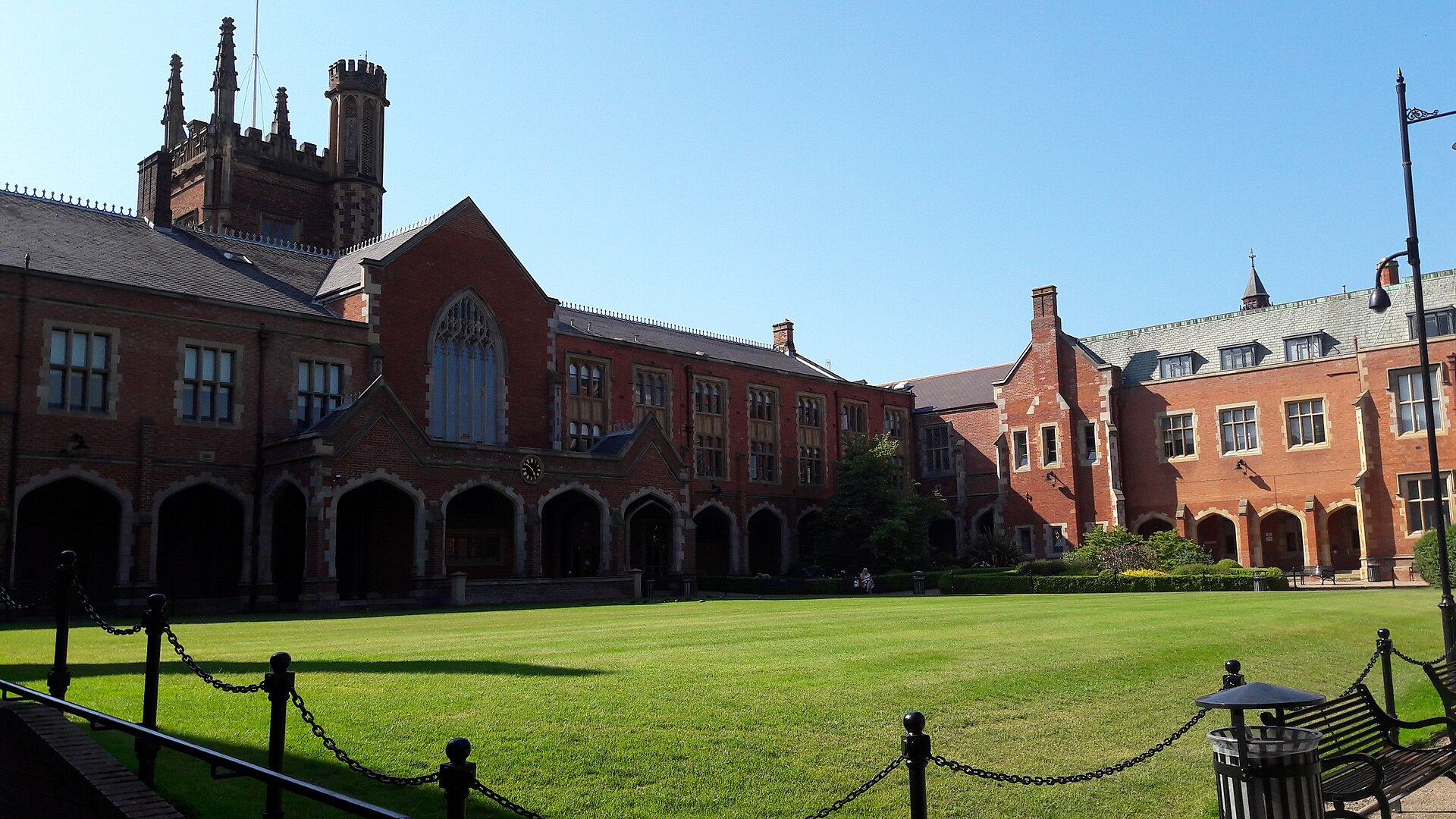

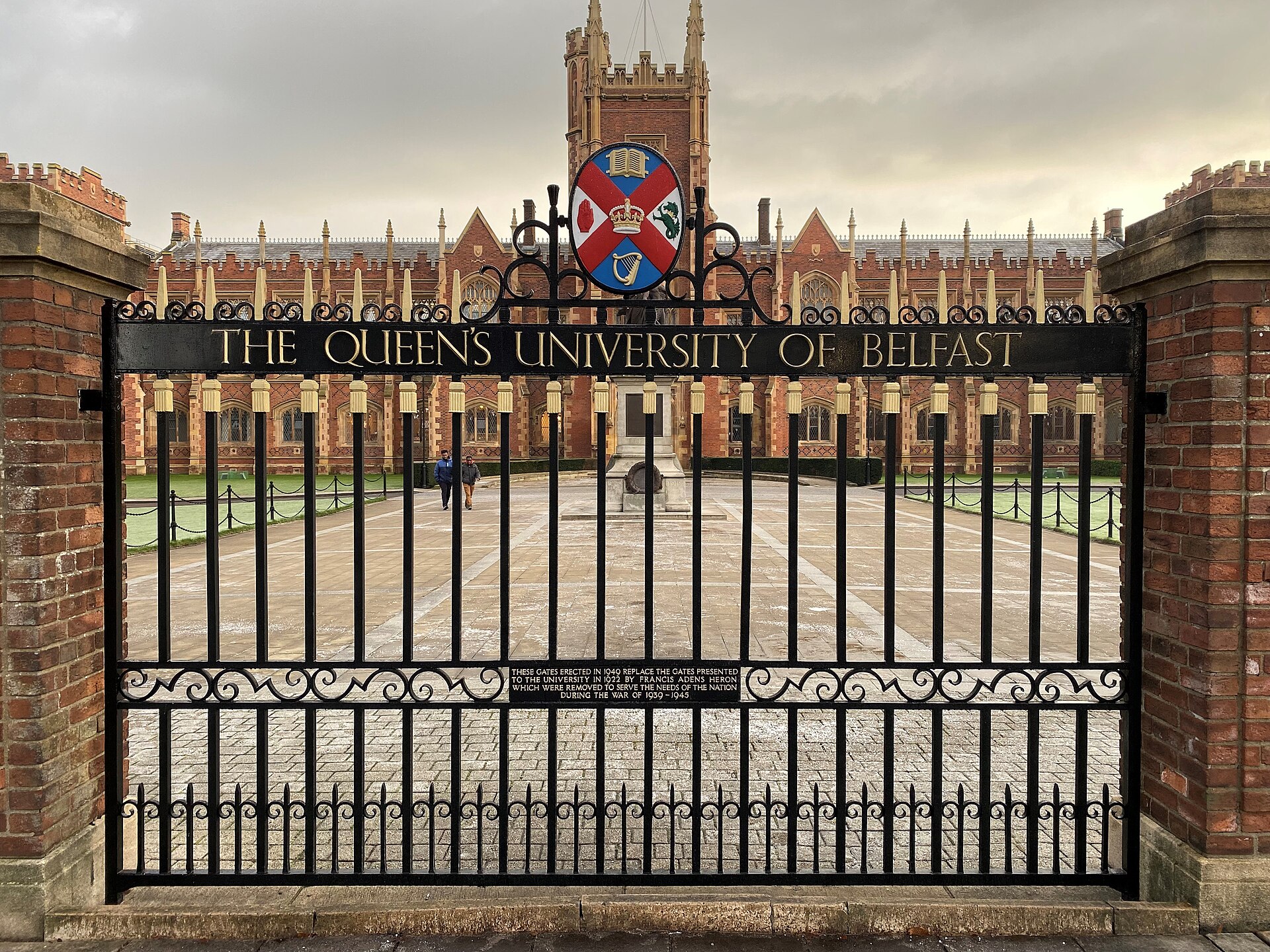
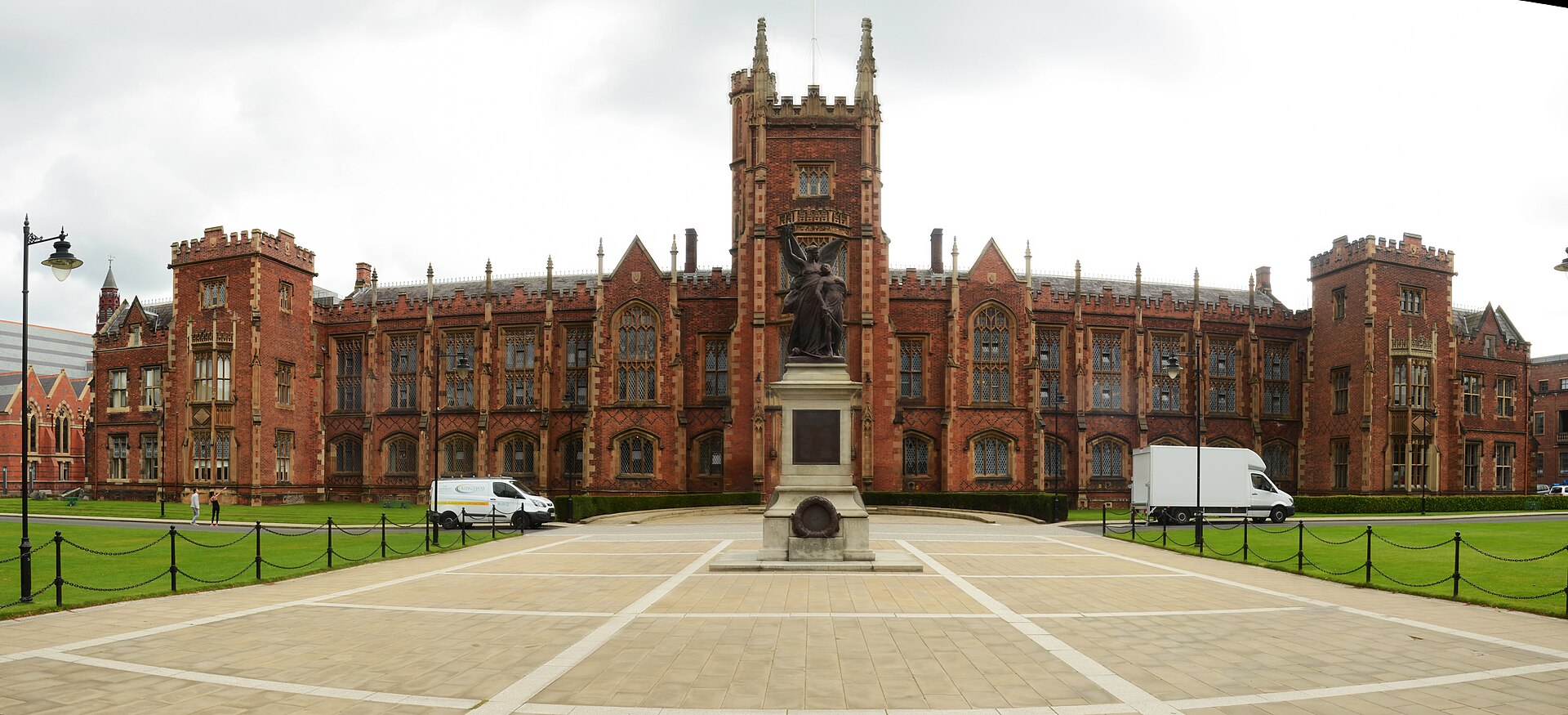

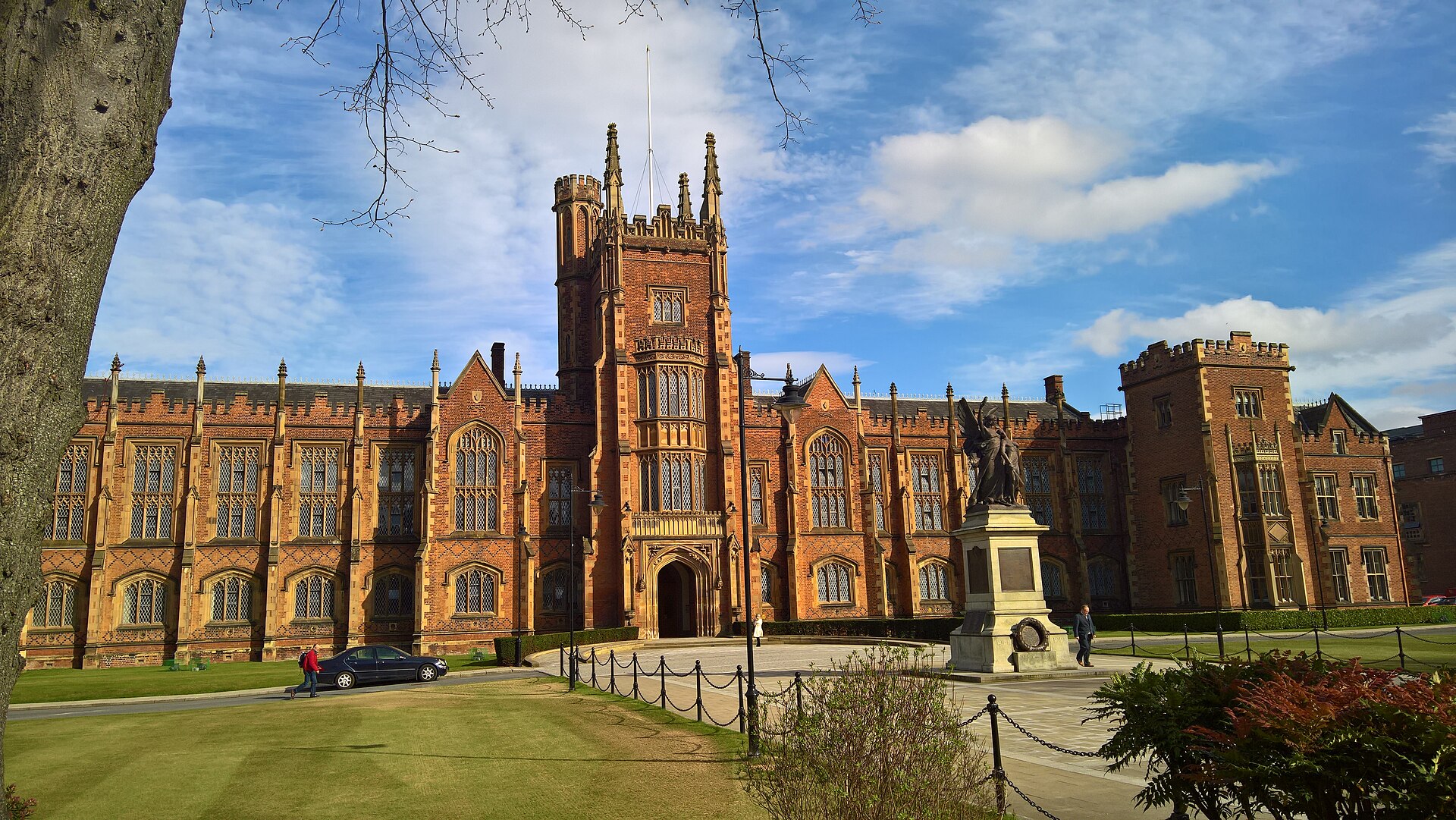
Why Queen's University Belfast — Russell Group Prestige at Genuine Affordability
Queen's sits in a rare position: a genuinely research-intensive Russell Group university where international students can access world-class academics, exceptional facilities, and a vibrant campus community without the stratospheric costs of London. For international students weighing a UK degree, it deserves serious consideration.
Queen's University Belfast Acceptance Rate & Typical Academic Profile
Stats
Profile Stats
Rea Vs Rd
Queen's University Belfast Admissions Requirements — A-Levels, IB & International Qualifications
- Most competitive courses require specific subjects — e.g. Chemistry + Biology for Medicine
- IB offers typically around 33 points overall, with HL subject conditions
- Course rigour and subject choice matter as much as grade level
- Predicted grades from your school teacher carry significant weight
- IELTS minimum 6.5 overall (no band below 5.5 for most courses)
- TOEFL iBT minimum 90
- Duolingo English Test minimum 120
- Higher requirements apply for Medicine, Law, and Nursing
- UCAT required for Medicine and Dentistry applicants
- LNAT may be required for Law — verify on course page
- UCAT must be sat before the 15 October UCAS deadline for Medicine
- Strong UCAT score substantially improves chances of interview invitation
Queen's Application Components — UCAS, Personal Statement & Supporting Documents
Queen's University Belfast uses UCAS for all undergraduate applications. The process is unified across UK universities — one application, up to five choices. Here is every component you need for a complete Queen's application.
UCAS Personal Statement — Writing for Queen's University Belfast
Tips
Prompts
What Queen's University Belfast Admissions Tutors Look For
Queen's uses a primarily academic admissions process, but for competitive courses the personal statement, UCAT/LNAT, and reference all matter. Understanding exactly what each part of your application must demonstrate is the foundation of a strong Queen's application strategy.
Financial Aid & Scholarships for International Students at Queen's
Financial aid for international undergraduates at UK universities is structured differently from the US model. Queen's offers merit scholarships and supports students in accessing external funding. The real affordability advantage at Queen's is the combination of competitive tuition and Belfast's exceptionally low cost of living.
All cost figures are USD approximations from the facts file. Actual fees are quoted in GBP and change annually. Always verify current GBP figures on qub.ac.uk/Study/Undergraduate/Fees-and-Finance/
Stats
Contribution Tiers
| Note | Range | Percent | Percent Value |
|---|---|---|---|
| Belfast — significantly lowest of any Russell Group city | Belfast (QUB) | ~$12,000/year | 40 |
| Manchester, Birmingham, Edinburgh — mid-range UK cities | Mid-tier UK cities | ~$16,000–$18,000/year | 60 |
| London — among the most expensive student cities globally | London (UCL, King's, Imperial) | ~$20,000–$24,000/year | 80 |
Key Dates
Advantages
- Medicine applicants MUST meet the 15 October deadline — no exceptions
- Applying in October/November for non-medicine courses maximises your chances in competitive programmes
- Earlier applications give more time for Queen's to process and request missing documents
- Pre-January applications allow more processing time for Student Visa applications
- First-round applicants receive earlier conditional offers and more time to secure accommodation
Disadvantages
- October deadline requires UCAT registration, sitting, and UCAS submission to all align
- Less time to improve senior-year grades before the medicine deadline
- Personal statement must be finalised earlier in Year 13
- Late applications (post-January) face reduced competition for places but fewer places remain
- Clearing is only available for courses with remaining spaces — competitive courses rarely appear
Queen's University Belfast Interview — Format, Questions & Preparation
Interviews at Queen's are primarily used for Medicine and Dentistry, where the interview is a critical selection stage. Most other undergraduate courses do not interview. For medicine, Queen's typically uses a Multiple Mini Interview (MMI) format — a series of short, structured stations testing communication, empathy, ethical reasoning, and clinical awareness. International medicine applicants should prepare specifically for the MMI format.
Meta
Questions
Accommodation & Residential Life at Queen's University Belfast
Unlike Oxford, Cambridge, or Yale, Queen's does not have a residential college system. Students find accommodation through Queen's purpose-built student accommodation (priority for first-years and international students) or private rental in Belfast's student-friendly neighbourhoods surrounding the campus.
Houses
Lottery Steps
- First-year and international students receive priority for on-campus accommodation — apply early through the Queen's Accommodation Portal
- Elms BT9 is the main student village — catered and self-catered options available
- Private accommodation in the Botanic, Holylands, and Stranmillis areas is affordable and student-friendly
- Belfast's compact city means most private accommodation is within walking or cycling distance of campus
- International students arriving for the first time should book university accommodation — the transition support is invaluable
Queen's Schools, Faculties & Key Programmes
- {"label":"Key programmes","value":"Law, English, History, Politics, Creative Writing"}
- {"label":"Distinctive strength","value":"Cross-border legal expertise (post-Brexit NI)"}
- {"label":"Law school reputation","value":"Top UK law school"}
- {"label":"Student satisfaction","value":"Consistently high NSS scores"}
- {"label":"Flagship programme","value":"Aerospace Engineering"}
- {"label":"Key industry partner","value":"Spirit AeroSystems (Belfast)"}
- {"label":"Research institute","value":"ECIT (Electronics & IT)"}
- {"label":"Programmes","value":"Computer Science, Electrical, Mechanical, Civil, Aerospace"}
- {"label":"Medical school","value":"The only medical school in Northern Ireland"}
- {"label":"Cancer research centre","value":"Patrick G Johnston Centre"}
- {"label":"Key programmes","value":"Medicine, Pharmacy, Dentistry, Nursing, Biomedical Sciences"}
- {"label":"NHS affiliation","value":"All NI health trusts"}
- {"label":"Flagship undergraduate","value":"Business Management / Accounting"}
- {"label":"Accreditations","value":"AACSB, AMBA (verify current status)"}
- {"label":"Industry links","value":"Belfast fintech and professional services"}
- {"label":"Postgraduate","value":"MBA, MSc Finance, MSc Management"}
Research & Extracurricular Opportunities at Queen's University Belfast
Career Outcomes & Graduate Employability from Queen's
Queen's graduates are highly regarded by employers in Northern Ireland, across Ireland, and in the UK. 88% are in employment or further study within 15 months of graduation. The university's Russell Group membership, combined with Belfast's lower cost of living and growing employer base, makes it an increasingly sought-after destination for career-focused international students.
Stats
Categories
Our Queen's University Belfast Admissions Track Record & Student Success Stories
Faqs
Is Queen's University Belfast a prestigious university internationally?+
Yes. Queen's is a member of the Russell Group, which comprises the 24 most research-intensive universities in the UK. This places it alongside institutions like the University of Glasgow, the University of Birmingham, and Durham. A QUB degree is internationally recognised by employers and graduate schools.
How do international students apply to Queen's?+
Undergraduate international applicants apply through UCAS (ucas.com), the same portal used by all UK applicants. This allows you to apply to up to five UK universities simultaneously. For postgraduate programmes, application is made directly to Queen's via its online admissions portal.
What IB score do I need for a Queen's offer?+
The typical IB Diploma offer is around 33 points overall, though this varies by course. Medicine and highly competitive courses require higher scores and specific HL subject conditions. Always check the specific IB requirements on the course page at qub.ac.uk — the indicative band is not a guarantee.
Is Belfast safe for international students?+
Yes. Belfast has transformed dramatically and is consistently rated one of the friendliest, most welcoming cities in the UK. The area around the Queen's campus (Botanic/University area) is particularly safe and well-served with student amenities. International students regularly note Belfast's warmth and accessibility.
Do I need a student visa to study at Queen's?+
Non-UK and non-Irish students who are not British citizens or settled in the UK generally need a UK Student Visa. Queen's International Student Support team provides guidance on the visa process. You apply for your visa after receiving your Confirmation of Acceptance for Studies (CAS) from Queen's.
Does Queen's accept US High School qualifications and SAT scores?+
Queen's accepts US applicants presenting their High School diploma together with SAT or ACT scores, and AP exam results. The exact combination required depends on the course. Check the international entry requirements at qub.ac.uk for your specific country and qualification combination.
Are there scholarships available to international students at Queen's?+
Queen's offers a range of merit-based international scholarships and bursaries. These include fee reductions and awards for high-achieving students. Eligibility and amounts change annually — check qub.ac.uk/Study/Undergraduate/Fees-and-Finance/scholarships/ for current offerings. External scholarships (Commonwealth, Chevening for postgraduate, home government schemes) can also be significant.
How does studying in Belfast compare cost-wise to London?+
Significantly lower. Belfast is consistently among the UK's cheapest student cities. Rent for on-campus or private accommodation, food, transport, and social expenses typically amounts to around $12,000 per year — well below the $20,000+ typical in London. The total cost of attendance at Queen's (~$46,000) compares very favourably with London Russell Group universities.
Book a Free Queen's University Belfast Admissions Strategy Session
In 60 minutes our UK admissions specialists will evaluate your academic profile against Queen's course-specific requirements, identify your strongest application angle, develop your UCAS personal statement strategy, and advise on UCAT preparation if you are applying for medicine.
- No commitment required
- UK admissions specialists with deep knowledge of UCAS and Queen's
- Personalised strategy — not generic advice
Queen's University Belfast — Academic Requirements
Queen's University Belfast Academic Requirements, The Honest Breakdown for International Students
What qualifications, grades, and academic profile do Queen's admitted students have? And what does Queen's holistic review mean for students from IB, A-Level, AP, Indian Boards, and other international curricula?
Grades & Academic Standing
How Queen's Evaluates Academic Performance — No GPA Required
Queen's University Belfast does not use the GPA system — the UK uses a different grading structure. For international students from GPA-based systems (US, Canada), Queen's admissions evaluates your academic record in context and translates it to UK equivalences.
For US applicants presenting a GPA: Queen's will look at your unweighted GPA alongside your SAT/ACT scores and AP exam results to build a complete picture. A high GPA without strong SAT scores or advanced coursework may be insufficient for competitive courses. A strong combination of GPA (3.7+), strong SAT performance, and AP scores of 4–5 in relevant subjects is typically competitive.
Academic Context
School Context and International Qualifications — How Queen's Reads Academic Performance
Queen's evaluates academic records within the context of the student's country, school, and qualification system. The university's admissions team has experience reading applications from over 100 countries and qualifications from across the world.
SAT for US Applicants
SAT at Queen's University Belfast — What US Applicants Need to Know
Queen's University Belfast does not require or primarily evaluate SAT scores. Unlike US universities where SAT is a central admissions criterion, Queen's is a qualification-based system. SAT scores are accepted from US applicants as supplementary evidence but do not replace A-Level or IB results.
| Label | Score | Percent |
|---|---|---|
| No published minimum | Supplementary | 50 |
| Indicative competitive range (US applicants) | 1300+ | 70 |
| Strong range for competitive courses | 1400+ | 85 |
ACT for US Applicants
ACT at Queen's — What to Know and How to Present It
The ACT is accepted by Queen's University Belfast alongside the SAT for US applicants presenting High School qualifications. As with the SAT, the ACT supplements rather than replaces the core academic qualification and course-specific subject evidence.
Metrics
Comparison Cards
Testing Strategy
Queen's and Standardised Tests — What Actually Matters
Queen's University Belfast does not have a 'test-optional' policy in the US sense. The university is not primarily a standardised test-based admissions system. Qualification-based entry (A-Level, IB, or international equivalents) is the standard, and SAT/ACT are supplementary tools for applicants from US curriculum schools.
Submit Items
Withhold Items
IB & A-Level Requirements
A-Levels and IB at Queen's — What the Course-Specific Requirements Actually Are
- {"label":"Indicative overall band","value":"33 points (competitive courses; some may be higher)"}
- {"label":"HL expectations","value":"Subject-specific HL grades required for professional courses (e.g. 6+ in HL Chemistry and Biology for Medicine)"}
- {"label":"Subject rigour","value":"HL subjects must align with course prerequisites — confirm on the specific course page"}
- {"label":"Extended Essay","value":"Mentioned in personal statement if relevant to the subject of study"}
- {"label":"Typical offer range","value":"AAB to AAA (course-dependent)"}
- {"label":"Subject requirements","value":"Course-specific — always verify at qub.ac.uk (e.g. Medicine: Chemistry + Biology required)"}
- {"label":"AS results","value":"Reviewed alongside predicted A-Level grades; strong AS performance supports predicted grades"}
Advanced Placement
AP Courses and Queen's — What Counts and What to Present
For US applicants presenting High School transcripts, AP (Advanced Placement) examination results are an important component of demonstrating subject-specific academic readiness. Queen's admissions evaluates AP scores alongside GPA and SAT/ACT to construct an overall academic picture.
Academic Rigour
Rigour of Secondary School Record — What Queen's Actually Evaluates
Queen's, like all Russell Group universities, evaluates not just what grades you achieved but what courses you took to achieve them. Course selection matters — particularly the prerequisite subjects for your chosen degree programme.
Meeting the required subjects for your chosen course, at the required level, in the most academically challenging way available to you.
Subject Preparation
Subject Preparation by Programme — What Queen's Expects
Queen's has specific subject prerequisites for most of its competitive programmes. Unlike Harvard, which admits students broadly to the university rather than a specific course, Queen's makes offers by course — so academic preparation must be directly targeted at your intended degree from the outset.
English Language Requirements
English Language Requirements for International Applicants to Queen's
Queen's University Belfast requires all international students whose first language is not English to demonstrate English language proficiency. Minimum requirements are set at university level but vary by course — always verify the specific requirement for your chosen programme.
Your UCAS personal statement is itself a demonstration of written English competence. A personal statement with significant grammatical errors, unclear expression, or limited vocabulary weakens your application regardless of your IELTS score. The quality of your written English in the personal statement matters to Queen's admissions tutors.
By Programme
Academic Requirements by Programme — What Each Queen's Course Actually Expects
Unlike US universities, Queen's admits students directly to specific courses — not to the university broadly. Academic requirements therefore vary significantly by programme. The table below gives indicative requirements; always verify on the specific course page at qub.ac.uk.
| Signals | Expectation | Concentration |
|---|---|---|
| UCAT score; clinical experience; biology/chemistry excellence | AAA at A-Level including Chemistry + Biology; IB 36+ with HL Chemistry and Biology | Medicine (MBChB) |
| UCAT score; dental work experience; strong science performance | AAA at A-Level including Chemistry + Biology/Physics; IB 36+ with HL Chemistry | Dentistry (BDS) |
| LNAT (verify); analytical writing; legal or policy engagement | AAA–AAB at A-Level; IB 33+ with strong HL humanities | Law LLB |
| Maths excellence; physics competition; coding projects | AAB including Maths + Physics; IB 33+ with HL Maths AA and HL Physics | Aerospace Engineering |
| Programming projects; competition performance; Maths excellence | AAB including Maths; IB 33+ with HL Maths | Computer Science |
| Chemistry excellence; research awareness; clinical interest | AAB including Chemistry; IB 33+ with HL Chemistry | Pharmacy MPharm |
| GCSE Business or Economics; commercial awareness; work experience | ABB–AAB; IB 30+ (no fixed subject prerequisite) | Business Management |
| Writing portfolio; wide reading; creative engagement | ABB including English; IB 30+ with HL English | Creative Writing |
International Curricula
How Queen's Evaluates International Qualifications — Your Curriculum Explained
Roadmap
Building a Competitive Queen's Application — What to Do at Each Stage
- Choose GCSE or MYP subjects that keep options open for your intended degree. For STEM professional courses, prioritise triple science and strong mathematics.
- Begin exploring your subject interest beyond school — wider reading, documentaries, subject-related YouTube channels, visiting university open days.
- Research UCAS and understand how the UK university system works early — it is fundamentally different from most national systems.
- Choose subjects that meet the EXACT prerequisite requirements for your target Queen's course. Do not sacrifice required subjects for variety.
- If applying for Medicine or Dentistry, research the UCAT — it is sat in Year 12 or early Year 13 and requires structured preparation.
- IB students: choose HL subjects in prerequisite areas (e.g. HL Chemistry and HL Biology for Medicine). Avoid choosing easier HL subjects to protect your grade — admissions tutors notice.
- Identify relevant work experience or volunteering opportunities to pursue in Year 12.
- Achieve strong AS or first-year IB predicted grades. These feed into your UCAS application.
- Pursue relevant work experience: clinical shadowing for medicine, legal volunteering or mooting for law, engineering or coding projects for STEM.
- Register for UCAT if applying for Medicine/Dentistry — typically in the spring before Year 13 submission.
- Begin background research on the UCAS personal statement. Start collecting specific examples and reading material you can reference.
- Write your UCAS personal statement carefully. Draft Section 1 (Why this subject?) first — this is the foundation.
- Register for and sit UCAT if applicable.
- Submit your UCAS application by 15 October for Medicine/Dentistry, or target November/December for other courses.
- Ensure your referee (school counsellor or head teacher) has ample time to write a strong reference — brief them well.
- Receive conditional offers from Queen's and other universities. Conditions are expressed as A-Level grades or IB points.
- If invited to interview for Medicine — prepare thoroughly for MMI format. Tychr provides structured MMI preparation.
- Continue working to achieve or exceed your predicted grades.
- Accept your Firm (first choice) and Insurance (backup) offers on UCAS before the reply deadline.
- If you meet or exceed your conditional offer conditions, your place is confirmed.
- If you narrowly miss conditions, contact Queen's admissions immediately — they sometimes accept students who are close.
- If your results are higher than expected, you may be eligible for Adjustment (upgrading to a higher-offer university).
- If you have no place, Clearing offers remaining spaces across UK universities.
Common Pitfalls
Academic Mistakes That Cost Queen's Applications — And How to Avoid Them
Real Outcomes
Academic Profiles of Tychr Students Admitted to Queen's University Belfast
The following profiles represent the academic backgrounds of international students Tychr has helped gain Queen's University Belfast admission. They illustrate the range of academic preparation that works — and what made each application distinctive.
Faqs
Is an IB score of 33 always enough for Queen's?+
It depends on the course. Some programmes (arts, social sciences, some sciences) will consider 33 points competitive. Medicine and other highly competitive courses may require higher points plus specific HL subject conditions. Always check the course page at qub.ac.uk for the specific IB requirement.
What is the minimum IB score for Queen's?+
The 33-point figure in the facts file is an indicative band for competitive courses — not the minimum for all courses. Some courses accept lower; some competitive courses require higher. Always verify the specific requirement for your course.
Do I need to take the SAT or ACT to apply to Queen's?+
No. SAT and ACT are only relevant for US High School applicants. If you have IB or A-Level qualifications, those are your primary academic credentials. Queen's does not require SAT or ACT from IB or A-Level students.
Can I apply to Queen's with Indian Board qualifications?+
Yes. Queen's accepts Indian Higher Secondary qualifications (CBSE and ISC). Very high marks are typically required for competitive courses — often 85%+ overall and high marks in required subjects. Check the specific Indian requirements on the Queen's international entry requirements page at qub.ac.uk.
Does Queen's offer foundation programmes for students who miss direct entry requirements?+
Yes. International students who do not yet meet direct entry requirements may be eligible for foundation or pathway programmes that lead into undergraduate study. These are typically one-year programmes. Contact Queen's International office for details on foundation pathways.
Cost & Financial Aid
Queen's University Belfast May Be More Affordable Than You Think — Here's the Full Picture.
Queen's University Belfast offers a Russell Group degree at a total cost of attendance that is among the lowest in the group. Belfast's exceptionally low cost of living is the key advantage — here is what it actually costs to study at Queen's, what financial support exists, and how to fund your degree.
Cost Transparency
What Queen's University Belfast Actually Costs — The Full Annual Figure
Belfast's cost of living advantage is the defining financial feature of studying at Queen's. The estimated $12,000 annual cost of living is well below comparable UK university cities. London, Edinburgh, Manchester, and Bristol all carry higher day-to-day costs — often by $6,000–$10,000 per year. Over a three-year degree, this difference compounds significantly.
Financial Aid Reality
Financial Aid for International Students at Queen's — How the UK System Works
UK universities including Queen's do not operate a US-style need-blind, full-need financial aid system for international undergraduate students. The UK system relies primarily on merit-based scholarships, external government scholarships (from your home country), and UK government schemes that are generally not available to international students.
The Queen's Value Proposition
Why Queen's Represents Exceptional Value for International Students
Funding Your Queen's Degree
How to Fund Your Queen's Degree — Step-by-Step
Unlike US need-blind universities where aid is centrally assessed, funding a Queen's degree as an international student requires proactive research across multiple sources — institutional, external, and government. Here is the complete process.
- Many national governments fund study at recognised UK universities — check what your government offers
- Chevening (UK government) funds postgraduate study for future leaders — primarily master's level
- Commonwealth Scholarships support citizens of Commonwealth nations at UK universities
- Some corporate and foundation scholarships specifically target UK study
- Most Queen's scholarships require you to hold an offer
- Apply to Queen's through UCAS (ucas.com)
- Once you receive a conditional offer, you can apply for relevant scholarships
- Visit qub.ac.uk/Study/Undergraduate/Fees-and-Finance/scholarships/
- Note which awards require a separate application vs automatic consideration
- Check eligibility — some awards are country-specific, subject-specific, or merit-threshold based
- British Council GREAT Scholarships — open to undergraduates from certain countries
- Commonwealth Scholarship and Fellowship Plan — check eligibility for your country
- Chevening — primarily postgraduate but worth understanding for future reference
- The UK Immigration Health Surcharge (IHS) is paid upfront with your Student Visa application
- IHS covers NHS healthcare during your studies
- Amount changes periodically — check gov.uk/healthcare-immigration-application for current rates
- Budget this into your overall cost planning
- Student Visa typically permits up to 20 hours/week during term time
- Full-time work permitted during vacations
- Belfast's student-friendly employers and cost of living make part-time work a practical supplement
- Confirm your specific visa conditions before working
For International Students
Financial Aid for International Students at Queen's — The Honest Picture
Here is what international undergraduates need to understand about financial support at Queen's — clearly and honestly.
What Aid Looks Like
Financial Support at Queen's — What International Students Actually Receive
Indicative Aid Scenarios for International Undergraduate Students
Specific scholarship amounts change annually. Always verify current awards on qub.ac.uk/Study/Undergraduate/Fees-and-Finance/scholarships/. No aid figures have been fabricated — only scenarios based on the types of support known to be available.
Unlike US need-blind institutions, Queen's does not publish average aid figures for international students. The most significant aid available is merit scholarships from Queen's (partial fee reduction), external government scholarships from your home country (potentially full cover), and the inherent cost advantage of Belfast's low cost of living relative to other UK university cities.
| Grant | Income | Contribution |
|---|---|---|
| Partial fee reduction (amount varies — verify at qub.ac.uk) | High academic achievement | Reduced tuition |
| External government scholarship (varies by country) | Home country scheme eligible | Full or partial cover |
| Commonwealth Scholarship (if eligible) | Commonwealth citizen | Full cover possible |
| No award — full costs | Standard international student | Full tuition + living (~$46,000/yr) |
Table Headers
Scholarship Landscape
Scholarships at Queen's — What Exists and Who Qualifies
Queen's offers merit-based scholarships for international undergraduate students. Unlike US need-blind institutions, the UK does not have a comprehensive need-based aid system for international students at the undergraduate level. Awards at Queen's are primarily merit-based.
External Funding
External Scholarships for International Students at Queen's
For international undergraduates at Queen's, external scholarships from home country governments, international organisations, and UK government programmes are often the most significant potential source of financial support. These are separate from — and often larger than — Queen's institutional awards.
Loan Policy
Student Loans and International Students at Queen's — What You Need to Know
International students at Queen's University Belfast are not eligible for UK Student Loans from Student Finance Northern Ireland (or Student Finance England, Scotland, or Wales). This is a fundamental planning assumption that all international students must understand before applying.
Part-Time Work
Part-Time Work for International Students at Queen's — What to Expect
International students at Queen's on a UK Student Visa are typically permitted to work up to 20 hours per week during term time and full-time during academic vacations. This is an important practical supplement for international students managing living costs in Belfast.
- On-campus roles in libraries, catering, student services, and administrative departments
- Part-time work in Belfast's hospitality, retail, and service sector (highly accessible in a compact city)
- Student Ambassador roles at Queen's open days and events
- Tutoring and peer mentoring through Queen's academic support services
- Research assistant roles in university departments (typically for later-year students with relevant academic backgrounds)
- Graduate-scheme and placement-year work experience (integrated into certain programmes)
Benchmarking
Queen's vs Other Russell Group Universities — Cost Comparison
| Policy | School | No Loans | Typical Cost |
|---|---|---|---|
| Merit scholarships available; no need-based aid for international UG | Queen's University Belfast | N/A (UK system) | ~$46,000/yr (COA estimate) |
| Merit scholarships; no need-based international UG aid | University of Edinburgh | N/A | ~$52,000–$58,000/yr |
| Merit scholarships; no need-based international UG aid | University of Manchester | N/A | ~$50,000–$56,000/yr |
| Merit scholarships; no need-based international UG aid | King's College London | N/A | ~$58,000–$68,000/yr |
| Need-blind, full-need, no-loan for all admitted students | Harvard University (comparison) | Yes (grant-only) | $0 for families under $85K/yr |
True Cost Analysis
Queen's vs Alternatives — What You Actually Pay as an International Student
For international students without major external scholarships, Queen's represents a genuinely more affordable Russell Group education than equivalent institutions in London. The prestige signal of Russell Group membership is present; the London cost premium is not. For families where total cost of degree matters, this comparison can be decisive.
| Policy | School | Contribution | Four Year Cost |
|---|---|---|---|
| Russell Group; Belfast low cost of living | Queen's University Belfast | ~$30,000/yr (tuition) | ~$138,000 (3yr degree) |
| Russell Group; London high cost of living | King's College London | ~$36,000–$40,000/yr (tuition) | ~$210,000+ (3yr) |
| Russell Group; Edinburgh medium-high cost | University of Edinburgh | ~$28,000–$32,000/yr (tuition) | ~$165,000+ (4yr Scottish) |
| Need-blind, no-loan (US comparison) | Harvard (family income $75K) | ~$0/yr | ~$0–$5,000 total |
Aid Review
Reviewing Aid Decisions at Queen's — What International Students Can Do
Queen's University Belfast does not use a financial aid appeals process in the US sense — because it does not operate a comprehensive need-based aid programme for international undergraduates. However, there are mechanisms for reviewing scholarship decisions and for seeking additional support in exceptional circumstances.
The honest note: the most effective approach is not to appeal an individual scholarship decision at Queen's, but to plan your funding strategy comprehensively from the start — identifying home government schemes, external scholarships, and the inherent cost advantage of Belfast living before committing to an application.
How To Appeal
- Contact Queen's Student Finance team directly to ask about the basis of any scholarship decision
- Check whether any additional bursary or hardship fund exists for students experiencing unexpected financial difficulty
- Contact your home country's government scholarship agency if you believe you may qualify for external support that was not explored at application stage
When To Appeal
- Your financial circumstances have changed significantly since you accepted your place (serious family financial difficulty)
- You believe a scholarship decision was based on incorrect information
- You want to ask whether any additional hardship or emergency funding is available during your studies
Planning Timeline
Planning for the Cost of Your Queen's Degree — What to Do and When
UCAS PERSONAL STATEMENT
Writing Your UCAS Personal Statement for Queen's University Belfast
Unlike US universities, Queen's University Belfast does not use supplemental essays. Undergraduate applications go through UCAS, and the core written element is the UCAS Personal Statement. From 2026, UCAS introduced a new three-section format replacing the old single-essay structure. This guide helps international students write a personal statement that stands out to Queen's admissions tutors.
The UCAS personal statement is read by every UK university you apply to, so it must be genuinely relevant to your chosen subject without being too institution-specific. Admissions tutors at Queen's are expert at spotting generic statements — they want to see real intellectual engagement with the discipline, specific evidence of preparation, and a clear sense of why you want to study this subject at degree level.
HOW IT WORKS
The UCAS Application: What You Write
From the 2026 UCAS admissions cycle, the personal statement has moved from a single open-ended essay to a structured three-question format. Each section is separately assessed and has its own character limit.
UCAS PROMPTS (2026 FORMAT)
The Three UCAS Personal Statement Questions
The following reflects the UCAS 2026 personal statement format. Confirm the exact character limits and wording at ucas.com for your specific application cycle, as UCAS continues to refine the format.
STRATEGY OVERVIEW
How to Approach the UCAS Personal Statement for Queen's
The UCAS personal statement is fundamentally different from a US Common App essay. It is not about your personality or life story — it is about your academic subject. UK admissions tutors at Queen's want to know that you are intellectually ready for degree-level study in your chosen field.
The three-section format introduced in 2026 has made this more structured. Each section answers a specific question, and there is less space for creative narrative. Clarity, specificity, and relevance are the core qualities. Your statement should read like it was written by someone who genuinely loves the subject and has spent real time preparing for it — not someone who has taken a scattershot approach to building a CV.
Since you apply to Queen's and up to four other UK universities on the same form, your statement must work for all five. If you are applying to different courses at different universities — e.g. Computer Science at Queen's and Software Engineering elsewhere — make sure your statement covers both adequately. Applying to different subjects (e.g. Medicine and Biology) on the same UCAS form is generally inadvisable as personal statements cannot serve both well.
COURSE-BY-COURSE TIPS
Personal Statement Strategy by Subject at Queen's
CHOOSING YOUR FOCUS
How to Find Your Angle for the UCAS Personal Statement
Many students struggle with what to write about. The key insight is that admissions tutors at Queen's are not looking for the most dramatic story — they are looking for the most intellectually engaged student. Here is how to find your approach.
WHAT NOT TO DO
Common Personal Statement Mistakes for Queen's Applications
- Writing about your personality traits or life philosophy rather than your academic subject. UK personal statements are about the subject, not the person.
- Mentioning a specific university by name in your personal statement — your statement is read by all five of your UCAS choices simultaneously.
- Using generic opening lines: 'From a young age I have always been fascinated by...' — these are spotted immediately and create a weak first impression.
- Listing extracurriculars with no relevance to the course. UK tutors are less impressed by a long activity list than US admissions officers. Every experience you mention should connect to your subject.
- Copying the structure of AI-generated or template personal statements. UCAS has plagiarism detection, and admissions tutors recognise mass-produced prose instantly.
- Mixing different subjects in one personal statement. If you are applying to both Law and History, your statement will be weak for both. Focus on one subject per application.
- Ignoring the three-question structure and trying to write one flowing essay. The 2026 UCAS format has distinct sections — address each directly.
- Leaving the personal statement until the last minute. The three-section format requires careful thought and multiple drafts. Start in Year 12 and plan to complete it well before the UCAS opening in September of Year 13.
PERSONAL STATEMENT FAQS
UCAS Personal Statement FAQs for Queen's Applicants
Does Queen's send my personal statement to the specific course admissions tutor?+
Yes. At most UK universities, personal statements are read by academic staff in the relevant department — not by a central admissions office as is common in the US. The person reading your Medicine statement is a medical academic at Queen's. Write with this specialist reader in mind.
Does Queen's interview all international applicants?+
Interviews are used for some courses (particularly Medicine and Dentistry), not for all courses. Medicine interviews at Queen's are typically structured MMI (Multiple Mini Interview) or panel format. If you are applying to medicine, prepare thoroughly for interview if you receive an invitation. Most other courses do not interview.
How much does the personal statement actually matter at Queen's compared to grades?+
For most courses, grades are the primary factor — if you do not meet the grade conditions, the personal statement cannot save your application. But for competitive courses where many applicants have similar predicted grades, the personal statement is the key differentiator. Medicine, Law, and competitive science courses are the most obvious examples.
Can I write about international experiences — e.g. a hospital visit in India or legal internship in Dubai?+
Absolutely. International experience is genuinely valued. What matters is that you reflect meaningfully on it — what you observed, what questions it raised, what you concluded. International healthcare, legal, or cultural experience can make a statement distinctive when discussed with specific reflection.
The new UCAS three-question format launched in 2026. Do I have to follow it?+
Yes — all applicants entering through the 2026 cycle onwards use the new format. The old single open-ended essay no longer exists for new applicants. Check ucas.com for the current character limits and exact wording for each question before you start writing.
Should I work with a counsellor on my UCAS personal statement?+
Working with an experienced admissions counsellor — particularly one familiar with UK UCAS applications and Queen's admission standards — can be very helpful for international students. The UK system is very different from US college applications and from most other national systems. Guidance on framing subject passion and structuring the three sections is valuable.
What is the word count limit for the UCAS personal statement sections?+
UCAS introduced character limits for each of the three sections in the 2026 format. Visit ucas.com for the exact character limits for your specific application cycle — these may be adjusted as UCAS refines the format. Do not assume historical word counts apply; always check the current guidance on the official UCAS website.
Does Queen's prefer medicine applicants from certain countries or educational backgrounds?+
No. Queen's evaluates international medicine applications on the same criteria as UK applicants: academic qualifications (equivalent to AAA at A-Level including Chemistry and Biology), UCAT score above the shortlisting threshold, and personal statement quality. Nationality is not a factor in the academic assessment.
Courses — schools, degrees & intake
89 degrees across 15 groupings.
School of Arts, English and Languages · 12 degrees
BA English
BA English Language and Linguistics
BA Drama
BA Music
BA French
BA Spanish
BA French and Spanish
BA Film Studies
BA Creative Writing
BA Liberal Arts
BA History of Art
BA Celtic Studies
School of History, Anthropology, Philosophy and Politics · 8 degrees
BA History
BA Politics
BA International Relations
BA Philosophy
BA Anthropology
BA Archaeology
BA Philosophy, Politics and Economics
BA History and Politics
School of Law · 5 degrees
LLB Law
LLB Law with French
LLB Law with Spanish
LLB Law with Politics
LLB Criminology and Criminal Justice
Queen's Business School · 8 degrees
BSc Accounting
BSc Business Management
BSc Economics
BSc Finance
BSc International Business
BSc Business Analytics
BSc Human Resource Management
BSc Marketing
School of Social Sciences, Education and Social Work · 5 degrees
BA Education (Primary)
BSc Social Work
BA Sociology
BSc Social Policy
BA Media and Communication
School of Chemistry and Chemical Engineering · 7 degrees
BSc Chemistry
MChem Chemistry
BEng Chemical Engineering
MEng Chemical Engineering
BSc Biochemistry
BSc Medicinal and Biological Chemistry
BSc Food Science
School of Electronics, Electrical Engineering and Computer Science · 9 degrees
BEng Computer Science
MEng Computer Science
BSc Software Engineering
BEng Electrical and Electronic Engineering
MEng Electrical and Electronic Engineering
BSc Data Science and Analytics
BSc Cybersecurity
BSc Artificial Intelligence
BEng Computer Science and Electronics
School of Mathematics and Physics · 6 degrees
BSc Mathematics
MMath Mathematics
BSc Physics
MSci Physics
BSc Mathematics and Physics
BSc Financial Mathematics
School of Mechanical and Aerospace Engineering · 5 degrees
BEng Mechanical Engineering
MEng Mechanical Engineering
BEng Aerospace Engineering
MEng Aerospace Engineering
BEng Product Design and Engineering
School of Natural and Built Environment · 7 degrees
BEng Civil Engineering
MEng Civil Engineering
BA Architecture
BSc Environmental Science
BSc Geography
BSc Planning
BSc Archaeology
School of Psychology · 2 degrees
BSc Psychology
BSc Applied Psychology
School of Biological Sciences · 7 degrees
BSc Biology
BSc Biomedical Science
BSc Genetics
BSc Microbiology
BSc Marine Biology
BSc Zoology
BSc Ecology
School of Medicine, Dentistry and Biomedical Sciences · 3 degrees
MB BCh BAO Medicine
BDS Dentistry
BSc Paramedicine
School of Nursing and Midwifery · 4 degrees
BNSc Nursing (Adult)
BNSc Nursing (Mental Health)
BNSc Nursing (Child)
BMid Midwifery
School of Pharmacy · 1 degrees
MPharm Pharmacy
Want your real chances at Queen's University Belfast?
Create a free TYCHR account for your personalised admit-chance, a shortlist you can track, exact entry requirements, and essay + counselling help.