← All universities

La Trobe University

Melbourne, Australia · Suburban

Innovative Research UniversitiesPublicResearchCoed
Acceptance
65.0%
QS World
#220
Tuition/yr
$25,100
Students
38,000
Founded
1964

La Trobe is one of Australia's leading public research universities — a parkland campus in Melbourne's north, a 30% international student body, and a national reputation built on health sciences, biomedicine, and applied research. For ambitious international students seeking direct, merit-based entry into Australia's healthcare, research, and professional sectors, La Trobe offers clarity, value, and genuine opportunity.

Campus

La Trobe University — campus in pictures

Real, freely-licensed photographs of the campus (via Wikimedia Commons).
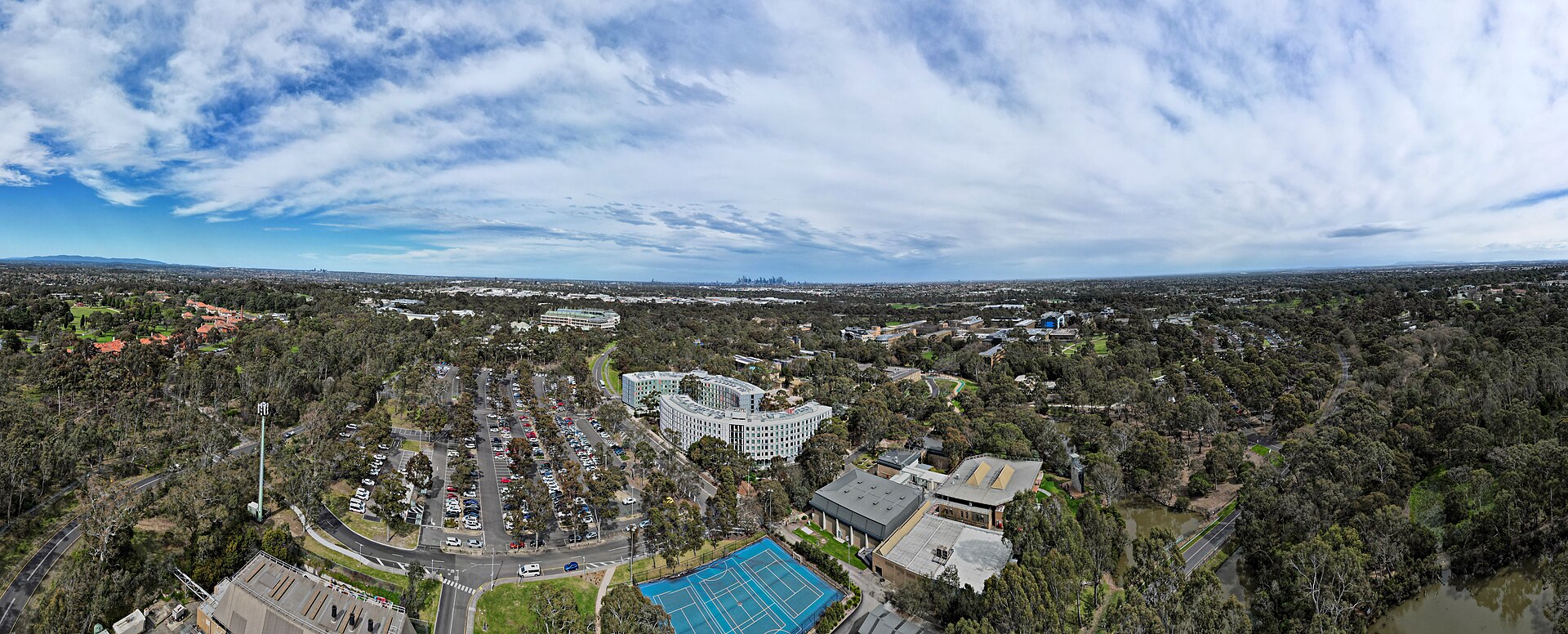
La Trobe University Bundoora Campus aerial panorama, facing south towards the city skyline. September 2023.
La Trobe University Bundoora Campus aerial panorama, facing south towards the city skyline. September 2023.Bob Tan · CC BY 4.0 · via Wikimedia Commons
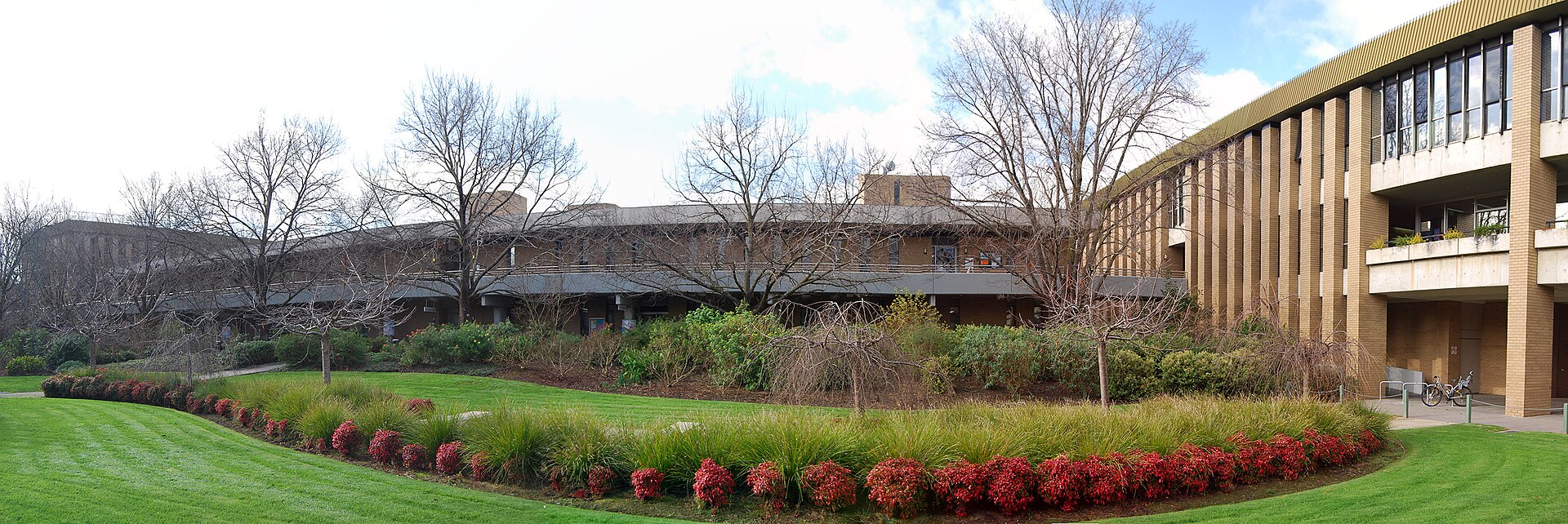
David Myers Building Panorama
David Myers Building PanoramaPhil Lees · CC BY-SA 2.0 · via Wikimedia Commons
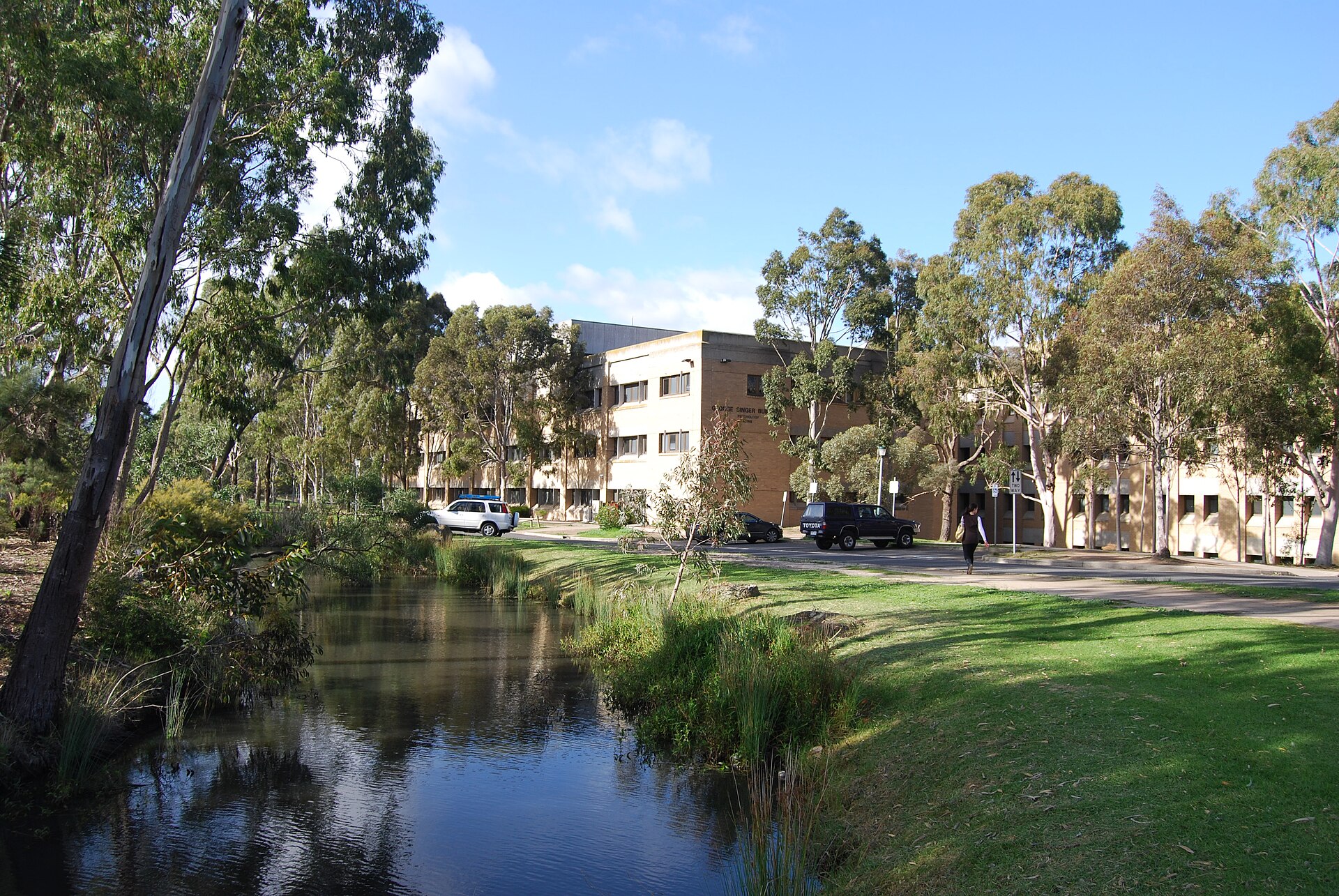
Moat with George Singer Building in the background, at La Trobe University Bundoora, Australia
Moat with George Singer Building in the background, at La Trobe University Bundoora, AustraliaPhil Lees · CC BY-SA 2.0 · via Wikimedia Commons
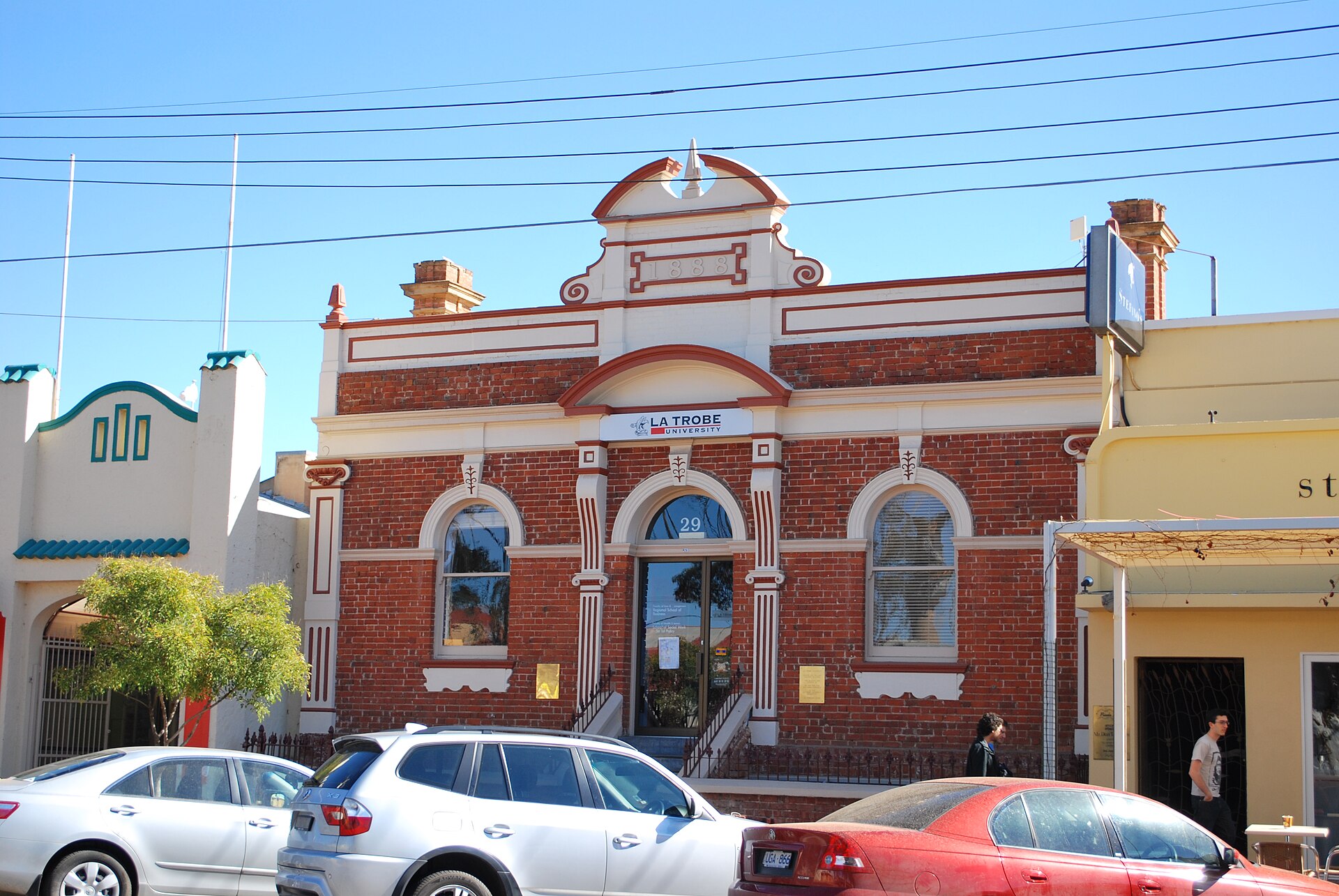
Offices of en:La Trobe University at en:Mildura, Victoria
Offices of en:La Trobe University at en:Mildura, VictoriaMattinbgn · CC BY-SA 3.0 · via Wikimedia Commons
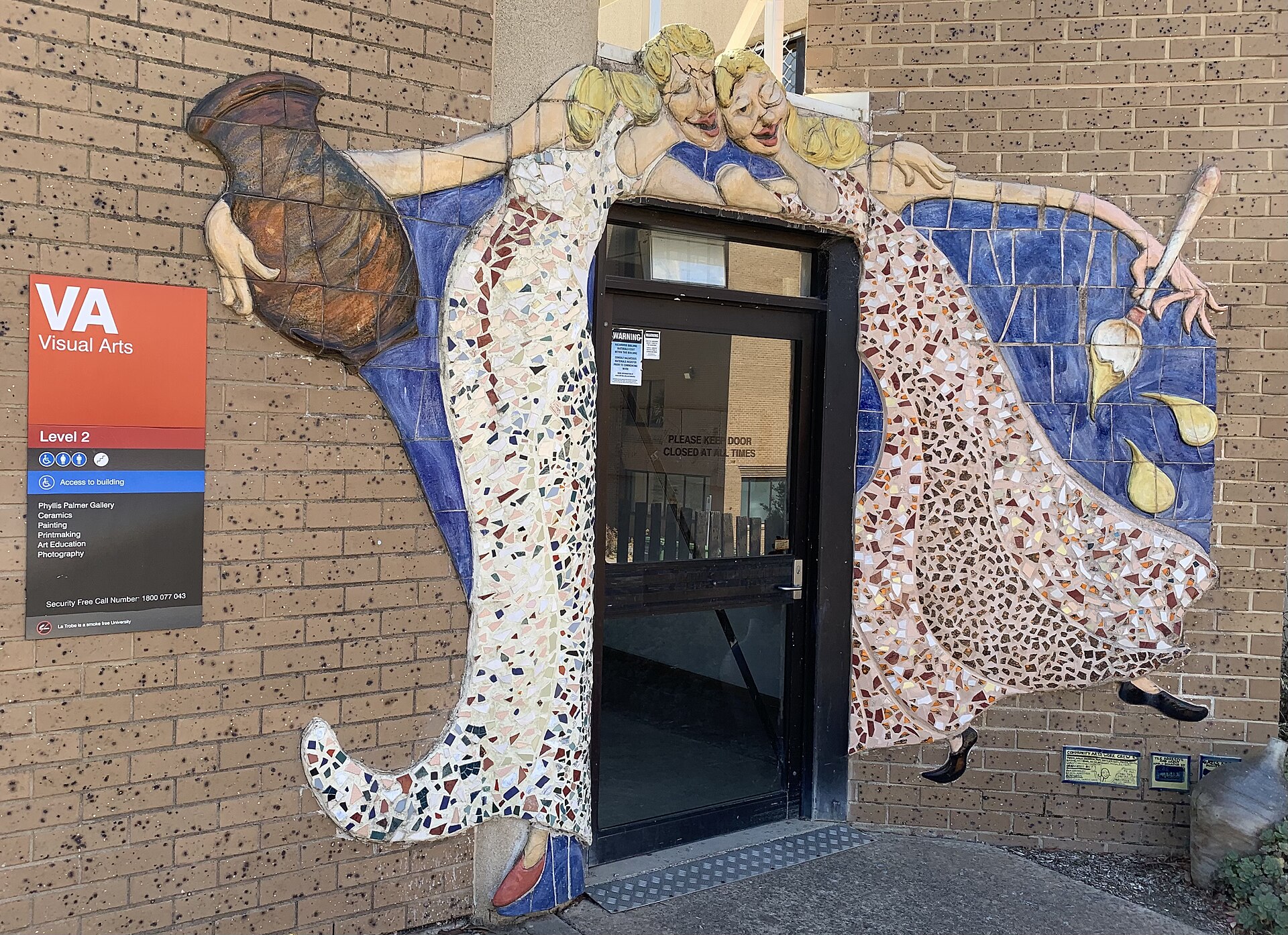
The Visual Arts Building at the Bendigo Campus (Flora Hill). A mosaic depicting two artists is visible
The Visual Arts Building at the Bendigo Campus (Flora Hill). A mosaic depicting two artists is visible118mate · CC BY-SA 4.0 · via Wikimedia Commons
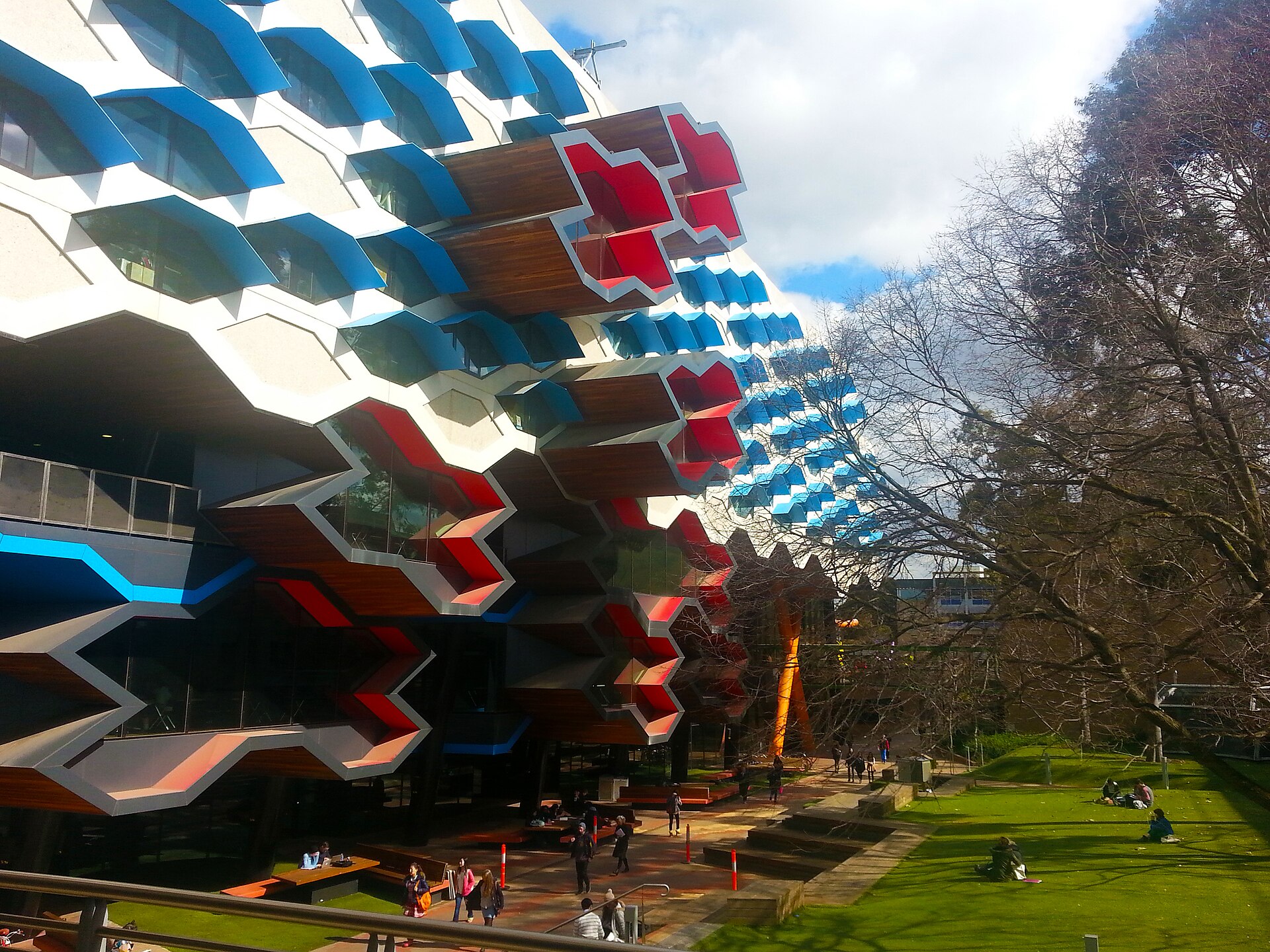
La Trobe Institute for Molecular Science (LIMS), Melbourne Australia - side view
La Trobe Institute for Molecular Science (LIMS), Melbourne Australia - side viewFung Lay · CC BY-SA 4.0 · via Wikimedia Commons

Why La Trobe — Health, Research, Melbourne & Outcomes

La Trobe is not simply a gateway to Australia — it is a serious research university with deep specialisation in health sciences, biomedicine, and applied social science. Its Melbourne location, genuine international community, and direct entry model make it one of the most accessible and strategically valuable choices in Australian higher education.

01Health Sciences Powerhouse
La Trobe is consistently recognised as one of Australia's leading universities for nursing, physiotherapy, biomedicine, and public health — with deep clinical placement networks across Victoria and nationally.
02QS Top 250 Globally
Ranked #220 in the QS World University Rankings and #18 nationally, La Trobe is a serious research university recognised by Australian employers and international graduate programmes alike.
03Melbourne — A World City for Students
The Bundoora campus lies in Melbourne's north, a 30-minute journey from the CBD. Melbourne is consistently ranked among the world's most liveable cities, with a vibrant multicultural scene, world-class public transport, and deep student infrastructure.
04Genuinely International Community
30% of La Trobe's 38,000 students are international, drawn from over 100 countries. Dedicated international student support — orientation, peer mentoring, academic skills, and counselling — is embedded across all campuses.
05Strong Graduate Employment
86% of La Trobe graduates are employed within four months of graduation, with average starting salaries around USD 42,000 (approximately AUD 65,000). Health, education, and business graduates benefit from direct industry partnerships across Victoria.
06Innovative Research Universities Network
La Trobe is a founding member of Australia's Innovative Research Universities (IRU) — a network of regionally engaged research universities emphasising applied research with genuine community and industry impact.

La Trobe Acceptance Rate & Entry Profile

Stats

38,000
Total Enrolment
30%
International Students
#220
QS World Rank

Profile Stats

~65%
Overall Acceptance Rate
27
IB Minimum Score
30%
International Students
86%
Graduate Employment Rate
#18
National Rank (Australia)
#275
THE World Rank
Overall acceptance rate — varies significantly by programme

Rea Vs Rd

Rd Label: Semester 2 (July) Intake
Rd Value: Mid-year
Rea Label: Semester 1 (February) Intake
Rea Value: Primary

La Trobe Admissions Requirements — Qualifications, English & Prerequisites

Academic Qualifications
Value: IB 27+ (floor)
  • IB minimum 27 university-wide; competitive programmes require more
  • Physiotherapy, Biomedicine, Nursing typically require IB 30–35+
  • A-Level equivalent assessed in ATAR terms
  • Indian board results converted to ATAR equivalent
La Trobe uses academic results as the primary admission criterion. Your secondary school results are converted to an ATAR equivalent. The minimum IB score is 27, but this is a floor — competitive health and law programmes require significantly higher results.
English Proficiency
Value: IELTS 6.5 overall
  • IELTS minimum: 6.5 overall, no band below 6.0
  • TOEFL iBT minimum: 79
  • Duolingo English Test minimum: 110
  • Health programmes may require IELTS 7.0+
All international students must demonstrate English proficiency via IELTS, TOEFL, Duolingo, or equivalent. Most undergraduate programmes require IELTS 6.5 overall with no band below 6.0. Health science programmes often require higher.
Subject Prerequisites
Value: Prerequisites matter
  • Biomedicine: Biology and Chemistry typically required
  • Physiotherapy: Biology essential, Chemistry preferred
  • Engineering and CS: Mathematics required
  • Law and Business: No specific prerequisites but strong English required
Many La Trobe programmes have mandatory prerequisite subjects. Missing a prerequisite is grounds for rejection regardless of overall academic performance. Always verify the specific programme page before applying.

La Trobe Application Components — Direct Online Application

La Trobe is a direct-apply institution for international students — there is no centralised application system like UCAS or the Common App. The process is significantly simpler: submit your documents online and receive an offer based on academic merit.

01RequiredOnline Application
Apply directly through La Trobe's online application portal at latrobe.edu.au. Select your programme, campus, and intake. Application fee: approximately USD 50 (AUD 75).
02RequiredAcademic Transcripts
Certified copies of official academic transcripts from all secondary institutions attended. Predicted grades accepted for conditional offers — final results required before enrolment.
03RequiredEnglish Proficiency Test
IELTS Academic, TOEFL iBT, Duolingo English Test, or equivalent. Submit with your application — do not sit the test close to your application deadline.
04RequiredPassport Copy
A current passport copy confirms your identity for visa and enrolment processing. Required for all international applicants.
05ConditionalProgramme-Specific Requirements
Some programmes require additional documentation — for example, creative arts portfolios, or statements for equity access applications. Check your specific programme page.
06OptionalScholarship Application
Scholarships have separate applications. Apply for merit scholarships immediately after (or during) your course application — deadlines vary and may close before the course deadline.
https://www.latrobe.edu.au/international/how-to-apply

La Trobe Application — No Essays, But Strategy Still Matters

Tips

La Trobe does not require application essays for standard undergraduate admission
This is one of the most important differences between Australian and US/UK university applications. Your admission is determined by your academic results — not a personal statement.
Scholarship statements are the exception
If you are applying for a La Trobe merit scholarship, a brief written statement may be required. Approach this with specificity: your academic record, your programme, your career goals in Australia, and why La Trobe specifically.
Portfolio programmes have creative requirements
Creative arts, design, and some education programmes may require a portfolio or supporting statement. These are evaluated differently from academic admissions — follow the individual programme's guidance.
Equity access statements should be factual
If applying through an equity access pathway due to extenuating circumstances, a factual account of those circumstances is required. Be precise and support with documentation.

Prompts

Standard Undergraduate Admission
La Trobe does not require a personal statement or essays for standard undergraduate admission. Entry is based on academic qualifications.
Scholarship Application Statement
Merit scholarship applications may require a brief personal statement addressing your academic achievement, programme goals, and reasons for choosing La Trobe.
Creative Portfolio Statement (Arts Only)
Creative arts and design programmes may require a portfolio and artist statement. Requirements vary by programme — check the specific course page.
The most common La Trobe application misconception. Spending time crafting a personal statement for La Trobe's main undergraduate application — it is not required and will not affect your admissions decision.
Application Strategy — Where Effort Pays Off

What La Trobe Admissions Evaluates

La Trobe's admissions process is primarily academic and transparent — your qualifications are assessed against published programme requirements. Unlike US university holistic review, there is no subjective narrative evaluation. Understanding what La Trobe actually assesses, and why, is the foundation of a strong application.

01Academic Results
Your secondary school results, converted to an ATAR equivalent, are the primary selection criterion. For IB students, the total score and subject combination are evaluated against programme entry requirements.
02Subject Prerequisites
Prerequisite subjects are non-negotiable for health sciences, engineering, and some science programmes. Missing a prerequisite results in rejection or downgrade to a different programme, regardless of overall academic performance.
03English Proficiency
A valid English proficiency test at or above the minimum threshold is required. Health science programmes often require higher minimums than the university-wide floor of IELTS 6.5.
04Programme Capacity
For limited-place programmes like Physiotherapy and Biomedicine, admission is competitive based on academic merit. The number of available places shapes effective entry requirements beyond the published minimum.
05Completeness of Application
All required documents — certified transcripts, English test results, and passport copy — must be submitted before an offer is processed. Incomplete applications delay decisions.
06Context of Qualifications
La Trobe evaluates international qualifications from over 80 countries. If your qualification is not on the standard equivalency list, the admissions team assesses it individually — contact admissions directly for unusual qualifications.

La Trobe Financial Aid & Scholarships for International Students

La Trobe does not operate a need-based aid programme for international students. The Australian Government's HECS-HELP loan system applies to domestic students only. International student financial support at La Trobe takes the form of competitive merit scholarships and Australia's globally competitive post-study work visa pathway.

All USD figures are approximate conversions. Confirm current AUD fees and scholarship amounts on La Trobe's official pages. Exchange rates and annual fee updates apply.

Stats

~10%
of international students receive scholarship or fee reduction
USD 25,100
estimated annual tuition (international)
USD 41,100
estimated total cost of attendance (annual)
2+ years
post-study work rights (bachelor's graduate)

Contribution Tiers

NoteRangePercentPercent Value
La Trobe Excellence Scholarship — partial tuition reduction for high academic achieversHigh AchieversPartial20
Faculty and programme-specific scholarships — varies by school and disciplineProgramme ExcellencePartial15
Australia Awards — full or substantial support for eligible country nationals (Government-funded)Eligible Country NationalsUp to Full80
Home government scholarships — varies by country; check with national education ministryGovernment Scholarship RecipientsVaries40
Work rights — part-time income during study (48 hrs/fortnight during term)All StudentsIncome Support25
Understanding Financial Support at La Trobe. Unlike US universities with complex aid systems, La Trobe does not offer need-based financial aid to international students. The primary financial benefit for international students at La Trobe is merit-based scholarship support (partial) and Australia's post-study work rights, which allow graduates to earn Australian wages for 2–4 years after completing their degree.
Scholarship Coverage — La Trobe Merit Awards

Key Dates

Semester 1 Application Deadline (prior year)
Date: ~November
Processing Time After Application
Date: 4–8 weeks
Semester 2 Application Deadline
Date: ~May
Semester 1 / Semester 2 Start Dates
Date: Feb / Jul

Advantages

  • Widest programme availability — all La Trobe programmes start in Semester 1
  • Maximum time for Australian student visa processing (apply immediately after offer)
  • Best accommodation availability at Bundoora residential colleges
  • Aligned with the natural secondary school graduation calendar (Nov–Dec IB/A-Level results)
  • Earlier confirmation — receive your conditional offer months before exams

Disadvantages

  • If results fall short of conditional offer, no time for upgrade before Semester 1 starts
  • Application and visa deadlines require careful early planning
  • Higher competition in limited-place programmes (Physiotherapy, Biomedicine)
Semester 1 vs Semester 2 Entry. Unlike US universities with Early Action and Regular Decision rounds, La Trobe offers two simple intake periods per year. The strategic choice is whether to enter in February (Semester 1) or July (Semester 2) — each has different implications for visa timing, programme availability, and accommodation.
Tychr's Intake Recommendation. Apply for Semester 1 (February) if your secondary school year ends in November–December and you wish to start university without a gap. Apply for Semester 2 (July) if you need additional time — to resit exams, improve English scores, or prepare for the visa application. Both intakes are equally valid.
La Trobe Application Rounds — Semester 1 vs Semester 2

La Trobe Interviews — Honest Guidance

La Trobe University does not conduct admission interviews for standard undergraduate programmes. Admission is based entirely on academic results, English proficiency, and prerequisite subjects. This is consistent with Australian university practice across all institutions. The admissions office's role is to verify your documents and assess your qualifications against published requirements — there is no holistic review process involving interviews, activities, or recommendations.

Meta

Not required for standard undergraduate admission
Interview Required?
Not applicable — merit-based academic entry
Format
Some clinical and creative programmes may have additional selection steps
Exceptions
Academic results, English proficiency, and prerequisite subjects
What Replaces It

Questions

Why did you choose this programme at La Trobe?
Tip: Not an interview question — but be ready to explain your programme choice clearly when contacting the admissions team. A specific, well-reasoned answer to 'why this programme at La Trobe' helps in scholarship and equity access contexts.
Does Physiotherapy or Biomedicine have a selection interview?
Tip: For competitive limited-entry programmes like Physiotherapy, confirm directly with the Faculty whether any additional selection processes apply in the current year.
Is there an audition or portfolio review for creative programmes?
Tip: Creative arts, design, and some education programmes may require a portfolio review meeting or audition. Check the specific programme page for current requirements.

La Trobe Campuses & Residential Life

La Trobe does not operate the residential college 'house' system found at Oxford, Cambridge, or Yale. Students live in on-campus residential colleges (Bundoora) or in private rental accommodation. On-campus living at Bundoora provides the strongest community experience — recommended for first-year international students who value proximity to campus services, peer networks, and support.

Houses

Glenn College
Tag: Bundoora
The largest on-campus residential college at Bundoora — a full-service residential community with dining, common areas, and active student community
Menzies College
Tag: Bundoora
Smaller, more intimate residential college environment at the main campus
University Hall
Tag: Bundoora
Modern self-catered apartments for students seeking independence with the convenience of on-campus living
Edwards Road Apartments
Tag: Bendigo
On-campus apartments at La Trobe's Bendigo regional campus — popular with health and education students
City Campus Accommodation
Tag: Melbourne CBD
Partner accommodation options near the Melbourne CBD campus for students enrolled in city-based programmes

Lottery Steps

  • Apply for on-campus accommodation at the same time as (or immediately after) your course application — places are limited and fill quickly
  • Glenn College and Menzies College at Bundoora offer catered and self-catered options
  • University Hall offers self-catered apartments — more independence, similar cost to private rental
  • Regional campuses (Bendigo, Albury-Wodonga) have their own residential facilities
  • If on-campus accommodation is full, La Trobe's student services office can assist with private rental referrals in Melbourne's northern suburbs

La Trobe Faculties & Schools

School of Allied Health, Human Services & Sport
Label: Health Sciences & Physiotherapy
  • {"label":"Flagship programme","value":"Physiotherapy (B.App.Sci)"}
  • {"label":"Key disciplines","value":"Physiotherapy, Nutrition, OT, Paramedic Practice"}
  • {"label":"Clinical placement","value":"Embedded across Victoria"}
  • {"label":"Entry","value":"Competitive — limited places"}
La Trobe's strongest nationally recognised school — Physiotherapy and allied health programmes have deep clinical networks and strong graduate employment pipelines into Victoria's healthcare system.
School of Nursing & Midwifery
Label: Nursing & Healthcare
  • {"label":"Flagship programme","value":"Bachelor of Nursing"}
  • {"label":"AHPRA registration","value":"Direct pathway"}
  • {"label":"Graduate outcomes","value":"Victoria's largest nursing workforce pipeline"}
  • {"label":"Campuses","value":"Bundoora, Bendigo, Albury-Wodonga"}
One of Australia's largest and longest-established nursing programmes. Graduates enter the Australian healthcare workforce through AHPRA registration.
School of Molecular Sciences & Medicine
Label: Biomedicine & Science
  • {"label":"Flagship programme","value":"Bachelor of Biomedicine"}
  • {"label":"Pathway","value":"Medicine, research, industry"}
  • {"label":"Research institutes","value":"La Trobe Institute for Molecular Science (LIMS)"}
  • {"label":"Entry","value":"Competitive — Biology & Chemistry prerequisites"}
The Biomedicine programme is a competitive pathway to medicine, research careers, and the biomedical industry. The La Trobe Institute for Molecular Science (LIMS) provides undergraduate research access.
La Trobe Business School
Label: Business, Economics & Commerce
  • {"label":"Flagship programme","value":"Bachelor of Business"}
  • {"label":"Specialisations","value":"Accounting, Finance, Marketing, Management, Economics"}
  • {"label":"Industry links","value":"Melbourne corporate sector"}
  • {"label":"AACSB accreditation","value":"Internationally recognised"}
La Trobe Business School is AACSB accredited and offers a broad range of business and commerce specialisations with strong Melbourne industry connections.
School of Psychology & Public Health
Label: Psychology & Mental Health
  • {"label":"Flagship programme","value":"Bachelor of Psychological Science"}
  • {"label":"Registration pathway","value":"AHPRA (Psychology) via Honours + postgrad"}
  • {"label":"Research strengths","value":"Clinical psychology, mental health"}
  • {"label":"APAC accreditation","value":"Australian Psychology Accreditation Council"}
Psychology at La Trobe is APAC accredited and provides a pathway to professional psychological registration in Australia — a significant advantage for students intending to practice.
School of Computing, Engineering & Mathematical Sciences
Label: Computer Science & Engineering
  • {"label":"Flagship programme","value":"Bachelor of Computer Science"}
  • {"label":"Key disciplines","value":"CS, Data Science, Engineering, IT"}
  • {"label":"Industry projects","value":"Embedded in final year"}
  • {"label":"Prerequisite","value":"Mathematics required"}
Computing and engineering programmes at La Trobe include industry project placements and have growing connections with Melbourne's technology sector.

Research & Student Life at La Trobe

La Trobe Institute for Molecular Science (LIMS)
Category: Research
LIMS is La Trobe's flagship research institute — a purpose-built facility for interdisciplinary molecular science research. Undergraduate students in biomedicine and science can engage with LIMS through research subjects, honours, and vacation research programmes.
Clinical Placements — Health Programmes
Category: Work-Integrated Learning
Health science, nursing, physiotherapy, and allied health students undertake mandatory clinical placements at hospitals and health services across Victoria. This is embedded in the degree structure — not optional — and provides real professional experience before graduation.
Student Clubs & Societies
Category: Community
Over 100 student clubs and societies at La Trobe — cultural, academic, sporting, creative, and professional. The La Trobe Student Union (LTSU) coordinates student life across campuses. International student associations are among the most active groups.
Sports & Wellbeing
Category: Campus Life
La Trobe's Bundoora campus includes extensive sports facilities, gyms, and ovals across 235 hectares of parkland. The university fields teams across a range of sports and has a strong sports science programme underpinning athletic development.
Scroll right to explore La Trobe's research institutes, clinical placements, and student life opportunities.

Career Outcomes & Graduate Employment

La Trobe graduates enter the workforce with strong employment rates and the advantage of Australia's post-study work visa pathway. The university's career services and industry partnership network — particularly in health, education, and business — provide direct routes into professional employment across Victoria and nationally.

Stats

86%
Graduate employment rate
USD 42,000
Average starting salary
30%
International students
2+ years
Post-study work rights (bachelor's)
38,000
Student population
#220
QS World Rank

Categories

Health & Allied Health
La Trobe nursing, physiotherapy, and allied health graduates enter Victoria's public hospital system, primary care sector, and aged care — with AHPRA registration providing a direct professional pathway. Australia's ongoing healthcare workforce shortage creates strong demand for La Trobe graduates.
Business & Commerce
La Trobe Business School graduates connect with Melbourne's banking, consulting, and government sectors. The city campus provides direct access to Melbourne's CBD professional network.
Post-Study Work Rights
Australia's post-study work visa (Subclass 485) allows La Trobe graduates to remain in Australia and work in their field for 2–4 years after graduation — a uniquely valuable career pathway compared to most other English-speaking countries.

Our La Trobe Admissions Track Record & Student Stories

Priya S.
Tychr helped me understand that my IB 31 was sufficient for nursing but not for physiotherapy. We redirected my application to nursing — with a plan to transfer into physiotherapy via the health sciences pathway. I am now in my second year and doing exactly that.
Country: India
Program: La Trobe — Bachelor of Nursing
Class Year: Class of 2024
Residential: Glenn College
Academic Profile: IB 31 · IELTS 7.0
Chen W.
I was worried my Chinese high school results would not be well understood in Australia. Tychr explained exactly how the ATAR equivalency works and what La Trobe's admissions team looks for from Chinese applicants. My offer came through in three weeks.
Country: China
Program: La Trobe — Bachelor of Business (Finance)
Class Year: Class of 2025
Residential: University Hall
Academic Profile: Gaokao 603 · IELTS 6.5
Amara N.
The La Trobe Excellence Scholarship covered a meaningful portion of my fees. Tychr helped me write the scholarship statement — specific, focused, and forward-looking. I received the scholarship within two weeks of submitting my course application.
Country: Nigeria
Program: La Trobe — Bachelor of Biomedicine
Class Year: Class of 2026
Residential: Menzies College
Academic Profile: A-Levels ABB · IELTS 7.0

Faqs

Do I need to sit the SAT or ACT to apply to La Trobe?+

No. La Trobe does not require or consider the SAT or ACT for international undergraduate admissions. Admission is based entirely on your secondary school qualifications (IB, A-Levels, Indian boards, etc.) converted to an Australian ATAR equivalent.

What is the minimum IB score to enter La Trobe?+

The university-wide minimum is an IB score of 27. This is a floor, not a target. Competitive programmes like Physiotherapy, Biomedicine, Nursing, and Law typically require significantly higher scores — often in the low-to-mid 30s. Always check the specific programme page.

When are the application intakes?+

La Trobe has two main intakes — Semester 1 (February/March) and Semester 2 (July/August). Most programmes are available in Semester 1; Semester 2 availability varies by course. Apply at least 3–4 months before your intended start date to allow time for a student visa.

Can I apply if I am still completing my IB Diploma?+

Yes. La Trobe accepts predicted grades and will issue a conditional offer. You must provide your final IB results once released — your unconditional offer will be confirmed against those results.

What English test scores do I need?+

Most undergraduate programmes require IELTS 6.5 overall (no band below 6.0), TOEFL iBT 79, or Duolingo 110. Health science programmes sometimes require higher. Verify the specific requirement on your programme page.

Does La Trobe offer scholarships for international students?+

Yes. La Trobe offers merit-based scholarships for high-achieving international students, including the Excellence Scholarship for International Students. These are partial fee reductions — not full scholarships. Check latrobe.edu.au/scholarships for current offerings.

What is the cost of living in Melbourne?+

La Trobe estimates a cost of living of approximately USD 16,000 per year (around AUD 24,000–25,000). On-campus accommodation at Bundoora is available but fills quickly — apply early.

What are post-study work rights in Australia?+

La Trobe bachelor's graduates on a student visa are typically eligible for a Temporary Graduate visa (Subclass 485) to work in Australia for at least 2 years. Regional campus graduates (Bendigo) may receive longer post-study work periods under Australian migration policy.

Book a Free La Trobe Admissions Strategy Session

In 60 minutes our Australian admissions specialists will evaluate your academic profile against La Trobe's programme requirements, identify the right intake and programme fit, advise on scholarships and the student visa timeline, and ensure your application is complete and competitive.

  • No commitment required
  • Australian university specialists
  • Personalised programme and intake strategy
Getting into the right Australian university isn't about finding the easiest path — it's about identifying the programme where your qualifications and ambitions align.

La Trobe Academic Requirements

La Trobe Academic Requirements — The Honest Breakdown for International Students

What academic qualifications does La Trobe actually require? How are IB, A-Level, Indian board, and other international results evaluated? And what does 'competitive entry' really mean for health sciences and biomedicine?

27
IB Minimum Score
University-wide floor
2.8
Min GPA (US equiv.)
Minimum; competitive pgms higher
6.5
IELTS Minimum
Overall; health pgms often 7.0+
~65%
Overall Acceptance Rate
Varies sharply by programme
#220
QS World Rank
2025 ranking
#18
National Rank
Australia

GPA & Academic Results

La Trobe and Academic Results — What the Data Shows

La Trobe does not use a US-style GPA. International students are assessed on their secondary school results converted to an Australian Tertiary Admission Rank (ATAR) equivalent. The facts file records a minimum GPA equivalent of 2.8 — this translates to a moderate ATAR score and represents the university-wide floor for standard programmes.

The minimum GPA equivalent of 2.8 and IB minimum of 27 are floors, not targets. For health sciences, biomedicine, physiotherapy, and law — La Trobe's most competitive programmes — applicants need to aim significantly higher. Always check the programme-specific entry requirements rather than relying on the university-wide minimum.

2.8
Minimum GPA equivalent — university-wide floor for standard programmes
27
IB score minimum — university-wide floor
What this means for international students. International students from systems without formal ATAR scores (IB, UK A-Levels, Indian boards, Gaokao, etc.) are assessed on their qualifications through established international equivalency tables. La Trobe's International Admissions team converts results from over 80 countries to an ATAR equivalent for consistent comparison.
Final grades are the deciding factor. La Trobe does not assess academic trajectory over multiple years in the way US universities do. Your final secondary school results are the primary criterion. Predicted grades can secure a conditional offer, with unconditional entry confirmed after final results are received — but the final grades are what ultimately determine your admission.

Academic Context

ATAR and International Equivalency — How La Trobe Reads Your Results

Australia's university system uses the ATAR — Australian Tertiary Admission Rank — as the common measure for domestic admissions. International students are assessed through qualification equivalency, not a separate exam.

How La Trobe reads international qualifications
La Trobe's admissions team uses published equivalency tables for over 80 countries. An IB score of 27 broadly equates to an ATAR in the low 60s — sufficient for standard entry. An IB score of 35+ equates to an ATAR in the mid-80s — necessary for competitive health programmes. A-Level results are similarly mapped. If your qualification is from a less commonly represented country, contact La Trobe's International Admissions team directly.
What this means practically for common qualifications
For IB students, the total score matters but so does the subject combination. Biology and Chemistry at Higher Level are prerequisites for biomedicine and physiotherapy. For A-Level students, a minimum of three subjects at grade B or above is generally expected for standard entry; competitive programmes require higher. For Indian board students, strong aggregate results — particularly in science subjects — translate well to La Trobe's ATAR equivalency tables.
For students with non-standard qualifications. Students from less well-known educational systems should contact La Trobe's International Admissions team directly rather than relying on the general equivalency tables. La Trobe has experience assessing qualifications from over 80 countries and is generally responsive to enquiries about non-standard qualifications.

SAT at La Trobe

SAT Scores at La Trobe — Not Required, Not Considered

La Trobe does not require or use SAT scores for international undergraduate admissions. Australia's direct admissions model is based on secondary school academic results only.

LabelScorePercent
SAT Required?No0
SAT Considered?No0
For US curriculum students. If you are a US curriculum student sitting the SAT, your SAT results can serve as useful evidence of academic ability — but they are not a formal part of La Trobe's admissions criteria. La Trobe's admissions team assesses US curriculum students primarily on their High School GPA and any AP or IB courses taken.
Preparation advice. Do not sit the SAT specifically for a La Trobe application. If you already have SAT scores, they may provide useful additional context in your application, but they are not required. Focus your preparation energy on achieving the strongest possible results in your secondary school curriculum.
Where to focus your effort. International students applying to La Trobe should focus entirely on maximising their secondary school academic results and meeting English proficiency requirements. Standardised tests like the SAT play no role in Australian university admissions for international students.

ACT at La Trobe

ACT at La Trobe — Australia's Qualifications-Based System

Like the SAT, the ACT is not required or considered by La Trobe for international undergraduate admission.

Metrics

ACT Required?
Score: No
ACT Considered?
Score: No

Comparison Cards

Why Australia is different
Australian universities universally assess international students on secondary school qualifications, not standardised university entrance tests. This is fundamentally different from the US system.
Applying to multiple countries simultaneously
If you are applying to both US and Australian universities simultaneously, you may sit the SAT/ACT for US applications. These scores are irrelevant to your La Trobe application but will not harm it.
What matters instead
Your secondary school academic results are the single most important document in a La Trobe application. Focus all academic preparation there.
No standardised testing at La Trobe. La Trobe does not have a superscore policy because it does not use any standardised test in its admissions process. All international undergraduate applicants are assessed on secondary school results and English proficiency tests only.
Tychr's recommendation. Students who have taken the SAT or ACT and are applying to La Trobe do not need to submit those scores. They are not part of the application and will not be evaluated. Submit your secondary school transcripts and English proficiency test results — that is the complete academic document set required.

Test Policy

La Trobe Test Policy — What 'Test Optional' Really Means in Australia

La Trobe's 'test optional' designation refers to the absence of any mandatory university entrance exam — not to SAT/ACT optionality in the US sense. Australian universities do not require standardised tests from international applicants.

Submit Items

Submit your IELTS, TOEFL, or Duolingo scores — these are required (not optional) for students from non-English-speaking backgrounds.
Submit your final secondary school results as soon as they are available to convert a conditional offer to unconditional.
Submit any additional programme-specific documents (portfolio, statement of circumstances) if your programme requires them.

Withhold Items

Do not submit SAT, ACT, GRE, or GMAT scores — they are not part of the La Trobe application and will not be evaluated.
Do not submit unofficial transcripts — certified copies are required.
La Trobe's actual policy. La Trobe requires no standardised tests (SAT, ACT, GRE, GMAT, etc.) for undergraduate admission. Entry is based on your secondary school academic results, an English proficiency test (IELTS, TOEFL, Duolingo, etc.), and your certified transcripts.
The key misconception for US-experienced applicants. Many international students — particularly those applying from countries where US universities are the primary target — assume that standardised tests are part of the Australian university application. They are not. This is a genuine difference in admissions philosophy: Australian universities assess demonstrated academic performance in your curriculum, not performance on a separate standardised test designed for a different purpose.

IB & A-Level

IB Diploma and A-Levels at La Trobe — Specific Benchmarks

IB Diploma
Note: IB students: La Trobe is a well-established IB destination with substantial experience reading IB transcripts. The minimum score of 27 is a floor — competitive programmes in health sciences and law require significantly higher. HL subject choices matter: Biology HL and Chemistry HL are prerequisites for biomedicine and physiotherapy, not just preferred subjects.
  • {"label":"Minimum IB score","value":"27 (university-wide floor)"}
  • {"label":"Health sciences competitive range","value":"30–35+ depending on programme"}
  • {"label":"Prerequisite HLs for health","value":"Biology HL; Chemistry HL for biomedicine/physiotherapy"}
  • {"label":"EE/TOK","value":"Not formally assessed but total diploma score counts"}
A-Levels
Note: A-Level students are assessed in ATAR-equivalent terms. Three A-Level subjects at grades B–A* are typically expected for standard entry. Competitive health programmes require higher grades in prerequisite subjects. Chemistry and Biology A-Levels are specific prerequisites for biomedicine and physiotherapy pathways.
  • {"label":"Standard entry","value":"Minimum three A-Level subjects, B grade or above"}
  • {"label":"Competitive programmes","value":"Higher grades required, plus subject prerequisites"}
  • {"label":"Subject prerequisites","value":"Biology and Chemistry for health sciences"}
  • {"label":"AS results","value":"Reviewed as part of the qualification history"}

AP Courses

AP Courses at La Trobe — For US Curriculum Students

AP courses are primarily a US curriculum qualification. La Trobe does not formally require AP results, but US curriculum students who have sat AP exams can submit these as supporting evidence of academic ability.

AP as prerequisite evidence
AP Biology and AP Chemistry scores of 4 or 5 can support an application for biomedicine or physiotherapy by demonstrating prerequisite subject knowledge. This is particularly relevant for students whose high school transcript does not clearly show prerequisite coverage.
Credit transfer for AP
La Trobe does not have a formal AP credit transfer policy in the same way US universities credit-transfer AP results. Advanced standing in first-year units may be available — enquire with the specific faculty.
How AP fits the La Trobe application
US curriculum students applying to La Trobe are primarily assessed on their High School GPA and class rank. AP courses demonstrate curriculum rigour and can strengthen this picture, but are not a primary admissions criterion.
La Trobe's faculty pages and the International Admissions team can advise on whether specific AP results qualify for advanced standing in first-year units. Contact the relevant faculty directly.
International students in IB, A-Level, Indian board, or other non-US curricula should not pursue AP courses specifically for La Trobe. Your own curriculum qualifications are assessed directly and are the appropriate credential.

Curriculum Rigour

Secondary School Record at La Trobe — Why Subject Selection Matters

La Trobe does not formally evaluate curriculum rigour as a separate admissions criterion — unlike Harvard or other US universities. However, the depth and subject selection of your secondary school record matters significantly for prerequisite coverage and competitive programme entry.

Studying Biology and Chemistry at the highest level available to you is the most important academic preparation decision for health science applicants.

The subject selection element. Australia's direct admissions model looks at your results and your subject combination. Rigour is implicitly assessed through the prerequisite requirement — a programme that requires Biology at Higher Level effectively screens for students who took the harder path. Choosing easier subjects to protect your GPA at the expense of covering prerequisites is a false economy in the Australian context.
What this means for your secondary school choices. For health sciences, the subject selection in secondary school is the single most consequential academic decision. For arts, business, and social sciences, a broader range of subjects is acceptable — the key criterion is the overall academic result.
What La Trobe's health programmes look for. La Trobe's health science programmes look for students who have covered Biology and Chemistry at an appropriate level. An IB student with Biology HL and Chemistry HL, even with a total score in the low 30s, may be more competitive for a health science programme than one with a higher total score in subjects that do not cover these prerequisites.

Subject Preparation

Subject Preparation by Discipline — What La Trobe Expects

La Trobe has no formal subject prerequisites that apply universally across all programmes, but programme-specific requirements are real and rigorously applied. Understanding what each programme expects, by discipline area, is essential before applying.

Biology (Health Sciences)
Biology is typically a prerequisite for health science, biomedicine, nursing, and physiotherapy programmes. At IB level, Biology HL is the expected form. A-Level Biology is the equivalent. Without Biology, you will be unable to apply to these programmes regardless of overall academic performance.
Chemistry (Biomedicine & Physiotherapy)
Chemistry is typically required alongside Biology for Biomedicine and Physiotherapy. IB Chemistry HL or A-Level Chemistry at grade B or above is the expected form. Foundation programmes are available for students who lack this background but wish to enter health sciences.
Mathematics (Engineering & CS)
Mathematics is a prerequisite for Engineering, Computer Science, and some Business specialisations. IB Mathematics (Standard or Higher Level) or A-Level Mathematics at grade B or above satisfies this requirement for most programmes.

English Language Requirements

English Language Requirements for International La Trobe Applicants

All international students from non-English-speaking backgrounds must provide evidence of English proficiency. La Trobe accepts IELTS Academic, TOEFL iBT, Duolingo English Test, PTE Academic, and Cambridge English qualifications.

Health professions programmes (Nursing, Physiotherapy, Speech Pathology) require higher English scores than the university-wide minimum — often IELTS 7.0 with no band below 7.0. If you are targeting a health programme, aim for IELTS 7.0 rather than 6.5 from the start. Sitting the test again after a borderline result takes time you may not have.

Test: IELTS Academic
Score: 6.5 (no band below 6.0)
Test: TOEFL iBT
Score: 79
Test: Duolingo English Test
Score: 110
Test: PTE Academic
Score: 58
Test: Cambridge English (C1 Advanced)
Score: 176 overall
Practical guidance: timing your English test. Do not sit the IELTS for the first time in your final exam window. Plan to sit the test in Year 12, ideally by September for a November Semester 1 application deadline. IELTS results take 2–4 weeks to arrive. Leaving the test to the last moment is the most common avoidable delay in La Trobe applications.
https://www.latrobe.edu.au/international/entry-requirements/english-language-requirements

By Programme

Academic Requirements by Programme — La Trobe Entry Benchmarks

La Trobe's programmes have published entry requirements by discipline. The following table provides a representative guide — always verify on the specific programme page, as requirements may be updated annually.

SignalsExpectationConcentration
Biology HL, Chemistry HL (or A-Level equiv.)IB 30+ or ATAR 70+ equiv.; Biology & Chemistry prereqsBiomedicine
Biology essential, Chemistry preferredIB 30+ or ATAR 70+ equiv.; Biology prereqPhysiotherapy
Biology and IELTS 7.0 typically requiredIB 27+ or ATAR 60+ equiv.; Biology prereqNursing
Mathematics at SL or above (IB) or A-LevelIB 27+ or ATAR 60+ equiv.; Mathematics prereqEngineering / Computer Science
No specific subject prereqs; strong EnglishIB 27+ or ATAR 60+ equiv.Business / Commerce
English and Social Sciences backgroundIB 27+ or ATAR 60+ equiv.; no specific prereqsPsychology
English and Humanities backgroundIB 27+ or ATAR 60+ equiv.; no specific prereqsLaw
Mathematics (SL or higher); Biology preferredIB 27+ or ATAR 60+ equiv.Sports Science

International Systems

La Trobe and International Education Systems — How Your Curriculum Is Evaluated

IB Diploma
Well understood and directly evaluated. La Trobe's admissions team regularly processes IB applicants. The total diploma score is mapped to an ATAR equivalent. HL subject choices are reviewed for prerequisite coverage. IB applicants from well-known international schools are typically processed efficiently.
A-Levels (Cambridge and Edexcel)
Directly evaluated and well understood. Three A-Level subjects are mapped to an ATAR equivalent. Subject grades and subject choices are both reviewed. Students from UK, Singapore, India (Cambridge boards), and other A-Level systems are all assessed on the same basis.
Indian Boards (CBSE / ISC)
La Trobe is experienced in assessing Indian board results (CBSE and ISC). The five-subject aggregate from Class 12 is converted to an ATAR equivalent. Strong science stream results translate well. Biology and Chemistry percentages are specifically reviewed for health science programmes.
Chinese Gaokao
Chinese Gaokao results are assessed using established ATAR equivalency tables. La Trobe has a significant Chinese student community and strong experience evaluating Gaokao results. Provincial context is considered.
Other International Qualifications (80+ countries)
La Trobe accepts a very wide range of international qualifications — from Singapore A-Levels to the Malaysian SPM/STPM to South African Matric to the Nigerian WAEC/NECO. If your qualification is from a country not on the standard list, contact the International Admissions team directly.

Roadmap

Building Your Academic Profile for La Trobe — What to Do at Each Stage

Year 9–10Lay the foundation
Year: Year 9–10
  • Identify your target programme area early — health sciences, business, technology, or social sciences.
  • If you are considering health sciences or biomedicine, ensure you are tracking to study Biology and Chemistry at the highest level available.
  • Build strong English reading and writing habits — these support all La Trobe programmes and your future IELTS preparation.
  • Research Australian university requirements broadly — the direct admissions model is simpler than US/UK but rewards early preparation.
Year 11Choose subjects strategically
Year: Year 11
  • Lock in your IB HL or A-Level subject choices with La Trobe prerequisites in mind.
  • For health science programmes: Biology HL and Chemistry HL (IB) or Biology and Chemistry A-Levels are essential.
  • For engineering and CS: Mathematics at the highest available level.
  • Begin researching specific programme entry requirements on La Trobe's website.
  • Start preparing for your English proficiency test — sit a practice IELTS to understand your baseline.
Year 12 (First Semester)Prepare your application documents
Year: Year 12 (First Semester)
  • Create your La Trobe applicant account at latrobe.edu.au.
  • Gather certified transcripts from all secondary institutions.
  • Sit your IELTS/TOEFL — aim to have results by September for a November Semester 1 application.
  • Research La Trobe scholarship options and their deadlines.
Year 12 (Mid-Year)Submit and secure your offer
Year: Year 12 (Mid-Year)
  • Submit your application to La Trobe using predicted grades or mid-year results.
  • Apply for scholarships immediately after submitting your course application.
  • Apply for on-campus accommodation — places fill quickly.
  • Applying well before the November deadline gives maximum time for offer processing and student visa application.
Year 12 (Final Results)Confirm and start visa process
Year: Year 12 (Final Results)
  • Submit final IB or A-Level results to convert your conditional offer to unconditional.
  • Apply for your Australian student visa (Subclass 500) immediately — allow 4–8 weeks processing time.
  • Confirm your accommodation, health cover (OSHC), and orientation registration.
  • Connect with La Trobe's international student community online before arrival.

Common Pitfalls

Academic Mistakes That Cost La Trobe Applications — And How to Avoid Them

Relying on the minimum IB score for a competitive programme
The university-wide minimum IB score of 27 is a floor for standard programmes — it is not a realistic target for Physiotherapy, Biomedicine, or Nursing. Students who apply to competitive health programmes with scores near the minimum are frequently unsuccessful. Research the realistic entry point for your target programme.
Missing a prerequisite subject
Applying to Biomedicine without IB Biology HL and Chemistry HL — or their A-Level equivalents — results in automatic ineligibility regardless of total academic score. Prerequisite verification is the first step before any La Trobe health science application.
Leaving the English proficiency test too late
IELTS results take 2–4 weeks to arrive. Sitting the test in the same window as final exams — October or November — risks missing the Semester 1 application deadline. Plan to sit the English test by September.
Missing scholarship application deadlines
La Trobe's scholarship applications have separate deadlines that may differ from the course application deadline. Students who focus only on the course application miss scholarship windows that cannot be reopened.
Assuming all programmes are available at all campuses
Not all La Trobe programmes are available at all campuses. Some health programmes are only available at Bundoora; others are at Bendigo. Confirm your target programme is available at your preferred campus before applying.

Real Outcomes

What Academic Profiles Tychr's La Trobe-Admitted Students Had

The following profiles represent the academic backgrounds of students Tychr has helped gain La Trobe admission. They illustrate the realistic academic preparation required for different programme areas.

Profile 1 — Nursing
IB HL Biology (6), HL Chemistry (6), HL Mathematics (5). IELTS 7.0. Applied for Bachelor of Nursing at Bundoora. Conditional offer received two weeks after application; unconditional confirmed after IB results.
Stats: IB 31 · IELTS 7.0
Takeaway: The IB total was modest but Biology HL and Chemistry HL satisfied prerequisites. The IELTS 7.0 met the nursing-specific English requirement. A clear, prerequisite-complete application.
Profile 2 — Biomedicine (Indian Board)
CBSE Class 12: 92% aggregate (Biology 94%, Chemistry 91%, Physics 88%). IELTS 6.5. Applied for Bachelor of Biomedicine at Bundoora. Conditional offer received; also applied for Excellence Scholarship.
Stats: CBSE 92% agg · IELTS 6.5
Takeaway: Strong Indian board science results translated well to the ATAR equivalency. Biology and Chemistry covered at high school level satisfied prerequisites. The scholarship application required a brief statement.
Profile 3 — Physiotherapy (A-Level)
A-Levels: Biology A, Chemistry A, Mathematics B. IELTS 6.5. Applied for Bachelor of Physiotherapy. Conditional offer received. Final offer confirmed after A-Level results.
Stats: A-Levels ABB · IELTS 6.5
Takeaway: A-Level Biology A and Chemistry A directly satisfied physiotherapy prerequisites. The ABB profile translated to a competitive ATAR equivalent for this programme. Clear documentation of results enabled a fast offer.

Faqs

Do I need an SAT score for La Trobe?+

No. La Trobe does not require or consider the SAT for any international undergraduate programme. Admission is based on secondary school results and English proficiency only.

What IB score do I need for La Trobe?+

The university-wide minimum is IB 27, but this is a floor. Physiotherapy and Biomedicine typically require IB 30–35+. Always check the specific programme page for the realistic entry requirement.

What IELTS score do I need for La Trobe?+

Most programmes require IELTS 6.5 overall with no band below 6.0. Health professions programmes (Nursing, Physiotherapy, Speech Pathology) typically require IELTS 7.0. Check your specific programme.

Can I apply with predicted grades?+

Yes. La Trobe accepts predicted grades and issues conditional offers. You must provide final results once available. If your final results meet the condition, the offer becomes unconditional.

Does La Trobe accept my country's qualifications?+

Yes. La Trobe accepts qualifications from over 80 countries. If your qualification is not standard, contact the International Admissions team. Foundation pathway programmes are available for students who do not meet direct entry requirements.

Fees & Funding

What La Trobe Actually Costs — And How to Reduce It.

La Trobe is a moderately priced Australian university for international students — tuition around USD 25,100 per year, with total costs of approximately USD 41,100 annually. No need-based aid is available, but merit scholarships, part-time work rights, and Australia's post-study visa pathway make La Trobe a financially viable choice for the right student.

No Need-Based Aid
International students are not eligible for HECS-HELP or need-based aid
Merit Scholarships Available
Competitive partial scholarships for high academic achievers

Cost Transparency

What La Trobe Actually Costs — The Full Annual Figure

La Trobe's tuition fees are moderate by Australian university standards — below the University of Melbourne and Monash University, and broadly comparable to Deakin, RMIT, and other Victoria-based institutions. Health science programmes may carry higher fees within La Trobe's own range.

Tuition (international)
Cost: ~USD 25,100
Cost of living (accommodation, food, transport, personal)
Cost: ~USD 16,000
Overseas Student Health Cover (OSHC — mandatory)
Cost: ~USD 700
Books and study materials
Cost: ~USD 300
Estimated total
Cost: ~USD 41,100
For high achievers. Merit Scholarship
Full Annual Cost. ~USD 41,100
La Trobe Estimated Annual Costs for International Students
La Trobe merit scholarships reduce tuition for eligible high achievers.
The estimated total cost for an international student without scholarship support.
https://www.latrobe.edu.au/international/fees-and-costs

Financial Support Policy

La Trobe Financial Aid — What Is and Is Not Available for International Students

As an Australian public university, La Trobe does not offer need-based financial aid to international students. The Australian Government's HECS-HELP loan system is available only to domestic students and eligible permanent residents — it does not apply to international students on student visas. International students are expected to demonstrate financial capacity to cover their study costs as part of the student visa process.

Australia vs. US: A Fundamentally Different Aid Model. At US universities with need-blind policies (Harvard, MIT, Princeton), financial need determines the aid package. At Australian universities including La Trobe, financial need is not assessed at all in the admissions or financial support process. La Trobe's international student financial support is entirely merit-based (scholarships) rather than need-based.
What Happens After Admission. Once admitted, students interested in scholarship support should immediately check La Trobe's scholarship portal at latrobe.edu.au/scholarships. Scholarship applications typically have deadlines shortly after (or concurrent with) course application deadlines. Applying late — or not applying at all — is the most common reason eligible students miss scholarship support.
No Need-Based Aid for International Students
La Trobe's financial support for international students consists of: (1) competitive merit scholarships offering partial tuition reduction, (2) Australia's robust part-time work rights (48 hours per fortnight during term), and (3) the post-study work visa pathway allowing graduates to earn Australian wages after graduation.

Affordability Strategy

La Trobe's Real Affordability — Work Rights and Post-Study Value

Part-Time Work Rights — A Real Financial Lever
Australia's student visa (Subclass 500) permits international students to work up to 48 hours per fortnight during teaching periods and unlimited hours during official breaks. Australia's national minimum wage is among the highest in the world — significantly above equivalent work rights in the UK or Canada. For a student working 15–20 hours per week during term and full-time during holidays, part-time work can contribute AUD 15,000–25,000 per year toward living costs.
Subtitle: 48 hrs/fortnight during term
Post-Study Work Rights — Long-Term Value
La Trobe graduates on a student visa are eligible for the Temporary Graduate visa (Subclass 485), which allows them to remain in Australia and work in their field after graduation. For a bachelor's graduate, this is typically 2 years; graduates from regional campuses (Bendigo) may qualify for extended periods. Working in Australia on an Australian professional salary for 2–4 years after graduation represents a significant long-term return on the investment in tuition.
Subtitle: 2–4 years post-graduation work
Graduate Employment Rate. 86% of La Trobe graduates are employed within four months of graduation, with average starting salaries of approximately USD 42,000 (AUD 65,000). For health science graduates entering Australia's underserved healthcare workforce, employment outcomes are particularly strong.
"Australia's post-study work rights make a La Trobe degree a genuine career investment, not just a qualification."

Scholarship Walkthrough

Applying for La Trobe Scholarships — The Process Step by Step

La Trobe scholarship support for international students is not automatic — it requires a separate search and application through the scholarship portal. Here is the complete process.

01Apply for Your Course First
  • Submit your course application at latrobe.edu.au
  • Pay the application fee (approximately USD 50 / AUD 75)
  • Upload certified transcripts and English proficiency test
Scholarship applications at La Trobe generally require you to have applied for or received a course offer. Start with the course application.
02Search the Scholarship Portal
  • Visit latrobe.edu.au/scholarships
  • Filter by 'International Students' and your programme area
  • Note closing dates — these vary and some close before the course deadline
La Trobe's scholarship portal lists all available awards. Search by your status and programme to identify what you are eligible for.
03Prepare Your Scholarship Application
  • Gather your academic transcript and English test results
  • Draft a brief personal statement if required (1–2 pages, specific to La Trobe)
  • Note any additional requirements (reference letters, programme statements)
Merit scholarships at La Trobe typically require a brief personal statement or online application form in addition to your academic results.
04Submit and Await Decision
  • Submit your scholarship application by the listed deadline
  • Scholarship decisions are typically communicated within 4–6 weeks
  • Some scholarships are announced at the time of your course offer
La Trobe scholarship decisions are communicated separately from your course offer. Some scholarships are automatically assessed based on your course application results.
05Check External Scholarships
  • Australia Awards (Australian Government) — check eligibility for your country
  • Home government overseas study schemes — enquire with your national ministry
  • Bilateral education agreements — La Trobe may have specific partnerships
External scholarships (Australia Awards, home government programmes) have separate applications and often earlier deadlines.
Student submitting scholarship application

International Students

Financial Aid for International Students at La Trobe — What's Honest

Australia's university system does not provide need-based financial aid to international students — this is a nationwide policy, not specific to La Trobe. Understanding what is available, and what is not, prevents misplaced expectations.

What is available: merit scholarships
La Trobe offers competitive merit scholarships for high-achieving international students. These are partial fee reductions — typically covering a portion of tuition — not full scholarship packages. Approximately 10% of international students receive some form of financial support.
What is not available: need-based aid
There is no need-based financial aid programme for international students at La Trobe. The Australian Government's HECS-HELP loan system is for domestic students only. International student visa requirements include evidence of financial capacity — not financial need assessment.
What is different from the US: part-time work
Australia's student visa provides strong part-time work rights — 48 hours per fortnight during term, unlimited during breaks. Combined with Australia's high minimum wage, this is a meaningful financial supplement unavailable in many other study destinations.
Long-term value: post-study work visa
The Subclass 485 visa allows La Trobe graduates to work in Australia after graduation, providing access to Australian professional salaries that represent a significant long-term return on the investment in tuition.

Financial Support Overview

La Trobe Financial Support — What Different Students Can Access

La Trobe Financial Support by Student Category

All USD figures are approximate conversions. Scholarship amounts vary and are not publicly fixed — confirm on the La Trobe scholarship portal. Exchange rates apply.

For most international students at La Trobe, the full tuition fee is payable. Merit scholarships offer partial support for high achievers; Australia Awards provide fuller support for eligible country nationals. Part-time work rights are the most universally accessible financial lever.

GrantIncomeContribution
Not applicableAny family incomeFull tuition (~USD 25,100/year)
Partial tuition reduction (merit scholarship, if awarded)High academic achieversReduced tuition (scholarship amount not publicly fixed)
Australia Awards (external, Government-funded)Eligible country nationalsUp to full tuition + living costs (varies by programme)
Part-time work incomeAll studentsUp to AUD 15,000–25,000/year (income supplement)
Australia does not use an expected family contribution formula. La Trobe's student visa requires evidence of financial capacity covering tuition and living costs — typically one year's fees held in a bank account or equivalent evidence. This is a visa requirement, not a needs assessment.

Table Headers

Grant: Financial Support Available
Income: Student Category
Contribution: Expected Tuition Cost

Qualification Criteria

La Trobe Scholarships — What Exists and Who Qualifies

La Trobe's international student scholarships are entirely merit-based. There is no need-based scholarship programme for international students. Academic achievement is the primary qualifying criterion for all La Trobe international student scholarships.

Excellence Scholarship for International Students
The La Trobe Excellence Scholarship for International Students is awarded based on academic performance in secondary school. High IB, A-Level, or equivalent results make you eligible. The scholarship offers a partial tuition fee reduction — check the current award amount and eligibility criteria on latrobe.edu.au/scholarships.
Faculty and Programme Scholarships
Individual faculties within La Trobe may offer programme-specific scholarships, particularly in health sciences and education. These have their own eligibility criteria and application timelines. Check the relevant faculty page in addition to the central scholarship portal.
ASPIRE Scholarship
The La Trobe ASPIRE Scholarship targets students from non-traditional educational backgrounds who demonstrate exceptional potential. While primarily for domestic students, some international applicants may be eligible. Check current eligibility on the scholarship portal.
Australia Awards (Government External)
Australia Awards are Australian Government-funded scholarships available to students from eligible countries — primarily in the Indo-Pacific region. These are not La Trobe scholarships but are available to La Trobe applicants from eligible countries. They can provide comprehensive support including tuition and living costs.

External Funding

External Scholarships — Additional Funding for La Trobe Students

Beyond La Trobe's own merit scholarships, several external programmes provide funding for international students at La Trobe — including Australian Government programmes and home government bilateral scholarships.

Australia Awards Scholarships
Australian Government programme for students from eligible Indo-Pacific countries — can provide full or near-full funding. Apply through the Australia Awards portal well in advance (deadlines typically 12 months before study).
Endeavour Leadership Programme
Australian Government awards for international students from eligible countries. Check current availability — programme structure has changed in recent years.
Home Government Scholarships
Many governments offer overseas study scholarships for citizens at recognised Australian universities — India (ICCR), UAE (various), Kenya (Government), Nigeria (various). Research your national ministry's current offerings.
Bilateral Agreements
La Trobe may have specific bilateral agreements with institutions or governments in particular countries. Contact the International Admissions team for information relevant to your country.
Tychr's scholarship guidance: As part of every La Trobe admissions programme, Tychr identifies external scholarship opportunities relevant to the student's country of origin and intended programme — including Australia Awards, home government programmes, and bilateral partnerships.
Scholarship stacking: If you receive an external scholarship alongside a La Trobe merit scholarship, confirm with the La Trobe scholarship office whether both can be held simultaneously. In some cases, an external scholarship reduces the La Trobe scholarship award.
Country-specific government scholarships vary enormously — some cover full costs, others provide supplementary funding. Tychr maintains awareness of major country-specific scholarship programmes and advises relevant students on the most appropriate options.

Loan Policy

Loans at La Trobe — Understanding Australia's No-Loan-for-Internationals System

Australia does not offer loan-based financial aid to international students. There are no institutional loans, no government loan programmes for international students, and no equivalent to US student loans available through La Trobe. Students must be financially self-sufficient or supported by scholarships, family, or external funding.

HECS-HELP is not available to international students
Australia's HECS-HELP loan system — which allows domestic students to defer their tuition fees until employed — is available only to Australian citizens, permanent residents, and some specific visa categories. International students on Subclass 500 student visas are explicitly excluded.
No institutional loans
La Trobe does not offer institutional loans to international students. Unlike some US universities that include subsidised loan options in aid packages, Australian universities operate on a fee-upfront basis for international students.
Visa financial capacity requirement
International students are required to demonstrate financial capacity as part of the student visa (Subclass 500) application. This typically means showing funds to cover at least one year of tuition plus living costs — not borrowing capacity, but held funds.
Part-time work is the functional equivalent
Part-time work rights (48 hours per fortnight during term, unlimited during breaks) combined with Australia's high minimum wage are the primary income supplement available to all international students. This is not a loan — it is earned income.

Work Rights

Working During Your Studies at La Trobe — Australia's Work Rights

Australia's student visa (Subclass 500) grants all international students the right to work part-time during their studies — up to 48 hours per fortnight during teaching periods and unlimited hours during official university breaks. This is a statutory right, not a programme administered by La Trobe.

  • On-campus student services roles (library, administration, student union)
  • Retail, hospitality, and service industry positions in Melbourne's northern suburbs
  • Healthcare support roles (relevant experience for health science students)
  • Tutoring and academic support services
  • Work-integrated learning placements embedded in some degree programmes
International students on a Subclass 500 visa can work for any employer in Australia, in any industry, for up to 48 hours per fortnight during term. During university breaks (summer, winter, semester breaks), there is no work limit. Students must maintain their enrolment and academic progress to maintain visa conditions — dropping below full-time study load jeopardises work rights.
Working 15–20 hours per week at Australia's minimum wage can contribute approximately AUD 15,000–20,000 per year — a meaningful supplement to living costs. Many international students in Melbourne find work in hospitality, retail, and tutoring sectors with relative ease.
Unlike US work-study programmes, La Trobe does not attach a work component to any financial aid package. Work rights are voluntary and independent — students choose whether and where to work based on their financial needs and academic workload.

Benchmarking

La Trobe vs. Alternatives — Cost and Financial Support Comparison

PolicySchoolNo LoansTypical Cost
Merit scholarships; no need-based aid; work rightsLa Trobe UniversityN/A~USD 25,100/year (tuition)
Merit scholarships; no need-based aid; work rightsUniversity of MelbourneN/A~USD 28,000–38,000/year
Merit scholarships; no need-based aid; work rightsMonash UniversityN/A~USD 27,000–36,000/year
Merit scholarships; no need-based aid; work rightsRMIT UniversityN/A~USD 24,000–30,000/year
Need-blind, full-need, no loans (international)Harvard University (US)Yes$0 for families under $85K/year
Tuition loans available; some need-based grantsUK Russell Group universitiesLoans available~GBP 20,000–30,000/year
Australia's direct application system has no Early Decision equivalent. Students can apply to multiple Australian universities simultaneously with no commitment required before receiving offers — a meaningful advantage for financial planning.
Among Australian universities, La Trobe offers competitive tuition relative to the University of Melbourne and Monash while delivering strong outcomes in health sciences. For students where cost is a primary consideration, La Trobe's moderate fees plus Melbourne's work rights make it a strategically sound choice.

Cost Analysis

La Trobe vs. Alternatives — What You Actually Pay

For families who cannot access US university need-based aid, La Trobe's moderate tuition (USD 25,100/year) combined with Australia's high part-time work wages and post-study work rights makes it financially competitive with UK and other English-speaking options — particularly when the post-study earning period is factored in.

PolicySchoolContributionFour Year Cost
Merit scholarship + work rightsLa Trobe (with Excellence Scholarship)Reduced tuition + living costs~USD 100,000–140,000 (depending on scholarship)
Full fees + work rightsLa Trobe (no scholarship)~USD 25,100/year tuition + ~USD 16,000/year living~USD 164,000
Higher fees + merit scholarshipsUniversity of Melbourne~USD 30,000+/year tuition~USD 185,000+
Need-blind, full-need, no loansHarvard (qualifying family income)$0–$5,000/year$0–$20,000
UK tuition loans availableUK Russell Group (e.g. Manchester)~GBP 22,000/year tuition~GBP 88,000
Estimated Four-Year Costs for an International Student

Scholarship Appeals

Scholarship Appeals at La Trobe — What You Can Do

La Trobe does not have a formal financial aid appeals process for international students — because there is no need-based aid programme. However, if you believe your scholarship application was assessed incorrectly, or if circumstances have changed that affect your eligibility, there are steps you can take.

The honest note: La Trobe's merit scholarship decisions are based on academic results. Appeals on scholarship decisions are generally only considered where there was a clear administrative error (e.g. transcript not received, eligibility criteria misapplied). Disagreement with the outcome of a correctly processed application rarely results in a changed decision.

How To Appeal

  • Contact La Trobe's Scholarships Office in writing, clearly identifying the scholarship in question and the basis for the appeal
  • Submit any supporting documentation (corrected transcript, additional academic results, relevant circumstances)
  • Reapply in the next available scholarship round if the appeal is unsuccessful — some scholarships are awarded annually

When To Appeal

  • You believe your academic results were not correctly assessed (e.g. a certified transcript was not received or was misread)
  • Your academic results improved significantly after the initial scholarship assessment (e.g. final IB results higher than predicted grades)
  • Your circumstances changed materially after the initial scholarship determination
La Trobe's Scholarships Office reviews written appeals on a case-by-case basis. Decisions are typically communicated within 2–4 weeks. The most successful appeals are those supported by clear, documented evidence of an administrative error or a significant change in circumstances.

Timeline & Planning

Planning for La Trobe Costs — What to Do and When

Research scholarship options early
Timeframe: Year 11 / 12 (before applying)
Visit latrobe.edu.au/scholarships and identify scholarships you may be eligible for. Note deadlines — some scholarships have deadlines that coincide with or precede the course application deadline. Research Australia Awards and your home government's overseas study programmes at the same time.
Apply for the course
Timeframe: Year 12 (ideally September–October for Semester 1)
Submit your course application with certified transcripts, English proficiency test results, and passport copy. Pay the application fee. Receiving your course offer triggers your eligibility for most La Trobe merit scholarships.
Apply for scholarships immediately
Timeframe: Within days of receiving your course offer or application
Submit your scholarship application through the La Trobe scholarship portal as soon as your course application is submitted or an offer is received. Do not delay — scholarship rounds close on fixed dates and cannot be extended.
Prepare visa financial documentation
Timeframe: After receiving unconditional offer
Gather financial documentation for the student visa (Subclass 500) application: bank statements, scholarship letters, and family support documentation. The visa requires evidence of financial capacity for the full course duration.
Plan your work rights strategy
Timeframe: Before arrival in Australia
Budget assuming part-time work will supplement living costs. Research the Melbourne job market for your skills — hospitality, retail, and healthcare support are accessible to most students. Register with the La Trobe Careers team within your first semester.

APPLICATION & STATEMENT

Applying to La Trobe — Australia's Grades-Based Entry System

La Trobe University, like all Australian universities, does not require application essays or personal statements for standard undergraduate admission. Entry is determined by your academic qualifications. This guide explains the Australian direct application process honestly — including the contexts where written statements do matter (scholarships, portfolio courses, equity access) — and helps you put your strongest foot forward in a grades-first system.

Australian System

How Australian University Admission Works

Australia operates a direct admissions model for international students. You apply directly to La Trobe online, submit your academic results and English proficiency test, and receive an offer based on academic merit. There are no supplemental essays, activity lists, teacher recommendations, or interviews for standard admission.

Optional Items

Scholarship OnlyMerit Scholarship Statement
Some La Trobe scholarships require a brief personal statement (typically 1–2 pages) explaining your academic achievement, programme goals, and reasons for choosing La Trobe. This is separate from the course application.
Arts Programmes OnlyCreative Portfolio Statement
Creative arts, design, and some education programmes may require a portfolio and artist statement. Requirements vary by programme — check the specific course page.

Required Items

RequiredAcademic Transcripts
Word Count: Certified copies
Certified copies of all secondary school transcripts. For IB students, predicted grades are accepted for conditional offers with final results required before enrolment.
RequiredEnglish Proficiency Test
Word Count: IELTS / TOEFL / Duolingo
IELTS 6.5 overall (or TOEFL 79 / Duolingo 110) for most programmes. Health programmes often require higher. This is not optional — a valid score is required for all international students from non-English-speaking backgrounds.

When Statements Matter

Written Statements at La Trobe — The Contexts Where They Apply

For most La Trobe undergraduate programmes, no personal statement is required. There are three specific contexts where written statements become relevant:

SCHOLARSHIPSMerit Scholarship Statement
Official Text: Scholarship application statements at La Trobe typically ask: why you deserve this scholarship, what your academic achievements are, what programme you are entering and why, and what your career goals in Australia are. Specific prompts vary by scholarship — always read the scholarship's own guidelines.
Strategic Guide: Keep scholarship statements specific: open with your strongest academic achievement, move directly to your programme and career goals in Australia, and explain why La Trobe is the right institution specifically. One to two focused pages is appropriate. Avoid generic language ('La Trobe is a world-class university') — say something specific about a programme strength, research centre, or clinical network.
Source: https://www.latrobe.edu.au/scholarships
ARTS PROGRAMMES ONLYCreative Arts Portfolio Statement
Official Text: Students applying to creative arts, design, or performing arts programmes may be required to submit a portfolio and artist statement. Requirements vary by programme. Check the individual course page for current requirements including portfolio format, word limits, and submission process.
Strategic Guide: An artist statement contextualises your creative work — your influences, your creative development, your intent. It is not a personal growth narrative in the US essay sense. Keep it focused on the work itself: what you make, why, and what you are hoping to develop further at La Trobe.
EQUITY ACCESSSpecial Circumstances Statement
Official Text: Students applying through an equity or access pathway — where academic results were affected by significant personal circumstances — can submit a factual supporting statement. This should describe the circumstances, their timing, and how they affected academic performance, supported by documentation.
Strategic Guide: Be factual and precise. Describe what happened, when it occurred, and specifically how it affected your study. Attach supporting documentation where available. Do not editorialise or seek sympathy — a clear factual account with documentation is more effective.

No Common App

La Trobe Does Not Use the Common App, UCAS, or Any Centralised System

International students from countries where Common App (US) or UCAS (UK) is the norm should note that La Trobe's direct application system is entirely separate and considerably simpler. You apply on La Trobe's own portal — there is no centralised application platform for Australian universities equivalent to Common App or UCAS.

If you are applying to La Trobe alongside US or UK universities, the La Trobe application can typically be completed in under two hours if your documents are prepared. Managing the timeline carefully — particularly the November Semester 1 deadline — is the key strategic consideration.

Tired Of List

  • Personal statements about 'why I want to study in Australia' — not part of the standard application
  • Teacher recommendations — not required
  • Activity lists — not evaluated
  • Essays on intellectual interests or life experiences — not part of the admissions decision

Looking For List

  • Certified academic transcripts that clearly show your results
  • A valid English proficiency test score at or above the programme minimum
  • Evidence of prerequisite subjects where required
  • A complete online application with no missing documents

Application Strategy

Making the Strongest La Trobe Application Without Essays

Because La Trobe selects on academic results, the strategic levers are fundamentally different from US or UK university admissions. Here is how to optimise your application:

PRIMARY LEVERMaximise Your Academic Results
Official Text: Your predicted IB or A-Level grades are the core of your application. Work closely with teachers to ensure predictions reflect your actual potential.
Strategic Guide: A strong predicted score (IB 32+ for health sciences, for example) can secure a competitive conditional offer months before final results. This is the single most effective investment in your La Trobe application.
CRITICALSatisfy Prerequisites — Non-Negotiably
Official Text: Missing a prerequisite subject is grounds for rejection regardless of overall academic score.
Strategic Guide: Before applying, verify the prerequisite subjects listed on your target programme page and confirm you are studying (or have studied) them. This check takes 10 minutes and can prevent the most avoidable rejection in Australian university applications.
TIMINGSit Your English Test Early
Official Text: IELTS results take 2–4 weeks to arrive. Sit your English test by September for a November application.
Strategic Guide: Aim above the minimum: IELTS 7.0 opens the door for health science programmes. If you receive a borderline result in September, you have time to resit before the November deadline.
FUNDINGApply for Scholarships Simultaneously
Official Text: Scholarship applications at La Trobe have separate deadlines. Apply immediately after submitting your course application.
Strategic Guide: The scholarship window does not wait for your course offer. Check the scholarship portal as soon as you submit your course application — some scholarships close independently of the course deadline.
LOGISTICSSecure Accommodation Early
Official Text: On-campus accommodation at Bundoora fills quickly. Apply within days of receiving your offer.
Strategic Guide: Late accommodation applicants end up in private rental — which requires independent navigation of Melbourne's rental market without local experience. Apply early for Glenn College or Menzies College immediately after receiving your offer.

Scholarship Statements

Writing a Strong La Trobe Scholarship Statement

If you are applying for a La Trobe merit scholarship that requires a written statement, approach it differently from a US personal essay. The goal is to clearly and specifically demonstrate why you deserve a scholarship and why La Trobe is the right institution for your studies.

Structure: Achieve → Goal → Why La Trobe
Open with your strongest academic achievement. Move directly to your professional or academic goal. Explain — concisely and specifically — why La Trobe (not just 'Australia') is the right institution to help you reach that goal. Reference a specific programme strength, research institute, or clinical network.
Be Specific About Your Programme
Name the degree. Reference something specific about La Trobe's offering — the LIMS research institute for biomedicine students, the clinical placement network for physiotherapy, the AACSB accreditation for business students. Generic statements add nothing to a scholarship application.
Show You Understand the Australian Context
Demonstrate that you understand what studying in Melbourne means for your career: Australia's healthcare system, the post-study work pathway, and the specific industries or sectors you plan to enter. This shows the scholarship committee that you have a serious, informed plan.
Be Achievement-Oriented, Not Narrative
Australian scholarship readers prefer clarity and evidence over personal growth narratives. Lead with your academic record. Be direct about what you have achieved and what you intend to do. Avoid philosophical ruminations — one to two focused, evidence-rich pages is ideal.

Common Mistakes

Application Mistakes to Avoid at La Trobe

  • Applying with missing or incorrect prerequisite subjects — this is the most common and most avoidable reason for rejection.
  • Submitting your English proficiency test too close to the application deadline, delaying your offer by several weeks.
  • Applying only to Semester 1 (February) without considering Semester 2 (July) as a backup — the mid-year intake is a genuine and equivalent option for most programmes.
  • Not verifying whether your target programme is available at your preferred campus — not all programmes are available at all La Trobe campuses.
  • Missing the scholarship application window by not checking the portal immediately after submitting your course application.
  • Providing uncertified copies of transcripts — La Trobe requires certified copies and uncertified documents delay the processing of your offer.
  • Forgetting to budget for Overseas Student Health Cover (OSHC) — this is a mandatory visa requirement and must be factored into financial planning.
  • Assuming the first offer you receive is final — if your final IB or A-Level results are stronger than your predicted grades, contact admissions to see if you qualify for a higher-ranked programme or scholarship upgrade.

Application FAQs

Frequently Asked Questions — La Trobe Application Process

Does La Trobe require a personal statement or essay?+

No, not for standard undergraduate admission. La Trobe selects international undergraduates based on academic results. Personal statements are only required for certain scholarship applications and some creative arts programmes. There is no application essay equivalent to the US Common App or UK UCAS personal statement for standard entry.

How do I apply to La Trobe as an international student?+

Apply directly through La Trobe's online application portal at latrobe.edu.au. You will need to select your programme and campus, upload certified academic transcripts (or predicted results), provide your English proficiency test score, and pay the application fee. If you have your documents prepared, the process typically takes under two hours.

Do I need teacher recommendations or a counsellor letter?+

No. La Trobe does not require teacher recommendations or counsellor letters for undergraduate admission. These are not part of the Australian direct admissions model.

Can I apply to multiple La Trobe programmes in one application?+

Check the current application portal for multi-programme preference options. In some cases you can express a preference order for related programmes — for example, listing Biomedicine as first preference and Health Sciences as a backup. Verify the current process on the La Trobe admissions portal.

How long does it take to receive an offer?+

La Trobe typically processes international applications within 4–8 weeks of receiving all required documents. Conditional offers can be issued quickly; unconditional offers require your final academic results. Ensure all documents are certified and submitted in full to avoid delays.

What should I write in a La Trobe scholarship statement?+

Focus on three things: your academic achievement, your specific programme and career goals in Australia, and why La Trobe is the right institution for you. Be concise, specific, and avoid generic language. One to two focused pages is ideal. Read the specific scholarship guidelines for any stated prompts or word limits.

Can I defer my La Trobe offer to the next intake?+

La Trobe's deferral policy varies by programme. Some programmes allow a one-semester deferral on request; others require re-application. Contact the International Admissions team as soon as you know you need to defer — do not wait until close to your enrolment date.

Is there an interview for La Trobe undergraduate admission?+

No. La Trobe does not conduct admission interviews for standard undergraduate programmes. Admission is based on academic results, English proficiency, and prerequisite subject coverage. Some limited-entry programmes may have additional selection steps — check your specific programme page.

Courses — schools, degrees & intake

49 degrees across 10 groupings.

School of Agriculture, Biomedicine and Environment · 6 degrees

Bachelor of Agricultural Science

BachelorsEntry IB 27; IELTS 6.5Deadline 2026-11-30

Bachelor of Biomedical Science

BachelorsEntry IB 27; IELTS 6.5Deadline 2026-11-30

Bachelor of Environmental Science

BachelorsEntry IB 27; IELTS 6.5Deadline 2026-11-30

Bachelor of Food Science and Human Nutrition

BachelorsEntry IB 27; IELTS 6.5Deadline 2026-11-30

Bachelor of Laboratory Medicine

BachelorsEntry IB 27; IELTS 6.5Deadline 2026-11-30

Bachelor of Science

BachelorsEntry IB 27; IELTS 6.5Deadline 2026-11-30

School of Allied Health, Human Services and Sport · 7 degrees

Bachelor of Exercise and Sport Sciences

BachelorsEntry IB 27; IELTS 6.5Deadline 2026-11-30

Bachelor of Human Services

BachelorsEntry IB 27; IELTS 6.5Deadline 2026-11-30

Bachelor of Occupational Therapy (Honours)

BachelorsEntry IB 30; IELTS 7.0Deadline 2026-10-31

Bachelor of Physiotherapy (Honours)

BachelorsEntry IB 32; IELTS 7.0Deadline 2026-10-31

Bachelor of Podiatric Medicine

BachelorsEntry IB 28; IELTS 7.0Deadline 2026-10-31

Bachelor of Social Work

BachelorsEntry IB 27; IELTS 7.0Deadline 2026-11-30

Bachelor of Speech Pathology

BachelorsEntry IB 30; IELTS 7.5Deadline 2026-10-31

School of Business · 5 degrees

Bachelor of Accounting

BachelorsEntry IB 27; IELTS 6.5Deadline 2026-11-30

Bachelor of Applied Finance

BachelorsEntry IB 27; IELTS 6.5Deadline 2026-11-30

Bachelor of Business

BachelorsEntry IB 27; IELTS 6.5Deadline 2026-11-30

Bachelor of Business Analytics

BachelorsEntry IB 27; IELTS 6.5Deadline 2026-11-30

Bachelor of Economics

BachelorsEntry IB 27; IELTS 6.5Deadline 2026-11-30

School of Computing, Engineering and Mathematical Sciences · 9 degrees

Bachelor of Computer Science

BachelorsEntry IB 27; IELTS 6.5Deadline 2026-11-30

Bachelor of Cybersecurity

BachelorsEntry IB 27; IELTS 6.5Deadline 2026-11-30

Bachelor of Data Science

BachelorsEntry IB 27; IELTS 6.5Deadline 2026-11-30

Bachelor of Engineering (Honours) – Civil Engineering

BachelorsEntry IB 28; IELTS 6.5Deadline 2026-11-30

Bachelor of Engineering (Honours) – Computer Systems Engineering

BachelorsEntry IB 28; IELTS 6.5Deadline 2026-11-30

Bachelor of Engineering (Honours) – Electronic and Communications Engineering

BachelorsEntry IB 28; IELTS 6.5Deadline 2026-11-30

Bachelor of Engineering (Honours) – Mechanical Engineering

BachelorsEntry IB 28; IELTS 6.5Deadline 2026-11-30

Bachelor of Information Technology

BachelorsEntry IB 27; IELTS 6.5Deadline 2026-11-30

Bachelor of Mathematical Sciences

BachelorsEntry IB 27; IELTS 6.5Deadline 2026-11-30

School of Education · 4 degrees

Bachelor of Education (Early Childhood)

BachelorsEntry IB 27; IELTS 7.5Deadline 2026-10-31

Bachelor of Education (Primary)

BachelorsEntry IB 27; IELTS 7.5Deadline 2026-10-31

Bachelor of Education (Secondary)

BachelorsEntry IB 27; IELTS 7.5Deadline 2026-10-31

Bachelor of Education (Early Childhood and Primary)

BachelorsEntry IB 27; IELTS 7.5Deadline 2026-10-31

School of Humanities and Social Sciences · 6 degrees

Bachelor of Archaeology

BachelorsEntry IB 27; IELTS 6.5Deadline 2026-11-30

Bachelor of Arts

BachelorsEntry IB 27; IELTS 6.5Deadline 2026-11-30

Bachelor of Communication

BachelorsEntry IB 27; IELTS 6.5Deadline 2026-11-30

Bachelor of Creative Arts

BachelorsEntry IB 27; IELTS 6.5Deadline 2026-11-30

Bachelor of Criminal Justice

BachelorsEntry IB 27; IELTS 6.5Deadline 2026-11-30

Bachelor of Music

BachelorsEntry IB 27; IELTS 6.5Deadline 2026-10-31

School of Law · 2 degrees

Bachelor of Laws (Honours)

BachelorsEntry IB 32; IELTS 7.0Deadline 2026-10-31

Bachelor of Legal and Justice Studies

BachelorsEntry IB 27; IELTS 6.5Deadline 2026-11-30

School of Nursing and Midwifery · 2 degrees

Bachelor of Midwifery

BachelorsEntry IB 28; IELTS 7.0Deadline 2026-10-31

Bachelor of Nursing

BachelorsEntry IB 28; IELTS 7.0Deadline 2026-10-31

School of Psychology and Public Health · 5 degrees

Bachelor of Counselling

BachelorsEntry IB 27; IELTS 6.5Deadline 2026-11-30

Bachelor of Health Sciences

BachelorsEntry IB 27; IELTS 6.5Deadline 2026-11-30

Bachelor of Psychological Science

BachelorsEntry IB 27; IELTS 6.5Deadline 2026-11-30

Bachelor of Psychology (Honours)

BachelorsEntry IB 30; IELTS 6.5Deadline 2026-10-31

Bachelor of Public Health

BachelorsEntry IB 27; IELTS 6.5Deadline 2026-11-30

La Trobe Rural Health School · 3 degrees

Bachelor of Dental Science

BachelorsEntry IB 35; IELTS 7.0Deadline 2026-09-30

Bachelor of Oral Health

BachelorsEntry IB 28; IELTS 7.0Deadline 2026-10-31

Bachelor of Pharmacy (Honours)

BachelorsEntry IB 30; IELTS 7.0Deadline 2026-10-31

Want your real chances at La Trobe University?

Create a free TYCHR account for your personalised admit-chance, a shortlist you can track, exact entry requirements, and essay + counselling help.