Humboldt-Universität zu Berlin
Berlin, Germany · Urban
BERLIN, GERMANY — FOUNDED 1810
Humboldt-Universität zu Berlin Admissions Guide for International Students
Humboldt-Universität zu Berlin is not merely one of Germany's oldest universities — it is the institution that invented the modern research university. Founded in 1810 by Prussian reformer Wilhelm von Humboldt, HU Berlin pioneered the idea that teaching and research belong together, a principle now adopted by every leading university worldwide. With 29 Nobel laureates among its alumni and faculty, a historic campus on Unter den Linden in central Berlin, and deep strengths across the humanities, law, social sciences, and natural sciences, HU Berlin remains one of Europe's great intellectual institutions.
For international students, HU Berlin offers a rare combination: a globally prestigious research environment, virtually zero tuition fees, life in one of the world's most dynamic and affordable capitals, and access to Germany's vast graduate job market. Most bachelor's programmes are taught in German; a growing portfolio of English-taught master's programmes serves international applicants directly. Whether you plan to learn German and pursue a full degree or enter a specialist English-medium master's, this guide walks you through every step of the HU Berlin application.
Campus
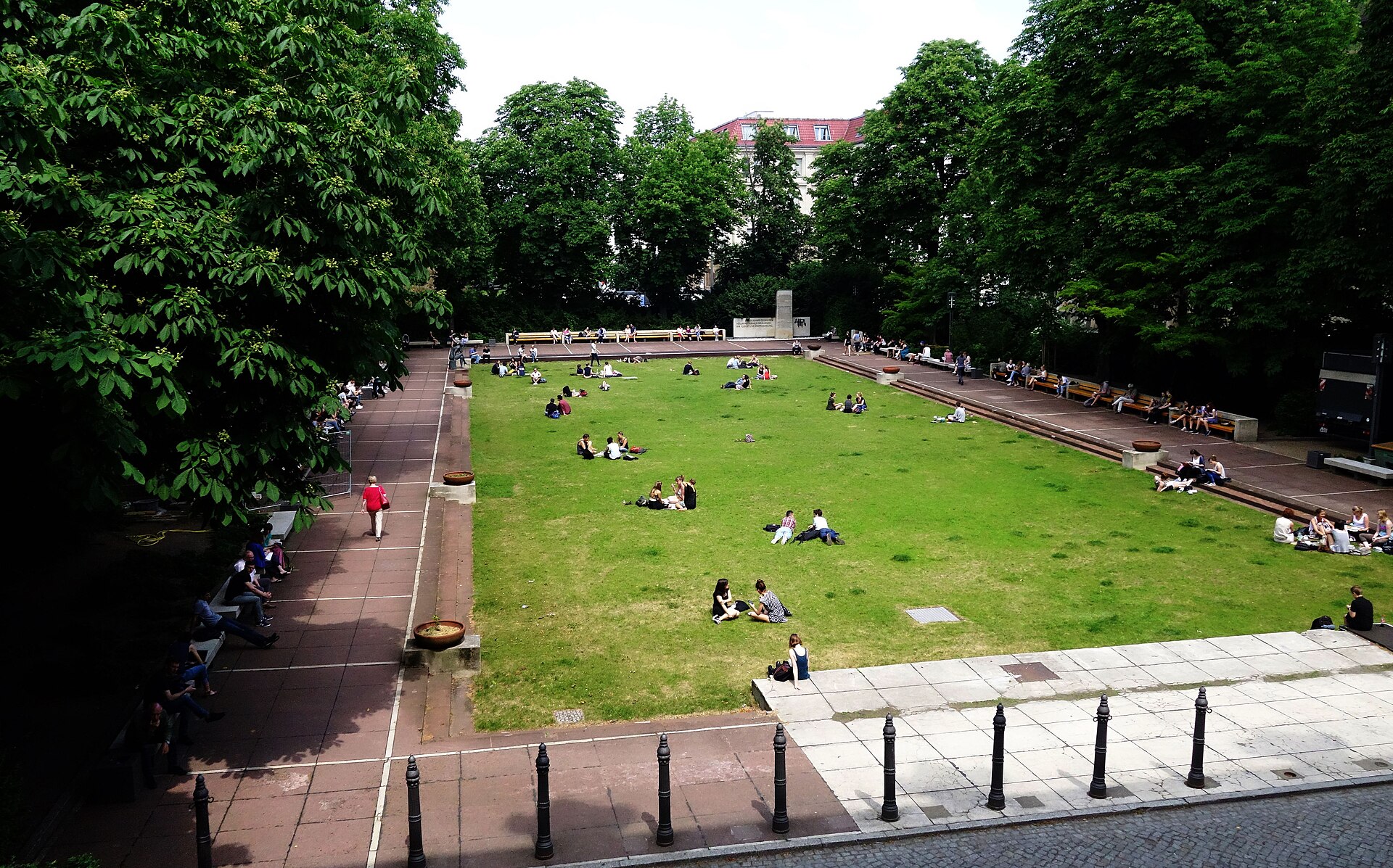
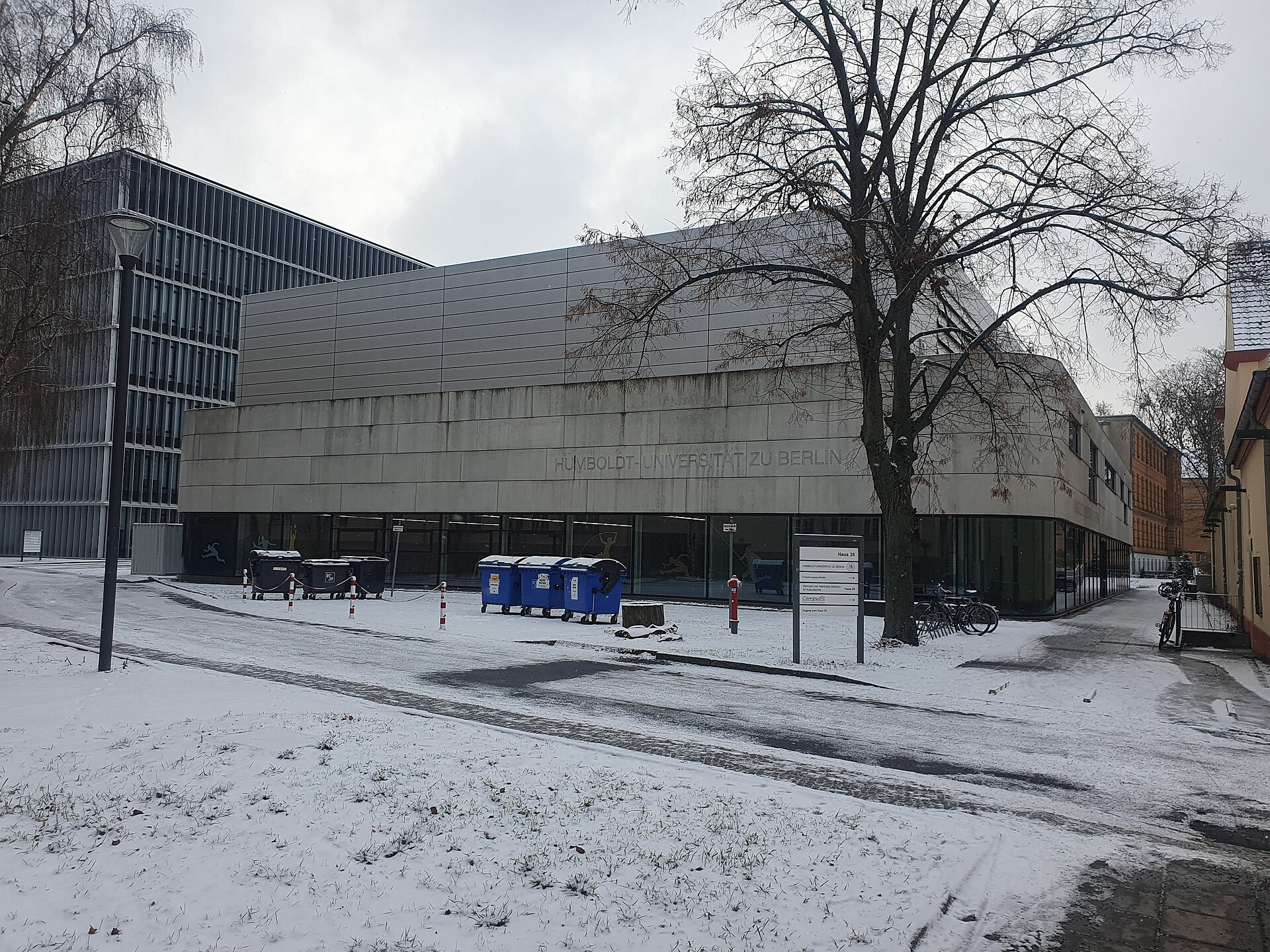
Humboldt-Universität zu Berlin — campus in pictures
Real, freely-licensed photographs of the campus (via Wikimedia Commons).




Why Humboldt-Universität — The University That Shaped Modern Academia
HU Berlin's influence on the structure of universities worldwide is unparalleled. Today it combines that founding legacy with a position inside Germany's most cosmopolitan city and a tuition-free model that makes it one of the most cost-effective elite universities on the planet.
HU Berlin Acceptance Rate & Admissions Profile
HU Berlin's overall acceptance rate of approximately 20% masks substantial variation by programme. Under the Numerus Clausus (NC) system, grade-restricted programmes such as law and psychology admit only the highest-performing applicants in a given cycle. Sciences and humanities programmes often have more available capacity. International students are assessed through the uni-assist qualification evaluation service, which converts home-country grades into a German equivalent.
NC thresholds change every cycle and are published after each admissions round. Always check the current Zulassungswerte on the HU Berlin admissions portal before applying.
Stats
Profile Stats
Rea Vs Rd
HU Berlin Admissions Requirements — Grades, Language & Qualification Recognition
- IB Diploma: minimum 32 points for competitive programmes
- A-Levels: typically three subjects at grade C or above
- Some qualifications require a Feststellungsprüfung (assessment exam) at a Studienkolleg
- uni-assist verifies and converts your qualification to a German grade equivalent
- DSH-2: 67% or above in all sections (reading, listening, writing, speaking)
- TestDaF TDN 4: in all four sub-tests; administered globally
- HU Berlin's Sprachenzentrum administers the DSH for enrolled/incoming students
- Allow 12–24 months of serious German study from beginner level to reach DSH-2
- IELTS Academic: overall 6.5 (verify per-programme band requirements)
- TOEFL iBT: minimum 87
- Medium-of-instruction letters may be accepted by some programmes
- No SAT, ACT, or GRE required for standard admission
HU Berlin Application Components — uni-assist, Grades & Motivation Letter
International students applying to HU Berlin typically go through uni-assist, Germany's centralised assessment centre for international qualifications. The application has no personal essays in the US-Common-App sense — admission is primarily grade-based. However, some master's programmes require a detailed motivation letter (Motivationsschreiben) and academic work samples.
HU Berlin Applications — The Motivation Letter & What Replaces Essays
HU Berlin does not use the Common App, UCAS personal statement, or any multi-essay system. Undergraduate admission is grade-based. For master's programmes, the Motivationsschreiben is the key written document — structured, scholarly, and specific.
Prompts
Tips
What HU Berlin Looks For
Admission to HU Berlin's bachelor's programmes is primarily grade-based under the Numerus Clausus system. For master's programmes — especially English-taught ones — the evaluation is broader. Here is what matters across both levels.
HU Berlin Financial Aid & Scholarships for International Students
HU Berlin's tuition-free model is its primary financial benefit. Institutional need-based grant programmes analogous to Harvard or Oxford do not exist — but Germany offers a rich ecosystem of external scholarships, student employment rights, and state support mechanisms.
Scholarship amounts and eligibility criteria are set by the awarding organisations and can change annually. Verify current amounts and deadlines on the official DAAD and HU Berlin portals.
Stats
Contribution Tiers
| Range | Percent | Percent Value | Note |
|---|---|---|---|
| Tuition fees | €0 | 0 | No tuition for any student — domestic or international |
| Semester contribution (×2) | ~€630/yr | 5 | Covers public transport, student services, student union |
| Housing (Studentenwerk or private WG) | €3,600–7,200/yr | 60 | €300–600/month depending on type; Studentenwerk is cheaper |
| Food, transport, personal | €3,600–4,800/yr | 30 | Transport included in Semester-Ticket; food ~€200/month |
| Health insurance | ~€1,500/yr | 12 | Compulsory statutory insurance ~€125/month for students under 30 |
Key Dates
Advantages
- Most bachelor's programmes only admit in the Winter Semester (October)
- Larger incoming cohort — more international student orientation support
- Full academic year from the start — no mid-year entry complications
- Most English-taught master's programmes also start in October
- Berlin's student community is most active from October — clubs, events, housing
Disadvantages
- Fewer programmes admit in April — check your target programme explicitly
- Most bachelor's programmes are not available in Summer Semester
- January application deadline falls during many countries' exam periods
- Smaller cohort — fewer orientation events and new-arrival support
- Some courses and modules only run in the Winter Semester
HU Berlin Interviews — Format, Exceptions & Preparation
The vast majority of bachelor's and master's programmes at HU Berlin do not include an interview stage. Admission is determined by documentation review — grades, language certificates, and (for master's) the motivation letter. However, exceptions exist for some programmes.
Meta
Questions
Housing & Residential Life in Berlin
HU Berlin does not operate a traditional residential college or house system in the Oxbridge or American sense. Students live independently in Berlin, supported by Studentenwerk Berlin — the student services organisation that manages affordable student halls (Wohnheime) across the city.
Lottery Steps
- Apply to Studentenwerk Berlin housing as early as possible — the waitlist opens before admission is confirmed for some halls
- Studentenwerk manages 33 halls of residence in Berlin with approximately 9,000 places across all universities
- Average rent in Studentenwerk housing: approximately €250–350/month including utilities
- If not allocated Studentenwerk housing, private shared flats (WGs) are the standard alternative — via WG-Gesucht, Studenten-WG, or ImmobilienScout24
- Private WG rent: €400–700/month for a room depending on neighbourhood and room size
- The Semester-Ticket covers all Berlin public transport (S-Bahn, U-Bahn, buses, trams) — no separate transport cost if living in an outer borough
- Berlin neighbourhoods popular with HU Berlin students: Mitte, Prenzlauer Berg, Friedrichshain, Kreuzberg, Neukölln
Houses
HU Berlin Faculties & Study Areas
- {"label":"Programme language","value":"German"}
- {"label":"NC restriction","value":"Very high"}
- {"label":"Duration (bachelor's equivalent)","value":"7 semesters + exams"}
- {"label":"Notable for","value":"European law, constitutional law"}
- {"label":"Primary language","value":"German (bachelor's); some English master's"}
- {"label":"THE Arts & Humanities rank","value":"Top 100 globally"}
- {"label":"Key strength","value":"German intellectual and cultural history"}
- {"label":"Research environment","value":"Seminar-intensive, archival"}
- {"label":"Campus location","value":"Adlershof (Berlin south-east)"}
- {"label":"Research infrastructure","value":"Helmholtz, Max Planck connections"}
- {"label":"Physics Nobel lineage","value":"Einstein, Planck, Schrödinger affiliated"}
- {"label":"International master's","value":"Some available in English"}
- {"label":"THE Social Sciences rank","value":"Top 100 globally"}
- {"label":"English master's","value":"Several available"}
- {"label":"Key strength","value":"Political economy, European politics"}
- {"label":"Berlin advantage","value":"Proximity to Bundestag, federal ministries"}
- {"label":"Campus","value":"Adlershof"}
- {"label":"Programme orientation","value":"Theoretical + applied"}
- {"label":"Industry connections","value":"Berlin start-up scene, tech companies"}
- {"label":"International graduate programmes","value":"Available in English"}
- {"label":"Type","value":"Joint medical school"}
- {"label":"Hospital beds","value":"One of Europe's largest"}
- {"label":"International entry","value":"Primarily master's / doctoral"}
- {"label":"Language","value":"German-taught primarily"}
Research & Extracurricular Opportunities at HU Berlin
Career Outcomes & HU Berlin Alumni Network
A degree from Humboldt-Universität zu Berlin carries strong recognition across Germany and Europe. HU Berlin's 85% graduate employment rate reflects the broad employability of its graduates across diverse sectors.
Germany's post-study work opportunities are strong for international graduates. Non-EU graduates can apply for an 18-month job-seeker visa after completing a German degree, giving substantial time to secure employment without leaving the country.
Stats
Categories
TYCHR Students at HU Berlin — Success Stories
Frequently Asked Questions
Do I need to speak German to study at HU Berlin?+
For most bachelor's programmes, yes — HU Berlin conducts the vast majority of its undergraduate teaching in German, and you will need DSH-2 or TestDaF TDN 4 (all sub-tests) as a minimum. A growing number of English-taught master's programmes exist for which German is not required. Check the language of instruction on each programme's description page before applying.
Is there tuition at HU Berlin?+
No. Like all German state universities, HU Berlin charges no tuition fees to any student, regardless of nationality. You pay a semester contribution (Semesterbeitrag) of approximately €315 per semester, which includes a Semester-Ticket for public transport in Berlin and Brandenburg, student union fees, and student services.
What is uni-assist and do I need it?+
uni-assist is Germany's centralised service for evaluating international educational qualifications. Most non-German applicants need to request a Preliminary Documentation (VPD) through uni-assist before HU Berlin can process their application. EU/EEA applicants who completed their schooling in certain European countries may apply directly. Check your eligibility on the HU Berlin admissions page.
Can I apply with an IB Diploma?+
Yes. The IB Diploma is recognised as a Hochschulzugangsberechtigung (university entrance qualification) in Germany. You will need to have your IB results verified through uni-assist. For most programmes an IB total of 32 or above is the general benchmark, though NC-restricted subjects in high demand may require higher scores.
When should I start my application?+
Start at least 6–9 months before your target intake. Non-EU/EEA students also need a German student visa, which can take 8–12 weeks. Factor in time to request your uni-assist VPD (allow 4–6 weeks), gather and translate documents, and secure housing.
Does HU Berlin offer accommodation for international students?+
HU Berlin partners with Studentenwerk Berlin for student housing but does not guarantee a place. Studentenwerk housing (Wohnheime) is affordable (roughly €250–350/month) but oversubscribed — apply immediately upon receiving your admission offer. Many students live in private shared flats (WGs) found through WG-Gesucht or similar platforms.
What scholarships are available to international students?+
Germany's national DAAD (German Academic Exchange Service) scholarships are the primary external funding route for international students. The Deutschlandstipendium, administered through HU Berlin, provides €300/month co-funded by private donors and the federal government. Some faculties also offer merit-based support. See the cost tab for full details.
Can I work while studying in Germany?+
International students on a German student visa from outside the EU are permitted to work up to 120 full days or 240 half-days per year without a special work permit. Berlin's part-time student job market (Studentenjobs) is active, and the Studentenwerk also provides a job board.
Book a Free HU Berlin Admissions Strategy Session
In 60 minutes our Germany admissions specialists will evaluate your academic profile and language readiness, clarify the uni-assist and NC process for your target programme, identify the right scholarships and funding timeline, and build a step-by-step application plan so nothing is missed.
- No commitment required
- Germany-specialist counsellors with insider knowledge
- Personalised plan — not generic advice
HU BERLIN ACADEMIC REQUIREMENTS
Academic Standards at Humboldt-Universität zu Berlin — The Honest Breakdown for International Students
What grades, language certificates, and qualification levels does HU Berlin actually expect? And what does the German Numerus Clausus system mean for students from IB, A-Level, and other international curricula?
GRADE REQUIREMENTS
Grades at HU Berlin — What the NC System Actually Means
HU Berlin does not publish a universal minimum GPA. Instead, each programme operates under a Numerus Clausus (NC) — a grade threshold determined by the pool of applicants each cycle. For international students, grades are converted to the German 1.0–4.0 scale by uni-assist.
For unrestricted (zulassungsfreie) programmes, meeting the basic HZB recognition threshold is sufficient — grade competition is not the barrier. Research which of your target programmes are NC-restricted and at what level before investing in the application.
ACADEMIC CONTEXT
How HU Berlin Reads International Academic Records
HU Berlin's admissions process does not involve human holistic review of academic context in the way US or UK universities operate. Grades are converted mechanically by uni-assist using a standard formula. However, the choice of subjects and academic curriculum still matters.
SAT — NOT APPLICABLE
SAT at HU Berlin — Not Required or Used
HU Berlin does not require, accept, or consider SAT scores in its admissions process. The German university system assesses academic readiness through school-leaving certificate grades, not standardised aptitude tests.
| Label | Score | Percent |
|---|---|---|
| SAT requirement | None | 0 |
ACT — NOT APPLICABLE
ACT Scores at HU Berlin — Not Part of the Admissions Process
HU Berlin does not require or consider ACT scores. The German admissions system has no equivalent of US standardised admissions testing for general university entry.
Metrics
Comparison Cards
TEST POLICY
HU Berlin Test Policy — Grade-Based Admissions Explained
HU Berlin operates a grade-based admissions system — not a holistic or test-optional one. The relevant 'tests' are language examinations, not aptitude or reasoning tests. Understanding this distinction is fundamental.
Submit Items
Withhold Items
IB DIPLOMA & A-LEVELS
IB Diploma and A-Levels at HU Berlin — Specific Benchmarks
- {"label":"Minimum recognised score","value":"24 points (general HZB minimum)"}
- {"label":"Competitive benchmark","value":"32+ points overall"}
- {"label":"Most selective programmes (Law, Psychology)","value":"35+ points expected"}
- {"label":"HL subjects","value":"Should align with target degree subject area"}
- {"label":"Minimum threshold","value":"Three A-Levels at grade C or above"}
- {"label":"Subject expectation","value":"Subjects relevant to the target degree"}
- {"label":"GCSE/IGCSE","value":"Considered alongside A-Levels in conversion"}
- {"label":"Competitive programmes","value":"A/A* grades expected in relevant subjects"}
AP COURSES
AP Courses at HU Berlin — How They Are Treated
Advanced Placement (AP) courses are a US-curriculum feature. HU Berlin does not have an AP-equivalent evaluation system or assign credit for AP scores as a general policy. However, AP performance can support your application profile in indirect ways.
CURRICULUM RIGOUR
Rigour of Secondary School Record — What HU Berlin's System Rewards
Unlike US universities that explicitly evaluate 'rigour of secondary school record' as a holistic factor, HU Berlin's grade-based NC system converts your final grade average mathematically. However, subject choice within your curriculum still matters for programme prerequisites.
Choose the subjects relevant to your target programme and achieve the highest possible grade in them — this is the German equivalent of 'academic rigour'.
SUBJECT PREPARATION
Mathematics, Language, and Subject Preparation — What HU Berlin Expects
HU Berlin's academic environment is research-oriented and seminar-intensive. The preparation required varies significantly by faculty. Below is what each major faculty expects from incoming students.
LANGUAGE REQUIREMENTS
English and German Language Requirements for HU Berlin
Language proficiency is the most distinctive admissions criterion for international students at HU Berlin — more so than at most other global universities. Both the German and English requirements are hard gates, not soft preferences.
Unlike US or UK universities where English proficiency is assessed partly through essay quality, HU Berlin requires a formal language certificate. A student who writes excellent English academic prose cannot substitute this for a TOEFL score — the certificate is required as documentation. Similarly, no amount of informal German conversation experience substitutes for a DSH or TestDaF result.
PROGRAMME-BY-PROGRAMME
Academic Requirements by Subject at HU Berlin
NC thresholds change each cycle. The grade equivalents below are indicative based on recent cycles — always verify the current Zulassungswerte on the HU Berlin admissions portal.
| Concentration | Expectation | Signals |
|---|---|---|
| Law (Rechtswissenschaft) | Grade equivalent 1.0–1.5; DSH-3 recommended | Highest NC threshold; analytical reasoning; German near-native |
| Psychology | Grade equivalent 1.0–1.5; strong mathematics background | Second-highest NC; quantitative orientation; statistics preparation |
| Economics | Grade equivalent 1.5–2.0; strong mathematics | Calculus, statistics, linear algebra; some English master's available |
| Computer Science | Grade equivalent 2.0–2.5; mathematics essential | Discrete maths, formal reasoning; programming experience a plus |
| Mathematics | Grade equivalent 2.0–2.5; HL Maths AA or equivalent | Proof-level thinking; abstract reasoning; Olympiad experience a plus |
| Biology / Chemistry / Physics | Grade equivalent 2.0–3.0 depending on programme | Advanced sciences at highest curriculum level; laboratory experience |
| History / Philosophy / Humanities | Grade equivalent 2.0–3.0; typically less NC-restricted | Strong German language; analytical writing; primary source engagement |
| English-Taught Master's (various faculties) | Bachelor's grade equivalent to 'gut' (2.0–2.5 German scale); IELTS 6.5 | Research interest match; motivation letter quality; academic writing sample |
QUALIFICATION EVALUATION
How International Curricula Are Evaluated — The uni-assist Process
uni-assist (Universität-Assistenz) is the German higher education sector's centralised service for evaluating international qualifications. Understanding exactly how this works — and what can go wrong — is critical for international applicants to HU Berlin.
STRATEGIC PREPARATION
Building Your Academic Profile: Grade 9 to Application
Success at HU Berlin starts years before the application deadline. Because the German system is grade-based, consistent academic performance throughout school is more important than late-stage test cramming.
COMMON PITFALLS
Academic and Application Mistakes to Avoid at HU Berlin
- Underestimating the importance of German language preparation — most bachelor's programmes are German-taught, and DSH-2/TestDaF TDN 4 is a non-negotiable gate
- Applying to NC-restricted programmes without checking the current Zulassungswert — your grade equivalent may not clear the threshold even if you are a strong student by global standards
- Submitting incomplete documentation — HU Berlin and uni-assist will not process applications with missing certified translations or uncertified copies
- Leaving the uni-assist VPD request to the last minute — allow at least 4–6 weeks for processing before the application deadline
- Forgetting to account for German student visa processing time (8–12 weeks for many nationalities from outside the EU)
- Assuming an English-medium environment even in German-taught programmes — outside international master's programmes, daily academic and social life requires German
- Not researching faculty research groups before writing the motivation letter for master's applications — generic motivation letters consistently fail at research-intensive universities
- Waiting until the final year to begin German language study — DSH-2 or TestDaF TDN 4 requires sustained study over at least 12–24 months from a beginner level
- Applying for the Summer Semester intake when your target programme only admits in the Winter Semester
- Assuming SAT/ACT or TOEFL/IELTS scores substitute for the required German language certificates — they do not
WHO GETS IN
Admitted Student Profiles at HU Berlin — What the Data Shows
HU Berlin's admissions are transparent in one important way: the NC thresholds (grade cutoffs) for each programme are published each cycle. Combined with IB and A-Level conversion benchmarks, this gives a clearer picture of what admitted students look like than at holistic US universities.
ACADEMIC FAQs
Frequently Asked Questions — Academic Requirements
Is there a minimum IB score to apply to HU Berlin?+
There is no single universal minimum — the effective threshold depends on the programme. An IB score of 24 is the general HZB recognition floor in Germany, but competitive programmes at HU Berlin may require 32+ in practice. Law and psychology typically require 35+ given their NC levels. Always check the most recently published NC values for your specific programme.
Can I apply to a German-taught programme if my German is not yet at DSH-2?+
In some cases, you can receive a conditional admission offer and complete the language certificate before the semester starts. However, HU Berlin will not fully enrol you without the certificate. If you do not have DSH-2 or TestDaF TDN 4 by the enrolment deadline, your admission lapses. Do not apply to German-taught programmes without a realistic plan to achieve the language requirement in time.
Does HU Berlin prefer any particular school curriculum?+
HU Berlin does not express a preference between IB Diploma, A-Levels, or other national curricula. All recognised qualifications are evaluated through the uni-assist conversion formula on an equal methodological footing. What matters is your grade position within your home system, translated to the German scale.
What GPA do I need for an HU Berlin master's programme?+
Most master's programmes require a bachelor's degree with a grade equivalent to 'gut' (good) or better in the German grading system — roughly equivalent to a GPA of 3.0/4.0, upper second class honours (2:1) in the UK, or equivalent. Highly competitive programmes in law, economics, or computer science effectively expect the upper quarter of your graduating class.
Can I get credit for my AP exams at HU Berlin?+
HU Berlin does not have a formal AP credit transfer policy. German bachelor's programmes do not typically exempt students from foundational coursework based on AP results. Unlike US universities, there is no credit-by-exam mechanism at German public universities for standard bachelor's entry.
How long does the uni-assist assessment take?+
Approximately 4–6 weeks once all documents are received. If you submit incomplete documents, the timeline restarts from when the missing items are received. Apply to uni-assist at least 6–8 weeks before the HU Berlin application deadline to ensure the VPD arrives in time.
COST & AFFORDABILITY
Studying at HU Berlin: One of the Best Value Propositions in Global Higher Education
Germany's commitment to publicly-funded higher education means that international students pay the same near-zero tuition as domestic students. At Humboldt-Universität zu Berlin, your primary financial concern is living costs in Berlin — not tuition fees. Combined with access to DAAD scholarships, the Deutschlandstipendium, and Germany's student-friendly work regulations, an HU Berlin education is accessible for well-prepared international students even without substantial family wealth.
ANNUAL COST ESTIMATE
Cost of Studying at HU Berlin — Annual Breakdown
All figures below are approximate annual estimates. Semester contribution covers public transport, student services, and union fees — it is not tuition.
Living cost estimates vary depending on lifestyle, accommodation type, and dietary habits. Berlin is more affordable than London, Paris, or Zurich but more expensive than many smaller German cities. Students in Studentenwerk housing will have the lower end of costs.
| Item | Annual Cost | Notes |
|---|---|---|
| Tuition fees | $0 | No tuition for any student; German public university model |
| Semester contribution (×2 per year) | ~$700 | Includes Berlin Semester-Ticket for all public transport in Berlin and Brandenburg |
| Housing (Studentenwerk halls) | $3,600–4,800 | €300–400/month; affordable but oversubscribed — apply early |
| Housing (private WG, shared flat) | $4,800–8,400 | €400–700/month depending on neighbourhood and room size |
| Food and groceries | $1,800–3,000 | Mensa meals from €2–4; self-catering typical for most students |
| Health insurance (statutory, under 30) | ~$1,500 | ~€125/month; compulsory for all students in Germany |
| Personal expenses, books, phone | $1,200–2,400 | Variable; library access reduces textbook costs significantly |
| Total estimated annual cost of attendance | ~$14,000 | Facts-file confirmed; includes all living costs; excludes international travel |
| uni-assist VPD assessment fee | $80 (once) | One-time application assessment fee; payable to uni-assist |
FINANCIAL AID
Financial Aid Framework for International Students at HU Berlin
HU Berlin does not operate a large institutional need-based grant programme analogous to Harvard or the University of Toronto. Instead, international students access funding primarily through external scholarship organisations — above all DAAD — and through Germany's broad student support mechanisms.
AFFORDABILITY REALITY
The Real Cost Advantage of HU Berlin for International Students
HU Berlin's tuition-free model is genuinely transformative for international students. At a comparable-quality university in the UK, USA, or Australia, total annual costs for an international student might be $45,000–$75,000. At HU Berlin, total annual costs including all living expenses run around $14,000.
The primary financial challenge is funding the gap between living costs and scholarship or work income. For self-funded students, having access to approximately €10,000–12,000 per year from family resources or savings — while supplementing with legal student employment — is a realistic baseline. Students who secure a DAAD scholarship or Deutschlandstipendium can significantly reduce this burden.
Germany requires proof of financial means for student visa purposes. A blocked account (Sperrkonto) is typically required as proof of funds for one year of study. The required amount is set by German immigration law and adjusted periodically — verify the current figure at the German embassy in your country or on the DAAD website. Services like Fintiba, Expatrio, and Deutsche Bank offer blocked account products designed for international students.
HOW TO FUND YOUR STUDIES
Steps to Secure Funding Before and After Arriving at HU Berlin
INTERNATIONAL STUDENT AID
Financial Aid Specifically for International Students at HU Berlin
International students at HU Berlin access financial support through a different set of channels than domestic German students. The key distinction is that most institutional support in Germany flows through external organisations (DAAD, foundations) rather than through the university itself.
AID STATISTICS
Average Financial Aid at HU Berlin — What the Data Shows
HU Berlin does not publish a central average aid figure for international students in the way US need-blind universities do. Aid is provided through external organisations; amounts vary by scheme.
These figures are indicative based on published scholarship documentation. Always verify current amounts directly with the awarding organisation — stipend levels are adjusted periodically. HU Berlin publishes no average aid figure for international students as a whole.
MERIT & NEED-BASED AID
Merit-Based vs Need-Based Funding at HU Berlin
Germany's scholarship landscape is primarily merit-based. Need-based student support (BAföG) is largely restricted to domestic students and long-term EU residents. International students access funding primarily through merit-based external scholarships.
EXTERNAL SCHOLARSHIPS
External Scholarships for International Students at HU Berlin
The following are verified, named scholarship routes for international students at HU Berlin or studying in Germany generally.
LOAN POLICY
Student Loans at HU Berlin — What Is and Is Not Available
Germany's higher education model is not loan-based in the way the US or UK systems are. International students do not take on large debt to attend HU Berlin — the primary challenge is funding living costs, not tuition.
For most international students at HU Berlin, the funding strategy is: (1) scholarship (DAAD/Deutschlandstipendium), (2) family support / savings, (3) legal part-time employment. Loans from home-country banks are an option where family resources are limited and scholarships are not secured.
STUDENT EMPLOYMENT
Working While Studying at HU Berlin
Germany's student work regulations are among the most favourable for international students in Europe. Part-time employment is a significant source of income for many HU Berlin students.
COMPARATIVE COSTS
HU Berlin Cost vs Comparable International Universities
To understand the financial case for HU Berlin, it helps to compare total annual costs — not just tuition — against alternatives of comparable academic quality.
Figures for non-HU Berlin universities are illustrative comparisons based on publicly available estimates for international students. Always verify current fees and costs on official university websites. HU Berlin figures are from the facts file.
| University | Tuition | Living | Total Annual | Notes |
|---|---|---|---|---|
| Humboldt-Universität zu Berlin | $0 | ~$12,000 | ~$14,000 | Tuition-free; semester contribution ~$700/year included |
| University College London (UK) | ~$35,000 | ~$20,000 | ~$55,000 | Comparable global ranking; much higher total cost |
| University of Toronto (Canada) | ~$40,000 | ~$16,000 | ~$56,000 | International fees for equivalent research university |
| University of Melbourne (Australia) | ~$36,000 | ~$18,000 | ~$54,000 | Comparable research profile; significantly higher cost |
| FU Berlin / TU Berlin (Germany) | $0 | ~$12,000 | ~$14,000 | Same German public model; similar total costs |
TRUE COST ANALYSIS
The True Cost of HU Berlin — What Students Actually Spend
The published cost-of-attendance figure of approximately $14,000 is achievable but represents a tight budget. Here is an honest breakdown of what different student profiles actually spend.
The $14,000 annual cost of attendance from the facts file corresponds to the typical-budget scenario. Students in Studentenwerk housing can achieve costs below this figure; students with higher accommodation or lifestyle expectations should budget accordingly.
FUNDING APPEALS
What To Do If Scholarship Applications Are Unsuccessful
HU Berlin's institutional aid is limited for international students, and external scholarships are competitive. Here is what to do if your initial funding applications are not successful.
FINANCIAL PLANNING
Financial Planning Timeline for HU Berlin
The German application and funding timeline requires planning 12–18 months in advance. Scholarship deadlines often predate application deadlines — co-ordinate them carefully.
APPLICATION & MOTIVATION
Applying to Humboldt-Universität: No US-Style Essays — But Motivation Still Matters
HU Berlin does not use the Common App, UCAS, or any other multi-essay application system. German university admissions are grade-certificate-based: your school results determine whether you meet the threshold. However, for many master's programmes — especially English-taught programmes aimed at international applicants — a motivation letter (Motivationsschreiben) is the one piece of writing that can differentiate you within the academic-grade band. This tab explains how the German application system works and how to write a compelling motivation for HU Berlin.
APPLICATION SYSTEM
How HU Berlin Admissions Works — What Writing Is (and Is Not) Required
Understanding the German application system is the first step. It differs fundamentally from US, UK, and Australian systems.
MOTIVATION LETTER
The Motivation Letter — What HU Berlin Programmes Typically Ask
There are no fixed prompts in the US-essay sense. The motivation letter is a structured academic document. Most HU Berlin programme guides ask you to address the following elements — confirm specific requirements on your target programme's admissions page.
BACHELOR'S APPLICATIONS
Bachelor's Applications to HU Berlin — What Replaces the Personal Statement
For bachelor's entry to HU Berlin, there is no personal statement, Common App essay, or UCAS personal statement equivalent. Understanding what the German system uses instead is critical for applicants coming from US, UK, or Australian school systems.
The German bachelor's application is a document submission, not a narrative one. The application consists of: (1) your uni-assist VPD confirming qualification recognition and grade equivalent, (2) your school-leaving certificate, (3) language proficiency certificate, and (4) proof of identity. That is the complete application for most bachelor's programmes. There is nothing to 'write' that will improve your admission outcome once your grade is fixed.
This does not mean communication doesn't matter at all. Correspondence with the admissions office should be precise and professional — Germans appreciate directness and correct formal language. Any written enquiries to HU Berlin should be concise, clearly structured, and free of grammatical errors in German (or English for English-medium contacts).
WRITING STRATEGY
How to Write a Winning Motivation Letter for HU Berlin
The motivation letter is the only personal writing in a German master's application. Use it to make a scholarly argument — not a personal story.
WHAT TO WRITE ABOUT
Choosing Your Motivation Letter Focus at HU Berlin
Because the German motivation letter is an academic document rather than a personal narrative, the question of 'what to write about' is really a question of intellectual positioning.
AVOID THESE ERRORS
Common Motivation Letter Mistakes at HU Berlin
- Writing a personal narrative ('my childhood fascination with...') instead of a scholarly argument — German admissions committees are not looking for personal essays
- Failing to name specific faculty, research groups, or programme modules at HU Berlin — generic letters are rejected in competitive applicant pools
- Submitting a letter of more than 2 pages — concision is valued in German academic culture; longer is not better
- Writing the motivation letter in English for a German-taught programme — write in German to demonstrate language readiness
- Describing past achievements without explaining their relevance to the specific master's programme you are applying to
- Using vague career goals ('I want to help make the world better') instead of specific professional or academic trajectories
- Submitting without proofreading by a native speaker — grammatical or stylistic errors are taken more seriously in academic applications
- Copying the same letter to multiple universities — admissions committees identify template letters immediately from generic phrasing
- Omitting a connection to HU Berlin's specific research strengths or Berlin's intellectual ecosystem — every good letter explains 'why here'
- Treating the motivation letter as an afterthought after assembling all other documentation — it deserves 2–3 weeks of drafting and revision
APPLICATION FAQs
Frequently Asked Questions — Application and Motivation
Do I need to write essays to apply to HU Berlin at bachelor's level?+
No. Bachelor's admission at HU Berlin is grade-based under the Numerus Clausus system. There are no personal statements or essays required for standard undergraduate applications. Your converted grade average (via uni-assist) determines eligibility.
Does HU Berlin use the Common App?+
No. HU Berlin uses its own online application portal and the uni-assist system for international qualifications assessment. It is not part of the Common Application, UCAS, or any other multi-university application consortium.
How long should the motivation letter be?+
Typically 1–2 pages (500–1,000 words). Specific programme requirements vary — always check the exact instructions on your target programme's admissions page. Longer letters are rarely an advantage; focused, precise letters are preferred.
Should I write the motivation letter in German or English?+
For German-taught programmes: write in German. For English-taught programmes: write in English. This is both a practical requirement and a signal of your linguistic readiness for the programme environment.
Can I contact professors before applying?+
Yes, and for research-oriented master's or doctoral programmes, it is often advisable to email a professor whose research aligns with your interests before applying. Keep the email concise, demonstrate that you have read their work, and explain your research background and interests. A positive response from a faculty member strengthens — but does not guarantee — your application.
Is there an interview stage?+
Most standard master's programmes at HU Berlin do not include an interview. Some highly selective or research-focused programmes and doctoral applications may include an interview stage. If applicable, this is communicated to candidates after the written application review.
What if my programme requires a writing sample?+
A Schreibprobe (writing sample) should be an extract from your best academic work — a thesis chapter, research paper, or seminar essay. Choose a piece that demonstrates analytical depth, clear argumentation, and engagement with scholarly literature relevant to your target programme. Follow any length or formatting instructions given by the programme.
How many universities should I apply to in Germany?+
Unlike the US system where applying to 10–15 schools is common, German applications are more targeted because each application is a significant documentation effort (uni-assist VPD, translations, etc.). Most students apply to 3–6 German universities. If your target subject has a competitive NC, having backup universities with higher NC tolerance is wise.
Courses — schools, degrees & intake
40 degrees across 8 groupings.
Faculty of Economics and Business Administration (Wirtschaftswissenschaftliche Fakultät) · 4 degrees
Business Administration (Betriebswirtschaftslehre)
Economics (Volkswirtschaftslehre)
Business Information Systems (Wirtschaftsinformatik)
Business Education (Wirtschaftspädagogik)
Faculty of Mathematics and Natural Sciences (Mathematisch-Naturwissenschaftliche Fakultät) · 6 degrees
Mathematics (Mathematik)
Computer Science (Informatik)
Physics (Physik)
Chemistry (Chemie)
Geography (Geographie)
Biophysics (Biophysik)
Faculty of Life Sciences (Lebenswissenschaftliche Fakultät) · 5 degrees
Biology (Biologie)
Psychology (Psychologie)
Agricultural Sciences (Agrarwissenschaften)
Horticultural Sciences (Gartenbauwissenschaften)
Resource Management (Ressourcenmanagement)
Faculty of Arts and Humanities (Philosophische Fakultät) · 4 degrees
History (Geschichte)
Philosophy (Philosophie)
European Ethnology (Europäische Ethnologie)
Library and Information Science (Bibliotheks- und Informationswissenschaft)
Faculty of Language, Literature and Humanities (Sprach- und literaturwissenschaftliche Fakultät) · 8 degrees
German Studies / Linguistics (Germanistik)
German Literature (Deutsche Literatur)
English and American Studies (Anglistik/Amerikanistik)
Romance Studies (Romanistik)
Scandinavian Studies (Skandinavistik)
Classical Philology (Klassische Philologie)
Slavic Studies (Slawistik)
Hungarian Studies (Ungarische Literatur- und Kulturwissenschaft)
Faculty of Humanities and Social Sciences (Kultur-, Sozial- und Bildungswissenschaftliche Fakultät) · 11 degrees
Sociology (Soziologie)
Political Science (Politikwissenschaft)
Education Studies (Erziehungswissenschaften)
Cultural Studies (Kulturwissenschaft)
Musicology (Musikwissenschaft)
Art and Visual History (Kunst- und Bildgeschichte)
Asian and African Studies (Asien- und Afrikawissenschaften)
Sports Sciences (Sportwissenschaft)
Rehabilitation Sciences (Rehabilitationswissenschaften)
Archaeology (Archäologie)
Transdisciplinary Gender Studies
Faculty of Theology (Theologische Fakultät) · 1 degrees
Protestant Theology (Evangelische Theologie)
Faculty of Law (Juristische Fakultät) · 1 degrees
Law (Rechtswissenschaft) — First State Examination
Want your real chances at Humboldt-Universität zu Berlin?
Create a free TYCHR account for your personalised admit-chance, a shortlist you can track, exact entry requirements, and essay + counselling help.