← All universities

Georgetown University

Washington, United States · Urban

Association of Jesuit Colleges and UniversitiesPrivateResearchReligiously affiliatedCoed
Acceptance
12.0%
QS World
#300
Tuition/yr
$68,000
Students
20,700
Founded
1789

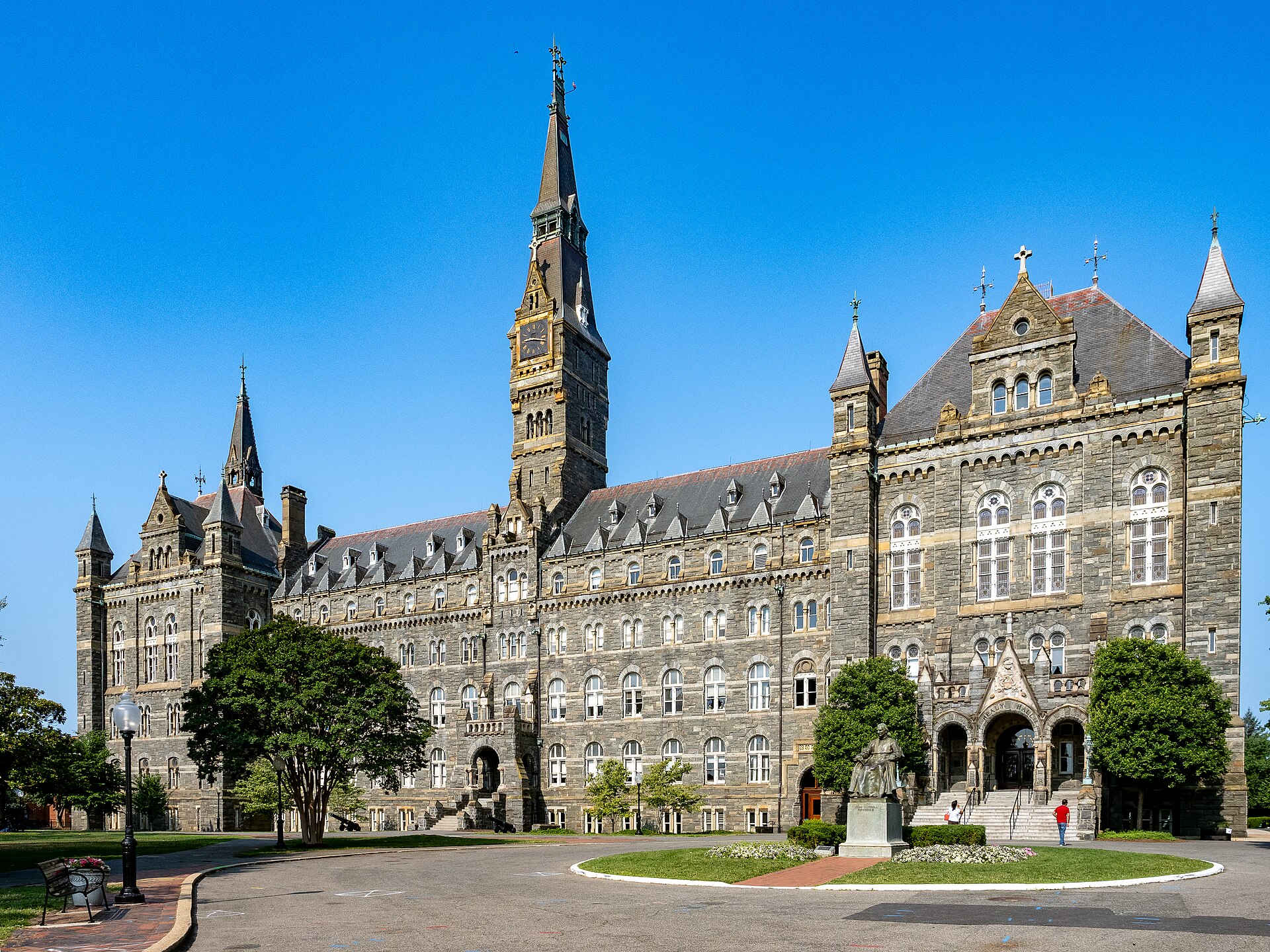
Georgetown University is the oldest Catholic and Jesuit university in the United States, perched above the Potomac in Washington, DC. Its Walsh School of Foreign Service — the oldest school of international affairs in the world — is a global pipeline into diplomacy, policy, and international organisations. For ambitious international students who want to be at the centre of global power, Georgetown offers a unique convergence of academic rigour, institutional prestige, and real-world proximity to government, multilateral institutions, and international business.

Georgetown University Admissions Guide for

Campus

Georgetown University — campus in pictures

Real, freely-licensed photographs of the campus (via Wikimedia Commons).

Panoramic view of Georgetown University campus from across the Potomac river (Key Bridge), Washington, D.C.
Panoramic view of Georgetown University campus from across the Potomac river (Key Bridge), Washington, D.C.Mariordo (Mario Roberto Durán Ortiz) · CC BY-SA 3.0 · via Wikimedia Commons
Engraving of Georgetown College campus from after the Gervase Building was completed in 1848 but before Old South was demolished in 1854.
Engraving of Georgetown College campus from after the Gervase Building was completed in 1848 but before Old South was demolished in 1854.Published by C. Bohn · Public domain · via Wikimedia Commons
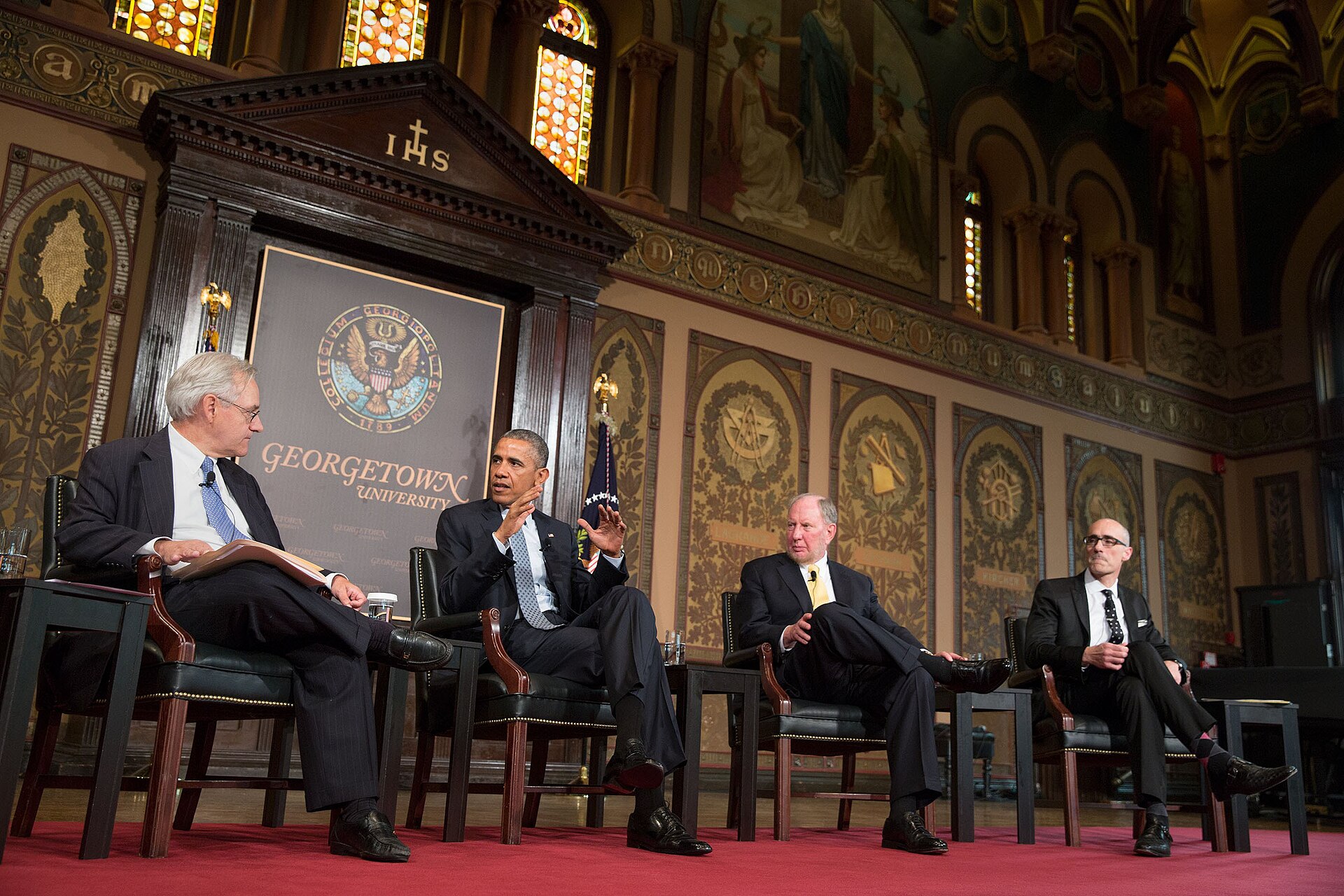
Obama at Georgetown University talk on poverty
Obama at Georgetown University talk on povertyOfficial White House Photo by Pete Souza · Public domain · via Wikimedia Commons
Three students studying outside Georgetown University's new Jesuit Residence, Wolfington Hall
Three students studying outside Georgetown University's new Jesuit Residence, Wolfington HallPatrickneil · CC BY-SA 3.0 · via Wikimedia Commons
Georgetown Riverview
Georgetown RiverviewPatrickneil · CC BY-SA 3.0 · via Wikimedia Commons
Washington, DC
Washington, DCajay_suresh · CC BY 2.0 · via Wikimedia Commons

Why Georgetown — Power, Purpose, and the World's Capital

Georgetown's Jesuit tradition asks every student not just what they know, but what they will do with it. In Washington, DC, that question has a very direct answer. The institution's location, mission, and academic programmes are more coherently aligned than almost any other American research university.

01The World's Capital — Literally
Georgetown sits minutes from Capitol Hill, the State Department, the World Bank, IMF, and the embassies of nearly every nation. No other campus in the world places undergraduates closer to the actual levers of global power.
02Walsh School of Foreign Service
Founded in 1919, SFS is the oldest and most prestigious undergraduate school of international affairs in the United States. It has produced senators, ambassadors, UN officials, and heads of state. Admission to SFS is direct and competitive.
03Jesuit Intellectual Tradition
The Jesuit ideal of cura personalis — care for the whole person — and the call to be 'men and women for others' shapes every dimension of Georgetown's curriculum. Graduates are expected to act on what they know.
04McDonough School of Business
One of the few undergraduate business schools in the Ivy-adjacent tier, McDonough feeds consulting, finance, and international business careers from a uniquely DC-integrated vantage point.

Georgetown Acceptance Rate & Admitted Class Profile

Stats

12%
Acceptance Rate
13%
International Students
20,700
Student Population

Profile Stats

1440–1550
SAT Middle 50%
32–35
ACT Middle 50%
39+
IB Typical Score
3.7
Minimum GPA
13%
International Students

Rea Vs Rd

Rd Label: Regular Decision
Rd Value: ~10–11%
Rea Label: Early Action (Non-Binding)
Rea Value: ~15–18%

Georgetown Admissions Requirements — Academics, Tests & International Profile

GPA & Coursework
Value: 3.7+ GPA
  • Most admitted students: strong A/A+ record in rigorous courses
  • IB Diploma: aim for 39+ out of 45
  • A-Levels: AAA or above in relevant subjects
  • Course rigour in core subjects is closely evaluated
Georgetown expects a minimum GPA of 3.7 and the most rigorous curriculum available to you — IB Diploma, A-Levels, AP courses, or the equivalent. The school-specific evaluation means your transcript is read relative to what your school offered.
SAT / ACT
Value: 1440–1550 / 32–35
  • Georgetown is test-required — scores are mandatory for all applicants
  • SAT middle 50%: 1440–1550; target 1500+ for competitiveness
  • ACT middle 50%: 32–35; target 34+ for upper band
  • No preference between SAT and ACT
Georgetown is test-required — one of the few highly selective US universities that maintained this policy through and after the COVID era. A strong test score is a genuine factor in your application, not optional context.
International Grades
Value: 39+ IB / AAA A-Levels
  • IB: 39+ overall; 6s and 7s at Higher Level in relevant subjects
  • A-Levels: AAA minimum; AAA* strengthens the file
  • CBSE/ISC: top academic performance + strong SAT
  • National Gaokao: contextualised alongside SAT scores
Georgetown's admissions office has substantial experience with international qualifications. IB and A-Level students are evaluated contextually, with attention to both the level and subject choices made.

Georgetown Application Components — Common App, Essays & Interviews

Georgetown accepts the Common Application or its own Georgetown Application. Below is every component of a complete Georgetown application — required and evaluative — with strategic notes for each.

01RequiredCommon App or Georgetown Application
Georgetown accepts both the Common Application and its own Georgetown Application. Both require the same essays and components.
02RequiredTwo Short Essays (250 words each)
Short Essay 1: significance of your most meaningful school or summer activity. Short Essay 2: experience with someone holding different viewpoints and what you learned.
03RequiredLong Essay 1 — Personal/Creative (650 words)
A brief essay, personal or creative, that best reflects who you are. Georgetown explicitly invites both narrative and creative writing forms.
04RequiredLong Essay 2 — School-Specific (500 words)
Why your chosen Georgetown school? Why does Georgetown specifically fit your academic goals? This essay is the most thoroughly evaluated component for school-fit.
05RequiredSchool Transcript & Counsellor Report
Official transcripts from all secondary schools attended. Midyear report required by February 10 — senior grades matter.
06RequiredTeacher Recommendation(s)
At least one recommendation from a core academic subject teacher. A second teacher recommendation is optional but strengthens the file.
07EvaluativeAlumni Interview
Georgetown assigns alumni interviews as applications are received. Interviews are evaluative — interviewers submit formal reports. Treat seriously.
https://uadmissions.georgetown.edu/first-year/application-requirements/

Georgetown Essays — Writing the Four Required Essays

Tips

The school-specific essay is the most important essay Georgetown reads
Georgetown admits to its undergraduate schools, not to the university as a whole. A vague or generic school-specific essay is the single most common reason strong Georgetown applications fail. Name faculty, name courses, name research centres — show you have done the work.
250 words is very short — every sentence must earn its place
The two short essays demand economy. Do not summarise your activity list — Georgetown already has it. In 250 words, reveal something about your character, values, or intellectual development that the list cannot.
Georgetown explicitly invites creative writing
The 650-word essay can be personal OR creative — fiction, lyric essay, experimental form are all welcome. If your strongest writing is creative, use this option. But the craft must be genuinely high.
The Jesuit fit should emerge, not be stated
You do not need to mention Catholic values or Jesuit ideals in your essays. What Georgetown responds to is evidence of serious ethical thinking, concern for others, and intellectual curiosity applied to real-world problems. If these qualities appear authentically, the fit is evident.

Prompts

Short Essay 1 — Activity Reflection (250 words)
Briefly discuss the significance to you of the school or summer activity in which you have been most involved.
Short Essay 2 — Perspectives (250 words)
Describe a challenge you have faced and what you have learned from that experience in a diverse world.
Long Essay 1 — Personal/Creative (650 words)
Submit a brief essay, either personal or creative, which you feel best reflects who you are.
Long Essay 2 — School-Specific (500 words)
Submit a statement addressing your reasons for applying to your chosen school and why Georgetown is a good fit for you.
The single most common Georgetown essay mistake. Submitting a school-specific essay that could have been written for any university — Georgetown admissions officers will recognise it immediately.
Writing Strategy — What Works at Georgetown
https://uadmissions.georgetown.edu/first-year/application-requirements/

What Georgetown Admissions Officers Are Looking For

Georgetown's holistic review is shaped by its Jesuit mission in ways that are more explicit than most American universities. Understanding all six dimensions — and knowing which are most specific to Georgetown — is the foundation of a strong application strategy.

01Academic Excellence in Rigorous Courses
Georgetown expects strong grades in the hardest available curriculum. IB Diploma, A-Levels, or a full AP load — what matters is that you challenged yourself, not that you protected your GPA.
02Intellectual Curiosity
Georgetown's Jesuit tradition prizes genuine engagement with ideas. Do you read widely, think critically across disciplines, and pursue knowledge beyond what's assigned?
03Service & Commitment to Others
The Jesuit ideal of 'men and women for others' is a real criterion. Evidence of community service, leadership, and genuine concern for people beyond yourself matters at Georgetown more explicitly than at most American universities.
04School-Specific Fit
Georgetown admits to its undergraduate schools. Your application must demonstrate that you understand what your chosen school actually offers — its curriculum, culture, and intellectual approach — and that it genuinely fits your goals.
05Personal Character
Who are you beyond your achievements? Georgetown's holistic review asks whether you will contribute to campus life, intellectual discourse, and the broader Hilltop community.
06Context of Opportunity
Georgetown evaluates your academic performance in the context of what was available to you. A student who excels within a challenging environment may outweigh one who underperformed despite significant advantages.

Georgetown Financial Aid — The Honest Picture for International Students

Georgetown's financial aid programme is strong for domestic students but extremely limited for international undergraduates. This is one of the most important facts for international families to understand before applying. The university's admissions process is described as need-blind — your financial need does not impact your admission decision — but this does not mean Georgetown can meet your financial need once admitted.

Aid figures are estimates. Georgetown's financial aid for international undergraduates is extremely limited. Families should plan to fund the full cost of attendance unless a specific award is confirmed at admission.

Stats

55%
of students receive grant aid (primarily domestic)
$68K
estimated annual tuition
$93K
total cost of attendance (annual)
13%
international student enrolment

Contribution Tiers

NoteRangePercentPercent Value
Full cost typically not covered — institutional aid is scarceAny income levelVery limited10
Georgetown vs. Need-Blind Peers — The Key Difference. Unlike Harvard, Princeton, or MIT, Georgetown does not have a no-loan policy or a need-blind policy that guarantees meeting full need for international students. The 55% aid figure applies primarily to domestic students. International families should approach Georgetown with a clear financial plan that does not depend on institutional support.
Planning Reality for International Families
https://finaid.georgetown.edu/undergrad/international-students/

Key Dates

Early Action Deadline
Date: Nov 1
Early Action Decisions
Date: Mid-Dec
Regular Decision Deadline
Date: Jan 1
RD Decisions Released
Date: Late Mar / Apr

Advantages

  • Historically higher acceptance rate than Regular Decision
  • Signals genuine first-choice commitment to Georgetown
  • Earlier decision — mid-December notification
  • Non-binding — no commitment required until May 1
  • Can compare financial aid offers from other institutions

Disadvantages

  • Application must be fully complete by November 1
  • Less time to strengthen senior-year grades for EA
  • Financial aid offers may arrive later than the EA decision
  • If deferred, wait until April without another early decision
Early Action vs Regular Decision. Georgetown offers non-binding Early Action — meaning you can apply EA without committing to Georgetown if admitted. This is meaningfully different from binding Early Decision. EA is almost always the right choice for serious Georgetown applicants.
Tychr's Early Action Recommendation. Apply Early Action if Georgetown is a genuine top choice and your application is complete by October. The non-binding nature of Georgetown's EA eliminates the main downside of early application at binding-ED schools. You can apply EA, receive a mid-December decision, and still compare financial aid from other institutions before May 1.
Georgetown Early Action — Non-Binding, Strategic, Recommended
https://uadmissions.georgetown.edu/apply/first-year/

Georgetown Alumni Interview — Format, Questions & Preparation

Georgetown assigns alumni interviews to applicants as applications are received — they are not optional. Georgetown's alumni interviewers submit formal evaluative reports to the admissions office. This is not an informational interview or a courtesy conversation; it is a genuine component of the holistic review. Treat it with the same seriousness as your strongest essay.

Meta

30–45 min conversation with an alumni interviewer
Format
As applications are received — not by request
Assigned
Intellectual curiosity, character, and genuine interest in Georgetown
Evaluates
Evaluative — interviewer submits a formal report to admissions
Weight

Questions

Why Georgetown — specifically?
Tip: Georgetown interviewers expect specific answers — reference SFS curriculum, the Berkley Center, a professor's work, or the DC location. Generic praise for Georgetown's reputation will not distinguish you.
What have you been reading or thinking about lately?
Tip: The Jesuit tradition values serious engagement with ideas across disciplines. Show that your reading goes beyond your intended major and that you engage with complexity.
Tell me about a commitment that has genuinely shaped who you are.
Tip: Georgetown is deeply interested in service, not just accomplishment. Show genuine motivation beyond résumé-building.
What is a complex problem you've thought seriously about?
Tip: Georgetown's Jesuit intellectual tradition prizes ethical reasoning. Have a considered, nuanced position and be willing to defend it thoughtfully.
How would you use the DC location during your four years?
Tip: Georgetown's location makes this a real question. Be specific about what you would do in DC — internships, organisations, research opportunities.

Georgetown Housing & Residential Life

Georgetown does not operate a residential 'house' system equivalent to Harvard's or Yale's. Instead, first-year students are assigned to residence halls on the main campus, and upperclass students live in apartment-style villages or traditional halls. Housing is guaranteed to all four-year students who wish to live on campus.

Houses

Harbin Hall
Tag: First-Year
Traditional first-year residence, social and central
New South Hall
Tag: First-Year
Large first-year hall, strong community culture
Darnall Hall
Tag: First-Year
Quieter first-year option, suite-style rooms
Henle Village
Tag: Village
Apartment-style upperclass housing, very popular
Village A
Tag: Village
Apartment-style, multiple buildings, strong community
Village C
Tag: Village
Newest residential complex, modern facilities
McCarthy Hall
Tag: Upperclass
Upperclass singles and doubles
Reynolds Hall
Tag: Upperclass
Traditional-style upperclass residence

Lottery Steps

  • First-year students: assigned to a first-year residence hall (Harbin, New South, Darnall, Ryan)
  • After first year: students enter an annual housing lottery for upperclass options
  • Upperclass housing includes apartment-style Henle Village and Village A/C
  • All housing is on or immediately adjacent to the main campus
  • Many students choose to live off-campus in the Georgetown neighbourhood from junior or senior year

Georgetown's Undergraduate Schools

Georgetown College (CAS)
Label: College of Arts & Sciences
  • {"label":"Academic approach","value":"Liberal arts core"}
  • {"label":"Core requirements","value":"Theology, philosophy, writing, sciences"}
  • {"label":"Most popular concentrations","value":"Government, Biology, English, History, Economics"}
  • {"label":"Distinctive feature","value":"Mandatory theology + philosophy for all students"}
The founding academic unit. All CAS students complete a rigorous core curriculum including theology and philosophy regardless of major. The most flexible school for students whose interests span multiple disciplines.
Walsh School of Foreign Service
Label: SFS — International Affairs
  • {"label":"Founded","value":"1919"}
  • {"label":"Distinction","value":"Oldest undergraduate school of international affairs in the US"}
  • {"label":"Tracks","value":"International Politics, Science & Technology, Global Business, Regional Studies"}
  • {"label":"Language requirement","value":"Proficiency in a second language required"}
Georgetown's flagship school and the most globally prestigious undergraduate international affairs programme in the United States. SFS alumni occupy senior roles in virtually every major government, international organisation, and multilateral institution in the world. Direct admission is competitive.
McDonough School of Business
Label: Business Administration
  • {"label":"Degree awarded","value":"B.S.B.A."}
  • {"label":"Key concentrations","value":"Finance, Marketing, Operations, International Business"}
  • {"label":"Location advantage","value":"Crossover access to policy and government sectors"}
  • {"label":"Career pipeline","value":"Consulting, investment banking, international business"}
One of the few truly elite undergraduate business programmes in the US. McDonough combines rigorous business fundamentals with Georgetown's liberal arts ethos and DC-adjacent access to economic policy and international business.
Berkley School of Nursing
Label: Nursing & Health Sciences
  • {"label":"Degree awarded","value":"B.S.N."}
  • {"label":"Core sciences","value":"Biology, Chemistry, Anatomy, Physiology"}
  • {"label":"Clinical training","value":"Georgetown University Medical Center"}
  • {"label":"ACT note","value":"Science section carries particular weight"}
Georgetown's nursing school integrates clinical training at Georgetown University Medical Center with the university's liberal arts core. Direct admission is competitive; strong science preparation is essential.
School of Health
Label: Health Sciences
  • {"label":"Key programmes","value":"Human Science, Health Care Management & Policy"}
  • {"label":"Pre-health pathway","value":"Strong preparation for graduate health programmes"}
  • {"label":"Interdisciplinary","value":"Bridges sciences, policy, and ethics"}
  • {"label":"Georgetown integration","value":"Shared core with Jesuit liberal arts tradition"}
Georgetown's health sciences undergraduate school, offering programmes at the intersection of science, policy, and ethical reasoning — grounded in Georgetown's Jesuit mission.

Research & Extracurricular Opportunities at Georgetown

Berkley Center for Religion, Peace & World Affairs
Category: Research & Policy
One of the world's leading centres for the study of religion in international affairs. Undergraduate research fellows and student programmes give Georgetown students direct access to policy research, seminars, and visiting scholars.
Georgetown Institute for Women, Peace & Security
Category: Research & Advocacy
A globally recognised research institute where undergraduate students engage with gender, conflict, and policy through research, events, and fellowships. Georgetown's DC location means speakers include sitting diplomats and UN officials.
GUSA & Student Leadership
Category: Student Government
Georgetown's student government (GUSA) is one of the more politically engaged student governments in the country — unsurprisingly, given the campus. Model UN, Mock Trial, and debate are among the most active student organisations.
The Hoya & Student Media
Category: Media & Journalism
The Hoya is Georgetown's independent student newspaper, one of the oldest college newspapers in the United States. Georgetown also has WGTB radio, The Georgetown Voice, and student publications spanning policy, culture, and law.
Scroll right to explore Georgetown's research centres and student life opportunities.

Career Outcomes & Georgetown Alumni Network

Georgetown's alumni network is particularly powerful in the fields the university has historically defined: foreign service, government, law, and international organisations. For international students, the Hilltop network in diplomatic and multilateral circles is often the most valuable professional asset they carry forward.

Stats

93%
Employed or in graduate school within 6 months
$80K
Average starting salary
13%
International students
#24
US News national ranking
Top 150
THE world ranking
11:1
Student:faculty ratio

Categories

Government & Diplomacy
Georgetown is one of the top feeder universities for the US State Department, NSC, CIA, and federal civil service. SFS alumni occupy senior positions at the World Bank, IMF, UN, and virtually every major international organisation.
Consulting & Finance
McKinsey, BCG, Bain, Deloitte, and the major investment banks all recruit from Georgetown. McDonough's DC location gives finance graduates unusual crossover opportunities in public-sector consulting and economic policy.
Law
Georgetown is one of the top pre-law universities in the United States. Its own Georgetown Law is a top-10 law school with a substantial pipeline from the undergraduate programme.

Our Georgetown Admissions Track Record & Student Success Stories

Priya S.
I applied to SFS with a strong IB score but a school-specific essay that was, in my first draft, basically a love letter to DC. My Tychr counsellor made me rewrite it three times until it actually addressed SFS's curriculum and the specific research I wanted to pursue. The final version named two faculty members and the International Development concentration — something I couldn't have written without genuine research.
Country: India
Program: Walsh School of Foreign Service
Class Year: Class of 2027
Residential: New South Hall
Academic Profile: IB 41 · SAT 1510
Rafael M.
McDonough was my first choice but I almost applied to CAS thinking it would be an easier path. Tychr's team pointed out that Georgetown would likely see through that — the school-specific essay would reveal the mismatch. I put in the work on the McDonough supplement and got in. The essay that got me there referenced the Global Business and Finance track specifically.
Country: Brazil
Program: McDonough School of Business
Class Year: Class of 2026
Residential: Village A
Academic Profile: 35 ACT · GPA 3.95
Aiko T.
The alumni interview was the part that worried me most. My Tychr coach ran three practice sessions with me, each time pushing me to be more specific about my intellectual interests — not just 'I care about policy' but what specific policy questions and why. When the actual interview came, I had an actual argument to make.
Country: Japan
Program: Georgetown College — Government
Class Year: Class of 2025
Residential: Henle Village
Academic Profile: IB 40 · SAT 1490

Faqs

Is Georgetown test-optional for international students?+

No. Georgetown is test-required for all applicants, including international students. You must submit either SAT or ACT scores. This is explicitly stated in Georgetown's admissions requirements and has not changed. AP scores are also highly recommended.

Does applying Early Action improve my chances at Georgetown?+

Yes, Georgetown's Early Action round historically shows a somewhat higher admission rate than Regular Decision. Crucially, Georgetown's EA is non-binding — you can apply EA, receive a mid-December decision, and still compare financial aid offers from other institutions before the May 1 deadline. There is no binding Early Decision option at Georgetown.

Which Georgetown school should I apply to?+

You apply directly to one undergraduate school: Georgetown College (Arts & Sciences), Walsh School of Foreign Service, McDonough School of Business, Berkley School of Nursing, School of Health, or Earth Commons Institute. Choose based on genuine academic fit — the school-specific supplement is evaluated with care. Do not apply to a different school as a strategy — it will likely show in your essay.

Is financial aid available for international undergraduates?+

Aid for international undergraduates at Georgetown is extremely limited. Georgetown's admissions process is need-blind (financial need does not affect your admission decision), but this does not mean aid will be available once admitted. If you are interested in aid, you must indicate so on your application and submit the CSS Profile. If no aid is awarded in your first year, Georgetown will not offer it in subsequent years. Plan accordingly.

Do I need to be Catholic to attend Georgetown?+

No. Georgetown is a Jesuit Catholic university, but students of all faiths and none are enrolled and welcomed. The Jesuit tradition shapes the academic culture, core curriculum, and values — not religious requirements.

How important is the Georgetown alumni interview?+

Georgetown's alumni interview is evaluative, not merely informational. Interviewers submit formal assessments to the admissions office. Prepare as you would for an academic conversation — have genuine intellectual interests to discuss, know why you want Georgetown specifically, and be ready to articulate how you would use the DC location.

Can I transfer between Georgetown schools after enrolling?+

Transfers between undergraduate schools are possible but not straightforward. Georgetown evaluates internal transfer requests based on GPA, space availability, and fit with the destination school. You should apply to the school that genuinely fits your academic goals — do not use another school as a back door.

What English proficiency test scores does Georgetown require?+

Georgetown requires a minimum IELTS of 7.5, a minimum TOEFL iBT of 105, or a minimum Duolingo score of 125. Students from countries where English is the primary language of instruction may be exempt — verify with the admissions office.

Book a Free Georgetown Admissions Strategy Session

In 60 minutes our Georgetown admissions specialists will evaluate your academic profile, identify which undergraduate school fits your genuine goals, map your school-specific essay strategy, prepare you for the alumni interview, and determine whether Early Action or Regular Decision gives you the best odds.

  • No commitment required
  • Georgetown specialists with school-specific expertise
  • Personalised strategy — not generic advice
Getting into Georgetown is not about sounding impressive — it is about showing Georgetown why you, in its schools, will do something with what you learn.

Georgetown Admissions Requirements

Georgetown Academic Requirements — The Honest Breakdown for International Students

What GPA, test scores, and academic profile do Georgetown's admitted students actually have? And what does Georgetown's holistic review mean for students from IB, A-Level, AP, and other international curricula? Here is the complete, grounded picture.

3.7
Minimum GPA
On a 4.0 scale
1440–1550
SAT Middle 50%
Evidence-Based Reading + Maths
32–35
ACT Middle 50%
Composite score
39+
IB Typical Score
Out of 45 points
AAA
A-Level Typical
In relevant subjects
12%
Acceptance Rate
Most recent cycle

GPA & Academic Standing

Georgetown and GPA — What the Academic Expectations Actually Are

Georgetown expects a minimum GPA of 3.7 on a 4.0 scale. In practice, the vast majority of competitive applicants significantly exceed this floor — the minimum is a threshold, not a target.

A 3.7 GPA is a floor, not a target. Competitive Georgetown applicants typically have GPAs significantly above 3.7, earned in the most rigorous available curriculum. What distinguishes strong applications is the combination of excellent grades in demanding courses — not grades alone.

3.7
Georgetown stated minimum GPA for competitive applicants
11:1
Georgetown's student-to-faculty ratio
What this means for international students. International students from systems without a formal GPA (IB, UK A-Levels, many Asian curricula) are evaluated on their results relative to their school's known performance range and in comparison to other applicants from the same educational background. Georgetown's admissions office has substantial experience reading international transcripts.
Grade trajectory matters. A student with an upward academic trajectory, improving from moderate to strong performance over their secondary years, is evaluated differently from one whose grades plateau or decline. Georgetown's holistic process considers context — an early difficult period followed by sustained excellence is a story, not a disqualifier.

Academic Context

Class Rank and School Context — How Georgetown Reads Academic Performance

Georgetown does not require class rank, and many international schools do not provide it. Georgetown's admissions office evaluates academic performance within the context of what your school offers and what your peers have achieved.

How Georgetown contextualises your academic record
Georgetown evaluates each application with reference to the specific school's curriculum, grading norms, and available courses. A student at a school that offers no IB or AP courses is evaluated differently from one with a full IB programme. Admissions officers use school profiles submitted through the Common App or Georgetown Application to understand the academic environment each applicant came from.
What this means in practice
Taking the most rigorous courses available at your school is more important than achieving top grades in easier options. Georgetown explicitly evaluates academic preparation in the context of what was available — rigour within your context is the standard, not absolute rigour against all possible curricula.
For students at less well-known international schools. Your school counsellor's letter is particularly important for Georgetown — it provides the institutional context needed to evaluate your academic performance fairly. International students at less well-known schools should ensure their counsellor's letter clearly describes the curriculum offered, grading standards, and the student's performance relative to peers.

Standardised Testing — SAT

SAT Scores at Georgetown — What You Actually Need

Georgetown SAT Data — Middle 50% Band

LabelScorePercent
25th percentile144055
75th percentile155088
Target for upper band1500+75
Subscore considerations. For STEM-focused applicants (sciences, engineering track, nursing, quantitative social sciences), a strong Math subscore matters. For humanities and social science applicants to CAS or SFS, the Evidence-Based Reading and Writing section carries more weight — Georgetown's academic culture prizes written communication and critical analysis.
Preparation guidance. Tychr's structured SAT preparation programme averages meaningful improvement over a structured preparation period. Students targeting Georgetown should aim for a composite score of 1500+ before considering submission — this places you comfortably in the upper portion of the admitted band.
Georgetown's test-required stance — strategy implications. Georgetown is test-required — you must submit scores. If your SAT is below 1440, seriously consider a retake. A score between 1440 and 1480 is within the band but in its lower quarter, where the rest of your application needs to be particularly strong. A score of 1500+ places you well within the competitive range.

Standardised Testing — ACT

ACT Scores at Georgetown — The Data and the Strategy

Georgetown ACT Data — Middle 50% Band

Metrics

25th percentile
Score: 32
75th percentile
Score: 35

Comparison Cards

Both accepted equally
Georgetown accepts both equally. Choose the test on which you score highest — take a diagnostic of both before committing.
SAT rewards
Rewards careful reading, analytical writing, and mathematical precision. Strong for students with particular strength in EBRW.
ACT rewards
Rewards speed, Science section data interpretation, and broad subject familiarity. Georgetown specifically requests Science section submission.
Superscore and Science section policy. Check Georgetown's current policy on ACT superscore directly on the admissions website — policies vary and should be confirmed for the current cycle. Georgetown specifically recommends that ACT test-takers submit their Science section score, particularly for applicants to nursing, health, and science programmes.
Tychr's recommendation. Take a diagnostic of both tests before committing to either. If your ACT diagnostic is 32 or above, it is worth pursuing. If your ACT Science section is a weakness, the SAT may be the better vehicle. Target a 34+ on the ACT or 1500+ on the SAT to be in the competitive range.

Test Policy — Required

Georgetown Test-Required Policy — What It Means for Your Strategy

Unlike most highly selective US universities, Georgetown has maintained a test-required policy through and beyond the COVID era. Understanding what this means — and what it does not mean — is essential for Georgetown applicants.

Submit Items

Submit your SAT if your score is 1440 or above — this is the floor of the admitted band.
Submit your ACT if your composite is 32 or above.
For science and nursing applicants, the ACT Science section score is specifically requested — submit it.

Withhold Items

You cannot withhold test scores at Georgetown — submission is required. If your scores are significantly below the admitted band, invest time in preparation and retesting rather than applying with a weak score.
Current policy — test required. Georgetown requires all applicants to submit either SAT or ACT scores. The university has explicitly not adopted test-optional or test-flexible policies. AP exam scores are highly recommended but not required.
The misconception about holistic review and weak test scores. Some applicants assume they can compensate for below-band test scores with exceptional essays or activities. While holistic review means no single factor is determinative, Georgetown's test-required stance signals that standardised testing is given genuine weight. A score below 1400 or below a 30 ACT substantially narrows the path to admission.
https://uadmissions.georgetown.edu/first-year/application-requirements/

International Curricula

A-Levels and IB at Georgetown — Specific Benchmarks

IB Diploma
Note: Georgetown values IB students who demonstrate genuine academic ambition through their subject choices. Higher Level subjects should reflect your intended area of study. For SFS applicants, strong HL Economics, History, or Global Politics reinforces your application narrative. For nursing and health, HL Biology and Chemistry are essential.
  • {"label":"Competitive range","value":"39–45 points overall"}
  • {"label":"HL expectations","value":"6s and 7s in subjects relevant to intended school/concentration"}
  • {"label":"Subject rigour","value":"HL Mathematics, sciences, or strong humanities — depending on chosen Georgetown school"}
  • {"label":"Extended Essay","value":"Strong EE in a relevant subject reinforces research capacity"}
A-Levels
Note: Georgetown's admissions office is experienced with A-Level predicted grade conventions. Strong predicted grades accompanied by strong GCSE/IGCSE results provide the expected academic profile. Subject selection should clearly map to your chosen Georgetown school.
  • {"label":"Competitive range","value":"AAA to AAA* in relevant subjects"}
  • {"label":"Subject rigour","value":"Mathematics, sciences for quantitative programmes; History, Languages, Economics for SFS and CAS humanities"}
  • {"label":"AS results","value":"Strong AS performance supports the predicted grade argument and reduces ambiguity"}

Advanced Placement

AP Courses at Georgetown — What Counts and What to Take

For students in the US system or at schools offering AP courses, Advanced Placement performance is a significant component of the academic profile — and Georgetown actively recommends that applicants submit AP scores.

What Georgetown is looking for
AP 4s and 5s across subjects relevant to your intended school: for SFS applicants, AP Economics, AP History, AP Government, AP Language; for McDonough, AP Calculus, AP Statistics, AP Economics; for nursing, AP Biology, AP Chemistry; for CAS, a range across sciences and humanities.
How many APs?
Georgetown does not publish a specific required number. Competitive applicants typically have 4–8 AP exams with strong results. Rigour and relevance to your intended school matters more than raw count.
AP scores as a cross-curriculum anchor
Strong AP scores provide an additional academic anchor for admissions officers, particularly useful for students from schools or countries where transcript grading norms are unfamiliar.
Georgetown awards course credits for AP scores of 4 and 5 in many subjects, allowing students to satisfy certain core curriculum requirements or advance into higher-level courses. Confirm Georgetown's current AP credit chart on the registrar website.
International students at schools that do not offer AP should not artificially pursue AP — the IB Diploma or A-Level system is the appropriate qualification for their context and is evaluated accordingly. Submit AP scores if you have taken AP exams; if not, your IB or A-Level results are the primary academic evidence.

Academic Rigour

Rigour of Secondary School Record — Georgetown's Core Academic Standard

Georgetown lists academic rigour of the secondary school record as a central factor in its holistic review. Understanding what this means — and how to demonstrate it — is fundamental to a competitive application.

Taking the most challenging courses available at your specific school, in the subjects most relevant to your chosen Georgetown school's curriculum.

The contextual standard. Rigour is always evaluated relative to what was available. A student at a school offering limited advanced options is evaluated differently from one at a school with a full IB or extensive AP programme. What matters is whether the student challenged themselves relative to what was possible.
What rigour means at Georgetown. This does not mean taking every possible challenging course simultaneously. It means demonstrating genuine academic ambition through course selection that aligns coherently with your intended direction — and then performing strongly in those courses.
What Georgetown is looking for. A student applying to SFS who took HL Economics, HL History, and HL Global Politics demonstrates the academic preparation and intellectual orientation that Georgetown's school-specific review rewards. A nursing applicant who completed HL Biology and HL Chemistry signals readiness for Georgetown's pre-clinical sciences. The coherence between course selection and chosen school matters.

School-Specific Academic Preparation

Academic Preparation by Georgetown School — What Each Programme Expects

Georgetown admits to its undergraduate schools, not to the university as a whole. This means academic preparation expectations vary meaningfully by school. Understanding what your chosen school expects — and building your preparation toward it — is a strategic advantage.

Walsh School of Foreign Service (SFS)
Strong preparation in history, economics, political science, statistics, and a second language. SFS requires language proficiency. If applying to the Science & Technology track, strong maths and science preparation is additionally important. Model UN, policy research, or international experience strengthen the application narrative.
McDonough School of Business
HL Mathematics at IB or equivalent is essential. AP Calculus and AP Statistics are strong foundations. Quantitative preparation must be strong; McDonough also values written communication skills and evidence of leadership in business or entrepreneurial contexts.
Georgetown College (CAS)
The most flexible preparation — strong academic performance across sciences, humanities, and social sciences. CAS's core curriculum requires all students to complete philosophy and theology, so evidence of engagement with ideas across disciplines is valued. Strong writing is essential regardless of major.
Berkley School of Nursing / School of Health
HL Biology and HL Chemistry at IB, or A-Level Biology and Chemistry, are essential. Clinical or healthcare volunteering is highly valued. The ACT Science section score carries particular weight for nursing applicants — submit it if you take the ACT.

Language Proficiency

English Language Requirements for International Georgetown Applicants

Georgetown requires English proficiency test scores from international students whose primary language of instruction has not been English. Georgetown's academic environment is highly language-intensive across all schools.

Georgetown's four-essay requirement is itself a sustained English language assessment. A student who writes compelling, clear, and analytical essays in English demonstrates proficiency more convincingly than any test score. Arrive with English writing ability well above the minimum thresholds — the SFS and CAS core curricula especially demand sophisticated written English.

Test: IELTS Academic
Score: 7.5
Test: TOEFL iBT
Score: 105
Test: Duolingo English Test
Score: 125
Practical guidance for non-native speakers. Students from countries where English is not the primary language of instruction are expected to demonstrate proficiency through the quality of their application essays as well as through test scores. Georgetown's academic programmes — especially SFS and the pre-law track in CAS — require a very high level of analytical writing in English.
https://uadmissions.georgetown.edu/first-year/application-requirements/

By School & Concentration

Academic Requirements by Georgetown School — What Each Path Expects

Georgetown admits directly to its undergraduate schools. The following signals represent the academic profiles that strengthen applications to each school's core concentrations.

SignalsExpectationConcentration
MUN; policy research; strong history/economics writingHL Economics + History or equivalentSFS — International Politics
STEM competitions; quantitative research; strong mathsHL Maths + sciencesSFS — Science & Technology
Finance coursework; economics research; business competitionHL Maths AA + EconomicsMcDonough — Finance
Lab research; clinical volunteering; biology competitionHL Biology + ChemistryBiology / Pre-Medical (CAS)
Clinical hours; healthcare advocacy; strong sciencesHL Biology + Chemistry; ACT ScienceBerkley School of Nursing
Legal writing; philosophy; strong debate/MUNStrong humanities profilePre-Law track (CAS)
Policy writing; economics; government courseworkMixed quant + humanitiesGovernment (CAS or SFS)
Language study; cultural engagement; global experienceProficiency in a second languageSFS — Regional Studies

International Systems

Georgetown and International Education Systems — How Your Curriculum Is Evaluated

IB Diploma
Georgetown's admissions office has deep experience evaluating IB transcripts. The choice of Higher Level subjects, the quality of predicted/achieved scores, and where relevant the Extended Essay topic all signal academic priorities. For SFS applicants, subject selection that demonstrates genuine interest in international affairs — economics, history, languages — is particularly meaningful.
A-Levels
A-Levels are fully understood and valued at Georgetown. The combination of subjects and the strength of achieved or predicted grades are evaluated in the context of the UK and international school system. Three or four strong A-Levels in subjects relevant to the chosen Georgetown school form the expected profile.
Indian Boards (CBSE / ISC)
CBSE and ISC results are contextualised with awareness of grading norms in Indian schools. Strong board scores combined with a competitive SAT or ACT score provide a cross-referenced academic picture. Olympiad results, competitive exam performance (JEE qualifying), and subject competitions can meaningfully supplement the transcript.
Chinese Gaokao
Gaokao results are one data point among several for Chinese applicants. A-Level or IB study combined with strong SAT scores typically makes for a more legible application profile for US admissions offices. Research experience or competitive achievement in science or mathematics subjects strengthens the file.
Other National Curricula
Students from other national systems — French Baccalauréat, German Abitur, Korean CSAT, etc. — are evaluated contextually. The SAT or ACT serves as a common metric, and Georgetown's admissions officers are experienced at reading qualifications from all major systems. If your system is less familiar to US admissions offices, a strong test score provides a crucial anchor.

Preparation Roadmap

Building an Academic Profile for Georgetown — What to Do at Each Stage

Grade 9–10Lay the Foundations
Year: Grade 9–10
  • Select IGCSE, MYP, or equivalent pre-courses that leave the widest possible options for IB HL or A-Level.
  • Identify your likely Georgetown school and begin researching its curriculum.
  • Begin language study that you can sustain — SFS requires proficiency in a second language.
  • Start community service activities that reflect genuine commitment, not résumé-padding.
Grade 11Depth and Direction
Year: Grade 11
  • Enter IB DP, A-Levels, or AP courses with full commitment to the subjects relevant to your chosen Georgetown school.
  • Begin SAT or ACT preparation — take a diagnostic of both and choose the test that suits your strengths.
  • Identify one or two areas of genuine extracurricular depth. Leadership and impact matter more than breadth.
  • If SFS is your target, pursue a Model UN conference, policy research project, or significant international engagement.
Summer Before Grade 12Research, Refine, Prepare
Year: Summer Before Grade 12
  • Finalise your Georgetown school selection — research the curriculum, faculty, and core requirements in depth.
  • Retake SAT/ACT if your first attempt was below the admitted band (1440/32).
  • Begin drafting your Georgetown essays — particularly the school-specific supplement, which requires genuine knowledge of the curriculum.
  • If possible, visit Georgetown campus or attend a virtual information session.
Grade 12Execute the Application
Year: Grade 12
  • Submit Early Action by November 1 if Georgetown is a genuine top choice.
  • Ensure counsellor and teacher recommendations are arranged at least 6–8 weeks before the deadline.
  • Submit AP scores from previous years as recommended.
  • Monitor your email for an alumni interview assignment — prepare substantively.
  • Maintain strong grades for the midyear report due February 10.

Common Pitfalls

Academic Application Mistakes That Cost Georgetown Applicants — And How to Avoid Them

Applying without submitting test scores
Georgetown is explicitly test-required. There is no workaround. If your scores are below the admitted band, invest in preparation and retesting rather than submitting a weak score.
Choosing a Georgetown school strategically rather than genuinely
The school-specific essay is evaluated precisely to assess whether you understand your chosen school's curriculum. Applying to CAS when your genuine interest is SFS — as a supposed back door — will be apparent in the essay quality and intellectual coherence of the file.
Ignoring AP score submission
Georgetown actively recommends submitting AP scores. Scores of 4 or 5 add positive academic signal. Weak scores can be strategically withheld — confirm Georgetown's current AP submission policy.
Treating Grade 12 as a coast year
Georgetown reviews senior-year grades at the midyear report stage (due February 10). Offers can be reconsidered. Maintain academic performance through Grade 12.
Underestimating the alumni interview
Georgetown's alumni interview is evaluative. Interviewers submit formal reports. A poorly prepared interview is a missed opportunity — and a negative report can affect your file. Prepare as seriously as you would for any high-stakes conversation.
Predicted grades that exceed demonstrated performance
For IB students: Georgetown wants predicted grades to be credible representations of likely performance, not aspirational. Predicted scores significantly above demonstrated performance raise questions.

Real Outcomes

What Academic Profiles Tychr's Georgetown-Admitted Students Had

The following profiles represent the academic backgrounds of students Tychr has helped gain Georgetown admission. They illustrate the range of preparation that works — and what typically differentiates admitted students.

Profile 1 — SFS Focus
HL Economics (7), HL History (7), HL French (6). Strong Model UN record. School-specific essay focused on SFS's International Development concentration and research interests at the Mortara Center.
Stats: IB 40 · SAT 1500
Takeaway: The IB score was mid-range for SFS; what differentiated the application was the depth of research on SFS's specific curriculum and the coherence between the academic profile and the intended track.
Profile 2 — McDonough Business
HL Maths AA (7), HL Economics (7), HL Business Management (6). Completed an independent economics research project published in a school journal. School-specific essay referenced the Finance concentration and the McDonough Trading Lab.
Stats: IB 40 · ACT 34
Takeaway: McDonough is among Georgetown's more competitive schools. Strong quantitative preparation and specific knowledge of McDonough's curriculum — evidenced in the essay — were decisive.
Profile 3 — Berkley Nursing
A-Level Biology (A*), Chemistry (A*), Mathematics (A). Strong clinical volunteering record at a local hospital. ACT Science section: 35. School-specific essay discussed Georgetown University Medical Center training.
Stats: A-Levels A*A*A · ACT 33
Takeaway: For nursing, the clinical experience and the ACT Science section score both mattered. The essay specifically addressed clinical training opportunities at Georgetown University Medical Center.

Faqs

Is a 3.7 GPA enough for Georgetown?+

A 3.7 is Georgetown's stated minimum — it is a floor, not a target. Competitive applicants significantly exceed 3.7. Strong grades in the most rigorous available curriculum is the expectation.

What IB score do I need for Georgetown?+

Competitive IB applicants to Georgetown typically score 39 or above. Scores below 37 are below the competitive range for most Georgetown schools. For SFS and McDonough specifically, 39+ is the expected floor.

Does Georgetown prefer SAT or ACT?+

No preference — Georgetown accepts both equally. Take the test on which you score highest. Note that the ACT Science section is specifically requested by Georgetown, especially for nursing and health applicants.

Can I apply to Georgetown without test scores?+

No. Georgetown is test-required. You must submit SAT or ACT scores. There is no test-optional or test-flexible policy.

Does Georgetown accept students who were not ranked first in their class?+

Yes, Georgetown evaluates academic performance contextually. A student who is the strongest performer at their school in a genuinely rigorous curriculum is competitive, even without a formal class rank. The counsellor's school profile letter is important for providing this context.

Cost & Financial Aid

Georgetown Is a High-Cost University — Here Is the Full, Honest Financial Picture.

Georgetown's cost of attendance exceeds $93,000 per year. For international undergraduates, institutional financial aid is extremely limited — this is one of the most important facts to understand before applying. Here is what Georgetown costs, what aid is available, and how to plan.

Test-Required
SAT/ACT scores are mandatory — no test-optional path
Limited International Aid
Institutional aid for international undergraduates is extremely scarce

Cost Transparency

What Georgetown Actually Costs — The Full Annual Figure

Washington, DC is one of the most expensive cities in the United States. The $22,000 living expense estimate covers on-campus housing options — off-campus living in the Georgetown neighbourhood can cost significantly more. Factor this into your financial planning.

Tuition
Cost: $68,000
Living Expenses (Washington, DC)
Cost: $22,000
Books, Supplies, and Personal Expenses
Cost: Included in COA estimate
Total Cost of Attendance (Approximate)
Cost: $93,000
Application Fee (One-Time). $75
Annual Sticker Price. $93,000
Georgetown Cost of Attendance (Annual, Approximate)
Non-refundable. Fee waivers available in specific circumstances.
Before any financial aid or scholarships. Four-year cost approximately $370,000–$400,000.

Admissions Policy

Georgetown's Need-Blind Policy — What It Means and What It Does Not Mean

Georgetown has stated that its admissions process is need-blind — financial need does not affect your admission decision. However, this is different from a need-blind policy that guarantees meeting full financial need. Georgetown meets demonstrated need for the students it can support, but for international undergraduates, institutional aid resources are extremely limited.

Why Georgetown's Policy Is Different from Harvard or Princeton. Harvard, Princeton, and MIT are need-blind in admissions AND commit to meeting 100% of demonstrated financial need for all admitted students, domestic and international, with grants only. Georgetown is need-blind in admissions — but does not make the same commitment to meeting full need, particularly for international undergraduates. This distinction matters enormously for international families.
What Happens After Admission for International Applicants. If you are an international student seeking financial aid at Georgetown, you must indicate interest on your application and submit the CSS Profile. If you do not receive aid in your first year, Georgetown will not offer it in subsequent years. This makes year 1 the only window for institutional support.
Need-Blind in Admissions, Not in Aid Allocation
Georgetown's need-blind admissions policy means that financial circumstances do not influence whether you are admitted. Once admitted, financial aid is awarded based on available resources — which for international undergraduates are extremely limited.
https://finaid.georgetown.edu/undergrad/international-students/

Financial Reality

Georgetown's Financial Aid Commitment — What International Families Need to Understand

The International Student Reality
Georgetown's financial aid programme is strong for domestic students — 55% of domestic students receive grant aid. For international undergraduates, the situation is materially different. Institutional funds available for international student support are limited, and most international families should plan to fund the full cost of attendance.
Subtitle: 55% domestic aid rate does not apply to internationals
Endowment Context
Georgetown's endowment, while substantial, is significantly smaller than those of Harvard, Princeton, or Yale — universities that can make much stronger financial aid commitments to international students. Families should not assume that Georgetown's Ivy-adjacent prestige translates to comparable financial aid generosity.
Subtitle: Aid capacity differs significantly from top need-blind peers
Average starting salary for Georgetown graduates. Georgetown graduates earn competitive salaries — an average starting salary of $80,000 reflects strong career outcomes. However, with a four-year cost potentially exceeding $370,000 and limited institutional aid for internationals, families must plan finances carefully.
"Georgetown strives to provide access to students of all socioeconomic backgrounds, but financial aid resources for international undergraduates are limited."
Georgetown Financial Aid — International Students

Financial Aid Process

Applying for Financial Aid at Georgetown — The Process Step by Step

Georgetown financial aid for international students requires a specific process. Following these steps correctly — and in time — is essential.

01Indicate Interest in Financial Aid on Your Application
  • When completing the Common Application or Georgetown Application, mark your interest in financial aid
  • This must be done at the time of application — it cannot be added retroactively
  • If you do not indicate interest, Georgetown will not consider you for aid
The first and most critical step is indicating financial aid interest at the time of application. This cannot be done after submission.
02Complete the CSS Profile
  • Access cssprofile.collegeboard.org
  • Gather all financial documentation: most recent tax returns, bank statements, property valuations
  • For international families: report income and assets in US dollars using current exchange rates
  • Include all parent financial information, including non-custodial parents if applicable
Georgetown uses the College Board CSS Profile to assess financial need. It is more detailed than the FAFSA and requires comprehensive financial documentation.
03Submit by the Application Deadline
Submit the CSS Profile by November 1 for Early Action applicants and by January 1 for Regular Decision applicants. Late submission may affect aid consideration.
  • {"date":"November 1","label":"Early Action Applicants"}
  • {"date":"January 1","label":"Regular Decision Applicants"}
04Receive Aid Decision
If Georgetown makes a financial aid award, it will be included with your admission offer. Review it carefully — understand whether the award is a grant (free money) or a loan (to be repaid).
05Reapply Annually if Aid is Received
If you receive aid in year 1, you must resubmit the CSS Profile each subsequent year. Aid packages may change based on updated family financial information. If no aid is received in year 1, reapplication is not possible.
https://finaid.georgetown.edu/undergrad/international-students/

International Students

Georgetown Financial Aid for International Students — How It Actually Works

Georgetown's financial aid for international undergraduates is fundamentally different from programmes at Harvard, Princeton, or MIT. Understanding the specific policy — and its limitations — is essential for international family planning.

Need-blind admissions, limited aid
Georgetown's admissions process does not consider financial need when making admission decisions. However, once admitted, the university's ability to provide institutional financial aid to international undergraduates is very limited. The 55% aid figure widely cited applies primarily to domestic students.
Year 1 is the only window
If you do not receive institutional financial aid in your first year at Georgetown, you will not be offered it in subsequent years. This makes the initial award determination the critical moment — and underscores why many international families plan for the full cost of attendance.
CSS Profile is required
All international students seeking aid must complete the CSS Profile. Georgetown's financial aid office uses it to assess demonstrated financial need. The profile must be submitted on time and with accurate, complete financial documentation.
Private education loans as an alternative
Private education loans are available for international students but typically require a creditworthy US citizen or eligible non-citizen co-signer. This is a separate pathway from institutional grant aid and involves repayment after graduation.
https://finaid.georgetown.edu/undergrad/international-students/

Aid Reality for International Applicants

Georgetown Financial Aid — What International Students Should Realistically Expect

Honest Assessment for International Undergraduate Applicants

Individual circumstances vary. Georgetown does make some awards to international students with demonstrated financial need, but the volume of such awards is very limited. Confirm directly with Georgetown's financial aid office for current information.

The 55% aid rate at Georgetown applies primarily to domestic US students. For international undergraduates, institutional aid is extremely scarce. Most international families should plan for the full annual cost of attendance of approximately $93,000 per year.

GrantIncomeContribution
Extremely limited for international studentsAll income levelsLikely full cost of attendance
For the small number of international students who receive institutional aid, awards are based on demonstrated financial need as assessed through the CSS Profile. Aid, where awarded, is reassessed annually upon reapplication.

Table Headers

Grant: Typical Institutional Grant
Income: Applicant Status
Contribution: Realistic Planning Assumption

Scholarship Landscape

Georgetown Scholarships — What Exists and Who Qualifies

Georgetown does not widely advertise large merit scholarships for international undergraduates. The limited institutional aid available is primarily need-based. The following summarises what does and does not exist.

Need-based aid: limited availability
Where Georgetown does award financial aid to international undergraduates, it is allocated based on demonstrated financial need as assessed through the CSS Profile. It is not merit-based — academic excellence does not automatically translate into a scholarship award.
QuestBridge partnership
Georgetown participates in QuestBridge, a programme that connects high-achieving, lower-income US students with partner universities offering full scholarships. This programme primarily serves US-resident students. International students should confirm eligibility directly with QuestBridge.
What does not exist
Georgetown does not broadly offer merit scholarships for international undergraduate students comparable to those at some US universities (such as Vanderbilt, Tulane, or Case Western). The Hilltop's financial model does not include a substantial merit scholarship programme for international applicants.
In-residence academic recognition
Students who excel academically while at Georgetown may be eligible for prize and award recognition — departmental prizes, honours designations, and named academic awards. These are in-residence recognitions, not pre-admission scholarships.

External Funding

External Scholarships — Additional Funding for Georgetown-Admitted International Students

Because Georgetown's institutional aid for international undergraduates is very limited, external scholarships are particularly important for international families. Research what is available in your home country well before applying.

Home country government scholarships
Many governments offer scholarships for citizens attending highly ranked US universities. Research your Ministry of Education, bilateral scholarship programmes, and cultural foundations well before applying.
QuestBridge
US-resident focused programme connecting high-achieving lower-income students with partner universities. Check eligibility for international applicants directly.
Private foundation scholarships
Numerous country-specific and sector-specific foundations offer scholarships for students in policy, international affairs, law, and business — fields well aligned with Georgetown programmes.
SFS-specific external fellowships
For students admitted to SFS, the foreign policy and international affairs community offers various external fellowships and research grants. The Hilltop's DC connections make SFS students well-positioned to identify and apply for these opportunities.
As part of Tychr's full admissions programme, advisors help identify external scholarship opportunities relevant to the student's country of origin, intended field, and financial need. This guidance is provided alongside the financial aid application coaching.
External scholarships awarded to admitted Georgetown students are typically applied to the student's balance. If Georgetown has already made an aid award, external scholarships may reduce the institutional grant dollar-for-dollar — Georgetown's grant fills the gap between costs and family contribution; an external scholarship reduces that gap. Verify the current stacking policy with Georgetown's financial aid office.
Government scholarship programmes vary enormously by country. Some provide full coverage; others provide supplementary funding. Tychr maintains awareness of major country-specific programmes and advises relevant students on applying.

Loan Policy

Georgetown's Loan Policy — What International Students Need to Know

Unlike Harvard, Princeton, or MIT — which have no-loan financial aid policies — Georgetown does not guarantee loan-free financial aid packages. For international students who do receive aid, the package may include a loan component. Understanding this difference is important for financial planning.

Georgetown's loan approach
Georgetown does not have a university-wide no-loan policy equivalent to Harvard's. If you receive financial aid at Georgetown, your package may include both grant aid (money you do not repay) and loan expectations (money you must repay). Review any aid package carefully to understand what portion is a grant and what portion is a loan.
Comparison to no-loan peers
Harvard, Princeton, and MIT guarantee that all institutional aid is in the form of grants — no loans. This is a meaningful distinction: students who receive full-need aid at these universities graduate with zero institutional debt. Georgetown does not make this same commitment.
Private loan options for international students
International students who need private loans to fund Georgetown attendance can explore private education loan options. These typically require a creditworthy US citizen or eligible non-citizen co-signer. Interest rates, repayment terms, and conditions vary by lender and borrower profile.
What to look for in your aid award
If you are admitted and receive a financial aid offer, review the award letter carefully. Ask Georgetown's financial aid office to clarify whether any component of the offer is a loan. This information should be transparent in the award letter.

Student Employment

Work-Study and Student Employment at Georgetown

Georgetown may include a work-study or student employment component in financial aid packages where institutional aid is awarded. For international students, work authorisation considerations apply.

  • Research assistant positions in faculty research centres (particularly at Berkley Center, GIWPS, and other Georgetown institutes)
  • Library positions across Georgetown's library system
  • Dining and campus operations roles
  • Administrative assistant roles in academic departments
  • IT and technology support
  • Campus tour and admissions ambassador roles
Georgetown's Student Employment Office lists on-campus employment opportunities. F-1 international students on valid student visas are generally eligible for on-campus employment under US immigration rules — this is separate from off-campus work authorisation. Verify current work eligibility with Georgetown's Office of Global Services.
On-campus employment at Georgetown provides both income and professional experience. For students in policy, law, and international affairs, positions in Georgetown's research centres can be especially valuable for building relevant experience while earning income.
If a work-study component is included in your financial aid award, it represents an expected contribution from student employment — the money is not automatically provided, you must find and work a qualifying position to earn it. Students who cannot or do not work the employment component must cover that amount from other sources.

Benchmarking

Georgetown vs. Peer Universities — Financial Aid for International Students

PolicySchoolNo LoansTypical Cost
Need-blind, full-need, no loans (internationals)HarvardYes$0 (low income)
Need-blind, full-need, no loans (internationals)PrincetonYes$0 (low income)
Need-blind, full-need, no loans (internationals)MITYes$0 (low income)
Need-aware for internationals, some aidYaleMinimalVaries — some aid
Need-blind admissions, limited international aidGeorgetownNo~$93,000/year for most internationals
Need-aware for internationalsColumbiaNoVaries — some aid
Need-aware for internationalsUPennNoVaries — some aid
At need-aware schools that offer binding Early Decision, applying ED without comparing financial aid packages is a risk — you commit before knowing the aid offer. Georgetown's non-binding Early Action eliminates this specific risk at Georgetown.
For international families with significant financial need, Harvard, Princeton, and MIT offer materially better financial aid outcomes. Georgetown's need-blind admissions policy does not translate into comparable financial aid generosity for international undergraduates. Families should factor this into their university list strategy.

Cost Analysis

Georgetown vs. Alternatives — What You Actually Pay as an International Student

For most international families, Georgetown at full cost ($93,000/year) is more expensive than a UK Russell Group university, an Australian Group of Eight institution, or many European universities. Families considering Georgetown should weigh this carefully against the value of the DC location, SFS prestige, and alumni network in the policy and government sectors.

PolicySchoolContributionFour Year Cost
Need-blind, full-need, no loansHarvard (low-income family)~$0/year~$0
Need-blind, limited international aidGeorgetown (typical international family)~$93,000/year~$370,000–$400,000
Top US state university (out-of-state)UC Berkeley / Michigan (non-resident)~$60,000–$70,000/year~$240,000–$280,000
UK Russell Group (international fees)UCL / Edinburgh~$35,000–$45,000/year~$140,000–$180,000
Illustrative Comparison: Typical International Family

Financial Aid Appeals

Appealing a Georgetown Financial Aid Decision — When and How

If Georgetown makes a financial aid award and your circumstances have changed, or if the initial award does not accurately reflect your family's financial situation, Georgetown has an appeals process.

Georgetown's financial aid resources for international undergraduates are limited. Appeals are most likely to succeed when based on a genuine change in circumstances or a clear error in the initial assessment — not on general disagreement with the award level.

How To Appeal

  • Contact Georgetown's Office of Student Financial Services directly
  • Submit a written appeal explaining the specific circumstances or changes
  • Provide supporting documentation (income changes, medical expenses, family circumstances)
  • Allow 2–4 weeks for a response — decisions are communicated in writing

When To Appeal

  • Family financial circumstances have changed significantly since the CSS Profile was submitted
  • The CSS Profile contained an error or omission that affected the assessment
  • The initial award seems inconsistent with the family's documented financial situation
  • You have received a substantially different aid offer from a comparable institution (relevant for domestic comparisons)
Georgetown's Student Financial Services team reviews appeals individually. Not all appeals result in increased aid, but a well-documented appeal that accurately reflects a changed or miscalculated situation may result in a revised award.

Financial Planning

Planning for Georgetown Costs — What to Do and When

Understand the financial picture early
Timeframe: Grade 10–11
Research Georgetown's full cost of attendance and its financial aid limitations for international students. Use Georgetown's Net Price Calculator to get a preliminary estimate. Investigate home-country government scholarship programmes early — many have early application deadlines.
Decide whether to apply for aid
Timeframe: Grade 12, September
Make the decision to apply for aid before submitting your application — you must indicate interest at the time of application. Gather all required financial documentation: recent tax returns, bank statements, property valuations, and business income documentation if applicable.
Submit the CSS Profile on time
Timeframe: Grade 12, October–November
Complete and submit the CSS Profile by your application deadline (November 1 for Early Action, January 1 for Regular Decision). For international families, report all income and assets in US dollars using current exchange rates. Complete the CSS Profile carefully and accurately — errors or omissions can affect the assessment.
Receive and review your offer
Timeframe: Grade 12, December–April
If Georgetown makes a financial aid offer, review it carefully. Understand what portion is grant (no repayment) and what portion is loan (repayment required). Contact Student Financial Services with questions before accepting.
Plan for four years
Timeframe: Before enrolling
If no institutional aid is offered, ensure your family has a clear four-year financial plan covering the full cost of attendance. A four-year Georgetown education at full cost represents approximately $370,000–$400,000. Annual cost increases should also be factored into planning.

ESSAYS & APPLICATION

Why Essays Matter at Georgetown — More Than Any Grade

Georgetown's four-essay requirement is among the most substantial of any highly selective US university. In a class where almost every applicant has near-perfect grades and strong test scores, the essays are where Georgetown actually gets to know you. They are the primary vehicle for assessing fit with the Jesuit mission, the depth of your intellectual curiosity, and the sincerity of your commitment to service.

Georgetown uses either the Georgetown Application or the Common Application. Both require the same four essays: two short essays (250 words each) and two long essays — a personal or creative essay (650 words) and a school-specific essay (500 words). The quality of your writing, the specificity of your self-reflection, and the research evident in your school-specific essay all matter significantly.

ESSAY STRUCTURE

Georgetown's Four-Essay Requirement

Georgetown requires four essays across two short and two long formats. All four are required — there is no optional essay that can be safely skipped. Together they give admissions officers a rounded picture of who you are — as a thinker, as a person, and as a fit for your chosen school.

Georgetown's application centres four essays that together ask: who are you, how do you engage with others different from you, what makes you distinctive as a person, and why this school specifically?

Required Items

RequiredShort Essay 1 — Activity Reflection
Word Count: 250 words
Briefly discuss the significance to you of the school or summer activity in which you have been most involved.
RequiredShort Essay 2 — Perspectives
Word Count: 250 words
Describe a challenge you have faced and what you have learned from that experience in a diverse world.
RequiredLong Essay 1 — Personal or Creative
Word Count: 650 words
Submit a brief essay, either personal or creative, which you feel best reflects who you are.
RequiredLong Essay 2 — School-Specific
Word Count: 500 words
Submit a statement addressing your reasons for applying to your chosen school and why Georgetown and this school are a good fit for you.

Rows

EssayWordsFocus
Short Essay 1250 wordsMost meaningful school or summer activity and its significance
Short Essay 2250 wordsChallenge faced and learning from a diverse world
Long Essay 1 (Personal/Creative)650 wordsBrief essay — personal or creative — that best reflects who you are
Long Essay 2 (School-Specific)500 wordsWhy your chosen Georgetown school and why Georgetown is a good fit
https://uadmissions.georgetown.edu/first-year/application-requirements/

ESSAY PROMPTS

Georgetown Essay Prompts — Current Requirements

The following prompts reflect Georgetown's stated requirements. Verify current prompts on the official application before writing — essay prompts can change cycle to cycle.

REQUIRED · 250 WORDSShort Essay 1 — Activity Reflection
Official Text: Briefly discuss the significance to you of the school or summer activity in which you have been most involved.
Strategic Guide: Do not describe the activity — Georgetown already has your activity list. In 250 words, you must convey what this activity revealed about your character, values, or intellectual development. Choose the activity that most authentically reflects who you are, not the one that sounds most impressive. Depth of reflection outperforms breadth of achievement in this format.
Source: https://uadmissions.georgetown.edu/first-year/application-requirements/
REQUIRED · 250 WORDSShort Essay 2 — Perspectives
Official Text: Describe a challenge you have faced and what you have learned from that experience in a diverse world.
Strategic Guide: Georgetown is a Jesuit institution that values genuine dialogue and engagement with difference. This prompt asks: can you authentically engage with people and perspectives unlike your own? The most compelling responses go beyond tolerance to active intellectual curiosity — show what changed in your thinking, not just that you 'learned to respect other views.' Be specific about the encounter, the challenge, and the shift. Generic diversity statements are the least effective response to this prompt.
Source: https://uadmissions.georgetown.edu/first-year/application-requirements/
REQUIRED · 650 WORDSLong Essay 1 — Personal or Creative Essay
Official Text: Submit a brief essay, either personal or creative, which you feel best reflects who you are.
Strategic Guide: This is the most open-ended of Georgetown's essays — and the most revealing. Georgetown explicitly invites both personal narratives and creative writing. If you write a personal essay, find the angle that is specifically, irreducibly yours — avoid the classic 'obstacle overcome' structure if it is generic. If you write creatively (fiction, prose poetry, lyric essay), ensure the craft matches the ambition. This essay should leave an admissions officer with a clear sense of who you are as a person after reading it. Write in your own voice — Georgetown's readers can detect an over-workshopped or ghost-written essay.
Source: https://uadmissions.georgetown.edu/first-year/application-requirements/
REQUIRED · 500 WORDSLong Essay 2 — School-Specific Supplement
Official Text: Submit a statement of approximately 500 words, addressing your reasons for applying to your chosen school (College of Arts & Sciences, McDonough School of Business, Walsh School of Foreign Service, McCourt School of Public Policy, Berkley School of Nursing, School of Health, or Earth Commons Institute). Tell us why you believe Georgetown and this school are a good fit for you.
Strategic Guide: This is the essay Georgetown reads most carefully in assessing school fit. Vague statements about 'wanting to make an impact' or 'Georgetown's amazing professors' will not distinguish you. Research the specific curriculum: what courses does your chosen school offer that you cannot get elsewhere? Name a professor whose work excites you. Reference specific programmes, research centres, or academic traditions. For SFS applicants: why the interdisciplinary approach to international affairs specifically — what would the Regional Studies track or the Science & Technology track give you that a political science major elsewhere cannot? For McDonough applicants: what in your preparation points toward the Finance or Global Business concentration? Demonstrate that your choice is the result of careful thought, not strategic hedging.
Source: https://uadmissions.georgetown.edu/first-year/application-requirements/

PERSONAL ESSAY STRATEGY

Writing the Georgetown Personal or Creative Essay

Georgetown's 650-word personal essay is the longest piece of writing in your application, and it carries the most weight for helping admissions officers understand who you are as a person — beyond your academic record, activity list, and intended school.

Georgetown is one of the few selective US universities that explicitly invites creative writing as an alternative to the personal narrative. If your strongest writing is creative, this is a genuine option — but the craft must be high.

Georgetown's Jesuit tradition places great value on the examined life — on self-knowledge, ethical reasoning, and service to others. The best Georgetown personal essays tend to show a mind that engages seriously with the world. You do not need to write about service or religion, but you should write about something that reveals genuine depth of character. International students often have rich material to draw from: experiences of navigating between cultures, family stories that illuminate broader historical or social forces, intellectual passions that were shaped by living somewhere specific in the world. These stories, told with specificity and self-awareness, can be extraordinarily compelling because they bring perspectives and experiences into the room that most domestic applicants cannot. Georgetown's admissions officers are experienced readers who can immediately identify a ghost-written essay, an over-workshopped essay, and a genuine one. The genuine one will always be more compelling. Write in your own voice — even imperfect, it is always more persuasive than a polished performance of someone you are not.

Looking For List

  • A genuine, distinctive perspective on something the student actually cares about
  • Evidence of how the student's mind works — not just what they've achieved, but how they think
  • Authentic voice — the essay should sound unmistakably like the person who wrote it
  • Intellectual or personal character not captured in grades, activities, or recommendations

Tired Of List

  • Essays that narrate the activity list instead of adding a new dimension
  • Generic 'obstacle overcome' essays with formulaic lessons learned
  • Essays written to impress rather than to reveal
  • Any essay that could have been written by a different applicant

SUPPLEMENT STRATEGY

Approaching Each Georgetown Essay

Georgetown's four-essay requirement gives you substantial space to present a multi-dimensional self-portrait. Use each essay to add a new dimension — not to repeat what you have already said.

Cards

SHORT ESSAYSShort Essays: Economy Is Everything
250 words is very short. Every sentence must earn its place. Avoid summarising and opt for close observation. A single specific moment, realisation, or conversation will outperform a broad survey of your experience. Draft, cut viciously, and cut again.
SHORT ESSAY 1Activity Essay: Show Transformation, Not Achievement
The question is not 'what did you do' but 'what did it mean to you.' Show the reader how you grew, what you discovered, or what commitment this activity represents in your life. Connect it naturally to your larger identity or values.
SHORT ESSAY 2Perspectives Essay: Show Genuine Change
Avoid responses that read as diversity awareness statements. Georgetown wants to see intellectual and personal humility — the capacity to be genuinely changed by an encounter with a different perspective. Show the discomfort, show the actual shift in thinking, not just the abstract lesson.
LONG ESSAY 2School-Specific Essay: Research Deeply
Read the chosen school's official website thoroughly. Review the core curriculum, required courses, research centres, named faculty, and distinct academic programmes. Reference specifics. A school-specific essay that could be submitted to any university is a wasted opportunity — and it signals to admissions officers that you have not done the work.

Prompts

OPTIONALOptional Additional Information
Official Text: Both the Common Application and Georgetown Application include an additional information section where you may share context not covered elsewhere in your application.
Strategic Guide: Use the additional information section if and only if there is genuinely important context: a gap in your academic record that needs explanation, a significant life circumstance, a compelling achievement that doesn't fit the activity slots, or a dimension of your story the four required essays couldn't accommodate. Do not use it to pad your application with repetitive information — it is a gap-filler, not an extra essay.

TOPIC SELECTION

Choosing What to Write About

The most common essay mistake is choosing a topic because it sounds impressive rather than because it is true. Georgetown's admissions readers are experienced and well-read — they will sense the difference between a performed identity and a real one.

For International Students
Your international background is an asset, not a liability. Stories of navigating between languages, cultures, educational systems, or national identities are genuinely interesting to Georgetown admissions officers, who are especially attuned to global perspectives given the SFS mission. Do not suppress your background — use it with specificity and self-awareness, not as a generic 'international student' narrative.
The Jesuit Angle
You do not need to align yourself with Catholicism or Jesuit values in your essay. What Georgetown responds to is evidence of serious ethical thinking, concern for others, and intellectual curiosity applied to real-world problems. If these qualities appear authentically in your writing, the Jesuit fit will be evident without being stated.
Originality
Avoid the most overused essay archetypes: the sports injury comeback, the immigrant grandparent tribute, the mission trip transformation. These are not forbidden, but the bar for execution is much higher when you choose a familiar topic. If you choose an expected topic, your angle must be genuinely fresh.
The Creative Essay Option
Georgetown explicitly invites creative writing as an alternative to the personal narrative. If you are a genuinely strong writer with a compelling creative piece — a short story, lyric essay, experimental form — this can be a powerful differentiator. Do not attempt the creative option unless your prose is genuinely at a high level; weak creative writing is more conspicuous than a straightforward personal essay.
The Tychr Topic Selection Framework. Tychr's brainstorming process uses structured questions to identify the genuine stories in a student's background before any writing begins. Most students find that the right topic is not what they initially planned to write about.
The right topic is specific enough that no other applicant could have written it. It reveals something about you not visible elsewhere in the application. And you genuinely care about it — not because it is impressive, but because it is true.

ESSAY PITFALLS

Common Georgetown Essay Mistakes

  • Writing a school-specific essay that could be submitted to any university — admissions officers will notice immediately and it signals inadequate preparation
  • Using the short essays to repeat information from the activity list — they must add new dimensions to your story, not summarise what admissions already knows
  • Being vague in the perspectives essay — generic statements about 'respecting all views' are not compelling; be specific about a real encounter, a real shift
  • Over-writing the personal essay with complex vocabulary and ornate syntax — Georgetown values clarity and authenticity over verbal performance
  • Applying to a Georgetown school you have not genuinely researched — curriculum gaps in the school-specific essay will reveal this unmistakably
  • Letting AI or a consultant write your essays — Georgetown admissions officers are experienced readers who detect inauthenticity; the essay must sound like you
  • Writing about controversial political positions in a divisive way — Georgetown values nuanced, reasoned engagement, not polemic
  • Treating the essays as afterthoughts — for Georgetown, they are among the most important components of the holistic review
  • Not knowing the school's curriculum — vague references to 'Georgetown's amazing opportunities' read as generic and unresearched
  • Ignoring the creative writing option when your strongest work is creative — if your prose is genuinely compelling, this option can differentiate your application

ESSAY FAQs

Frequently Asked Questions — Georgetown Essays

Does Georgetown require the Common App essay in addition to its own supplements?+

If you apply via the Common Application, you will submit the Common App Personal Statement (650 words) separately from Georgetown's four required essays. Georgetown's four essays are additional requirements beyond the Common App personal statement. If you use the Georgetown Application directly, the 650-word personal or creative essay is Georgetown's own requirement. Clarify the specific requirements for your chosen application platform before beginning.

How much does the school-specific essay matter?+

It matters greatly. Georgetown admits students to specific undergraduate schools, not to the university as a whole. The school-specific supplement is how admissions officers assess whether your academic interests genuinely align with the school's curriculum and culture. An inadequate school-specific essay is one of the most common reasons strong Georgetown applications are unsuccessful.

Can I apply to more than one Georgetown school?+

No. You apply to one undergraduate school. If you are not admitted to your chosen school, Georgetown does not automatically route your application to another school. Choose carefully — and choose based on genuine academic fit, not strategic calculations.

Is the alumni interview required?+

Georgetown assigns alumni interviews as applications are received — they are not initiated by the applicant. If you are in a region without alumni interviewers, this will be noted on your file and will not disadvantage you. If an interview is offered, it is evaluative — interviewers submit formal reports. Treat it seriously.

How should I approach the activity significance essay?+

Focus entirely on meaning, not description. Georgetown already has your activity list. The essay should reveal something about your character, values, or growth that the list cannot. Aim for a specific, reflective lens on one moment or aspect of the activity rather than a general overview of everything you did.

Can the personal essay be a creative piece?+

Yes, explicitly. Georgetown invites either a personal or creative essay. If you have genuinely strong creative writing skills, a short story, lyric essay, or experimental form can be a powerful differentiator. The craft must be high — do not attempt creative writing unless your prose is genuinely compelling. A clear, authentic personal essay is always preferable to weak creative writing.

How do I research the Georgetown school I'm applying to?+

Visit the chosen school's official Georgetown website thoroughly: read the core curriculum, required courses, research centres, faculty pages, and any named concentrations or tracks. Look for specific programme elements that align with your stated interests. Reference these specifics in your school-specific essay — naming a professor, a course, a research centre, or a programme element signals genuine engagement.

What is the biggest mistake Georgetown applicants make in their essays?+

Submitting a school-specific essay that is generic enough to apply to any university. Georgetown admissions officers read this essay specifically to assess fit with their school's curriculum and culture. A vague essay signals that the applicant has not done the research — and that the school choice may not reflect genuine academic alignment.

Courses — schools, degrees & intake

64 degrees across 6 groupings.

College of Arts & Sciences · 42 degrees

American Studies

BachelorsEntry 39Deadline 2026-11-01

Anthropology

BachelorsEntry 39Deadline 2026-11-01

Arabic

BachelorsEntry 39Deadline 2026-11-01

Art

BachelorsEntry 39Deadline 2026-11-01

Art History

BachelorsEntry 39Deadline 2026-11-01

Black Studies

BachelorsEntry 39Deadline 2026-11-01

Chemistry (A.B.)

BachelorsEntry 39Deadline 2026-11-01

Chinese

BachelorsEntry 39Deadline 2026-11-01

Classics

BachelorsEntry 39Deadline 2026-11-01

Computer Science (A.B.)

BachelorsEntry 39Deadline 2026-11-01

Economics

BachelorsEntry 39Deadline 2026-11-01

English

BachelorsEntry 39Deadline 2026-11-01

French and Francophone Studies

BachelorsEntry 39Deadline 2026-11-01

German

BachelorsEntry 39Deadline 2026-11-01

Global and Comparative Literature

BachelorsEntry 39Deadline 2026-11-01

Government

BachelorsEntry 39Deadline 2026-11-01

History

BachelorsEntry 39Deadline 2026-11-01

Italian

BachelorsEntry 39Deadline 2026-11-01

Japanese

BachelorsEntry 39Deadline 2026-11-01

Justice and Peace Studies

BachelorsEntry 39Deadline 2026-11-01

Linguistics

BachelorsEntry 39Deadline 2026-11-01

Mathematics (A.B.)

BachelorsEntry 39Deadline 2026-11-01

Philosophy

BachelorsEntry 39Deadline 2026-11-01

Physics (A.B.)

BachelorsEntry 39Deadline 2026-11-01

Portuguese

BachelorsEntry 39Deadline 2026-11-01

Psychology

BachelorsEntry 39Deadline 2026-11-01

Russian

BachelorsEntry 39Deadline 2026-11-01

Sociology

BachelorsEntry 39Deadline 2026-11-01

Spanish

BachelorsEntry 39Deadline 2026-11-01

Theater and Performance Studies

BachelorsEntry 39Deadline 2026-11-01

Theology and Religious Studies

BachelorsEntry 39Deadline 2026-11-01

Women's and Gender Studies

BachelorsEntry 39Deadline 2026-11-01

Biochemistry (B.S.)

BachelorsEntry 39Deadline 2026-11-01

Biological Physics (B.S.)

BachelorsEntry 39Deadline 2026-11-01

Biology (B.S.)

BachelorsEntry 39Deadline 2026-11-01

Biology of Global Health (B.S.)

BachelorsEntry 39Deadline 2026-11-01

Computer Science (B.S.)

BachelorsEntry 39Deadline 2026-11-01

Environmental Biology (B.S.)

BachelorsEntry 39Deadline 2026-11-01

Environment & Sustainability (B.S.)

BachelorsEntry 39Deadline 2026-11-01

Mathematics (B.S.)

BachelorsEntry 39Deadline 2026-11-01

Neurobiology (B.S.)

BachelorsEntry 39Deadline 2026-11-01

Physics (B.S.)

BachelorsEntry 39Deadline 2026-11-01

Edmund A. Walsh School of Foreign Service · 9 degrees

B.S. in Foreign Service — Culture and Politics

BachelorsEntry 39Deadline 2026-11-01

B.S. in Foreign Service — Global Business

BachelorsEntry 39Deadline 2026-11-01

B.S. in Foreign Service — International Economics

BachelorsEntry 39Deadline 2026-11-01

B.S. in Foreign Service — International History

BachelorsEntry 39Deadline 2026-11-01

B.S. in Foreign Service — International Political Economy

BachelorsEntry 39Deadline 2026-11-01

B.S. in Foreign Service — International Politics

BachelorsEntry 39Deadline 2026-11-01

B.S. in Foreign Service — Regional Studies

BachelorsEntry 39Deadline 2026-11-01

B.S. in Foreign Service — Science, Technology and International Affairs

BachelorsEntry 39Deadline 2026-11-01

B.S. in Business and Global Affairs (Dikran Izmirlian Program)

BachelorsEntry 39Deadline 2026-11-01

McDonough School of Business · 8 degrees

B.S. in Business Administration — Accounting

BachelorsEntry 39Deadline 2026-11-01

B.S. in Business Administration — Finance

BachelorsEntry 39Deadline 2026-11-01

B.S. in Business Administration — International Political Economy and Business

BachelorsEntry 39Deadline 2026-11-01

B.S. in Business Administration — International Business Regional Studies

BachelorsEntry 39Deadline 2026-11-01

B.S. in Business Administration — Management

BachelorsEntry 39Deadline 2026-11-01

B.S. in Business Administration — Marketing

BachelorsEntry 39Deadline 2026-11-01

B.S. in Business Administration — Operations and Analytics

BachelorsEntry 39Deadline 2026-11-01

B.S. in International Business, Language, and Culture (IBLC)

BachelorsEntry 39Deadline 2026-11-01

Berkley School of Nursing · 1 degrees

Bachelor of Science in Nursing (BSN)

BachelorsEntry 39Deadline 2026-11-01

School of Health · 3 degrees

Bachelor of Science in Global Health

BachelorsEntry 39Deadline 2026-11-01

Bachelor of Science in Health Care Management & Policy

BachelorsEntry 39Deadline 2026-11-01

Bachelor of Science in Human Science

BachelorsEntry 39Deadline 2026-11-01

School of Continuing Studies · 1 degrees

Bachelor of Arts in Liberal Studies

BachelorsEntry 39

Want your real chances at Georgetown University?

Create a free TYCHR account for your personalised admit-chance, a shortlist you can track, exact entry requirements, and essay + counselling help.